Crypto.com’s sports market-making hire signals where prediction markets are heading—and what Malta iGaming teams can learn about AI-driven liquidity and risk.
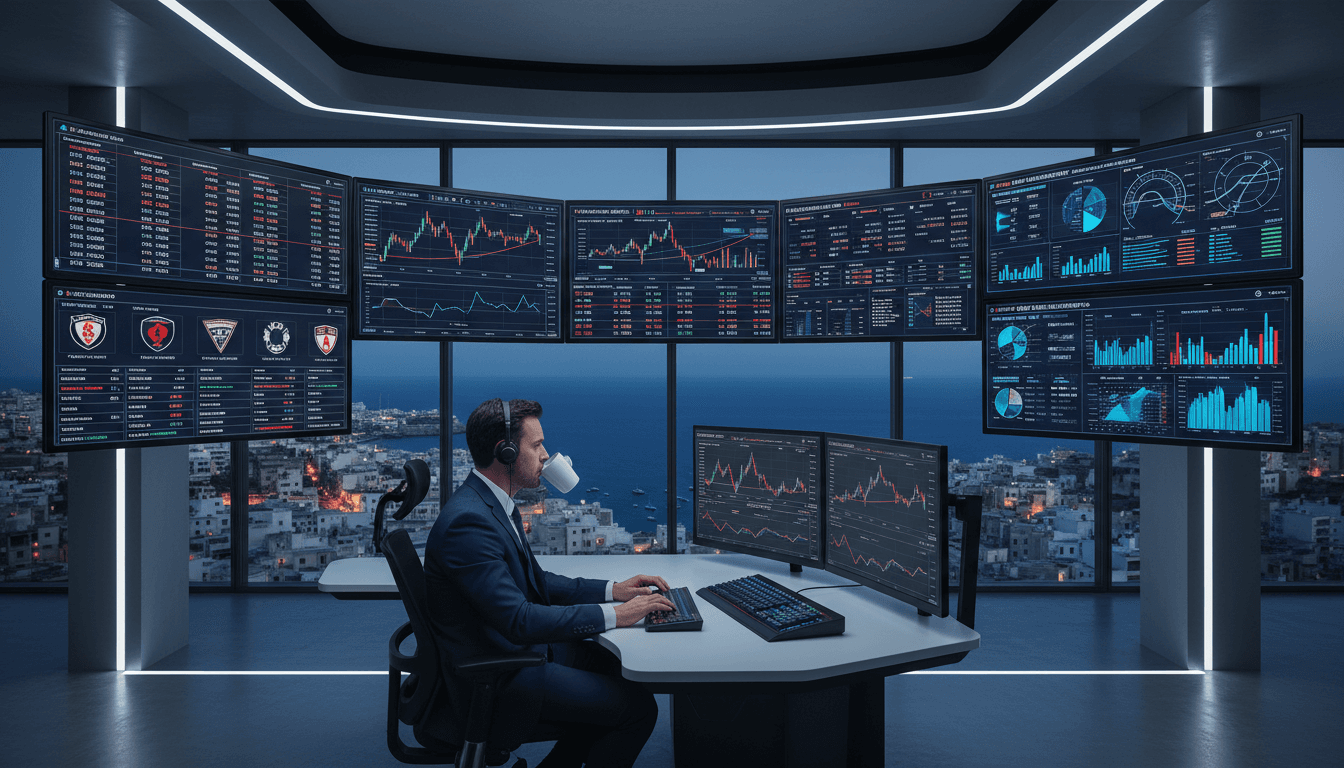
Crypto Sports Market-Making: AI Lessons for iGaming Malta
A single job ad can say more about a market’s direction than a dozen press releases.
Crypto.com is reportedly hiring a sports market-making trader—a role built around liquidity and risk management for prediction markets. At the same time, competitors like Kalshi are plotting expansion moves (including Brazil) and signing major sports sponsorships (like an NHL deal). Put those pieces together and you get a clear signal: sports prediction markets are shifting from “niche product” to “serious, globally marketed financial-style trading.”
For Malta-based iGaming teams, this matters for one reason: the operational playbook behind prediction markets (market-making, real-time pricing, fraud controls, segmentation, multilingual acquisition) looks a lot like modern iGaming—just with a more explicit “trading” wrapper. And the connective tissue is AI: algorithms that price, hedge, monitor, and personalize at speed.
Crypto.com’s trader hire is a strategy signal, not HR noise
When a platform hires a market-making trader for sports, it’s telling you it wants tighter spreads, more reliable execution, and better user trust—the same fundamentals that keep sportsbook and casino players engaged.
Market-making is the unglamorous engine room of any exchange-style product. If users open a market and see thin liquidity, wild price swings, or orders that don’t fill, they don’t come back. So hiring specifically for market-making indicates an intention to engineer consistent depth and stability across sports contracts.
Here’s the stance I’ll take: this is less about adding “sports” and more about building a scalable trading operation that can compete on experience—fast fills, predictable pricing, and smart risk limits.
What “market-making” means in prediction markets
A prediction market is essentially an exchange where outcomes have prices. Users trade “Yes/No” style contracts. A market maker’s job is to:
- Quote two-sided prices (buy and sell) so people can trade instantly
- Manage inventory (exposure to outcomes) as flows come in
- Control risk so one-sided traffic doesn’t blow out the book
- Keep spreads tight enough to attract volume without inviting exploitation
That’s why this hiring move matters. It suggests Crypto.com wants to compete on the core metrics that define a credible market:
- Liquidity availability (someone is always there to trade)
- Spread quality (cost to enter/exit positions)
- Stability under volatility (big games, injuries, lineup news)
Why AI is the hidden requirement for modern market-making
A human trader alone can’t price hundreds (or thousands) of sports contracts across leagues, time zones, and news cycles. The only workable solution at scale is a human + AI system.
In practice, prediction market-making relies on a stack that looks very familiar to Malta’s AI-forward iGaming operators:
- Real-time data ingestion (odds moves, injuries, social chatter, order book)
- Automated pricing and hedging
- Automated surveillance (manipulation, collusion, bonus abuse equivalents)
- Personalized UX and retention triggers
If you’re working in iGaming in Malta, you’ve likely seen the same pattern: AI doesn’t replace teams; it makes the product operable at global scale.
AI for liquidity: pricing, spreads, and “don’t get picked off” protection
Market makers live in a world where being slow is expensive. If a price is stale by even a few seconds when news breaks, sophisticated traders will “pick off” the wrong quote.
AI helps by:
- Detecting regime shifts (e.g., injury news → volatility jump)
- Auto-widening spreads when uncertainty spikes
- Auto-limiting size when models disagree or data quality drops
- Re-pricing instantly across correlated markets (player props, match outcome, futures)
This mirrors how AI is used in iGaming operations to adjust risk limits, game recommendations, and promotional eligibility when player behavior or market conditions change.
AI for risk management: the part users never see
Prediction markets introduce a different kind of risk than fixed-odds betting. It’s closer to exchange risk: you’re managing a book where exposure shifts with every trade.
AI-driven risk management focuses on:
- Inventory control: keeping exposure balanced across outcomes
- Correlation management: a single real-world event can hit multiple contracts
- User-level risk scoring: identifying patterns consistent with abuse or manipulation
For regulated Malta iGaming brands, that last point is especially relevant. The best AI systems in iGaming today don’t just drive revenue—they reduce avoidable pain by improving:
- safer gambling triggers
- AML monitoring
- fraud and bonus abuse detection
- customer support triage
The engagement play: sponsorships, sports audiences, and personalization
Kalshi’s NHL sponsorship and international expansion talk aren’t random. They’re the obvious next move once the product has enough liquidity to support mainstream traffic.
Sponsorships work when the onboarding experience doesn’t disappoint. If a user comes in off a big sports moment and the market is illiquid or confusing, marketing spend leaks.
This is where AI-driven user engagement becomes the bridge between prediction markets and iGaming:
- Smarter onboarding: showing the right markets to the right user (beginner vs. trader)
- Personalized content: match alerts, market moves, explainers
- Retention loops: notifying users when price moves create a better entry or exit
Malta’s iGaming industry is already strong at operating multilingual, international funnels. The same capabilities apply here.
Multilingual content isn’t “nice to have” anymore
Prediction markets and iGaming share one growth constraint: global demand exists, but trust and comprehension are local.
AI content workflows (with human review) can support:
- localized market descriptions that don’t sound machine-written
- consistent terminology across sports and jurisdictions
- faster publishing around live events (without sacrificing compliance tone)
If you’re running acquisition for an iGaming brand in Malta, you already know the real challenge: it’s not translating words—it’s translating intent while staying compliant.
What this means for Malta: skills, compliance, and product direction
Malta sits at the intersection of gaming operations, payments, and regulation. If prediction markets keep converging with betting-style experiences, Malta-based teams have an advantage—if they treat AI and quantitative risk as core product functions, not side projects.
Here are three concrete implications I’d bet on for 2026 planning.
1) “Quant + compliance” becomes a hiring pairing
The Crypto.com role points to a future where platforms want people who can do both:
- understand trading dynamics (liquidity, spreads, hedging)
- operate inside strict controls (surveillance, auditability, user protections)
For iGaming companies, the analogue is pairing:
- CRM and personalization teams
- risk/AML teams
- data science teams
…so that growth experiments don’t create regulatory headaches.
2) AI models need to be explainable, not just accurate
In regulated environments, a black-box model that “works” can still be a liability. The most useful AI is:
- measurable (clear KPIs)
- auditable (why did the system act?)
- controllable (safe thresholds, rollback paths)
That’s true whether you’re flagging suspicious gameplay in Malta iGaming or adjusting spreads in a sports prediction market.
3) Liquidity is a product feature
Most teams treat liquidity as an operational detail. That’s a mistake.
Users experience liquidity as:
- speed (did my action complete?)
- fairness (did I get a reasonable price?)
- confidence (does this feel “real” and stable?)
In iGaming, the equivalents are session stability, payment reliability, and support responsiveness. They’re not back-office details. They’re the product.
Practical playbook: what iGaming teams can borrow from market-making
If you’re building or optimizing an iGaming product in Malta—and you’re watching prediction markets with interest—these are actionable moves that translate well.
Set up “real-time operations” KPIs (not weekly dashboards)
Market makers manage in real time because risk accumulates fast. iGaming teams should do the same for:
- fraud spikes
- VIP volatility (sudden deposit/withdraw changes)
- bonus abuse patterns during big sports weekends
- churn signals (support tickets + payment failures + session drops)
A practical setup is a live ops layer that combines:
- anomaly detection alerts
- human review queues
- automated safeguards (limits, step-up verification)
Use AI to segment by intent, not demographics
Prediction market users vary widely: casual fans, arbitrage hunters, long-term speculators. The same is true in iGaming.
Intent-based segmentation (powered by behavioral models) typically outperforms demographic assumptions:
- “explorers” need guidance and frictionless onboarding
- “value seekers” respond to clear offers and transparent terms
- “power users” want speed, depth, and reliability
Design pricing/offer strategy like spread management
A market maker balances attractiveness with risk using spreads and size limits. iGaming can borrow the logic:
- your “spread” is promo generosity vs. abuse exposure
- your “size limit” is deposit/bonus caps based on risk scoring
- your “inventory” is exposure to volatile cohorts or acquisition channels
The reality? The most profitable offers are the ones you can defend operationally.
One-liner worth keeping: Liquidity and trust are twins—if one breaks, the other follows.
Where this fits in our Malta AI iGaming series
This topic series looks at how intelliġenza artifiċjali is reshaping iGaming in Malta: multilingual content, automated marketing, and better player communications inside a regulated, global industry.
Crypto.com’s move toward sports prediction market-making is a parallel story from the crypto side, but it reinforces the same lesson: AI isn’t a “feature.” It’s the operating system for fast-moving, high-compliance digital gambling and trading products.
If you’re responsible for growth, risk, product, or compliance in a Malta iGaming business, the next 12 months are a good time to ask a sharper question than “Should we use AI?”
The better question is: Which decisions must become algorithmic because humans can’t keep up—without losing control or explainability?