AI-driven decision-making helps cities deliver climate action: better resilience planning, smarter funding, and measurable outcomes across infrastructure and services.
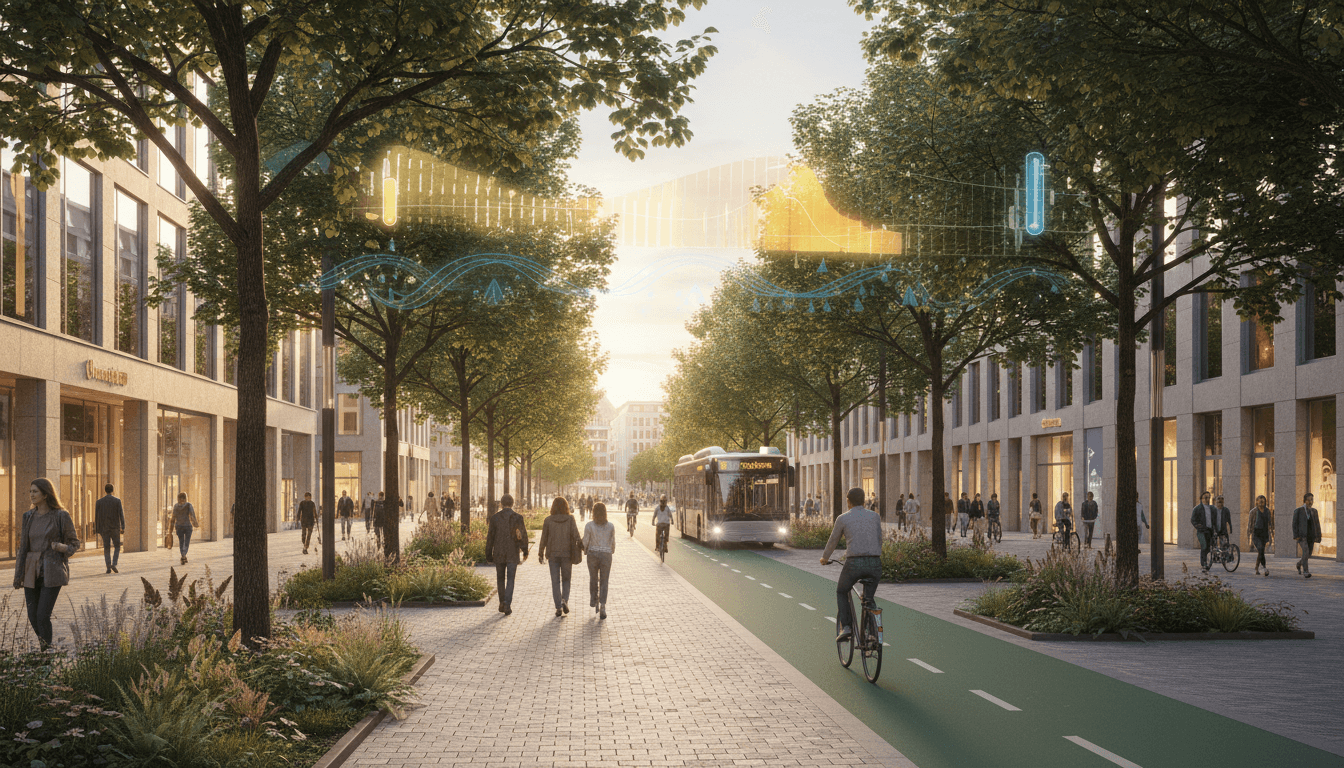
AI at the Center of Urban Climate Action Plans
Cities don’t fail on climate because they lack plans. They fail because plans don’t survive contact with reality: budget cycles, competing priorities, procurement delays, fragmented data, and the simple fact that heatwaves and floods don’t wait for committee meetings.
That’s why the conversation in the SmartCitiesWorld podcast episode “Urban climate action for today and tomorrow” lands so well. When practitioners like Clare Wildfire (Global Practice Lead for Cities) and Madeleine Rawlins (Global Practice Lead for Climate Change) talk about resilience, funding, and the “good and bad” of progress, what I hear is a practical message: urban climate action is now a delivery problem.
In the context of our series “Mākslīgais intelekts publiskajā sektorā un viedajās pilsētās”, the most useful lens is this: AI in the public sector isn’t a shiny add-on—it’s an execution engine. Used well, it helps cities choose the right interventions, sequence them, measure impact, and adapt when assumptions break.
Urban climate action needs systems thinking (and cities are systems)
Direct answer: Cities make faster climate progress when they treat decarbonisation and resilience as a connected system—energy, mobility, buildings, land use, health, and finance—rather than separate projects.
Clare Wildfire’s background in systemic engineering is a clue to what works. Urban emissions and climate risks rarely sit neatly in one department. Transport policy affects air quality and health costs. Building retrofits change peak electricity demand. Tree canopy influences heat stress, stormwater runoff, and property values.
So why do cities still execute climate action as isolated initiatives? Because their information and governance structures often mirror the org chart, not the city.
Where AI actually fits: turning “systems” into decisions
AI-driven decision-making helps cities operate like systems without waiting for a perfect re-org. A pragmatic approach looks like this:
- Unify data across departments (mobility, permitting, utilities, emergency services) using a shared data model.
- Use predictive modeling to stress-test climate plans against plausible futures (heat, rainfall extremes, energy price spikes).
- Run scenario analysis to compare interventions (e-buses vs. cycling networks vs. low-traffic zones) on outcomes that matter: emissions, travel time, equity, safety, and operating cost.
A snippet-worthy way to say it:
A climate plan without a feedback loop is a brochure; AI helps turn it into a control system.
In practice, this is what “AI uz datiem balstītu lēmumu pieņemšanu” should mean in municipalities: not more dashboards, but better choices and faster learning.
Resilience can’t be a chapter in the strategy—AI makes it operational
Direct answer: Climate resilience becomes real when cities use AI to predict impacts, prioritise assets, and automate response playbooks.
The podcast highlights the need to “build resilience into city strategies across the board.” That’s the right ambition. But it often collapses into vague statements like “increase resilience” or “improve preparedness.” Residents don’t experience “preparedness.” They experience overheated apartments, flooded underpasses, delayed ambulances, and power outages.
Three AI use cases cities can deploy now
1) Heat-risk microtargeting (street-by-street)
Heat is a public health emergency that hides in averages. Citywide temperature is less useful than block-level heat exposure + vulnerability.
AI models can combine:
- satellite thermal imagery
- land use and tree canopy
- building age and insulation proxies
- demographics and health indicators
Outcome: a ranked list of streets/buildings where interventions save the most lives per euro—cool roofs, shade structures, hydration points, or outreach checks.
2) Flood prediction + asset triage
Flood risk isn’t just “will it rain?” It’s drainage capacity, soil saturation, tide levels, and where critical infrastructure sits.
AI-assisted models can:
- predict which intersections and underpasses fail first
- prioritise clearing drains in specific hotspots
- flag at-risk substations, pump stations, and telecom nodes
This is where viedās pilsētas earn the name: prevention beats response.
3) Maintenance that prevents failures during extremes
If a storm hits when pumps, sensors, or traffic signals are already degraded, you get cascading disruption.
Machine learning on maintenance logs + sensor signals can predict failure risk, allowing targeted repairs before high-risk periods (and yes—December planning matters because procurement and works scheduling for spring/summer starts now).
Green recovery: AI turns stimulus spending into measurable outcomes
Direct answer: AI improves “green recovery” by selecting projects with the highest combined impact on emissions, jobs, and service reliability—and tracking benefits after rollout.
The episode points to the potential for a green recovery post-pandemic. In late 2025, many cities are no longer in “recovery mode” emotionally, but they’re still dealing with structural budget pressure: higher operating costs, staffing gaps, and infrastructure backlogs.
That means every climate euro has to do double duty.
A practical framework: the 4-score project filter
When cities evaluate climate projects, they often over-weight capital cost and under-weight delivery risk and operating impact. I prefer a simple 4-score filter that AI tools can support:
- Carbon impact (tCO₂e avoided per year and over asset life)
- Resilience impact (risk reduction for critical services)
- Service impact (travel time reliability, air quality, health)
- Deliverability (permitting complexity, supply chain, skills)
AI helps by estimating these scores consistently and quickly across a large portfolio—especially when departments propose projects in different formats.
Policy modeling that doesn’t take a year
A recurring public-sector pain point: by the time a policy impact assessment is done, the assumptions are outdated.
AI-assisted policy modeling can speed up:
- estimating emissions impacts of zoning changes
- forecasting mode shift from pricing or transit improvements
- testing “what if” packages (not single interventions)
This is where AI e-pārvalde becomes climate infrastructure: faster, evidence-based policy cycles.
Funding urban climate action: the missing link is proof
Direct answer: Cities raise more funding for climate projects when they can prove outcomes, reduce uncertainty, and report consistently—AI helps with all three.
The podcast mentions “methods of funding the urgent climate action cities need.” Here’s the blunt truth: funders pay for confidence. They want credible baselines, transparent measurement, and early warning signals when delivery drifts.
What AI changes in climate finance
Better baselines and MRV (Measurement, Reporting, Verification)
AI can automate parts of MRV by integrating:
- energy consumption data (where legally and ethically possible)
- mobility sensor data
- remote sensing for land cover and urban heat
- project execution data (work orders, contractor reports)
Result: faster reporting, fewer manual spreadsheets, and stronger audit trails.
Lower risk premiums through predictive oversight
If a city can predict cost overruns or underperformance early, it can intervene. Predictability lowers financing costs.
Use cases include:
- forecasting delays from procurement bottlenecks
- detecting contractor performance issues earlier
- predicting whether retrofit programs are hitting the most wasteful buildings
The governance piece (don’t skip this)
AI doesn’t fix broken governance. Cities need clear rules:
- who owns models and data pipelines
- how bias and equity are assessed
- what human sign-off is required for high-impact decisions
- how residents can contest decisions
A useful standard inside municipalities: “No automated denial of service.” AI can prioritise inspections or target outreach, but residents should always have a human path to appeal.
From strategy to street level: an AI playbook for municipalities
Direct answer: The fastest path is to start with one climate outcome, one operational workflow, and one dataset you can trust—then scale.
Many cities get stuck trying to build a “city digital twin” before they can answer basic questions like: Which buildings should we retrofit first? Which streets need shade next summer? Which bus routes should electrify first?
Here’s a practical sequence I’ve seen work in public-sector AI programs:
Step 1: Pick one outcome with political cover
Examples:
- reduce heat-related emergency calls in two districts
- cut municipal building energy use by 15% in 18 months
- improve stormwater incident response time by 25%
Step 2: Build a cross-department data product (not a dashboard)
A data product is curated, documented, refreshed, and owned. It’s what makes AI sustainable.
Step 3: Deploy AI into an existing workflow
Good targets:
- capital planning prioritisation
- inspection routing
- preventive maintenance scheduling
- permit review triage (with strict human oversight)
Step 4: Measure, publish, iterate
If residents can’t see progress, trust erodes.
Publish:
- baselines
- what changed
- what you learned
- what you’re doing next
That’s “viedās pilsētas” done in a way people actually feel.
What to listen for in the podcast—and what to do next
The value of the SmartCitiesWorld episode isn’t a single silver bullet. It’s the emphasis on resilience-by-default, realistic views on progress, and the hard topic of funding.
For public sector leaders working on AI and smart city programs, the next step is straightforward: treat climate action as a core e-governance use case. Put the same discipline into climate delivery that you put into tax systems, permitting platforms, or emergency response.
If your city is planning 2026 budgets right now, ask one hard question that tends to separate talk from traction:
Which climate decision will we make differently in the next 90 days because we used data and AI—and how will we prove it?