Sri Lankan apparel makers can use AI to improve quality, planning, compliance, and sustainability. A practical 90-day pilot plan for 2026.
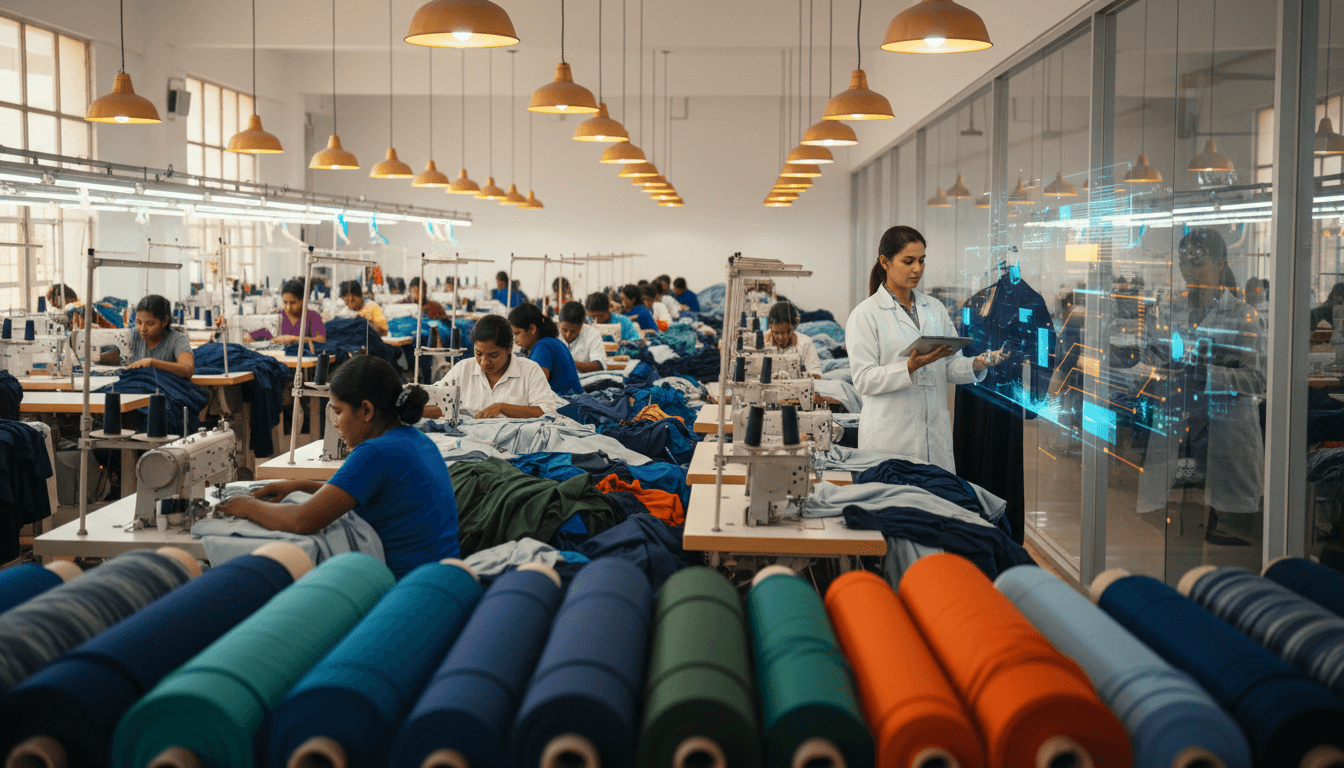
AI-Ready Textiles: What Sri Lanka Can Learn in 2026
1,781 workplaces in the textile and apparel sectors closed in just five months in Türkiye. That number, highlighted in the latest November–December 2025 issue of Textilegence, isn’t just a headline—it’s a warning sign for every manufacturing country that competes on speed, quality, and cost.
Sri Lanka’s apparel industry knows this pressure well. Buyers want shorter lead times, tighter compliance, transparent sustainability metrics, and fewer defects—while negotiating harder than ever on price. Most companies get this wrong by treating AI as a “future project.” The reality? AI is now a practical toolkit for surviving margin pressure, stabilising quality, and proving compliance at scale.
This post is part of our series on “ශ්රී ලංකාවේ වස්ත්ර හා ඇඳුම් කර්මාන්තය කෘත්රිම බුද්ධිය මඟින් කෙසේ වෙනස් වෙමින් තිබේද”. I’m using the Textilegence year-end issue as a springboard to talk about what Sri Lankan manufacturers can do next—with concrete use cases, a simple rollout plan, and the traps that waste budgets.
Why the 2025 textile slowdown matters to Sri Lanka
The key lesson from Türkiye’s turbulence is simple: when costs rise and demand softens, weak operations get exposed fast. Factory closures don’t happen only because of macroeconomics—they happen because operations can’t adapt quickly enough.
Sri Lanka competes in many of the same buyer conversations as Türkiye, Bangladesh, Vietnam, and India. When one market struggles, orders don’t disappear—they shift to suppliers who can offer:
- Predictable quality (low defect rates, consistent shade, fewer claims)
- Real-time production visibility (accurate ETAs, fewer surprises)
- Compliance evidence on demand (audit readiness without panic)
- Sustainability proof (energy, water, wastewater, chemical controls)
AI in textile manufacturing isn’t about fancy robots. It’s about using data you already generate—ERP, QC sheets, machine logs, lab results, operator outputs—to make better decisions every day.
A year-end industry issue is a strategy signal
The Textilegence November–December issue is packed with themes that matter to Sri Lanka: cost pressure, investment moves, machinery upgrades, sustainability programs, and production quality technologies.
When magazines like this keep emphasising efficiency, monitoring, control, and sustainable transformation, it’s a hint that buyers and suppliers globally are re-orienting around measurable performance. AI is the glue that connects those pieces.
Where AI creates real value in apparel manufacturing (not theory)
Sri Lankan factories get the biggest AI gains in four places: demand/production planning, quality control, maintenance, and compliance reporting. These are measurable, finance-friendly, and don’t require a complete tech overhaul.
1) Smarter planning: fewer firefights, fewer air shipments
Planning teams often run on spreadsheets, tribal knowledge, and last-minute buyer changes. AI helps by forecasting and recommending.
Practical AI use cases:
- Order risk scoring: flag styles likely to miss ex-factory based on historical bottlenecks (fabric delays, high rework lines, complex trims)
- Line balancing suggestions: predict the best operator mix for a style based on learning curves and past efficiency
- Material availability alerts: detect when consumption patterns deviate (waste spikes, shade rejections) before stores run dry
A useful stance: If your factory is paying regularly for air freight, you don’t have a logistics problem—you have a prediction problem.
2) AI-driven quality control: stop defects earlier
The Textilegence issue points to continuing advances in technologies that directly affect garment quality—yarn monitoring, cotton cleaning efficiency, printing innovations, and finishing progress. Sri Lanka can translate that into a simple AI roadmap.
High-impact QC applications:
- Computer vision for defect detection (fabric inspection, print alignment, seam issues)
- Root-cause analytics for rework (which line, which operation, which time window)
- Shade/lot consistency prediction using lab and production parameters to prevent bulk failures
You don’t need perfect data to start. You need consistent capture for 6–8 weeks, then iterate.
AI works best when you use it to prevent defects, not to explain defects.
3) Predictive maintenance: protect throughput when margins are tight
When the market is volatile, downtime hurts more because you can’t “buy your way out” with overtime forever. Predictive maintenance uses machine signals and production patterns to anticipate failures.
Start with your most painful assets:
- Compressors
- Boilers
- Critical finishing/printing equipment
- High-utilisation sewing lines where stoppages cascade
A practical KPI set to track:
- Unplanned downtime hours per week
- Mean time between failures (MTBF)
- Maintenance response time
- Spares consumption anomalies
The goal isn’t zero downtime. The goal is predictable downtime.
Sustainability and AI: the fastest path to credible reporting
The Green Times content mentioned in the issue—organic cotton education, drought-linked yield losses, wastewater recovery awards, standards training—reflects where buyer expectations are heading: proof, not promises.
Sri Lanka’s competitive edge improves when sustainability isn’t a “department,” but a data stream.
AI for resource efficiency (energy, water, wastewater)
AI helps factories reduce costs while improving sustainability performance. Typical wins:
- Energy optimisation: predict peak loads, smooth consumption, reduce demand charges
- Water and chemical control: detect abnormal consumption, leaks, over-dosing events
- Wastewater process stability: model pH/temperature/flow patterns to reduce treatment failures
These improvements matter because they show up in two places buyers care about:
- Reduced risk (fewer environmental non-compliances)
- Better unit economics (lower cost per garment)
Compliance automation: audit readiness without chaos
One of the most underrated AI use cases is document intelligence:
- Auto-classify compliance documents
- Extract key fields (cert numbers, validity dates, test results)
- Alert before expiries
- Create buyer-ready packs quickly
If you’re still building audit files manually, your team is doing clerical work when they should be doing risk control.
What the global events and machinery trend tells us about 2026
Industry events referenced in the issue—major trade fairs and technology showcases—signal a broader reality: hardware innovation is accelerating, but software is deciding who benefits.
Sri Lankan manufacturers often invest in machinery and expect automatic performance gains. The missing layer is connecting machines, QC, and planning into a decision system.
The “AI stack” Sri Lankan factories actually need
Keep it boring. Boring scales.
- Clean master data (styles, operations, SAM, lines, defect taxonomy)
- Basic integration (ERP + production + QC + lab results)
- Dashboards that answer one question: “Where will we fail next?”
- Simple models (forecasting, classification, anomaly detection)
- Workflow changes (what happens when the system flags risk?)
If step 5 isn’t real, the AI becomes a fancy report no one uses.
A 90-day AI pilot plan for Sri Lankan apparel manufacturers
A good pilot improves one KPI, in one factory area, with one accountable owner. Here’s a structure that works.
Days 1–15: Pick one pain point and define success
Choose one:
- Reduce rework rate on a product family
- Reduce shade/print-related claims
- Improve OTIF (on-time in-full)
- Cut unplanned downtime for one asset group
Define success in numbers (example targets):
- Rework rate: 8% → 6%
- Fabric defect escapes: 12/week → 7/week
- Downtime: 14 hrs/week → 10 hrs/week
Days 16–45: Instrumentation and data discipline
- Standardise defect codes (don’t allow “other” to dominate)
- Capture timestamps and line/operator references
- Add minimal sensors only where needed
- Validate data weekly with production and QA together
Days 46–75: Build a model and operational workflow
- Start with anomaly detection or classification (fast ROI)
- Create a daily “risk list” report that supervisors trust
- Decide actions: stop line, retrain operator, re-check fabric lot, adjust machine settings
Days 76–90: Prove ROI and prepare scale-up
- Compare against baseline
- Identify what data was missing
- Decide whether to scale to more lines/plants
A blunt rule: If you can’t prove value in 90 days, you probably picked the wrong first use case.
Common mistakes Sri Lankan teams should avoid
1) Buying tools before fixing definitions
If defect categories are inconsistent, AI will learn noise.
2) Treating AI as an IT-only project
Quality, production, and maintenance must co-own the pilot.
3) Starting with “big transformation”
Start with a narrow win. Then expand.
4) Ignoring change management
If supervisors don’t trust the output, it won’t be used.
How a magazine like Textilegence fits into your AI learning loop
A lot of executives underestimate trade publications. I don’t. A good industry issue gives you three things: signal, vocabulary, and benchmarks.
- Signal: which problems everyone is trying to solve (cost, quality, sustainability)
- Vocabulary: what buyers and suppliers will expect you to understand in meetings
- Benchmarks: where global investment is flowing (spandex capacity, finishing tech, printing)
For Sri Lanka, the opportunity is to use that signal and translate it into an AI action plan: better prediction, better control, better proof.
What to do next (and what to ask your team on Monday)
Sri Lanka’s apparel sector doesn’t need to copy anyone’s technology roadmap. It needs to choose a few AI use cases that protect margins and strengthen buyer confidence—then execute fast.
If you want a practical starting point, ask your teams:
- Where did we lose the most money this quarter—rework, claims, downtime, or air freight?
- Which of those losses could have been predicted 7 days earlier?
- What data do we already have that we’re not using?
Our broader series—“ශ්රී ලංකාවේ වස්ත්ර හා ඇඳුම් කර්මාන්තය කෘත්රිම බුද්ධිය මඟින් කෙසේ වෙනස් වෙමින් තිබේද”—keeps coming back to one idea: AI isn’t a trend to follow; it’s a discipline to build.
So here’s the forward-looking question that matters as we head into 2026: When your next big buyer asks for faster lead times, tighter traceability, and measurable sustainability—will your factory answer with confidence, or with excuses?