India’s PLI adds 30 new apparel units. Here’s how Sri Lankan manufacturers can use AI to boost quality, productivity, and buyer trust.
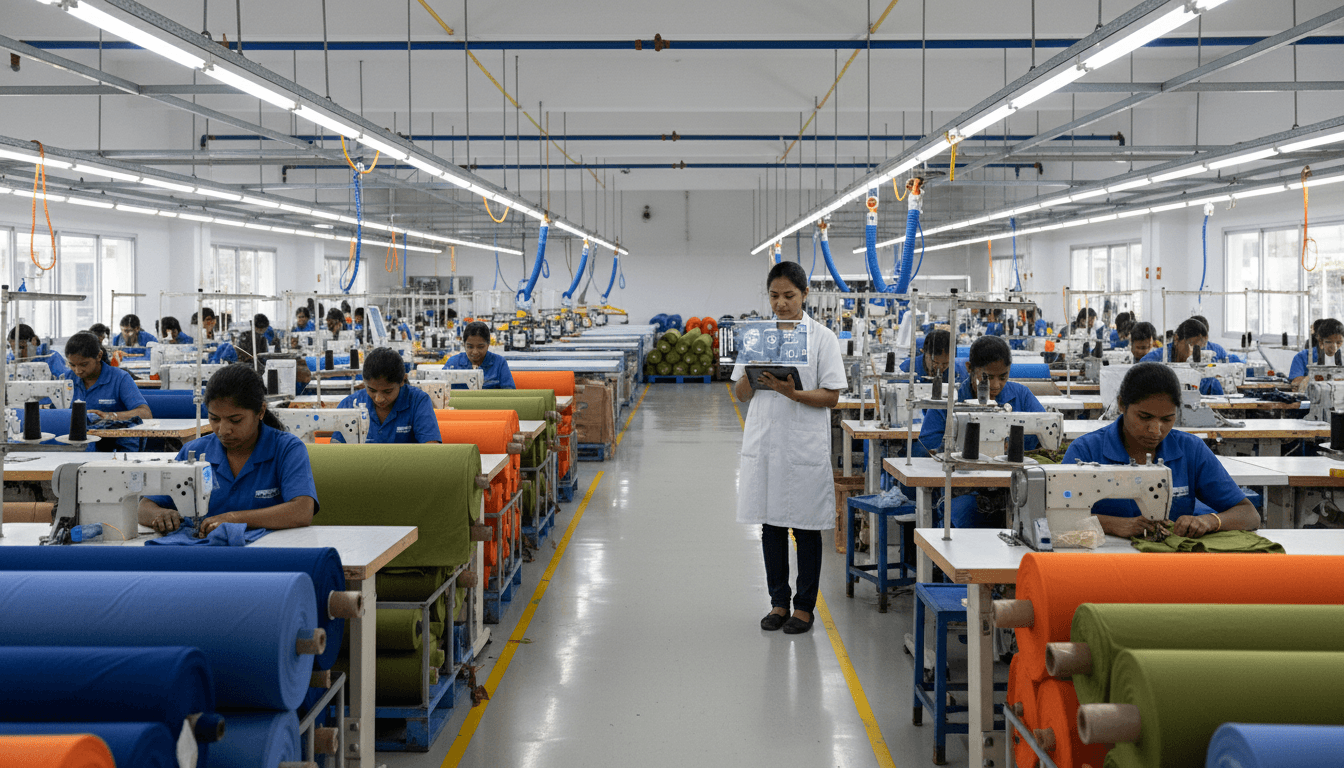
AI-ready apparel factories: Sri Lanka lessons from India
India’s textile ministry says 30 textile and apparel units have already started production under its Production Linked Incentive (PLI) scheme. That’s not a headline about a single factory opening—it’s a signal that a whole cluster of new capacity is switching on at once. And when new capacity comes online, the winners aren’t the ones who merely run more machines. The winners are the ones who run smarter systems.
For Sri Lanka’s apparel and textile sector, this is a useful moment to pause and take stock. India is pushing scale in man-made fibre (MMF) apparel, MMF fabrics, and technical textiles, backed by policy. Sri Lanka doesn’t need to copy the policy model to learn the operational lesson: when competitors add capacity, you need productivity, quality consistency, and speed of response to stay preferred by global buyers. That’s where AI in apparel manufacturing stops being a buzzword and becomes a practical requirement.
This post fits into our series on “ශ්රී ලංකාවේ වස්ත්ර හා ඇඳුම් කර්මාන්තය කෘත්රිම බුද්ධිය මඟින් කෙසේ වෙනස් වෙමින් තිබේද” by translating that India news into a clear, factory-floor question: If 30 new units can start production, how do Sri Lankan manufacturers use AI to ship better quality, faster, with fewer surprises—and win more orders?
What India’s PLI update really tells manufacturers
India’s PLI update carries three numbers that matter to any apparel exporter watching regional competition:
- 74 applications approved under the textile PLI scheme (notified in September 2021)
- 30 units have started production, 40 companies have begun investments, and 22 have reached the prescribed investment threshold
- The scheme outlay is Rs. 10,683 crore, with proposed investment of Rs. 28,711 crore, projected turnover Rs. 2,16,760 crore, and expected employment around 2.59 lakh people
There’s also a directional clue: more than half of approved applications are in technical textiles—a segment where specs are tighter, defects are costlier, and traceability is becoming non-negotiable.
Here’s the blunt takeaway for Sri Lanka: India is increasing capacity in categories where buyers are already demanding more data, more compliance, and fewer defects. Competing on “we’ll work harder” won’t hold. Competing on predictability will.
Why “more factories” increases the value of AI (not the opposite)
When capacity expands in a region, buyers get options. Options push factories into two uncomfortable realities:
- Quality becomes a selection filter. Buyers don’t want “good average quality.” They want consistent quality across lots, lines, and seasons.
- Speed becomes a price. Late approvals, slow sampling, and rework quietly destroy margins.
AI helps because it’s built for patterns at scale. In apparel production, patterns show up everywhere: defect types, operator learning curves, machine downtime, needle breakages, shade variation, delays at process bottlenecks.
A sentence worth pinning on a factory noticeboard: “AI is less about replacing people and more about removing avoidable surprises.”
For Sri Lanka—where many manufacturers already compete on reliability and ethical manufacturing—AI can be the next layer: data-backed reliability.
Where AI fits in the apparel value chain (and what to implement first)
If you’re planning AI adoption, start where you can measure impact within one season. These are the “first 90 days” wins I’ve seen work best in manufacturing environments.
1) AI for fabric and garment quality control (computer vision)
Answer first: Computer vision reduces defect leakage by catching issues early and consistently.
Traditional inline and endline inspection depends on human attention. Humans get tired. Lighting changes. Standards drift between shifts. AI-based inspection systems don’t have those problems.
Practical use cases in Sri Lankan apparel manufacturing:
- Fabric inspection (holes, slubs, streaks, contamination) before cutting
- Stitching defect detection (skips, puckering, seam slippage indicators)
- Print/embroidery placement checks to reduce rework after assembly
What to measure:
- Defects per 100 units (DPU)
- Rework rate
- Endline rejection rate
- Cost of quality (COQ) per style
A realistic stance: AI QC won’t replace inspectors overnight. It becomes your second set of eyes—and the standard-setter.
2) AI for planning: line balancing, SAM drift, and bottleneck prediction
Answer first: AI-assisted planning improves on-time delivery by forecasting bottlenecks before they hit WIP chaos.
Most planning teams already use industrial engineering methods. The problem is the real world: operator variability, absenteeism, machine condition, and style complexity.
AI models can forecast:
- Likely bottleneck operations by style/line/operator mix
- Expected output vs. plan based on early-hour production signals
- Which lines need rebalancing before the day collapses
Simple implementation path:
- Clean your core data: style, operation bulletin, SAM, target, actual output, downtime reasons
- Start with prediction dashboards (not automation)
- Add “recommended actions” once the team trusts the signals
The best factories treat planning like a living system. AI helps it stay living.
3) AI to reduce fabric consumption (marker efficiency + cutting accuracy)
Answer first: AI-based marker optimization and consumption analytics protect margin when costs fluctuate.
In MMF and technical textiles, fabric cost volatility and shade/lot constraints can hit hard. India’s focus on MMF and technical textiles under PLI is a reminder: material efficiency is competitiveness.
AI can help by:
- Optimizing markers with constraints (grain, stripe checks, shrinkage allowances)
- Predicting fabric utilization by style before bulk
- Flagging high-waste styles early so merchandising can negotiate or redesign
Track:
- Marker efficiency %
- Fabric per garment vs. standard
- Cutting room re-cut rate
4) AI for compliance documentation and traceability
Answer first: AI reduces admin load and speeds buyer reporting by structuring unstructured data.
Buyer compliance is becoming more document-heavy, not less—especially for technical textiles and performance categories. Even if you don’t call it “AI,” using language models and workflow automation to draft, classify, and validate documentation is an immediate advantage.
Good first targets:
- Auto-summarising audit findings into corrective action plans
- Mapping SOPs to buyer code-of-conduct checklists
- Extracting key fields from invoices, test reports, and lab certificates
This matters because a factory that answers compliance queries in 24 hours feels “safe” to a buyer. Safety wins repeat orders.
5) AI for product development speed (3D + demand signals)
Answer first: AI shortens the sample-to-approval cycle by reducing back-and-forth.
Seasonal pressure is real in late December: brands are locking plans, evaluating vendor performance, and preparing Q1/Q2 pipelines. The factories that offer faster development support often get early allocations.
Practical combination:
- 3D prototyping for early approvals
- AI-assisted tech pack checks (missing measurements, inconsistent tolerances)
- Fit feedback classification from historical comments to predict likely changes
Sri Lanka can compete strongly here because many local manufacturers already have strong customer communication culture. AI just speeds the loop.
A Sri Lankan “AI adoption checklist” for factory leadership
AI programs fail for predictable reasons: messy data, unclear ownership, and trying to do everything at once.
Here’s a practical checklist that keeps it grounded.
Define the business problem in one line
Examples:
- “Reduce rework from 6% to 4% on knit tops in 12 weeks.”
- “Improve on-time delivery from 82% to 90% for two key buyers next season.”
- “Cut fabric consumption variance by 0.3% on three core styles.”
Start with one line, one style family, one team
If you start with 10 lines, you’ll end up with 10 arguments about data quality.
Appoint an owner who can change routines
AI insights are useless if nobody can change:
- inspection checkpoints
- machine maintenance schedules
- operator allocation
- line targets and balancing
Put governance around data (small, strict rules)
Minimum viable governance:
- standard downtime reason codes
- consistent defect taxonomy
- one source of truth for style master data
Decide what stays human
The right boundary is often:
- AI detects and recommends
- Humans approve and act
That’s how you build trust without creating risk.
What PLI-style expansion means for Sri Lanka in 2026 buying cycles
India’s update also mentions PM MITRA parks progressing with approved reports and allocations for integrated textile infrastructure. Whether or not every number hits its projection, the direction is clear: more integrated capacity, more scale, more competition.
Sri Lanka’s opportunity is not to outscale India. It’s to out-execute on the dimensions buyers feel every day:
- fewer defects arriving at destination
- fewer production “surprises” mid-order
- faster development response
- cleaner compliance reporting
AI in the Sri Lankan apparel industry is the most practical path to protect those strengths while keeping costs under control.
If your factory can predict problems 48 hours earlier, you don’t just save money—you become easier to buy from.
Next steps: a simple plan you can run in one quarter
If you want a realistic AI program (not a slide deck), run a 12-week sprint:
- Week 1–2: pick one measurable problem (quality, planning, fabric)
- Week 3–4: clean data + set baseline metrics
- Week 5–8: pilot a tool/workflow (computer vision, forecasting dashboard, document automation)
- Week 9–12: expand to a second line and compare against baseline
The point isn’t to “digitise everything.” The point is to create a repeatable method for AI adoption inside your operational culture.
As this series on ශ්රී ලංකාවේ වස්ත්ර හා ඇඳුම් කර්මාන්තය කෘත්රිම බුද්ධිය මඟින් කෙසේ වෙනස් වෙමින් තිබේද continues, we’ll go deeper into specific AI systems (quality, IE, compliance, and buyer communication) and what it takes to implement them without disrupting deliveries.
If India can bring 30 new units into production under a national scheme, Sri Lanka’s challenge is sharper: make every existing line more intelligent. Which factory process in your operation creates the most avoidable surprises right now—and what would it be worth to remove them?