Cyclone Ditwah exposed supply chain fragility. Here’s how AI can help Sri Lanka’s apparel industry plan, adapt, and protect export delivery reliability.
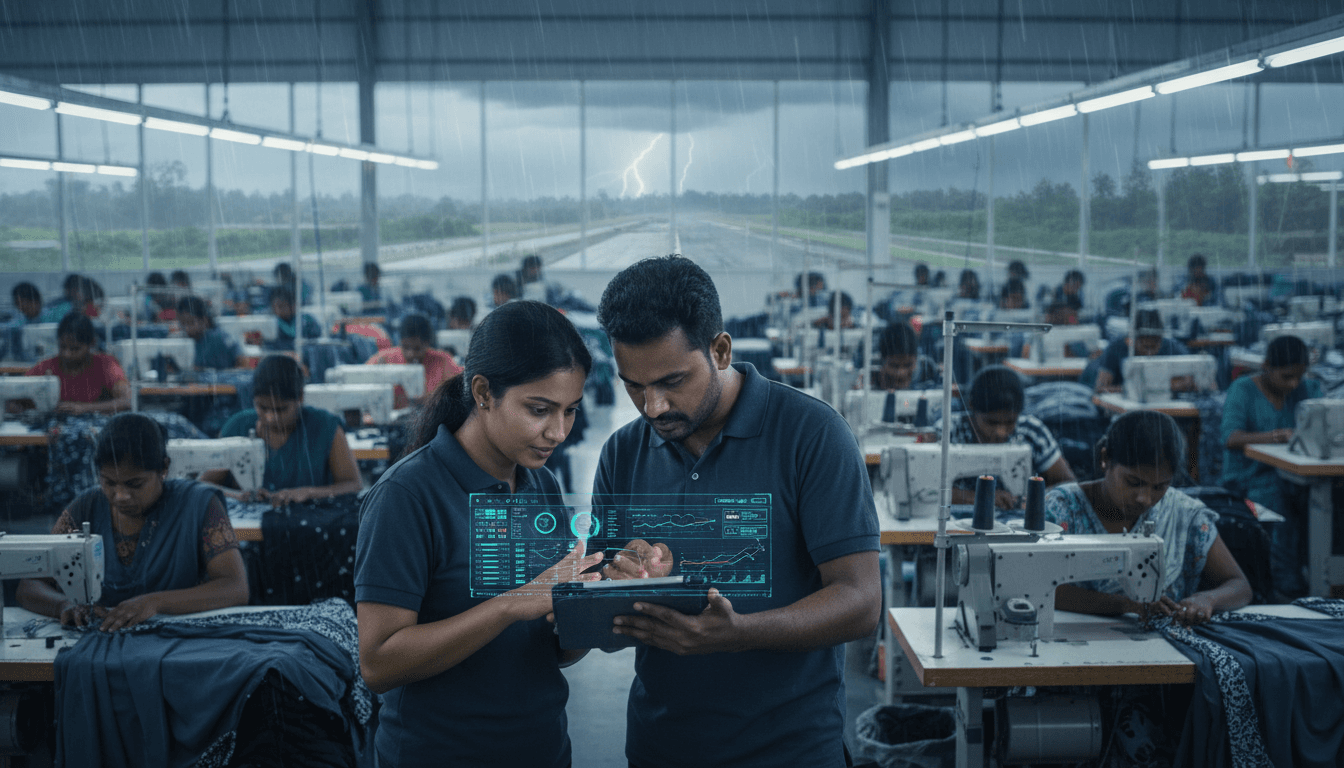
AI-Ready Apparel: Sri Lanka’s Disaster-Proof Playbook
Cyclone Ditwah didn’t just flood roads and homes—it exposed how quickly a modern economy can lose days, weeks, and export credibility when a shock hits. The numbers reported in mid-December were brutal: 644 deaths, 180+ missing, and entire districts—from Batticaloa and Ampara to Kandy and Colombo—dealing with collapsed roads, damaged bridges, and displaced communities. Winds peaked around 75 km/h, but it was the sustained rain and knock-on effects that did the real damage.
For Sri Lanka’s textile and apparel industry, a cyclone is rarely “just” a weather event. It becomes a supply chain crisis: workers can’t commute, factories lose power, inbound fabric shipments stall, and finished goods miss vessel cut-offs. And if you export to global brands, a missed delivery isn’t a local inconvenience—it’s a scorecard problem.
This post sits inside our series on ශ්රී ලංකාවේ වස්ත්ර හා ඇඳුම් කර්මාන්තය කෘත්රිම බුද්ධිය මඟින් කෙසේ වෙනස් වෙමින් තිබේද—and here’s the stance I’m taking: AI isn’t a luxury add-on for Sri Lankan apparel; it’s becoming a basic requirement for resilience. Not because it’s fashionable, but because climate risk is now operational risk.
Cyclone Ditwah showed the real cost of “late signals”
The clearest lesson from the Ditwah coverage is timing: the cyclone was reportedly detected earlier in the month, yet meaningful action lagged until impact. That gap—between early detection and real-world response—is where industries bleed money.
For apparel manufacturing, the “late signal” problem shows up in familiar ways:
- A plant manager learns too late that a key highway is impassable.
- A procurement team assumes a fabric container will clear on schedule—until port-side disruption cascades.
- A compliance lead scrambles because documentation is scattered across emails and spreadsheets, and auditors want explanations for delays.
Answer-first reality: Natural disasters don’t only break infrastructure. They break coordination. That’s exactly the part digital systems—and AI on top of them—handle well.
What a cyclone disrupts inside an apparel exporter
When flooding hits districts like Kandy, Gampaha, or Colombo, apparel exporters typically face five immediate bottlenecks:
- Workforce availability: transport shutdowns, school closures, displacement.
- Utilities and facility risk: power instability, water ingress, machine downtime.
- Inbound materials: yarn/fabric/trim delivery delays and supplier uncertainty.
- Outbound logistics: missed booking windows, storage shortages, demurrage.
- Customer communication: global brand updates, revised ETAs, documentation.
Most companies treat these as “separate fires.” The better approach is to treat them as a single system with early-warning triggers.
Where AI actually helps (and where it doesn’t)
AI helps when it sits on top of clean, timely data—and when decisions are already mapped. It doesn’t help when the business has no standard operating playbooks, no reliable data capture, and no accountability.
So let’s be specific. In Sri Lanka’s apparel sector, AI creates value in three places during disasters:
- Prediction (what’s likely to happen)
- Prioritisation (what must be done first)
- Coordination (who needs to act, with what information)
AI for early warning + operational triggers
Weather forecasting is improving globally, but factories often don’t translate forecasts into actionable thresholds. A practical AI-enabled setup looks like this:
- A system monitors forecasts and risk indicators (rainfall intensity, river basin alerts, wind warnings).
- It maps that risk to factory-specific vulnerabilities (low-lying access roads, worker catchment areas, critical machine zones).
- It triggers a checklist automatically: shift changes, transport plans, raw material reallocation, backup generator fuel check.
Snippet-worthy rule: A forecast is useless until it changes a schedule.
AI-driven workforce continuity planning
Most apparel exporters already run HR systems, attendance, and shift planning. The missed opportunity is using that data for scenario planning.
AI can help you answer, within minutes:
- If 30% of operators from certain districts can’t report, which lines are at risk?
- Which styles can be switched to a smaller crew without quality loss?
- Who has cross-skills and can be reassigned?
That’s not futuristic. It’s structured resourcing with better math.
Quality control and compliance don’t pause for storms
Global buyers don’t waive quality standards because there was flooding. In fact, disruptions often increase defects: rushed output, stressed teams, unstable humidity conditions, and machine stoppages.
Computer vision and AI-assisted quality inspection can keep defect rates under control when experienced inspectors are stretched. And compliance automation matters even more when you must explain deviations.
In the broader theme of this series, Sri Lankan manufacturers are increasingly using AI for quality control, automated compliance workflows, and digital communication with brands. Disaster periods are when these tools justify their cost.
Building a supply chain that can bend without breaking
The apparel industry’s biggest vulnerability isn’t one factory—it’s the network. Ditwah affected multiple districts, which means single-source dependencies become visible instantly.
Answer-first: Resilience comes from options: alternate suppliers, alternate routes, alternate production plans. AI helps you price those options and pick them fast.
AI for inventory and procurement decisions under uncertainty
During disruption, the worst move is “panic buying” or freezing orders without a plan. AI-based demand and supply planning can support decisions like:
- Which raw materials are critical for export orders due in the next 14–21 days?
- Which inputs can be substituted without violating buyer specs?
- How much safety stock is justified for trims and packaging, given lead times?
Even basic machine-learning models can outperform gut-feel when the environment is noisy.
Logistics resilience: route risk and booking discipline
Flooded roads, damaged bridges, and delayed clearances translate into missed vessel deadlines. AI can support logistics resilience through:
- Route risk scoring using historical disruption patterns
- Dynamic ETAs based on real-time constraints
- Shipment prioritisation: allocate scarce trucking capacity to the orders with the highest penalty risk
The measurable outcome here is simple: fewer missed cut-offs and fewer emergency air shipments.
Buyer communication: speed beats perfection
One under-discussed point from the Ditwah aftermath is how quickly citizens coordinated via social media to organise support. That same principle applies to exporter–buyer communication.
Brands want clarity:
- What’s the current status?
- What’s the revised plan?
- What do you need from them (approvals, spec flexibility, revised ship windows)?
AI can help generate structured updates from operational data—production status, WIP, shipment readiness—so merchandisers aren’t compiling crisis emails manually.
A factory that communicates early and accurately wins trust, even when timelines slip.
A practical “AI + continuity” blueprint for Sri Lankan apparel firms
Most companies get this wrong by starting with tools. Start with decisions.
Below is a realistic blueprint that fits mid-to-large Sri Lankan apparel exporters—and scales down for SMEs with the right priorities.
Step 1: Map your critical decisions (before buying any AI)
Write down the decisions you must make within the first 6 hours, 24 hours, and 72 hours of a major weather event.
Examples:
- Cancel/adjust shifts?
- Activate worker transport?
- Move finished goods to higher ground?
- Re-plan production by style and line?
- Communicate revised ETAs to buyers?
If a decision can’t be named, it can’t be automated.
Step 2: Fix data capture where it hurts most
You don’t need “perfect data.” You need usable data.
Prioritise:
- Real-time production line status
- Attendance and skill matrix
- Inventory of critical inputs
- Shipment readiness and booking information
Step 3: Implement three AI use cases that pay back fast
If you’re trying to generate leads and quick business impact, these three are the best starting points:
- Disruption-aware production scheduling (reduce missed deliveries)
- AI-assisted quality inspection (prevent defect spikes)
- Automated buyer updates (protect relationships and reduce churn)
Step 4: Run drills like you mean it
A continuity plan that isn’t tested is theatre.
Do a quarterly “storm drill”:
- Simulate 25–40% absenteeism
- Simulate a blocked primary logistics route
- Simulate a two-day power instability window
Track metrics: decision time, output recovery time, defect rate, on-time shipment percentage.
Step 5: Don’t ignore human welfare—it's an operational lever
Ditwah’s story is also about displacement, disease risk, and emotional trauma. Apparel is a people-led industry. If you want continuity, invest in worker support:
- Safe transport and verified routes
- Clear emergency communications (Sinhala/Tamil/English)
- On-site health and hygiene protocols during flood aftermath
This isn’t corporate charity. It’s operational stability.
“People also ask” for Sri Lanka’s apparel leaders
Can AI really reduce cyclone impact on apparel exports?
Yes—by reducing decision time and preventing cascading delays. AI helps you re-plan production, prioritise shipments, and communicate ETAs faster. It doesn’t stop flooding; it stops confusion.
What’s the first AI project an apparel factory should start with?
Start with production scheduling under disruption or AI quality inspection, depending on your pain. If late deliveries are killing you, prioritise scheduling. If rework and claims are rising, prioritise inspection.
Will global brands care about AI adoption?
They care about outcomes: reliability, transparency, compliance, and speed of response. AI is increasingly the easiest way to hit those expectations consistently.
What Ditwah means for the next chapter of Sri Lanka’s apparel industry
Sri Lanka has built its reputation on reliability, ethical manufacturing, and strong relationships with global buyers. Climate risk threatens that reputation unless we upgrade how we operate.
Here’s the better way to approach this: treat AI as part of business continuity, not as an innovation side-project. When storms hit, the winners won’t be the companies with the nicest dashboards—they’ll be the ones that can re-plan in hours, protect quality, and keep buyers informed without drama.
If you’re already following this series on how කෘත්රිම බුද්ධිය is changing ශ්රී ලංකාවේ වස්ත්ර හා ඇඳුම් කර්මාන්තය, Ditwah is a reminder that efficiency and resilience are now the same agenda. The question worth asking inside your leadership team is simple: if the next cyclone lands during peak production, do you have a system—or just heroics?