U.S. LNG exports hit 111M tons in 2025. See what it signals—and how AI can help Kazakhstan boost uptime, efficiency, and competitiveness.
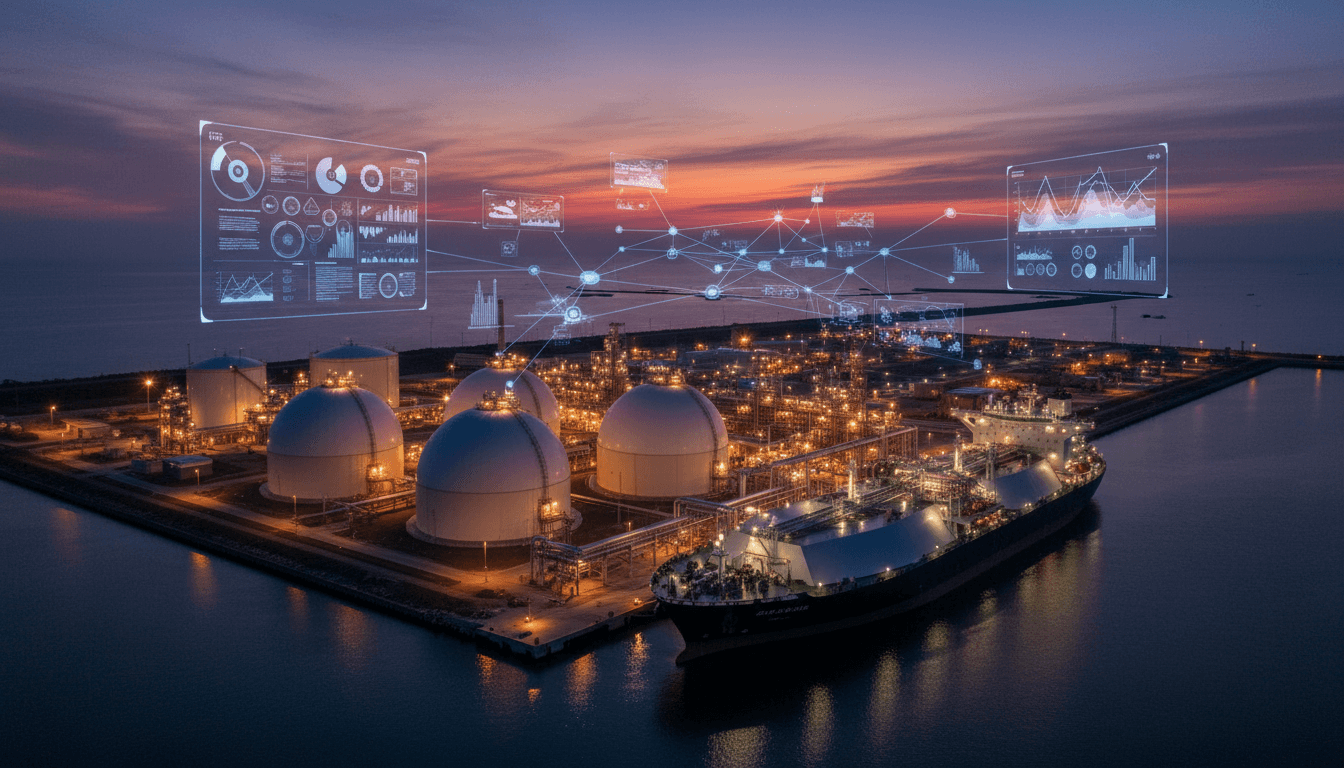
U.S. LNG Export Record: Kazakhstan’s AI Lesson
U.S. LNG exports hit 111 million metric tons in 2025, the first time any country has crossed 100 million tons in a single year. That number matters far beyond U.S. headlines. It’s a clean signal to every energy producer—from upstream operators to midstream and power—about what wins in a tight global market: capacity is necessary, but operational precision is what turns capacity into cash.
Here’s the part many companies miss. The U.S. didn’t reach that scale only by building plants. It did it by running those plants hard—high utilization, fewer unplanned outages, tighter scheduling, and faster decisions. Those are exactly the areas where data-driven operations and AI make a measurable difference. For Kazakhstan’s energy and oil-gas sector—at a time when 2026 planning cycles, budget scrutiny, and reliability demands are all rising—this is the right case study to steal from.
This post sits inside our series “Қазақстандағы энергия және мұнай-газ саласын жасанды интеллект қалай түрлендіріп жатыр”. The goal is practical: translate global signals into actions Kazakhstan’s companies can take—especially actions that create better uptime, safer operations, and stronger export competitiveness.
What the 2025 U.S. LNG record really says (and what it doesn’t)
Answer first: The 111 million-ton milestone says utilization + reliability + logistics discipline are now as important as newbuild projects. It doesn’t say “just build more.”
Preliminary data cited by LSEG shows U.S. exports reached 111 million metric tons in 2025, about 23 million tons higher than 2024 and roughly 20 million tons ahead of Qatar. This jump tracks with two realities:
- New capacity came online (the visible part).
- Existing terminals ran at high utilization (the hard part).
High utilization is where operational maturity shows up. It’s also where margins are made or lost. If you can’t predict failures, coordinate shipping windows, and stabilize throughput, extra capacity becomes a stranded asset wearing a hard hat.
Snippet-worthy truth: In LNG, “nameplate capacity” is marketing; delivered cargoes are revenue.
For Kazakhstan, the parallel isn’t “we should copy the U.S. LNG buildout tomorrow.” The parallel is: when global energy trade rewards reliability, the winners are the operators who treat every hour of uptime as a product.
LNG is a systems business: why AI fits the job
Answer first: LNG exports are a chain of dependent systems—gas supply, compression, cryogenic processing, storage, shipping slots, weather, buyers’ nominations—so AI works best as an optimizer across the whole chain, not as a single isolated tool.
LNG performance isn’t decided inside one control room. It’s decided across an ecosystem:
- Upstream production consistency and treating
- Midstream pipeline constraints and compressor station performance
- Liquefaction train reliability (rotating equipment, heat exchangers, refrigerant cycles)
- Storage tank boil-off management
- Marine logistics: berthing windows, tug availability, demurrage risk
- Commercial scheduling: offtake contracts, nominations, spot cargo decisions
Traditional operations handle this with rules, experience, and “war-room” calls. That works—until variability spikes: weather events, equipment degradation, supply swings, or last-minute cargo changes. AI doesn’t remove the need for operators; it reduces decision latency and makes trade-offs explicit.
Predictive maintenance that’s actually about throughput
Answer first: Predictive maintenance in LNG is valuable because it prevents cascading constraints that kill utilization.
A single rotating equipment failure can ripple into missed cargo windows and penalties. In practice, AI-driven predictive maintenance blends:
- Time-series sensor data (vibration, temperature, pressure)
- Maintenance history and work orders
- Operating context (load, ambient conditions, start/stop cycles)
- Failure mode libraries for critical assets
The KPI isn’t “number of predictions.” The KPI is unplanned downtime avoided and throughput preserved. If a model helps you schedule a bearing replacement during a planned slowdown instead of during peak nominations, that’s direct value.
Scheduling and logistics: the quiet profit center
Answer first: The fastest ROI often comes from AI-assisted scheduling—because it reduces demurrage, flattens bottlenecks, and increases delivered volume.
When terminals run near capacity, small inefficiencies become expensive:
- Queueing at berth
- Suboptimal train ramp-up/ramp-down patterns
- Late paperwork or handover delays
- Mismatched storage inventory vs. shipping schedule
AI scheduling models can prioritize actions based on cost: “If we delay Train 2 by 6 hours, do we lose a cargo slot or gain stability that prevents a trip?” This is where optimization beats gut feel—especially when multiple constraints change daily.
Kazakhstan’s opportunity: “smart utilization” before “big utilization”
Answer first: Kazakhstan can compete better by improving asset reliability, energy efficiency, and planning accuracy—the same operational traits behind high LNG utilization—using AI across oil-gas, power, and midstream.
Kazakhstan’s energy system has different geography and export routes than U.S. LNG. But the operational challenge is familiar: complex assets, harsh conditions, long supply chains, and high cost of downtime. If global markets are rewarding the operators who deliver reliably, then Kazakhstan’s advantage will come from being predictable—in volume, quality, safety, and delivery.
Here are the most transferable “U.S. LNG lessons,” mapped to Kazakhstan’s realities.
1) Uptime is a strategy, not a maintenance task
Most companies say reliability matters. Fewer treat it like a board-level growth lever.
Practical AI moves:
- Build asset health scores for critical equipment (compressors, turbines, pumps, valves)
- Use anomaly detection for early warnings (not just alarms)
- Connect maintenance plans to commercial impact (which assets threaten throughput this month?)
What I’ve found works: start with 10–20 critical assets where failures create immediate production or shipment losses. Prove value, then scale.
2) Energy efficiency is the hidden production increase
When plants run hard, energy losses multiply. In LNG, liquefaction is energy-intensive. In oil-gas processing and power, it’s the same story: reduce fuel and power per unit output, and you effectively “create” capacity.
AI can help by:
- Optimizing setpoints for compressors and heat exchange networks
- Detecting fouling and performance drift earlier
- Forecasting demand and adjusting operations to avoid peaks and penalties
Energy optimization is especially relevant in 2026 because CFOs are demanding payback that doesn’t require massive capex.
3) Planning accuracy beats heroic firefighting
The U.S. export milestone is also a planning milestone: predictable supply + predictable operations + predictable shipping.
Kazakhstan’s companies can adopt:
- AI-enhanced production forecasting (with uncertainty bands)
- Scenario planning for outages and supply constraints
- Integrated “control tower” views (production + storage + transport + customer commitments)
Snippet-worthy truth: You don’t eliminate uncertainty in energy—you price it, plan it, and reduce it.
A practical AI roadmap for energy operators (90 days to first results)
Answer first: Start with use cases that touch utilization—predictive maintenance, operations optimization, and scheduling—then build the data foundation only as far as the use case demands.
AI programs stall when they begin with “collect all data” and end with “we’ll see.” A better pattern is: pick a revenue-impacting constraint, ship a minimum viable model, then iterate.
Step 1: Choose one operational constraint with a clear KPI
Good starter KPIs:
- Unplanned downtime hours/month
- Mean time between failures (MTBF)
- Energy intensity (fuel/power per unit)
- Cargo or shipment delay hours
- Maintenance backlog on critical assets
Step 2: Make the data usable (not perfect)
You usually need:
- Historian time-series (even if messy)
- Maintenance logs/work orders
- Operating modes and shift notes
- A simple asset hierarchy
If the team can’t answer “Which sensor tags matter for this pump train?” the project will drift. Assign an owner who knows the equipment.
Step 3: Put the model where decisions happen
A model that lives in a notebook doesn’t change utilization.
Deploy into:
- Maintenance planning meetings (weekly)
- Operations shift handover dashboards (daily)
- Reliability engineering workflows (continuous)
Step 4: Measure value in operations language
Avoid vanity metrics like model accuracy without context.
Measure:
- Failures prevented (and the downtime avoided)
- Maintenance cost avoided or deferred responsibly
- Throughput preserved
- Safety incidents reduced (near-misses included)
Common questions leaders ask (and direct answers)
“Do we need huge data volumes to start?”
No. You need relevant data for a narrow problem. A year of clean historian data on one compressor train can beat five years of disorganized archives.
“Will AI replace experienced engineers?”
It won’t replace them, but it will expose weak processes. The companies that win use AI to standardize decisions, not to remove accountability.
“Where does cybersecurity fit?”
Right at the start. Industrial AI touches operational technology (OT). The safest path is segmentation, strict access control, and deploying models in ways that don’t increase OT attack surface.
What to take from the U.S. LNG story in 2026
The U.S. crossing 111 million metric tons of LNG exports in 2025 isn’t just a capacity headline. It’s a proof point that global energy trade is now a competition in operational excellence—utilization, reliability, and logistics.
For Kazakhstan’s energy and oil-gas sector, the strongest move in 2026 is to treat AI as an uptime and efficiency discipline, not a tech experiment. Start where downtime hurts, tie models to real workflows, and measure value in hours, tons, and tenge.
If the U.S. LNG surge shows anything, it’s this: the operators who can run complex infrastructure predictably will keep winning market share. What would change in your business if you could forecast your next outage—and prevent it—before it touches production?