Europe’s auto shock from China’s EV surge is a warning. Here’s how AI helps Kazakhstan’s energy and oil & gas stay competitive.
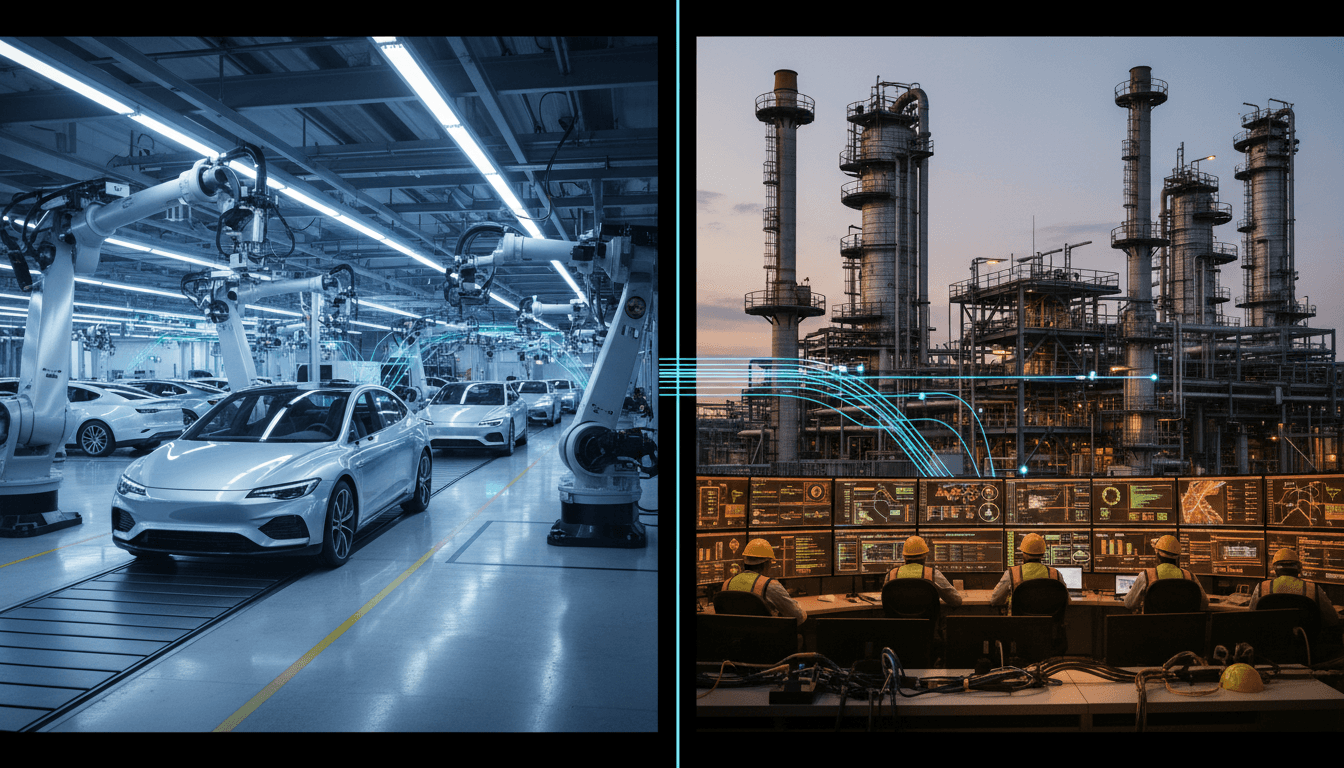
China EV Surge: What Kazakhstan Energy Can Learn
Europe’s car industry is hearing an uncomfortable sentence more often than it wants to admit: “It’s doomed.”
That’s not a headline writer being dramatic. In late 2025, a senior manager named Tomas (a Czech automotive veteran) told RFE/RL he walked away after two decades in the business because he believes Europe’s auto manufacturing model can’t withstand what’s coming: a flood of high-quality Chinese electric vehicles (EVs) and the supply chains behind them.
This matters in Kazakhstan more than it first appears. The auto story isn’t “about cars.” It’s about what happens when a traditional industry meets a faster, more data-driven competitor—and hesitates. For our series «Қазақстандағы энергия және мұнай-газ саласын жасанды интеллект қалай түрлендіріп жатыр», the automotive shake-up is a clean case study: technological disruption doesn’t ask permission. You either build the capability to respond (increasingly with AI), or you end up defending yesterday’s economics.
Europe’s auto problem isn’t just China—it’s speed
Europe’s challenge isn’t that Chinese EVs exist. It’s that Chinese manufacturers learned to ship product cycles faster, cheaper, and with software-first thinking—and they did it at scale.
Over the past decade, the car stopped being “mostly mechanical.” It became a rolling stack of:
- battery chemistry and thermal management
- embedded software and connectivity
- sensor fusion and driver-assist algorithms
- digital manufacturing and quality analytics
That shift favors companies that treat data as a core input. If your development process still assumes long model cycles, fragmented supplier data, and slow decision-making, you can build excellent vehicles and still lose.
A useful one-liner for executives: When the product becomes software-heavy, the slowest part of your organization becomes your main competitor.
The supply chain changed shape
Chinese EV dominance isn’t only about final assembly. It’s also about control of upstream inputs (especially battery materials and processing capacity), tight integration with suppliers, and high-volume learning.
Even when European manufacturers design competitive models, they can be squeezed by:
- battery cost volatility
- supplier lead-time risk
- slower ramp-up (the painful phase between prototype and profitable volume)
The existential part is psychological: once experienced managers start exiting because they don’t believe adaptation is realistic, the industry loses more than headcount—it loses confidence.
The parallel to Kazakhstan’s energy and oil & gas: legacy is a liability
Kazakhstan’s oil, gas, and power sectors have enormous strengths: resource base, industrial talent, and decades of operational experience. But the same pattern that’s hitting Europe’s autos can hit energy: a new competitive basis emerges, and old advantages stop converting into profit.
In energy, the competitive basis is shifting toward:
- operational efficiency per barrel / per kWh (not just volume)
- safety performance under stricter expectations
- carbon intensity tracking and reporting credibility
- asset uptime and reliability in aging infrastructure
- speed of decisions during market volatility
AI is the practical tool that changes those outcomes. Not as a buzzword, but as a way to run complex assets with less waste, fewer incidents, and faster response.
“Doomed” usually means: the cost curve didn’t move
When people say an industry is doomed, they’re often describing one simple reality: the cost curve didn’t improve fast enough compared with competitors.
For Europe’s carmakers, that cost curve includes batteries, manufacturing automation, and software development.
For Kazakhstan’s energy companies, the cost curve includes:
- unplanned downtime
- energy losses in grids and plants
- drilling inefficiency and non-productive time
- maintenance practices that are reactive instead of predictive
- paperwork-heavy compliance and reporting
AI directly targets these costs—if it’s deployed with discipline.
Where AI actually moves the needle in Kazakhstan’s energy sector
AI value in oil, gas, and power is not a single “big system.” It’s a set of targeted capabilities that compound.
1) Predictive maintenance that prevents expensive surprises
Answer first: Predictive maintenance reduces unplanned downtime by detecting failure patterns early, using sensor data and historical work orders.
In practice, that means machine learning models flagging anomalies in:
- rotating equipment vibration (pumps, compressors, turbines)
- temperature and pressure trends
- electrical signatures in motors
- lubricant and corrosion indicators
The operational effect is straightforward: maintenance becomes planned, spare parts become forecastable, and outages become shorter.
What I’ve found works best is starting with one equipment class (say, compressors at a gas processing facility) and building a repeatable pipeline: data capture → labeling → model → workflow integration. The workflow part matters more than the model. If the alert doesn’t route to the right team with a clear action, it becomes noise.
2) Production optimization: fewer losses, more stable output
Answer first: AI-driven optimization improves throughput by continuously tuning operating parameters within safety and quality limits.
Oil and gas operations generate constant trade-offs: pressure vs. flow, yield vs. energy consumption, speed vs. wear. Humans can manage this, but not at the full resolution of modern data.
AI helps by:
- recommending optimal setpoints for separators, heaters, and compressors
- detecting subtle changes in reservoir behavior earlier
- prioritizing interventions (which well, which choke, which chemical treatment)
This is where Kazakhstan can gain a defensible edge: better decisions per hour across thousands of micro-choices.
3) Grid and power plant efficiency: less waste per kWh
Answer first: AI reduces technical and commercial losses by forecasting demand, balancing loads, and spotting irregularities.
For power and grid operators, common wins include:
- demand forecasting for dispatch planning
- dynamic line rating and congestion prediction
- detection of abnormal consumption patterns (loss/theft signals)
- predictive maintenance for transformers and switchgear
Winter demand peaks and infrastructure stress make January a good time to say this plainly: every percentage point of loss reduction is real money and often cheaper than new capacity.
4) Safety, incident prevention, and “human factors”
Answer first: AI improves safety by detecting risky conditions earlier and standardizing responses.
Examples that are already practical:
- computer vision to detect PPE compliance or restricted-zone entry
- natural language processing (NLP) to analyze incident reports for recurring root causes
- fatigue risk scoring using shift patterns and operational context
One stance I’ll defend: Safety is the strongest AI business case because it avoids catastrophic downside and improves operational discipline.
What Europe’s auto pain teaches: integration beats pilots
Europe didn’t lose because it had zero technology. It lost momentum because technology wasn’t integrated into the operating model fast enough.
Kazakhstan’s energy sector should treat this as a warning: AI pilots are easy; AI adoption is hard.
Here’s what separates “innovation theater” from real transformation:
Make AI a business system, not an IT project
AI programs succeed when they’re owned by operations with clear metrics, such as:
- mean time between failures (MTBF)
- unplanned downtime hours
- maintenance cost per operating hour
- energy intensity (kWh per unit output)
- process safety event frequency
If the KPI isn’t owned by a line leader, the project drifts.
Fix data plumbing early (and don’t chase perfection)
Industrial AI doesn’t require perfect data. It requires consistent data and known gaps.
Practical steps that work:
- Standardize tag naming and sensor metadata
- Create a single “asset registry” (equipment hierarchy)
- Link work orders to asset IDs and timestamps
- Start with “good enough” sampling rates for the use case
Build capability inside the company
Relying entirely on vendors creates dependency. The best model is mixed:
- internal product owner + reliability engineer + data engineer
- vendor/partner support for tooling and advanced modeling
- a training path for operations staff to trust and use outputs
If Europe’s auto industry has taught anything, it’s that capability compounds. If you don’t build it, you rent it forever.
“People also ask” (and the direct answers)
Will EV growth reduce oil demand enough to threaten Kazakhstan?
EVs pressure gasoline demand over time, but the bigger risk for producers is cost competitiveness and carbon intensity. Countries and companies with efficient operations and credible reporting keep market access longer.
Is AI relevant if you’re focused on drilling and production, not software?
Yes. Drilling and production are optimization problems under uncertainty—exactly what machine learning is good at when paired with domain expertise. The payoff comes from less non-productive time, fewer failures, and more stable production.
What’s the fastest AI win in oil & gas?
Predictive maintenance and anomaly detection usually deliver the quickest returns because they use existing sensor data and have clear operational actions.
The bet Kazakhstan should make in 2026: compete on intelligence, not inertia
Europe’s auto leaders are discovering that brand heritage doesn’t protect you when competitors build faster learning loops. That’s the lesson worth importing.
Kazakhstan’s energy and oil & gas sector doesn’t need to be the next industry where experienced managers say “it’s doomed” and exit. It needs to move its cost curve and safety curve now, while demand still exists and while modernization budgets can be justified.
If you’re planning your 2026 roadmap, a good starting question is simple: which three decisions do our teams make every day that would improve most with better data and AI assistance—and what would that be worth per month?