Valero’s $3.82 EPS beat shows margins follow execution. Here’s how AI can lift refining margins and throughput in Kazakhstan—practically, fast.
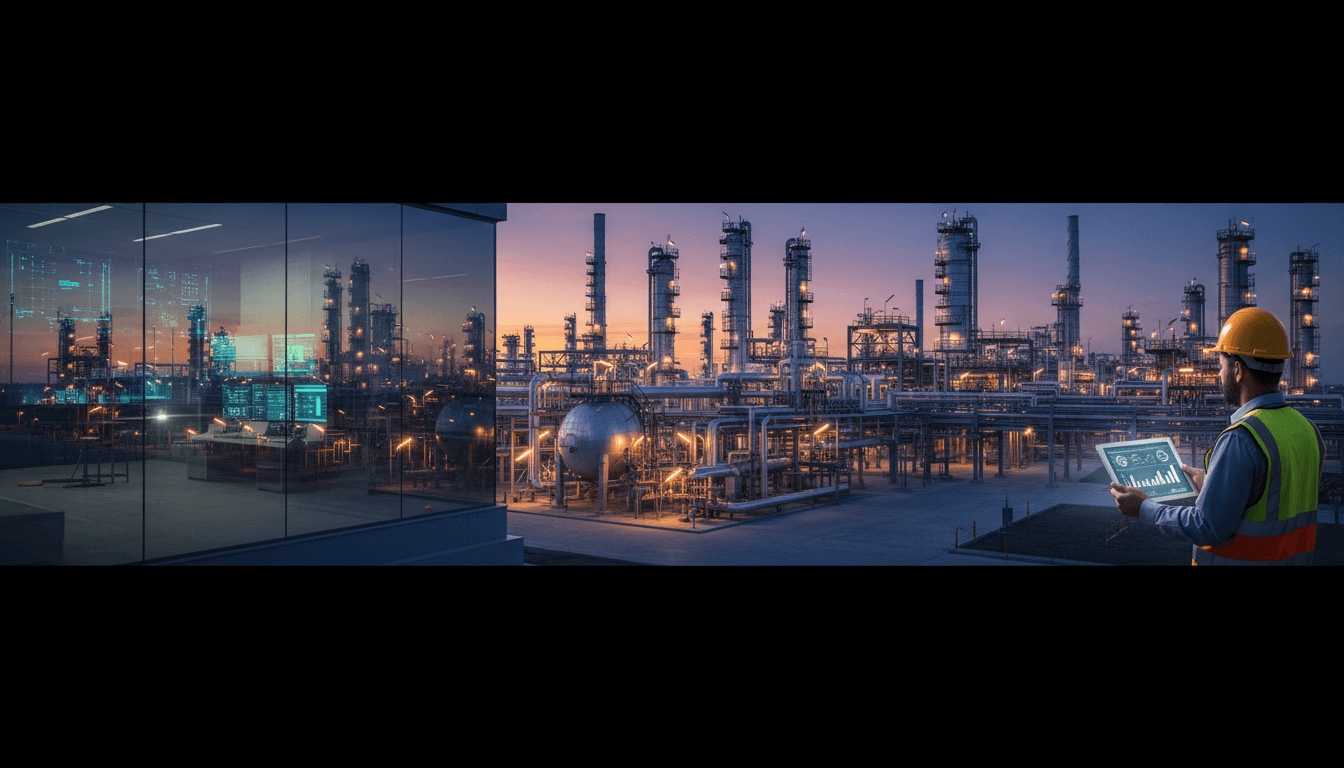
AI refining: margins like Valero’s, lessons for Kazakhstan
Valero just gave the refining market a blunt reminder: when margins widen and units run reliably, profits follow fast. In its latest quarter, the U.S. refiner reported adjusted net income of $1.2B (or $3.82 per share)—well above the $3.27 EPS consensus cited by The Wall Street Journal. The RSS summary credits two drivers: stronger refining margins and higher throughput volumes.
That headline is U.S.-focused, but the mechanics are universal—and very relevant to our series on Қазақстандағы энергия және мұнай-газ саласын жасанды интеллект қалай түрлендіріп жатыр. Refining and processing plants in Kazakhstan face the same daily reality: crude quality shifts, unit constraints, unplanned downtime, energy intensity, and a constant trade-off between yield, quality, and cost.
Here’s the stance I’ll take: margin performance isn’t “market luck.” It’s increasingly a data and operations problem. And that’s exactly where AI in oil and gas (and in downstream energy) earns its keep.
What Valero’s quarter really signals: margins are operational
Refining margins aren’t a single number; they’re the outcome of hundreds of micro-decisions. When a company beats earnings because of margin strength and throughput, it typically means it did many things right at once: it ran units closer to optimal, avoided costly upsets, managed product yields, and kept energy use under control.
Valero’s $3.82 EPS (vs. $3.27 expected) is a tidy example of what happens when commercial conditions (crack spreads, product demand) line up with execution (reliability and utilization). Many teams obsess over the market piece because it’s easier to blame. The real money is often in the execution piece because it’s controllable.
For Kazakhstan’s refineries and gas processing facilities, that execution gap shows up as:
- Unplanned downtime that forces suboptimal blending or purchase of components
- Conservative setpoints used as a safety blanket because the plant is “not fully understood”
- Energy penalties (steam, fuel gas, electricity) that quietly eat the margin every hour
- Quality giveaway, when products exceed spec “just to be safe”
AI doesn’t replace process engineering. It makes process engineering scalable, faster, and more consistent.
Where AI actually increases refining margins (not buzzwords)
AI increases margin by improving decisions under constraints. In refining, the best opportunities are the ones that combine high frequency (daily/hourly decisions) with measurable economics.
1) Throughput gains without safety compromises
Pushing more barrels through a constrained unit is the classic route to higher profit—until vibration, fouling, coking, corrosion, or compressor limits bite back.
What AI does well here: it spots patterns humans miss because it can ingest years of historian data, lab results, maintenance logs, and ambient conditions.
Practical use cases:
- Early warning models for exchanger fouling, compressor surge risk, column flooding, and catalyst deactivation
- Soft sensors that estimate hard-to-measure variables (e.g., inferred product qualities, unit constraints) in near real time
- Constraint prediction (hours/days ahead), so planners don’t schedule the plant into a corner
Margin impact is simple cause-effect: fewer upsets → higher utilization → higher throughput → better fixed-cost absorption.
2) Yield and quality optimization (the “hidden” margin)
Most companies get this wrong: they chase a single unit’s KPI and accidentally damage the site-wide optimum.
AI-driven real-time optimization looks across multiple units and the blending system to maximize value subject to constraints. Even small yield shifts matter. A 0.2–0.5% improvement in high-value product yield across a big site can be material over a quarter.
Where Kazakhstan can benefit immediately:
- Blending optimization that reduces quality giveaway (octane, vapor pressure, sulfur, aromatics)
- Crude selection and scheduling models that learn how local crude variability affects yields and constraints
- Advanced process control (APC) + ML hybrids: APC keeps the unit stable; ML helps update targets and anticipate disturbances
A useful one-liner for leadership teams: “Every off-spec scare makes operators conservative; AI gives them confidence to run closer to the edge—safely.”
3) Energy intensity reduction (margin by cutting the quiet costs)
In winter, energy costs and stability risks tend to rise (steam demand, heating, viscosity issues). January is a good time to be honest: energy is not a back-office utility line item. It’s a profit lever.
AI targets:
- Boiler and steam network optimization (load forecasting, header pressure optimization)
- Furnace efficiency models (excess O₂, stack temperature, draft control, coil fouling detection)
- Power management (peak shaving, load shifting, predictive maintenance for rotating equipment)
In refining, the economic KPI isn’t “energy per ton” by itself. It’s energy per ton at the optimal yield and quality.
A Kazakhstan-focused blueprint: from “data” to margin in 90–180 days
AI projects fail when they start with algorithms instead of a margin problem. If you want results that look like “higher margins + higher throughput,” structure the work in a way that operations trusts.
Step 1: Pick 1–2 margin-critical decisions
Good starting points are decisions that happen daily and have visible dollar impact:
- crude slate / feed quality handling
- CDU/VDU constraints and stability
- hydrotreater severity vs. hydrogen and quality
- gasoline/diesel blending giveaway
- energy (steam/power) optimization
Step 2: Build the “minimum viable data stack”
You don’t need perfection, but you do need reliability.
- historians (DCS/SCADA data)
- LIMS (lab results) with timestamps aligned
- planning/blending system exports
- maintenance events (CMMS) as structured tags
- a clear tag dictionary (the unsexy part that saves months)
Step 3: Deliver an operator-facing tool, not a dashboard
Dashboards are fine. Decision support is better. The output should look like:
- “If you increase reflux by X and reduce furnace duty by Y, predicted diesel cloud point stays within spec, energy drops Z.”
Operators adopt tools that:
- explain why (feature importance, constraint rationale)
- show confidence bands (so people know when not to trust it)
- fit into existing workflows (shift handover, daily meeting)
Step 4: Close the loop with governance
AI that isn’t governed becomes a science project.
Define:
- model ownership (process engineer + data specialist)
- update cadence (monthly/quarterly)
- KPI tracking tied to margin, not model accuracy
Rule of thumb: if a model improves RMSE but nobody changes a setpoint, you didn’t create value.
“People also ask” (the questions leaders in oil & gas ask privately)
Does AI in refining require a full digital twin?
No. A full physics-based digital twin is powerful but slow to implement. Many margin wins come from targeted ML models combined with existing APC and engineering constraints.
Where does AI break down in downstream operations?
AI breaks down when:
- data quality is poor and not fixed
- incentives conflict (production vs. reliability)
- teams treat models as “black boxes”
- cybersecurity and access rules are an afterthought
What’s the fastest ROI use case for Kazakhstan refineries?
In my experience, it’s usually one of these:
- blending optimization to reduce giveaway
- predictive maintenance on critical rotating equipment
- steam/power optimization
They’re measurable, operationally intuitive, and don’t require a multi-year transformation to start paying back.
The Valero lesson, applied: AI turns good quarters into repeatable performance
Valero’s beat—$3.82 EPS vs. $3.27 expected, with $1.2B adjusted net income—isn’t just a financial headline. It’s a clean case study in how refining rewards execution when the market gives you room.
For Kazakhstan’s energy and oil & gas leaders, the opportunity is to make that execution less dependent on heroics and more dependent on disciplined, data-driven operations.
If your refinery or processing plant is already running “pretty well,” that’s exactly when AI pays off: the last few percent of throughput, yield, and energy efficiency is where margins hide. And those percent points are too complex for manual tuning alone.
The next question I’d ask on Monday morning is simple: which constraint—or which recurring upset—costs you the most margin per month, and why are you still managing it without predictive models?