CPC’s Black Sea storm halt shows why AI-driven planning matters. Learn how weather, storage, and scheduling models reduce downtime in Kazakh oil exports.
AI Kazakh Oil Exports: Cut Storm Downtime Fast
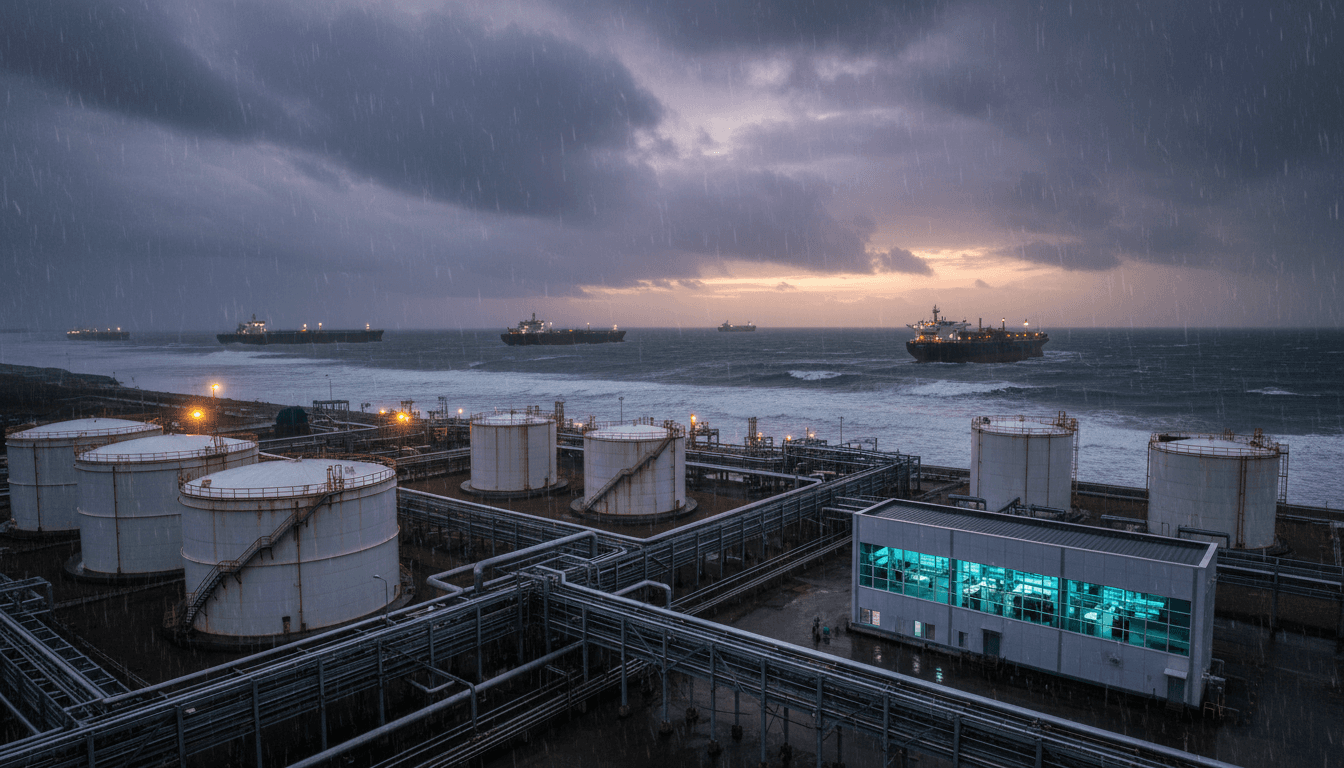
A storm in the Black Sea shouldn’t be able to put a country’s export plan on hold—but this week it did. The Caspian Pipeline Consortium (CPC) said it suspended crude oil transshipment and loadings at its Black Sea terminal due to adverse weather, and even halted accepting oil for a period because storage space became tight. That’s not just a bad operations day; it’s a reminder that weather risk is supply-chain risk.
For Kazakhstan, where a large share of export volumes rely on a limited number of corridors, a shutdown at a single chokepoint can ripple through production scheduling, shipping nominations, inventory buffers, and cash flow. And here’s my stance: most oil-and-gas organizations still treat disruptions like this as “unavoidable.” They’re not. You can’t stop storms—but you can stop storms from turning into extended downtime.
This post is part of our series “Қазақстандағы энергия және мұнай-газ саласын жасанды интеллект қалай түрлендіріп жатыр”. We’ll use the CPC weather halt as a practical case study to show how AI in oil and gas (plus smart sensing and optimization) can predict, mitigate, and manage export disruptions—especially in Kazakhstan’s high-stakes logistics.
What the CPC storm halt tells us about Kazakhstan’s risk profile
Direct answer: The halt shows that Kazakhstan’s export system is efficient in normal conditions, but fragile under correlated shocks (weather + storage limits + vessel scheduling).
When CPC suspends operations due to storm warnings, it typically affects several linked steps at once:
- Marine safety constraints (waves, wind, visibility) stop tanker approaches and offshore operations.
- Terminal throughput drops to zero, instantly creating a queue in nominations and vessel lineups.
- Upstream flows don’t stop as quickly, so storage fills—then the terminal may need to stop accepting crude to avoid overflow.
That last point matters. A weather disruption becomes more expensive when it turns into a storage and scheduling problem. In practice, it can force:
- short-term production adjustments upstream,
- re-optimization of blending and tank allocation,
- demurrage costs for waiting vessels,
- missed delivery windows and commercial penalties.
January adds a seasonal layer. Winter storms in the Black Sea region are not rare, which means a “one-off event” is often part of a repeating pattern. Repeating patterns are exactly where AI performs well—if you set up the data and the decision process to use it.
Why “weather monitoring” isn’t enough (and what AI adds)
Direct answer: Traditional monitoring tells you what’s happening; AI-driven disruption management tells you what will happen next and what to do about it.
Many operators already track forecasts and marine advisories. The gap is that the forecast rarely translates into operational actions early enough—because decisions are distributed across teams (marine, terminal, pipeline scheduling, trading, HSE), and each team sees only part of the picture.
The difference between forecast and decision intelligence
A useful mental model:
- Forecasting: “A storm is likely Tuesday night.”
- Decision intelligence: “Given the storm probability, vessel ETA distribution, current tank levels, and pipeline inflow, we should advance loading of cargo A by 10 hours, delay cargo B by 18 hours, and reroute volume C to alternative storage—because that minimizes total demurrage and prevents a terminal intake stop.”
AI becomes valuable when it fuses:
- weather and ocean data,
- vessel AIS and ETA variability,
- terminal constraints (berths, pumps, allowable sea state),
- tank farm dynamics (fill/empty rates, segregation rules),
- pipeline inflow and upstream production flexibility.
In other words, AI doesn’t replace the marine team’s judgment. It turns judgment into repeatable, faster, quantitatively supported decisions.
AI use cases that reduce downtime at export terminals
Direct answer: The highest ROI comes from three areas: probabilistic weather-to-operations modeling, constraint-based scheduling, and inventory risk prediction.
Below are concrete applications that fit Kazakhstan’s oil export reality and the CPC-style terminal environment.
1) Probabilistic weather impact models (not just “storm/no storm”)
Weather is uncertain. The operational question isn’t “Will there be a storm?” It’s “How likely are conditions to breach our operating limits, and for how long?”
A practical AI setup:
- Inputs: multiple numerical weather models, historical metocean measurements, storm warnings, local sensor feeds.
- Output: probability distributions for wave height, wind speed, and visibility at the terminal’s operating area.
- Decision layer: predicted “operability windows” (e.g., 6–10 hour windows where loading is safe) with confidence levels.
Why it works: terminal shutdowns often happen because teams wait for certainty. Probabilities let you act earlier—for example, accelerating a partial loading that fits into a predicted operability window.
Snippet-worthy line: “Storms don’t cause the biggest losses—uncertainty does.”
2) AI-assisted berth and loading schedule optimization
When a storm hits, schedule changes cascade. A good optimizer can re-plan under constraints:
- berth availability and tug/pilot constraints,
- loading rates,
- tanker sizes and draft limits,
- contractual priorities,
- safe shutdown and restart sequences.
The goal isn’t a “perfect schedule.” It’s a schedule that minimizes total cost of disruption (demurrage + missed nominations + tank overflow risk + restart delays).
In Kazakhstan’s context, this matters because export programs are planned tightly. If you can cut even 6–12 hours of unnecessary idle time per disruption event, the economic impact can be material across a winter season.
3) Predicting storage saturation and preventing intake stoppages
The RSS summary notes the terminal halted accepting oil due to insufficient storage space. That’s a classic “second-order disruption.”
An AI model can forecast:
- tank fill trajectories under different shutdown durations,
- blending/segregation conflicts (what can go where, and when),
- time-to-saturation with confidence intervals.
Then it can trigger recommended actions:
- adjust upstream inflow earlier,
- re-sequence tanks and transfer plans,
- prioritize certain cargoes to free the “right” tank space.
Preventing an intake stop is often more valuable than speeding up restart, because intake stops push pressure back into the whole system.
4) Real-time ETA and queue prediction using AIS + port activity
Marine logistics is messy: weather reroutes vessels, ports congest, and ETAs drift. AI can use AIS plus historical turnaround times to predict:
- likely arrival windows,
- probability of missing a berth slot,
- expected queue length and demurrage exposure.
This is especially useful when you need to decide whether to hold a berth open for a late vessel or swap the sequence.
5) Operational playbooks that run like checklists—updated by data
A lot of disruption response lives in people’s heads. The better approach: encode response plans as dynamic playbooks.
For example, if the model predicts operability returning at 02:00 with 70% confidence, the playbook can:
- pre-stage crews,
- pre-approve startup sequences,
- ensure tank lineups are ready,
- verify HSE constraints and permits.
This is where “smart technologies” become real: not dashboards, but shorter time from ‘conditions improve’ to ‘loading resumes’.
What a realistic implementation looks like in Kazakhstan
Direct answer: Start with a narrow, high-impact scope (weather-to-operations + storage risk), prove value in 8–12 weeks, then expand to full logistics optimization.
AI programs fail when they start as massive transformations. For export disruption management, a phased plan works better.
Phase 1 (0–3 months): Build the disruption data spine
Focus on data that already exists but isn’t connected:
- metocean forecasts + on-site sensor readings,
- terminal operating limits (documented thresholds),
- tank levels and transfer logs,
- vessel AIS feeds and historical berth times.
Deliverable: a single “truth layer” that supports analytics without manual spreadsheet stitching.
Phase 2 (2–4 months): Deploy two models that pay for themselves
Prioritize:
- Operability window prediction (probabilistic)
- Time-to-storage-saturation forecasting
Success metric examples you can actually track:
- hours of intake stoppage avoided,
- reduction in demurrage hours,
- fewer emergency schedule changes,
- improved on-time nomination performance.
Phase 3 (4–9 months): Add optimization and automation
Expand to:
- berth sequencing optimization,
- dynamic upstream flow recommendations,
- automated alerts and playbook triggers.
The aim is not “full autonomy.” It’s a system where planners and ops teams spend less time reacting and more time choosing between ranked options.
People also ask: practical questions about AI for oil export disruptions
Direct answer: The tech is mature; the hard part is governance, integration, and trust.
“Can AI really predict weather-related shutdowns?”
AI won’t beat physics, but it can combine multiple models and local observations to estimate the probability your specific operating thresholds will be breached. That’s what planners need.
“Do we need a giant data lake first?”
No. You need a use-case data product: a minimal, governed dataset for weather, tanks, and vessel movement that updates reliably.
“Will this create safety risks?”
If done right, it reduces risk. The AI should recommend actions within HSE constraints, never override them. The winning design is “AI suggests, humans approve,” with auditable logic.
“What’s the biggest hidden bottleneck?”
Change management. If schedulers don’t trust the model—or if roles and decision rights are unclear—tools become expensive dashboards.
The bigger point for our AI-in-energy series
Direct answer: Kazakhstan’s energy and oil-and-gas sector doesn’t need more reports; it needs faster, coordinated decisions during disruptions.
The CPC storm halt is a clean example of why. Weather stops the terminal, storage tightens, and then the system starts making defensive moves. AI helps most at the moment where humans are under time pressure and uncertainty is high: it turns scattered signals into a shared operational picture and recommends the next best action.
If you’re responsible for export reliability, terminal operations, supply chain, or digital transformation, a good next step is simple: map your last three disruption events (weather, maintenance, congestion) and quantify where time was lost—forecast lag, schedule churn, storage constraints, or restart delays. Then pick one place where an AI model can remove hours, not just add visibility.
There’s a question worth asking before the next storm warning: when operations stop, do you already know the best restart plan—or do you start figuring it out after the shutdown?