China’s renewable microgrid policy highlights why AI dispatch, standards, and grid coordination matter. Apply the lessons to Kazakhstan’s industrial energy systems.
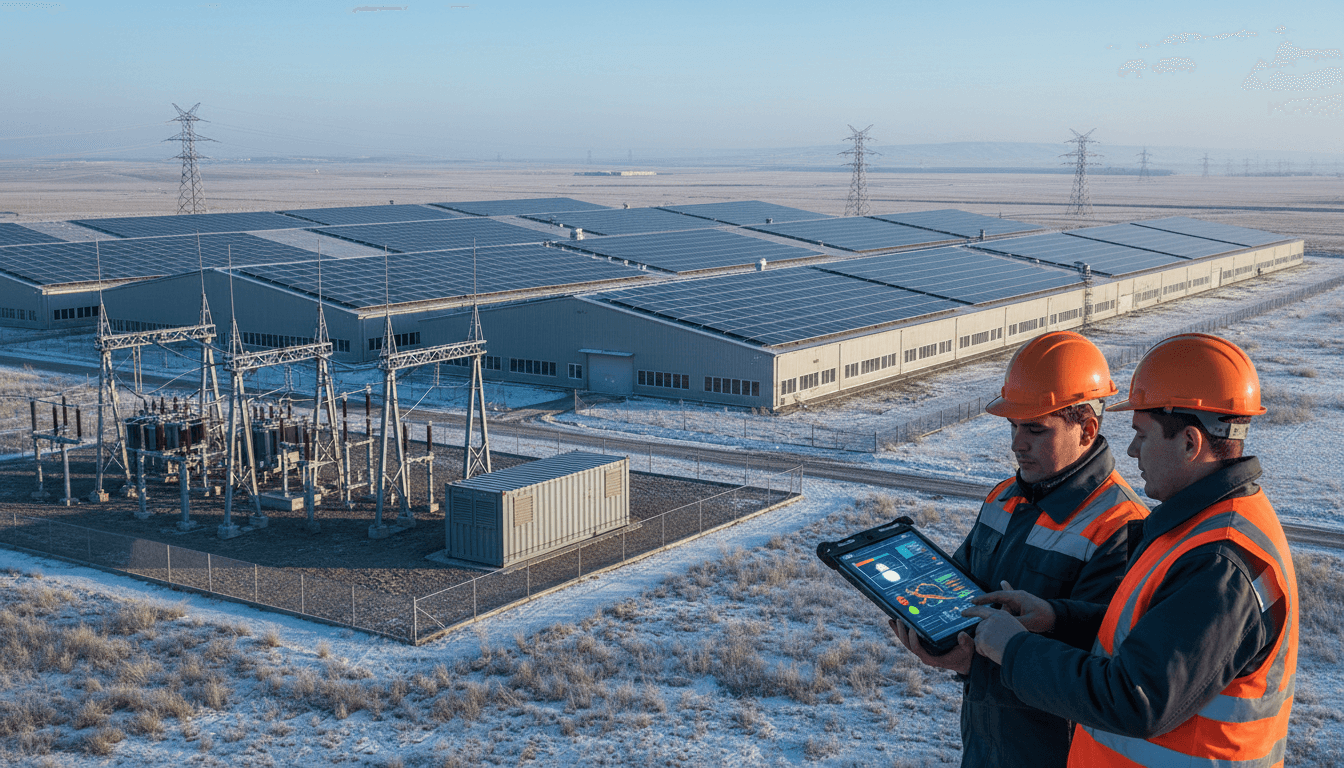
AI-Driven Microgrids: Lessons for Kazakhstan Industry
China’s latest push on renewable microgrids in industrial parks isn’t a feel-good climate headline. It’s a grid-management story. The policy message is blunt: if factories generate more green electricity locally, they shouldn’t automatically dump it onto the national grid when it’s inconvenient for the park, then pull power back later as if nothing happened. Coordination is the whole point.
That’s exactly why this matters for Kazakhstan right now. As the country modernizes energy infrastructure and decarbonization pressure grows (from investors, supply-chain rules, and domestic efficiency targets), industrial energy optimization will move from “nice-to-have” to “license to operate.” And the fastest way to make microgrids work at scale—without turning dispatch into chaos—is AI-driven energy management.
This post uses China’s new microgrid guidelines as a practical mirror for Kazakhstan: what problems China is trying to fix (standards, markets, coordination), what AI actually does inside an industrial microgrid, and what a Kazakhstan refinery, mine, or industrial zone should do first if it wants measurable savings and lower emissions.
What China’s microgrid policy is really solving
China’s new guidelines (issued by several central departments including the Ministry of Industry and Information Technology) highlight three obstacles that will sound familiar to anyone who’s tried to run complex energy assets:
1) No unified technical standards. If every industrial park uses different control protocols, telemetry formats, protection schemes, and interconnection rules, the grid operator can’t safely forecast or dispatch.
2) Incomplete market mechanisms. Microgrids need clear pricing and settlement rules for self-consumption, exports to the grid, curtailment compensation, ancillary services, and storage value. If the economics are fuzzy, projects stall—or operate inefficiently.
3) Weak coordination with the main grid. A microgrid that optimizes only for the site can unintentionally raise system-wide costs: causing peaks, backfeeding at the wrong time, or relying on the grid as a “free battery.”
Here’s the key stance: renewable microgrids succeed when they’re treated as dispatchable participants, not isolated islands. That’s where advanced control—and increasingly, AI—becomes non-negotiable.
Why industrial microgrids are an AI problem (not just an engineering one)
An industrial microgrid is a living system: variable solar output, fluctuating loads, equipment constraints, and grid signals that change by the minute. Traditional rule-based control works fine in stable environments. Industrial sites aren’t stable.
AI in energy and oil-gas operations earns its keep when it turns messy, high-frequency decisions into consistent performance:
Forecasting: the hidden driver of savings
Accurate short-term forecasting is the foundation for good dispatch.
- Load forecasting (15-minute to 24-hour): production schedules, shift patterns, temperature, and equipment states all matter.
- Renewables forecasting: solar/wind output depends on weather nowcasting, seasonal profiles, and site-specific losses.
- Price/constraint forecasting: when tariffs include time-of-use pricing or demand charges, microgrids need to anticipate cost spikes.
AI models (often gradient boosting, LSTM/transformer time-series models, or hybrid physics + ML) typically outperform manual heuristics because they learn nonlinear patterns—like how a compressor train’s load behaves after maintenance or how smelter demand shifts during product changeovers.
Optimization: dispatch is a math problem with real consequences
Once you can forecast, you can optimize. The dispatch controller chooses how much to:
- self-consume renewables
- charge/discharge batteries
- run gas turbines/boilers/CHP
- curtail loads (demand response)
- import/export from the grid
The most common approach in industry is model predictive control (MPC) combined with mixed-integer optimization. AI helps by producing better forecasts and constraint estimates, and by learning equipment efficiency curves that drift over time.
A snippet-worthy truth: microgrids don’t fail because solar is intermittent—they fail because control decisions are inconsistent.
Coordination: the grid wants predictability
China’s policy emphasis on “dispatch less green energy to the main grid” is a coordination signal. If the system has surplus renewables, exporting from an industrial park may be helpful. If the system is already saturated, exporting can increase curtailment elsewhere.
AI-enabled coordination can support:
- export caps based on feeder constraints
- ramp-rate limits so sites don’t create volatility
- ancillary services (frequency response) where regulation allows
- event-driven islanding during outages, with safe reconnection
For Kazakhstan, this point is crucial: as more renewables connect, grid stability becomes a bigger economic issue than “green branding.”
Kazakhstan: where microgrids fit in oil, gas, mining, and industrial zones
Kazakhstan’s industrial energy profile is dominated by large, steady loads (mining, metallurgy), critical infrastructure (pipelines, compressor stations), and energy-intensive processing (refining, petrochemicals). These are ideal microgrid candidates—not because they’re trendy, but because power quality and uptime are money.
Use case 1: refinery and petrochemical clusters
Refineries already operate complex utilities: steam networks, boilers, CHP, flares, and backup generators. Adding renewables + storage without advanced control can create operational risk.
Where AI helps most:
- optimizing CHP setpoints against electricity prices and steam demand
- detecting efficiency drift (heat rate) in turbines and boilers
- preventing demand peaks that trigger demand charges or penalties
Use case 2: remote oil & gas assets and compressor stations
Remote sites often rely on diesel or gas gensets. A microgrid with solar + storage can reduce fuel burn, but only if dispatch respects engine minimum loading, maintenance intervals, and reliability constraints.
Practical AI value:
- predictive maintenance to avoid forced outages
- dynamic spinning reserve sizing (don’t overrun gensets “just in case”)
- fuel logistics optimization (especially in winter access constraints)
Use case 3: mining operations with volatile loads
Mines have sharp load swings from crushers, mills, hoists, and ventilation. Microgrids can shave peaks and stabilize voltage/frequency.
AI can learn production-linked load signatures and schedule battery discharge during the exact peak windows that matter.
What Kazakhstan can learn from China’s “standards + market + coordination” approach
China is telegraphing a playbook that Kazakhstan can adapt rather than copy.
1) Standardize data before you standardize AI
Most companies try to “buy AI” while their SCADA, meters, historian tags, and maintenance logs don’t match.
A minimum viable standardization checklist for an industrial microgrid:
- unified meter naming and time sync (NTP/PTP)
- consistent tag taxonomy across assets (inverters, batteries, gensets)
- power quality and protection event logging
- a single source of truth for tariffs, contracts, and constraints
If you can’t trust timestamps, you can’t trust forecasts. If you can’t trust forecasts, dispatch becomes guesswork.
2) Make settlement rules explicit, even inside one company
Even without a perfect national market design, large holdings can create internal “prices” for energy flows between subsidiaries, plants, and utility blocks. This forces discipline:
- what is the value of 1 MWh stored vs exported?
- what is the cost of curtailment?
- what is the value of avoided downtime?
AI optimization works best when the objective function is clear. If finance and operations disagree on what “optimal” means, the controller will be blamed for a governance issue.
3) Treat the grid operator as a partner from day one
China’s policy calls out poor coordination explicitly. Kazakhstan projects should assume the same risk: interconnection approvals, export limits, protection settings, and operational procedures can delay launches.
A better approach:
- share day-ahead export/import plans (even if informal)
- agree on constraints and emergency actions
- design for safe islanding and reconnection
A practical rollout plan: 90 days to a credible AI microgrid pilot
Most companies get this wrong by starting with a big capex build. Start with control and visibility.
Step 1: Instrumentation and data readiness (Weeks 1–4)
- validate meters at feeder, major loads, and generation points
- create a clean historian pipeline (1–5 minute granularity)
- document constraints (ramp rates, min/max outputs, reserve needs)
Deliverable: a data set that operations trusts.
Step 2: Forecasting models (Weeks 3–8)
- baseline forecasts (statistical) vs ML forecasts
- choose 2–3 KPIs: MAPE for load forecast, renewable forecast error, peak prediction accuracy
Deliverable: forecasts that beat the site’s current “gut feel.”
Step 3: Optimization and operator-in-the-loop dispatch (Weeks 6–12)
- run the optimizer in “recommendation mode” first
- compare recommended dispatch vs actual
- quantify savings from peak shaving, fuel reduction, curtailment reduction
Deliverable: a business case with real numbers, not promises.
One useful rule: if the pilot can’t show value without new hardware, the control problem isn’t understood yet.
People also ask: microgrids, AI, and industrial decarbonization
Does an industrial microgrid always need batteries?
No. Batteries help with peak shaving and renewable smoothing, but many sites get early wins from better CHP scheduling, demand response, and power factor correction. Storage becomes compelling when tariffs penalize peaks or when reliability requirements are high.
Is AI necessary, or can a conventional EMS do the job?
Conventional EMS can work for stable loads and simple assets. AI becomes valuable when you have volatile demand, multiple generators, changing tariffs, and frequent constraints. That describes most large industrial sites.
What’s the biggest operational risk?
Bad interconnection and protection design. Optimization can’t fix a protection scheme that trips unnecessarily or an export limit that wasn’t accounted for.
Where this fits in Kazakhstan’s AI-in-energy journey
This post is part of the series “Қазақстандағы энергия және мұнай-газ саласын жасанды интеллект қалай түрлендіріп жатыр” for a reason: microgrids are where AI stops being a dashboard and starts being an operator.
China’s microgrid guidelines underline a simple message Kazakhstan shouldn’t ignore: decarbonization in industry will be managed through dispatch, standards, and coordination—not slogans. If you’re running an industrial park, refinery, mine, or pipeline power system, the question isn’t “should we add renewables?” It’s “can we control them in a way that improves reliability and cost?”
If you’re considering an industrial renewable microgrid, start with a pilot focused on forecasting and dispatch optimization. Get the data right. Agree on economics. Align with the grid operator early. Then scale.
What would change fastest in your organization if you could predict tomorrow’s load and dispatch your assets automatically—without risking uptime?