Waymo’s move into Minneapolis, New Orleans, and Tampa shows why AI must handle snow, narrow streets, and heavy rain to scale robotaxis safely.
Waymo’s 3-City Expansion Shows What AV AI Must Solve
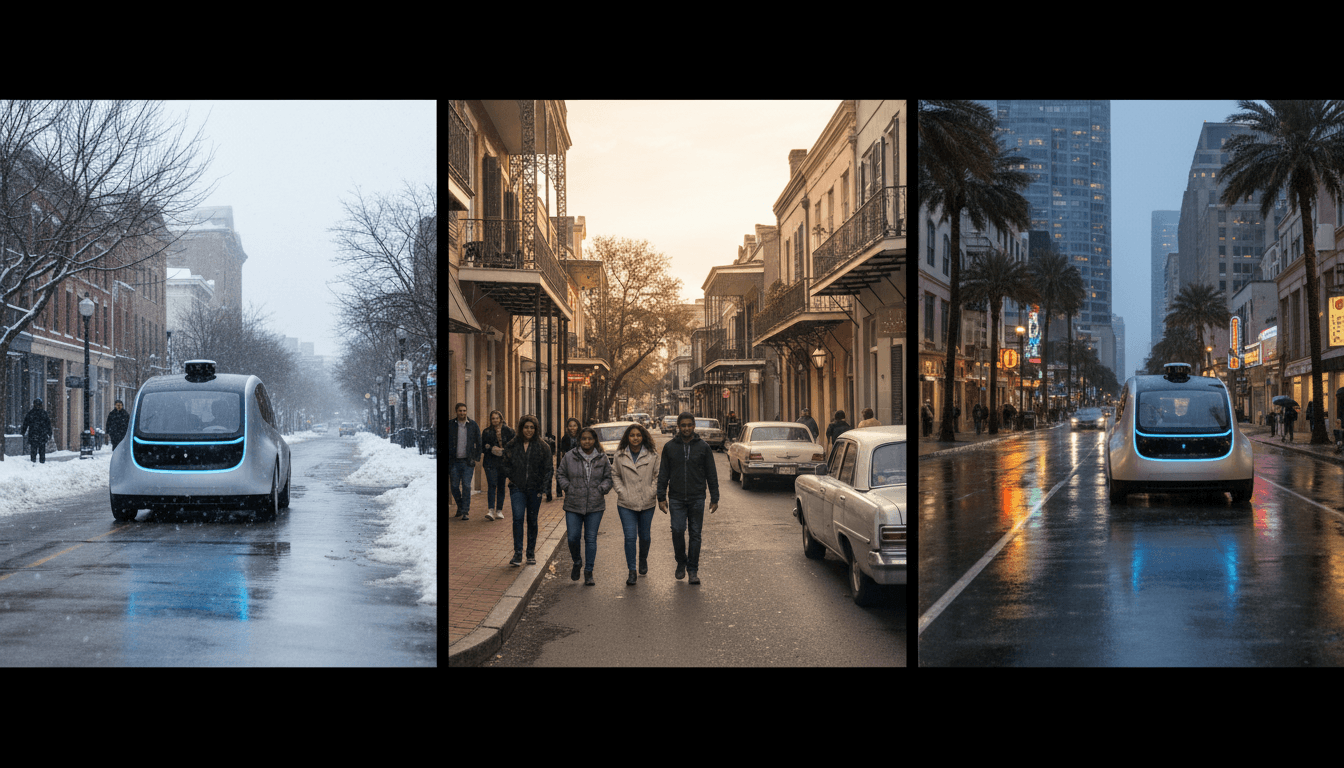
Waymo expanding into Minneapolis, New Orleans, and Tampa isn’t just a market move—it’s a technical statement. Each city forces autonomous driving AI to handle a different kind of “hard mode”: snow and slush that hide lane lines, narrow streets with messy curb geometry, and torrential rain with glare-heavy lighting.
Most companies get this wrong: they talk about autonomous vehicles as if you can copy-paste the same driving brain everywhere. Reality check—robotaxi scaling is less about map coverage and more about AI robustness. The reason this matters to the automotive industry (and to anyone building ADAS or self-driving stacks) is simple: every new city is a fresh exam for perception, prediction, and planning.
This post is part of our “자동차 산업 및 자율주행에서의 AI” series, and we’ll treat Waymo’s expansion like what it is: a real-world case study in how AI in autonomous driving adapts to weather, infrastructure quirks, and human behavior—without compromising safety.
City expansion is an AI problem, not a PR problem
Answer first: Expanding to new cities stresses the full autonomy stack—data, sensors, simulation, and safety validation—and AI is the only scalable way to make that repeatable.
A robotaxi doesn’t “learn a city” the way a human does. It learns patterns—and then it has to prove those patterns hold under new distributions: different signage, different driver etiquette, different road textures, different construction norms. The technical term is domain shift, and it’s where good demos go to die.
Waymo’s choice of Minneapolis, New Orleans, and Tampa is telling because it’s not three versions of the same driving environment:
- Minneapolis: sustained winter conditions, salt-sprayed roads, occluded markings, low-friction driving.
- New Orleans: older street layouts, tight lanes, heavy curbside activity, irregular intersections.
- Tampa: frequent heavy rain, glare and reflection, fast-growing suburban/arterial mix.
If your AI stack handles those well, you’re not just expanding—you’re building generalization. And generalization is the difference between a pilot and a business.
What “scaling safely” really means for robotaxis
Scaling robotaxis isn’t mainly about adding vehicles. It’s about increasing Operational Design Domain (ODD) coverage while keeping the safety case intact.
In practice, that means:
- Collecting targeted data (not just more data) in edge conditions.
- Updating perception models so they don’t degrade in new weather/lighting.
- Validating in simulation at a volume that physical testing can’t match.
- Proving performance stability with strong monitoring and rollback discipline.
That’s an AI lifecycle problem: training, evaluation, deployment, and continuous improvement—under safety constraints.
Minneapolis: winter is where perception models get humbled
Answer first: Winter driving forces autonomy AI to rely less on lane paint and more on robust scene understanding—drivable space, object permanence, and risk-aware planning.
Minneapolis is a stress test because winter attacks the assumptions many perception pipelines quietly depend on:
- Lane markers disappear under snow.
- Curbs blur into plowed piles.
- Vehicles throw up spray that behaves like moving fog.
- Sun angles plus snow create brutal exposure swings.
For human drivers, winter is “drive slower.” For autonomous systems, it’s a full-stack negotiation between perception confidence and motion planning.
Sensor fusion isn’t optional when the world turns white
A common misconception: “Just add better lidar.” The truth is harsher: winter can degrade every sensor modality.
- Cameras struggle with low contrast, glare, and precipitation streaking.
- Lidar can see false returns in heavy snow (backscatter).
- Radar is more weather-tolerant but lower-resolution and noisier for classification.
So the AI challenge becomes fusion with uncertainty:
- How does the system down-weight a camera when it’s overexposed by snow glare?
- How does it keep tracking a pedestrian partially occluded by a snowbank?
- How does it decide whether a “flat white region” is drivable road or piled snow?
The best systems treat perception as probabilistic, then feed those probabilities into planning. That’s where modern AI—especially deep learning perception with calibrated uncertainty—earns its keep.
Planning on low friction: the subtle danger
Snow isn’t only a perception issue. It’s physics.
Robotaxi planning has to internalize that braking and turning limits shrink on low-friction surfaces. A safe planner in Minneapolis needs:
- More conservative following distances n- Earlier deceleration profiles
- Smooth steering (avoid abrupt lateral moves)
- Higher sensitivity to cut-ins because recovery margins are smaller
This is also where AI-powered vehicle dynamics models matter. If your stack doesn’t correctly estimate road friction (even indirectly), it will behave “confidently wrong.” And that’s one of the worst failure modes in autonomy.
New Orleans: narrow streets expose the long tail of urban driving
Answer first: Older, tighter urban environments push AI to master close-quarters negotiation—curbside chaos, occlusions, and ambiguous right-of-way.
New Orleans isn’t just “a city.” It’s a collection of constraints: narrower lanes, dense curb parking, delivery activity, tourists stepping unpredictably, and intersections that can feel informal.
For AI in autonomous vehicles, narrow streets create two hard problems at once:
- Occlusion management (what you can’t see is often the thing that hurts you)
- Social driving (humans communicate with micro-behaviors, not rulebooks)
Perception under occlusion: prediction has to do more work
When streets are narrow and lined with parked cars, pedestrians and cyclists appear late. That shifts load from perception to prediction.
Practical techniques the industry uses include:
- Occlusion-aware tracking: maintaining “ghost” hypotheses behind obstacles
- Intent prediction: estimating whether a pedestrian near a curb is about to cross
- Risk field modeling: treating certain zones (between parked cars, near bus stops) as higher probability of emergence
This is a place where ADAS and robotaxi stacks converge. Even if you’re “only” shipping Level 2+ features, urban occlusion handling improves:
- AEB timing
- pedestrian braking confidence
- driver warning quality (fewer false alarms, fewer misses)
The curb is the new battleground
Curb behavior is where autonomy gets judged by riders.
- Can the vehicle pull over without blocking traffic?
- Can it handle double-parkers without aggressive lane swings?
- Can it re-enter traffic smoothly?
These are planning problems, but they’re also policy problems: what does the car consider “polite” versus “overly timid”? The answer changes by city. AI helps by learning distributions of human behavior, but engineering still sets the boundaries.
A robotaxi that’s technically safe but socially awkward won’t scale. People stop trusting it long before it crashes.
Tampa: rain, glare, and fast roads test reliability
Answer first: Heavy rain and reflective road surfaces force autonomy AI to prove it can keep stable perception and safe speed control when visibility collapses.
Tampa brings a different challenge than Minneapolis. Snow is seasonal and structured; Florida rain can be sudden, intense, and paired with complex lighting—headlights, wet asphalt reflections, and smeared camera lenses.
Rain exposes data gaps and monitoring discipline
Many autonomy teams discover too late that their training set is “sunny-heavy.” You can’t fix that with a last-minute fine-tune. You need:
- Purposeful collection in heavy rain and night rain
- Robust labeling policies for partially visible objects
- Sensor health monitoring (lens obstruction, droplet artifacts)
This is also where online monitoring matters:
- If perception confidence drops, the stack should respond predictably.
- The system should reduce speed, increase following distance, and avoid complex maneuvers.
- It should have clear fallback behaviors that are safe and rider-comprehensible.
Reliability isn’t only model accuracy. It’s how the system behaves when it knows it doesn’t know.
Why this matters for the broader automotive ecosystem
OEMs shipping ADAS face the same physics and optics. Rain is where drivers notice:
- lane-keeping ping-pong
- phantom braking
- late detection of stopped vehicles
The lessons from robotaxi-grade rain robustness—sensor cleaning strategies, fusion tuning, uncertainty-aware planning—translate directly into better ADAS safety performance.
What Waymo’s city choices signal about AI strategy
Answer first: The selection looks like a deliberate attempt to harden generalization across weather and urban complexity—exactly what autonomous driving AI must prove to scale.
I don’t think these cities are random. They cover three failure classes that have repeatedly slowed autonomy programs:
- Adverse weather perception (snow/rain)
- Dense urban negotiation (narrow streets, occlusions)
- Operational consistency (repeatable deployments with a stable safety case)
The subtext for the industry is clear: the next phase of autonomy is less about novelty and more about coverage. Coverage across cities, conditions, and corner cases.
“More cities” also means more safety work
Every expansion adds complexity to:
- incident review workflows
- model update governance
- remote assistance policies
- rider experience consistency
This is where mature autonomy teams look more like aviation organizations than app startups. Safety isn’t a feature; it’s an operating system.
Practical lessons for teams building ADAS and autonomous driving AI
Answer first: If you want to scale AI in vehicles, build for domain shift: targeted data, robust validation, and clear fallback behaviors.
Here’s what I’d copy from the robotaxi playbook if I were building production ADAS or autonomy features inside an OEM or Tier 1:
-
Create a “hard conditions” dataset roadmap
- Don’t wait for winter or monsoon season. Plan collection.
- Track coverage by weather, time-of-day, and road type.
-
Measure model performance by scenario, not just global metrics
- Split evaluation into snow/rain/night/occlusion buckets.
- Require no-regression gates for each bucket before release.
-
Invest in uncertainty estimation and confidence-aware planning
- The goal isn’t perfect perception; it’s safe behavior under uncertainty.
-
Make simulation a first-class product
- Use scenario generation for rare events.
- Validate planner behavior, not just perception accuracy.
-
Design human-understandable fallback behaviors
- Drivers and riders tolerate caution.
- They don’t tolerate randomness.
These aren’t academic suggestions. They’re how you avoid the classic trap: shipping impressive features that crumble outside the lab.
Where this goes next in the “자동차 산업 및 자율주행에서의 AI” series
Waymo entering Minneapolis, New Orleans, and Tampa is a clean lens on the real work behind autonomous vehicles: AI that holds up when the environment stops cooperating. Snow hides structure. Narrow streets hide intent. Rain hides everything.
For readers tracking the automotive industry, the signal is encouraging: expansion now looks like controlled, AI-driven iteration—not blind scaling. The companies that win won’t be the ones with the flashiest demo route; they’ll be the ones that can bring performance guarantees to the messy parts of the map.
If you’re building ADAS, autonomy software, or the data infrastructure behind it, ask your team one hard question: Which city would break your system fastest—and what data would you need to prove it won’t?