AI-powered biomining is helping the US squeeze more nickel and copper from lower-grade ore. Learn what it means—and how to turn it into lead-gen social content.
AI + Biomining: The New Nickel Supply Playbook
A single aging mine in Michigan’s Upper Peninsula helps explain why AI is showing up in places you wouldn’t expect—including piles of crushed rock.
At Eagle Mine (currently the only active nickel mine in the US), the high-grade ore is running out. That’s not a niche problem. Nickel is one of the metals that sits inside the clean-tech stack powering 2026 America: EV batteries, grid storage, renewable buildouts, and the metal-hungry data centers behind everything from streaming to generative AI.
Here’s the twist: the next jump in US supply isn’t only about finding new deposits. It’s about getting more metal from what we already have—lower-quality ore, old heaps, and even industrial waste. And the most practical path I’m seeing is a partnership between biotechnology (microbes and fermentation) and AI (models that predict, control, and optimize messy real-world processes).
This post is part of our Small Business Social Media USA series, so we’ll also talk about something most coverage skips: how small businesses—marketing agencies, local manufacturers, B2B service providers, and cleantech vendors—can use this story to create smarter social media content that attracts leads.
Why nickel and copper shortages are also a “digital services” story
Answer first: Demand for metals is rising partly because US digital services are expanding, and that growth has a physical footprint—data centers, networks, batteries, and electrified fleets.
A lot of small businesses think of “AI” as software: chatbots, ad targeting, content calendars. That’s real, but incomplete. AI growth increases demand for data centers, and data centers are metal-intensive to build and power—copper for wiring, steel for structure, and nickel (indirectly) through batteries and electrification.
That’s why “biomining” matters beyond the mining sector. If the US can’t scale critical materials responsibly, costs rise across the supply chain—construction, logistics, energy, hardware, and even the cloud services your business relies on.
There’s also a local angle: new extraction approaches can extend the life of existing US sites, which affects regional jobs, permitting timelines, and procurement opportunities.
The hard truth about mining in 2026
Answer first: Mining is getting tougher because the easy ore is gone.
The source article highlights what every operator knows: miners already extracted the highest-grade deposits first. What’s left is often lower concentration ore, harder-to-process material, or waste piles that weren’t economical years ago.
That sets up the central opportunity: process innovation beats “just dig more.”
Biomining 101: microbes already help extract copper—now the tools are better
Answer first: Bioleaching works because microbes break chemical bonds that trap metals, and new genetic and measurement tools make the process more controllable.
Bioleaching isn’t new. Copper operations have used microbes for decades by piling crushed ore into heaps and adding sulfuric acid. Acid-loving bacteria—like Acidithiobacillus ferrooxidans—colonize the heap and produce chemicals that help free copper from sulfur-bearing minerals.
What’s new is control.
Historically, the “controls” were blunt instruments: keep acidity in range, pump air, wait. Now startups are treating bioleaching like a living factory.
Endolith’s approach: measure the heap like a microbiome
Answer first: If you can identify which organisms are in the heap, you can steer the community toward better extraction.
Endolith’s model, as described in the article, is to analyze DNA and RNA in the liquid flowing out of ore heaps to identify which microbes are active—then recommend which microbes to add to improve performance.
In lab tests on ore from BHP, Endolith’s active techniques beat passive bioleaching. The company raised $16.5 million (reported in the article) to move from lab columns into active mine heaps.
Skeptics like longtime bioleaching engineer Corale Brierley raise a fair point: it’s one thing to add microbes in a lab, another to make them consistently grow at full scale.
That debate—lab vs. field—is exactly where AI can be the difference between “cool pilot” and “real production.”
Where AI fits: turning microbes into a controllable industrial system
Answer first: AI helps biomining by predicting outcomes, optimizing inputs, detecting failures early, and reducing the time it takes to prove ROI.
Mining executives don’t adopt new processes because they’re trendy. They adopt them when they’re repeatable, safe, and profitable. And mining moves slowly because the downside of being wrong is huge.
AI helps address that adoption barrier by improving four things mining companies care about:
1) Faster learning cycles (less “this is not software” pain)
Diana Rasner of Cleantech Group nails the reality in the article: miners want years of data, and VC timelines don’t always match. AI can compress that.
If you instrument a heap—pH, oxidation-reduction potential, temperature, flow rates, metal concentration, microbial signals—machine learning can find relationships humans miss, suggest the next best experiment, and estimate confidence intervals sooner.
Practical AI methods that fit bioleaching:
- Bayesian optimization to tune variables (acid dosing, aeration, nutrient blends) with fewer trials
- Digital twins of heaps and reactors to simulate scenarios before touching production
- Causal modeling to separate “this correlates” from “this causes better yield”
2) Early warning systems (avoid expensive downtime)
Bio-processes fail in non-obvious ways: contamination, temperature drift, oxygen pockets, channeling, unexpected mineralogy.
AI-based anomaly detection can flag problems when the signal is weak—before extraction falls off a cliff.
A snippet-worthy way to put it:
A biomining heap is less like a machine and more like a patient—AI is the continuous monitor.
3) Better scale-up from lab columns to mine heaps
Scale-up is where most “promising” industrial biotech dies.
AI can connect lab results with field variability by learning from:
- ore particle size distributions
- heap geometry and permeability
- climate and seasonal shifts
- local water chemistry
That’s especially relevant in the US, where winter conditions, water constraints, and permitting pressures vary dramatically by region.
4) Confidence for conservative buyers
Mining firms are, frankly, hard customers. They should be.
AI can create a clearer business case by producing forecastable outputs: expected recovery %, time-to-recovery, reagent costs, and sensitivity analyses operators can audit.
This is the difference between “trust us” and “here’s the model, here’s the data, here’s the risk band.”
Beyond copper: nickel, rare earths, and the fermentation route
Answer first: The next wave of biomining focuses on harder metals (nickel, rare earths) and often uses fermentation products instead of live microbes.
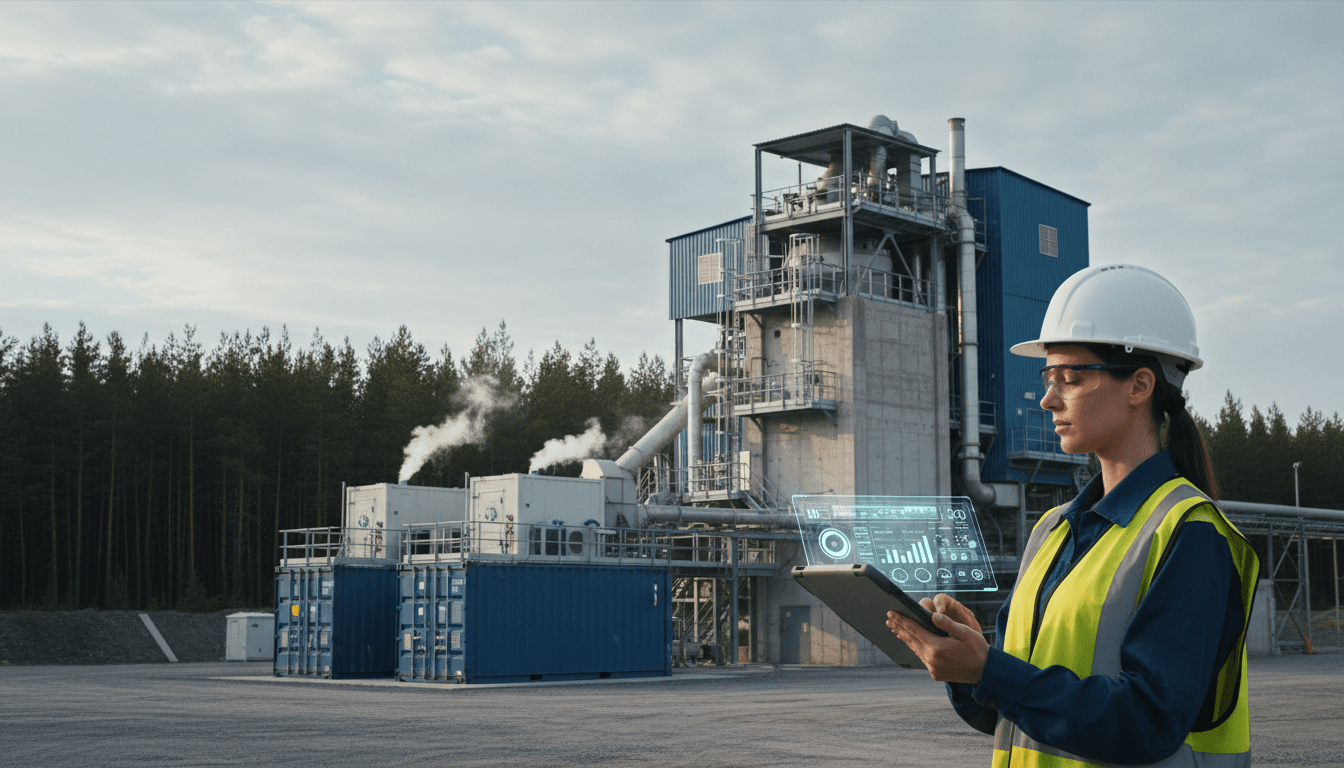
The Eagle Mine example in the article isn’t classic heap bioleaching. Allonnia is testing a fermentation-derived broth inside shipping containers at the mine’s mill. The broth is mixed with concentrated ore to capture impurities so the mine can keep producing nickel from lower-quality material.
That “containerized bio-process” detail matters because it hints at scalability: standardized modules, repeatable conditions, and easier monitoring.
Meanwhile, other companies are pushing rare earth element (REE) extraction:
- Alta Resource Technologies is engineering microbes to make proteins that can separate REEs (raised $28 million, per the article).
- REEgen uses organic acids produced by an engineered strain of Gluconobacter oxydans to extract REEs from ore and waste streams like recycling slag, coal ash, and old electronics.
I’m biased toward these fermentation-product approaches (proteins, organic acids, broths) for near-term adoption because you get many benefits of biology without asking an engineered organism to survive a harsh industrial environment.
The “waste is ore” opportunity is bigger than it sounds
Answer first: AI + biotech can turn mining waste and industrial byproducts into viable feedstock, which reduces permitting pressure and improves sustainability.
If you can economically recover metals from:
- tailings piles
- coal ash
- e-waste streams
- recycling slag
…you don’t just add supply. You also reduce environmental liabilities.
AI helps here by sorting and characterizing feedstocks (computer vision + spectroscopy + predictive models), then routing materials to the best process path.
What small businesses can learn (and post) from AI-powered biomining
Answer first: This story is a social media content goldmine for US small businesses because it connects AI to real-world outcomes—cost, resilience, and domestic supply.
If you’re in the Small Business Social Media USA audience, you may not sell to mines. But you can still benefit from the narrative:
- It’s concrete: shipping containers at a US nickel mine beats abstract “AI transformation” posts.
- It’s timely: February 2026 is packed with conversations about AI infrastructure, electrification, and US manufacturing.
- It supports lead generation: buyers respond to posts that show operational understanding, not just branding.
Social media content angles that actually generate leads
Answer first: The best-performing posts tie a specific innovation to a measurable business outcome.
Here are angles you can adapt for LinkedIn, Instagram, and YouTube Shorts:
-
“AI isn’t only software” post
- Hook: data centers increase metal demand
- Point: AI also optimizes physical processes like biomining
- CTA: “If you’re modernizing operations, start with measurement + models.”
-
Myth-bust: “Mining innovation takes decades”
- Use examples from the article: Endolith funding, Rio Tinto’s Nuton demonstration, modular container pilots
- Add your stance: “It’s slow, but it’s speeding up where data is clean.”
-
Before/after process visualization
- Simple diagram carousel: passive heap → instrumented heap → AI-optimized dosing
- Add a checklist slide (see below)
-
Local procurement and jobs lens
- “Extending the life of existing US sites matters for regional supply chains.”
A practical checklist: how to talk about AI credibly
Use this when writing posts so you don’t sound like you’re repeating buzzwords:
- Name the system: heap, reactor, mill, tailings pond, sorting line
- Name the signals: pH, flow, temp, oxidation-reduction, assay results
- Name the model goal: maximize recovery %, reduce reagent cost, shorten time-to-yield
- Name the risk: contamination, variability, scale-up failure
- Name the metric you’d report weekly
Even if you’re “just” a marketing firm, this level of specificity boosts trust fast.
The adoption bottleneck: data, timelines, and proof
Answer first: Biomining will scale in the US when companies prove repeatability, not when they show one strong pilot.
The article includes a tension that’s worth saying out loud: mining wants lots of data, biotech startups want fast returns, and both can be right.
My take: AI is the bridge, but only if it’s paired with instrumentation and process discipline. A machine learning model trained on noisy, inconsistent sampling will produce confident nonsense.
For vendors in this ecosystem—sensor companies, analytics consultancies, cloud providers, and yes, small marketing agencies—the opportunity is to help operators build the “data spine” that makes new processes bankable.
What to do next (even if you’re not in mining)
The US cleantech supply chain is being rebuilt in real time. Microbes extracting metals from low-grade ore, and AI optimizing those microbes, is part of that rebuild.
If you run a small business, here’s the play: use these real industrial stories to anchor your social media strategy. Practical, specific posts outperform vague “AI future” content—especially on LinkedIn, where B2B buyers are allergic to fluff.
The question I keep coming back to is simple: as AI demand drives more infrastructure, will we scale materials supply responsibly enough to keep costs stable—and will your business be visible in the conversations where those buying decisions start?
Visual suggestion: Use the article’s imagery as inspiration—lab scientists testing ore columns or a mining heap operation—to make the “AI meets biology” story feel real.