Global grid-scale battery storage grew 29% year-on-year in October, led by China. Here’s what that means for utilities, developers, and green tech investors.
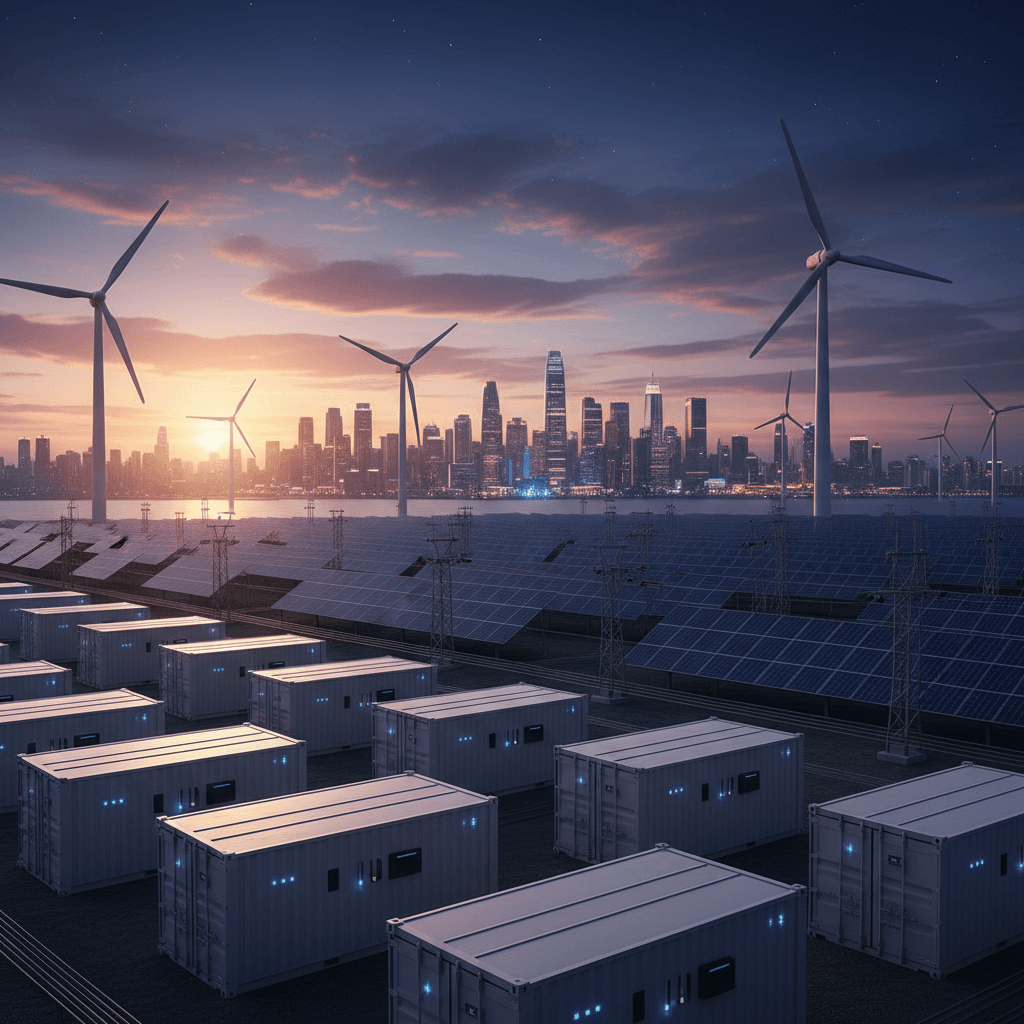
Most companies looking at green technology focus on solar and wind capacity and quietly ignore the unglamorous bit in the middle: storage. That’s a mistake.
In October 2025, 4.5GW / 12.7GWh of grid-scale battery energy storage systems (BESS) were commissioned worldwide—29% more than in October 2024. Nearly 70% of that capacity was in China alone. For anyone working in clean energy, infrastructure, or climate-focused investing, that’s not just a headline. It’s a signal.
Here’s the thing about this BESS boom: it’s not just about adding more batteries. It’s about who’s moving fastest, which technologies are gaining ground, and how data and AI are quietly reshaping how these assets are planned, operated, and monetised.
This post breaks down what China’s lead in BESS deployments really means, how it fits into the broader green technology transition, and—most importantly—what practical moves you can make now if you’re a utility, developer, corporate energy buyer, or investor.
1. The October numbers: China is setting the pace
The headline is straightforward: global grid-scale BESS deployments increased 29% year-on-year in October, reaching 4.5GW / 12.7GWh of new capacity. According to Rho Motion’s Battery Energy Stationary Storage Monthly Database, almost 2,988MW / 8,786MWh of that came from China.
That means:
- Roughly two-thirds of all new grid-scale storage added in October was in a single country.
- Cumulative deployments for January–October 2025 hit 156GWh, up 39% year-on-year.
- The month before, deployments were down 19%, largely because China had a quieter month—highlighting just how much the global curve depends on Chinese activity.
The reality? Global BESS growth is strong, but it’s also asymmetric. If you’re operating in Europe, North America, Australia, or the Middle East, you’re not competing in a gentle, steady market. You’re competing against a system that’s scaling at speed in China and dragging technology costs and expectations with it.
This matters because grid-scale storage is now the backbone technology that lets solar, wind, and other green technologies operate as a reliable system, not just a collection of assets. Whoever scales storage fastest shapes future power markets.
2. Why China is racing ahead on battery storage
China’s dominance in October isn’t a one-off spike; it’s the product of deliberate industrial and energy policy.
Three drivers stand out:
-
Integrated supply chains
China already leads in lithium-ion manufacturing, raw material processing, and component supply. When that capacity turns toward stationary storage, project timelines collapse and costs fall quickly. -
Policy and grid planning
Provincial governments and grid operators are mandating storage next to large solar and wind plants, often with minimum storage durations (2–4 hours). That creates a stable pipeline developers and manufacturers can plan around. -
Technology diversity
October’s deployments weren’t just lithium-ion. One of the major projects was a large vanadium redox flow battery (VRFB)—part of a series of grid-forming flow projects in China.
Flow batteries are especially relevant for green technology because they:
- Offer longer lifetimes (20+ years of cycling) with lower degradation.
- Can be sized flexibly: power (MW) and energy (MWh) can be scaled somewhat independently.
- Use electrolyte-based storage, which can be easier to refurbish or repurpose.
When a market this large starts commissioning grid-forming flow batteries, it sends a clear signal: the storage stack of the 2030s won’t be lithium-ion only.
For developers and utilities outside China, the takeaway is blunt: pricing, performance benchmarks, and project timelines are being reset elsewhere, and you’ll feel that pressure—on offtake contracts, grid services markets, and customer expectations.
3. How global markets are responding: US, Europe, Australia and beyond
China might be the volume leader, but it’s not the only story. Grid-scale BESS is accelerating across multiple regions, each with its own flavour.
Europe: from pilots to pipelines
Germany, Italy, the Netherlands, Bulgaria and others have shifted from small standalone projects to serious pipelines in the hundreds of megawatts. European projects often focus on:
- Frequency control and ancillary services
- Arbitrage between high-renewables hours and evening peaks
- Co-location with solar and, increasingly, with data centres
Revenue stacking is the default strategy, not the exception. That raises the bar on software, forecasting, and AI-driven optimisation. A 100MW battery is only as valuable as its bidding strategy.
Australia: storage at the heart of a “green superpower” vision
Australia is quietly turning into a live test bed for hybrid green technology systems:
- Massive solar-plus-storage projects in South Australia and Queensland
- Mining sites with hybrid systems: solar, wind, gas peakers, and large BESS assets
- Long-duration and grid-forming batteries integrated directly into weak parts of the grid
Projects like Australia’s large Mannum BESS (highlighted as one of the biggest commissioned outside China in October) show what a mature, storage-centric grid design looks like. Energy storage there isn’t an add-on; it’s structural.
Americas, Middle East & Africa: diverse but converging
From Texas and Arizona to Gulf states and South Africa, the pattern is similar:
- High solar penetration creates steep evening ramps.
- Grids need fast, flexible capacity that can respond in seconds, not minutes.
- Battery storage is increasingly cheaper and faster to deploy than gas peakers.
The shape of demand differs, but the underlying logic doesn’t: without large-scale storage, high shares of renewables hit a ceiling.
4. Where AI fits in: turning batteries into smart grid assets
The green technology series on this blog focuses heavily on AI for a reason: energy storage without intelligence is just expensive hardware.
To make a 12.7GWh monthly deployment wave profitable and climate-effective, operators are leaning on AI in four key ways:
4.1. Revenue optimisation and market bidding
Modern BESS assets participate simultaneously in:
- Energy arbitrage (buy low, sell high)
- Frequency response and ancillary services
- Capacity markets or resource adequacy schemes
AI-driven optimisation platforms forecast:
- Short-term prices (minutes to days ahead)
- Grid constraints and congestion patterns
- Battery degradation impacts under different operating strategies
They then generate automated bidding strategies that can materially increase project revenues. I’ve seen models that boost annual returns by 10–30% compared to static rule-based dispatch, simply by learning local market patterns.
4.2. Predictive maintenance and asset health
Batteries degrade. That’s not a bug; it’s physics. But unmanaged degradation kills project economics.
AI models trained on operational data can:
- Detect early signs of cell imbalance or overheating
- Recommend modified dispatch patterns to extend useful life
- Optimise cooling, charge rates, and depth-of-discharge in real time
This is where VRFB and other long-duration chemistries become even more compelling: combine inherently durable chemistry with smart controls and you get assets that behave more like long-lived infrastructure than consumables.
4.3. Grid-level planning and system design
Grid operators are starting to use AI not just for operations but for planning:
- Where should storage be placed to relieve congestion most effectively?
- How much storage is needed to safely retire specific fossil assets?
- What mix of lithium-ion, flow, and other storage types provides the most resilient system?
Instead of one-off planning studies, AI enables iterative, scenario-based planning that updates as new projects, loads (like data centres and EVs), and policies emerge.
4.4. Carbon-aware dispatch
For anyone serious about sustainability metrics, not just cost, AI enables carbon-aware optimisation:
- Charge when grid carbon intensity is low (e.g., midday solar peaks)
- Discharge when fossil plants would otherwise ramp up
That transforms batteries from generic flexibility tools into targeted emissions-reduction assets, driving real progress toward corporate net-zero goals.
5. What this means for utilities, developers and investors
If you’re working in energy, infrastructure, heavy industry, or climate tech, October’s deployment jump—and China’s share of it—should trigger some concrete actions.
For utilities and grid operators
Treat storage as core grid infrastructure, not a side project.
Practical steps:
- Integrate storage into resource planning as a default part of capacity expansion, not a niche category.
- Require or strongly incentivise grid-forming capabilities in new BESS procurements.
- Invest in or partner on AI-driven control platforms; a 200MW battery run badly is more expensive than a 100MW battery run well.
For developers and IPPs
Most developers underestimate how quickly expectations around duration, flexibility, and software sophistication are rising.
Consider:
- Designing projects from day one with multi-service revenue stacking in mind.
- Evaluating whether longer-duration chemistries (like flow batteries) make sense for certain sites, especially where curtailment is chronic.
- Building in data infrastructure (sensors, high-frequency telemetry, robust SCADA) so you can actually use advanced optimisation later, not bolt it on as a fragile afterthought.
For corporates and large energy users
If you’re running data centres, manufacturing plants, or large campuses, grid-scale storage isn’t just a utility concern anymore.
Practical moves:
- Explore behind-the-meter BESS paired with solar or PPAs to manage demand charges, blackout risk, and carbon intensity.
- Insist that your offtake contracts and green PPAs include storage-backed delivery rather than generic “100% renewable on an annual basis” claims.
- Use AI-based energy management systems that factor in carbon signals, grid prices, and your own operational constraints.
For investors and financiers
The data is clear: 156GWh of deployments in ten months, +39% year-on-year isn’t a niche market; it’s a core infrastructure growth story.
Consider:
- Developing specialised investment theses for battery assets, not just folding them into generic renewable funds.
- Pricing in software and operational excellence as value drivers, not overhead. A technically similar project with superior AI optimisation is a different asset class.
- Looking beyond lithium-only portfolios and stress-testing exposure to technology shifts (e.g., flow batteries, thermal storage, hydrogen hybrids).
6. How this fits into the broader green technology shift
Battery storage is often framed as a support act to solar and wind. That framing is outdated.
When you combine:
- Mass manufacturing and deployment muscle (as we’re seeing in China),
- Diverse storage chemistries (lithium-ion, flow, thermal), and
- AI-driven optimisation and planning,
…you don’t just get a more flexible grid. You get the core infrastructure for electrifying transport, heating, industry, and even AI data centres themselves.
From a green technology perspective, BESS is the keystone:
- It stabilises high-renewable grids.
- It enables local resilience for communities and businesses.
- It turns intermittent resources into dispatchable, financeable assets.
As we head into 2026—when most analysts expect another step-change in storage deployments—the organisations that will win aren’t just those who buy more batteries. They’re the ones who treat storage as a strategic, AI-enabled platform, not a line item.
If your energy strategy still treats storage as optional, now’s the moment to rethink it. The global market clearly made its choice in October.
Where to go from here
If you’re:
- Planning new renewable capacity,
- Reviewing a net-zero roadmap, or
- Evaluating infrastructure investments,
start by asking one hard question: “Where does storage sit in this plan, and how smart is it?”
Because the gap between passive batteries and intelligent, integrated storage portfolios is exactly where the next wave of value—and impact—will be created.