Ontario’s 1,858MWh Skyview 2 project shows how grid-scale batteries, AI, and Indigenous partnerships are reshaping Canada’s clean energy future.
Canada’s New Mega-Battery Is a Preview of the Future Grid
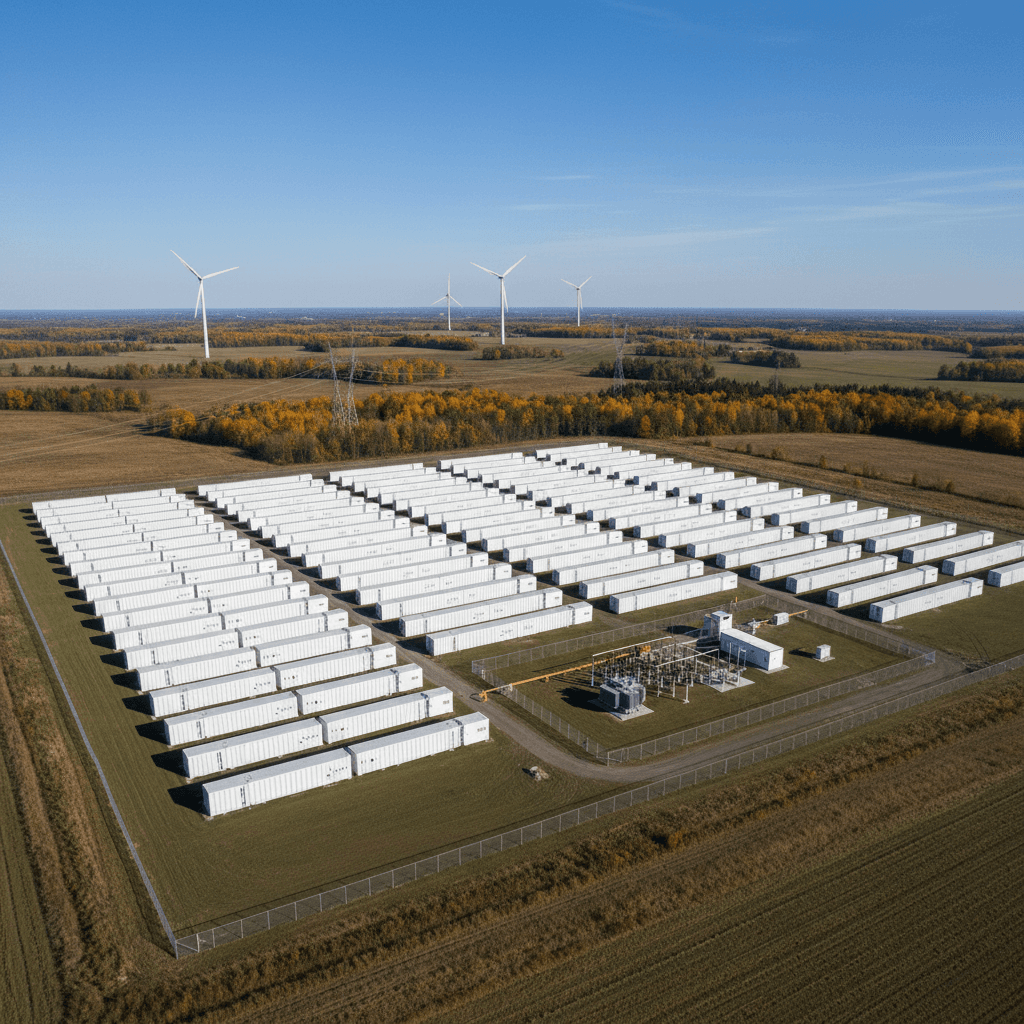
Ontario just started building a 1,858MWh battery energy storage system (BESS) called Skyview 2. When it comes online in 2027, it’s expected to be Canada’s largest battery storage project.
This matters because grid-scale batteries are quietly becoming the backbone of green technology. They turn variable solar and wind into reliable, on-demand power. They stabilize aging grids. And they’re one of the few tools that can support both the rise of AI data centres and deep decarbonisation without building endless gas peakers.
Skyview 2 isn’t just a big number on a press release. It shows how utility-scale storage, Indigenous partnerships, and advanced battery tech are starting to come together in real projects. If you work in energy, infrastructure, sustainability, or you’re just trying to understand where clean power is heading by 2030, this project is a useful blueprint.
In this Green Technology series post, I’ll break down what Skyview 2 actually is, why it’s a big deal for Ontario and Canada, and what businesses can learn from it if they want to plan around a storage-heavy, AI-era grid.
What Skyview 2 Actually Is: Numbers That Matter
Skyview 2 is a 411MW / up to 1,858MWh battery energy storage system being built in Edwardsburgh Cardinal, Ontario.
- Power (MW): 411MW – how much power the system can push into or pull from the grid at any moment.
- Energy (MWh): 1,560+MWh under contract, with 1,858MWh nameplate capacity – how long it can sustain that power.
At nameplate, that’s roughly:
- Enough energy to power 600,000+ homes for about 2–3 hours, depending on demand assumptions.
- More usefully for grid operators: enough to shift large blocks of solar/wind or flatten evening peaks across a regional system.
The project was awarded under Ontario’s Long-Term Reliability (LT1) procurement, which is the province’s main tool for bringing large-scale storage into the grid mix.
Key players:
- Developer: Potentia Renewables (part of Potentia Energy, a JV of Enel Green Power and INPEX)
- Partner: Algonquins of Pikwàkanagàn First Nation
- Technology & EPC: e-STORAGE, Canadian Solar’s storage arm
- Technology used: Around 390 units of SolBank 3.0 containerized BESS
Shipments of the SolBank systems are due to start in February 2026, with commercial operation targeted for Q2 2027.
The headline: Skyview 2 is big, bankable, and contracted for the long haul, with a 21‑year Long-Term Service Agreement (LTSA) – exactly the kind of profile that gives investors and policymakers confidence to scale this type of green technology.
Why This BESS Is a Big Deal for Ontario’s Clean Energy Future
Skyview 2 is being built now because Ontario’s demand forecast is getting serious. Provincial planning expects electricity demand to increase sharply through 2050, driven by EVs, building electrification, new industry, and power‑hungry AI and data centres.
Ontario’s Integrated Energy Plan leans hard on three things:
- More storage capacity to smooth out renewables and manage peaks.
- Transmission upgrades so storage can be placed where it does the most good.
- Flexible resources that can ramp quickly when nuclear or hydro can’t.
Storage sits at the center of all three.
Ontario is quietly becoming a storage leader
Canada isn’t usually the first name that comes up in energy storage conversations, but the numbers tell a different story regionally:
- Ontario currently has over two-thirds of Canada’s grid-connected storage, about 486MW.
- Alberta holds over a quarter, with around 190MW.
- In May 2025, Ontario more than doubled its operating storage when the Oneida Energy Storage project (250MW / 1,000MWh) went live.
Skyview 2 pushes that curve further, stacking on top of Oneida and a pipeline of LT1 projects.
For Ontario, that means:
- Lower reliance on gas peaker plants over time.
- More room to integrate additional wind and solar without risking reliability.
- The ability to better handle extremes – heatwaves, cold snaps, wildfire smoke, and other climate-related volatility.
For businesses, especially those with high, time-sensitive loads (manufacturing, logistics, AI/ML compute, data centres), it translates into a grid that’s better able to:
- Maintain uptime during stress events.
- Offer meaningful demand response and capacity contracts.
- Support on-site or nearby storage projects with clearer market rules.
The reality? Large BESS projects like Skyview 2 are now part of the base case for planning long-term operations in Ontario, not speculative tech for later.
The Technology Behind Skyview 2: SolBank 3.0 and Smart Storage
The tech story here is e-STORAGE’s SolBank 3.0 platform, which is providing about 390 BESS units as part of a turnkey EPC scope.
What SolBank brings to the table
SolBank 3.0 is a containerized, utility-scale lithium-ion battery system designed for grid applications like:
- Energy arbitrage (buy low, sell high on the power curve)
- Capacity and resource adequacy
- Frequency regulation and ancillary services
- Renewable smoothing and firming
Canadian Solar has been scaling hard on the storage side:
- e-STORAGE delivered a record 2.7GWh of BESS in Q3 2025, beating its 2.1–2.3GWh guidance.
- It’s targeting 30GWh of annual system production capacity by end of 2025, up from 20GWh in March.
- Battery cell production capacity stays at 3GWh/year, so a lot of their role is integration, controls, and turnkey delivery.
That distinction matters. In green technology, the value isn’t only in the cell chemistry – it’s in how well the full system is engineered, monitored, and monetized.
Where AI fits into modern BESS projects
Even though Skyview 2’s announcement doesn’t shout about AI, sophisticated storage like this almost always relies on AI-driven or algorithmic control systems:
- Forecasting: Machine learning models predict load, prices, and renewable output.
- Optimization: AI schedules charge/discharge cycles to maximize revenue and minimize degradation.
- Asset health: Predictive analytics flag cell and module issues before they cascade into safety or performance problems.
If you’re a C&I or infrastructure player considering your own storage deployment, I’d argue the control software and data layer now matter as much as the battery hardware. Projects that treat BESS as “just a big battery” tend to underperform both technically and economically.
Partnership, Policy, and Business Models: Why This Project Works
Projects at this scale only move when policy, partnerships, and business models line up. Skyview 2 is a good example of that alignment.
Indigenous partnership as a core feature, not a side note
Skyview 2 is being developed in collaboration with the Algonquins of Pikwàkanagàn First Nation. That’s not just a checkbox on a permit application – it reflects a broader shift in how major projects are structured in Canada.
Done well, these partnerships can:
- Create long-term revenue streams for Indigenous communities.
- Bring local environmental and land-use knowledge into project design.
- Reduce social risk that can sink or delay projects for years.
If you’re planning grid-scale energy or infrastructure in Canada (or similarly structured jurisdictions), ignoring this dimension is no longer an option. Co-ownership, revenue-sharing, and genuine governance roles are becoming standard practice.
LT1 procurement and long-term contracts
Skyview 2 didn’t appear out of thin air – it came through Ontario’s Long-Term Reliability (LT1) storage procurement.
Why this model works:
- Long-term revenue visibility (20+ years) underpins financing.
- Clear technical and performance requirements create bankable project templates.
- Competition on price and capability pushes the market forward without one-off negotiations on every deal.
For developers and investors, the signal is strong: if you can meet LT1 requirements with credible tech and partners, you have a real path to scale.
For large energy users, the indirect benefit is a more liquid and predictable market for storage-backed services – capacity, flexibility, and potentially even bilateral arrangements tied to these assets.
What This Means for Businesses Planning Around a Greener Grid
Here’s the thing about a 1,858MWh battery project: it doesn’t just help the grid; it reshapes the opportunity set for everyone connected to it.
If you’re running or planning a business in Ontario (or a market following a similar path), here’s how to think about it.
1. Storage-backed reliability is becoming the norm
Large BESS fleets change how grid operators manage risk. That opens the door for:
- More flexible, performance-based power contracts.
- Stronger demand response programs that actually pay.
- Greater tolerance for high-density loads like AI data centres or advanced manufacturing, as long as they play nicely with grid signals.
ACTIONABLE MOVE: If your load profile is spiky or critical, start talking to your utility and potential aggregators about how you can participate in flexibility markets instead of just being a passive customer.
2. On-site and behind-the-meter storage pencils out faster
As grid-scale storage grows, market structures and software for storage optimization mature along with it. That makes it easier for behind‑the‑meter systems to:
- Share control and data with grid operators.
- Participate in multiple revenue streams (peak shaving, capacity, ancillary services).
- Use the same or similar control platforms as utility-scale assets.
ACTIONABLE MOVE: If you’re planning solar, EV charging, or a facility expansion for 2026–2030, run the numbers with and without a BESS. The gap is shrinking fast, especially where demand charges are high.
3. AI and green technology are now tightly linked
As AI workloads surge, energy planners are under pressure to add massive new load without wrecking climate targets. Projects like Skyview 2 are a direct answer: they provide the flexibility needed to connect more renewables and serve round-the-clock data centres.
The flip side is also true: AI is making storage more valuable by improving dispatch, forecasting, and asset life.
If you’re in tech, data, or cloud services in Canada, the message is clear: your long-term resilience and ESG story are going to depend on how well you align with storage- and renewables-driven grids.
Where Green Technology Goes Next – And How to Prepare
Skyview 2 is one project, but it signals where things are heading:
- Bigger, longer-duration batteries as standard grid assets.
- Integrated planning that treats storage, generation, and transmission as a coordinated system.
- AI-driven optimization as a non-negotiable part of storage economics.
- Community and Indigenous partnerships as a core ingredient, not an afterthought.
If you’re making strategic decisions today – on sites, operations, data centre locations, manufacturing, or fleet electrification – you should be assuming a future grid where projects like Skyview 2 are normal.
The smart move now is to treat large-scale storage not as a curiosity, but as infrastructure you can plan around and plug into.
Green technology isn’t just about cleaner electrons; it’s about using intelligence – human and artificial – to run those electrons through smarter systems. Canada’s largest BESS is a concrete example of that shift.
The real question is whether your next investment, facility, or product roadmap is designed for that kind of grid – or still assuming the old one.