Arizona’s 600MW Snowflake A solar-plus-storage hub shows how AI-optimized hybrid plants are becoming core grid infrastructure—not experiments.
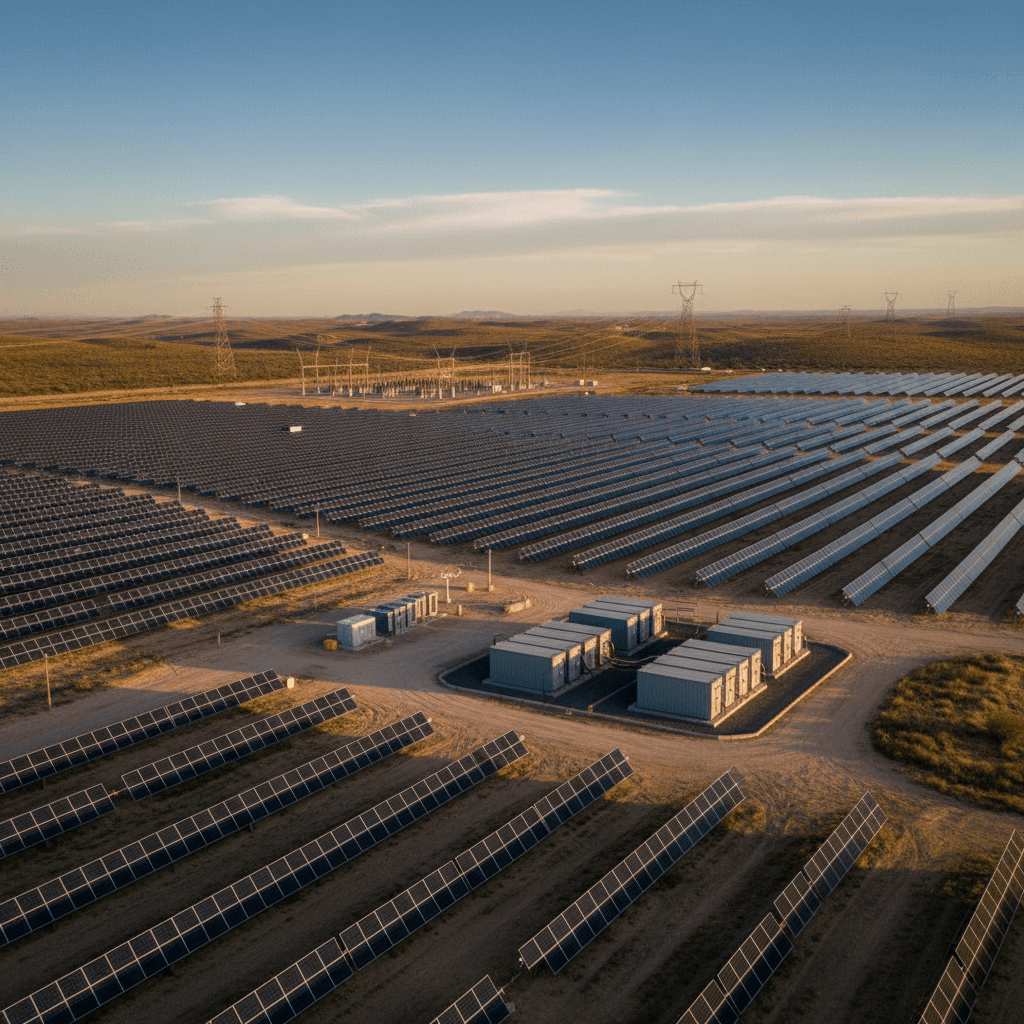
Most companies still treat energy storage as an add-on to solar. Snowflake A in Arizona blows that idea up.
A single project—600MW of solar PV paired with 1,900MWh of battery storage and backed by US$1.44 billion in financing—is quietly showing where green technology is really headed: large, AI-optimized clean power hubs that behave more like infrastructure than “projects.”
This matters because utilities, corporates, and cities trying to hit climate targets don’t just need more renewable megawatts. They need controllable clean power that behaves like a traditional plant but runs on sunlight and software.
In this piece, part of our Green Technology series, I’ll break down what Enlight Renewable Energy’s Snowflake A project actually is, why the financing structure matters, and how AI and digital tools will shape the way assets like this operate and earn money over the next decade.
Snowflake A at a glance: a new kind of clean power plant
Snowflake A is a hybrid solar-plus-storage plant under development near Holbrook, Arizona. The numbers are the headline:
- 600MW of solar PV (utility scale)
- 1,900MWh of battery energy storage
- US$1.44 billion in debt financing secured
- Target commercial operation: second half of 2027
- 20-year busbar PPA with Arizona Public Service (APS)
Enlight Renewable Energy, through its US arm Clēnera Holdings, has lined up commitments from six major international banks. After Snowflake A reaches its commercial operation date (COD), part of that debt converts into a term loan, and the rest is expected to be repaid from tax equity proceeds.
On the revenue side, Enlight expects in Snowflake A’s first full year:
- Roughly US$128 million in revenue
- Around US$104 million in EBITDA
Those aren’t “nice pilot” numbers. That’s full-scale infrastructure, designed to sit on the grid for decades.
Why the “hybrid” structure is the real story
The important shift isn’t just that Snowflake A is big. It’s that it combines:
- Zero-marginal-cost generation (solar PV)
- Dispatchable flexibility (battery storage)
- Long-term revenue certainty (20-year busbar PPA)
That’s exactly the recipe utilities and grid operators need as coal retires, gas becomes more volatile, and electrification loads jump—especially with data centers, EVs, and heat pumps surging across the US Southwest.
How the financing works – and why investors care
The Snowflake A deal shows how mature green technology has become in the eyes of big finance.
The capital stack in plain English
Here’s what Enlight has done, step by step:
- Secured US$1.44 billion in construction and term debt from a syndicate of major banks (including Wells Fargo, BNP Paribas, Crédit Agricole, MUFG, and others).
- Plans tax equity for 2026, taking advantage of US incentives under the Inflation Reduction Act.
- Structures post-COD cash flows so part of the loan becomes a term loan, while another part is repaid with tax equity proceeds.
- Locks in a 20-year busbar PPA with APS, stabilizing a large slice of revenue.
If you’re a CFO or investor watching green technology, here’s the key point:
Large-scale solar-plus-storage is now being financed and underwritten like traditional energy infrastructure, not “emerging tech.”
That shift unlocks cheaper capital and bigger projects. You can already see the pattern in Enlight’s broader Southwest portfolio:
- Quail Ranch (New Mexico): 128MW/400MWh solar-plus-storage with US$150 million in tax equity and a prior US$243 million construction financing.
- Roadrunner (Arizona): 290MWdc/940MWh with nearly US$340 million in tax equity partnerships and a total investment of about US$621 million.
Snowflake A is now the largest in Enlight’s portfolio to hit financial close—and it won’t stay the largest for long.
Why long-term PPAs still matter in a volatile grid
Some traders love merchant risk. Most asset owners don’t.
The 20-year busbar PPA with APS is a big reason Snowflake A got banked at this scale. For utilities, busbar PPAs simplify things:
- Power is purchased directly at the project’s connection point.
- There’s less complexity in congestion and delivery risk.
- It’s easier to model long-term costs for ratepayers.
For investors, this means:
- Predictable cash flows
- Lower perceived risk
- Better debt terms
In a grid that’s becoming more complex by the year, the finance side still loves simplicity. Snowflake A is complex under the hood—but the contractual wrapper is familiar.
Why 1,900MWh of storage changes how solar behaves
The 600MW of PV is impressive, but the 1,900MWh battery is what turns Snowflake A from “big solar farm” into a firm, flexible asset.
What can 1,900MWh actually do?
Think about it this way:
- At a 475MW discharge rate, 1,900MWh can run for about 4 hours.
- That’s long enough to flatten the evening peak, shift midday solar into high-value evening prices, and provide fast reserves.
On a modern grid, that means the plant can:
- Shift energy from low-price midday hours to high-price evening demand.
- Provide ancillary services like frequency regulation and reserves.
- Firm solar output, making it much more “utility-friendly.”
In practice, Snowflake A won’t just be generating and dumping power. It will be optimizing every MWh across:
- Energy arbitrage (buy low / store / sell high)
- Capacity value
- Grid support services
That’s where AI and software step in.
The AI layer: from static asset to smart portfolio
Modern battery energy storage systems (BESS) are operated with algorithmic control platforms that:
- Forecast solar production using weather and irradiance data
- Predict demand and price curves based on historical and real-time data
- Decide when to charge, discharge, or hold
For a hybrid system like Snowflake A, an AI-powered energy management system can:
- Reduce curtailment by storing excess midday solar instead of wasting it
- Maximize revenue within PPA and grid constraints
- Extend asset life by optimizing state-of-charge windows and cycling behavior
This is where green technology really earns its name: large chunks of emissions are avoided not just by installing panels and batteries, but by letting intelligent software orchestrate them every 5 minutes.
The bigger vision: Arizona’s Snowflake complex and beyond
Snowflake A is just the first phase. Enlight’s planning a second, larger phase within what it calls the Snowflake complex.
Why the 1GW interconnection is strategic
The site has a 1GW grid interconnection, which is one of the scarcest resources in US power development right now. Enlight’s second phase, listed in its “Advanced Development Portfolio,” is designed to lean on that interconnection to:
- Share infrastructure (substations, grid tie-ins, site roads, O&M facilities)
- Cut per-MW balance-of-plant and interconnection costs
- Speed up time-to-market for additional capacity
If you’re planning a portfolio strategy, this is the playbook:
- Secure a strong interconnection early.
- Phase your buildout across multiple projects.
- Standardize your technical and digital stack (inverters, BESS, EMS, SCADA).
- Use shared data and AI models across the whole complex.
The more projects run on a similar platform, the better your algorithms get—and the more predictable your returns become.
How this fits the US Southwest clean energy story
Enlight’s US footprint—Snowflake A, Roadrunner, Quail Ranch—lines up almost perfectly with where:
- Solar irradiance is high
- Demand is growing fast
- Data centers and industrial loads are arriving
- Transmission constraints are biting
For utilities and large buyers in the Southwest, hybrid projects like these are going to be the backbone of:
- 24/7 clean power procurement
- Grid reliability as fossil plants retire
- Electrification of transport and industry without spiking emissions
The story here isn’t one project. It’s a new normal where clean generation and storage come as a package.
What this means for utilities, corporates, and cities
If you’re not directly in the project finance world, why should you care about a 600MW/1,900MWh project in Arizona?
Because it quietly resets expectations for what’s possible.
For utilities
Utilities can now:
- Treat solar-plus-storage as dispatchable capacity, not just “variable renewables.”
- Use AI-driven control to support grid stability while meeting regulatory clean energy mandates.
- Structure long-term PPAs that balance price certainty with the flexibility to call on storage when it’s most valuable.
The smart utilities will partner early on operational analytics and data sharing, not just on PPA terms.
For corporates and large energy buyers
If your sustainability team is chasing 24/7 carbon-free power, projects like Snowflake A are the real tools, not just marketing slides.
You can:
- Bundle procurement: work with utilities (like APS or AEPCO in Enlight’s other deals) to align corporate clean energy goals with new hybrid capacity.
- Use contract structures that value flexibility—capacity payments, shape premiums, or storage-specific rights.
- Push for granular carbon accounting, where time-matched clean energy from hybrid projects earns a premium over generic RECs.
For cities and regions
Regions that host this kind of infrastructure get more than clean energy stats in a press release. They gain:
- Local jobs during construction and operations
- A more resilient grid in heat waves and extreme weather
- A better story for attracting data centers and clean industry
I’ve seen local governments underestimate how central grid reliability is to economic development. Hybrid solar-plus-storage is quickly becoming the ticket of entry for serious, energy-intensive investment.
Where green technology goes next – and how to get involved
Here’s the thing about Snowflake A: it’s a sign that green technology has left the “demonstration” era behind. Large, AI-optimized, solar-plus-storage hubs are now bankable, repeatable, and scalable.
If you’re working in energy, sustainability, or infrastructure, here are concrete ways to act on this trend:
- Benchmark your plans against hybrid projects. If your roadmap is still “solar now, storage later,” you’re leaving value on the table.
- Build digital into your RFPs. Don’t just ask for MW and MWh. Ask how assets will be optimized, what data you’ll receive, and how AI will be used to manage risk and performance.
- Think portfolio, not project. The real efficiency shows up when multiple hybrid assets share interconnections, designs, and software.
Snowflake A won’t solve the energy transition on its own. But it’s a clear signal of where serious capital, utilities, and technology providers are going: large-scale clean energy hubs that blend renewables, storage, and intelligence.
The next step is simple: if your organization depends on power—meaning every organization—this is the model you should be planning around. The companies that learn to procure, operate, and integrate hybrid green technology projects now will be the ones dictating terms later.