AI weather balloons are quietly transforming climate risk, renewable energy, and resilience planning by filling huge data gaps and boosting forecast accuracy.
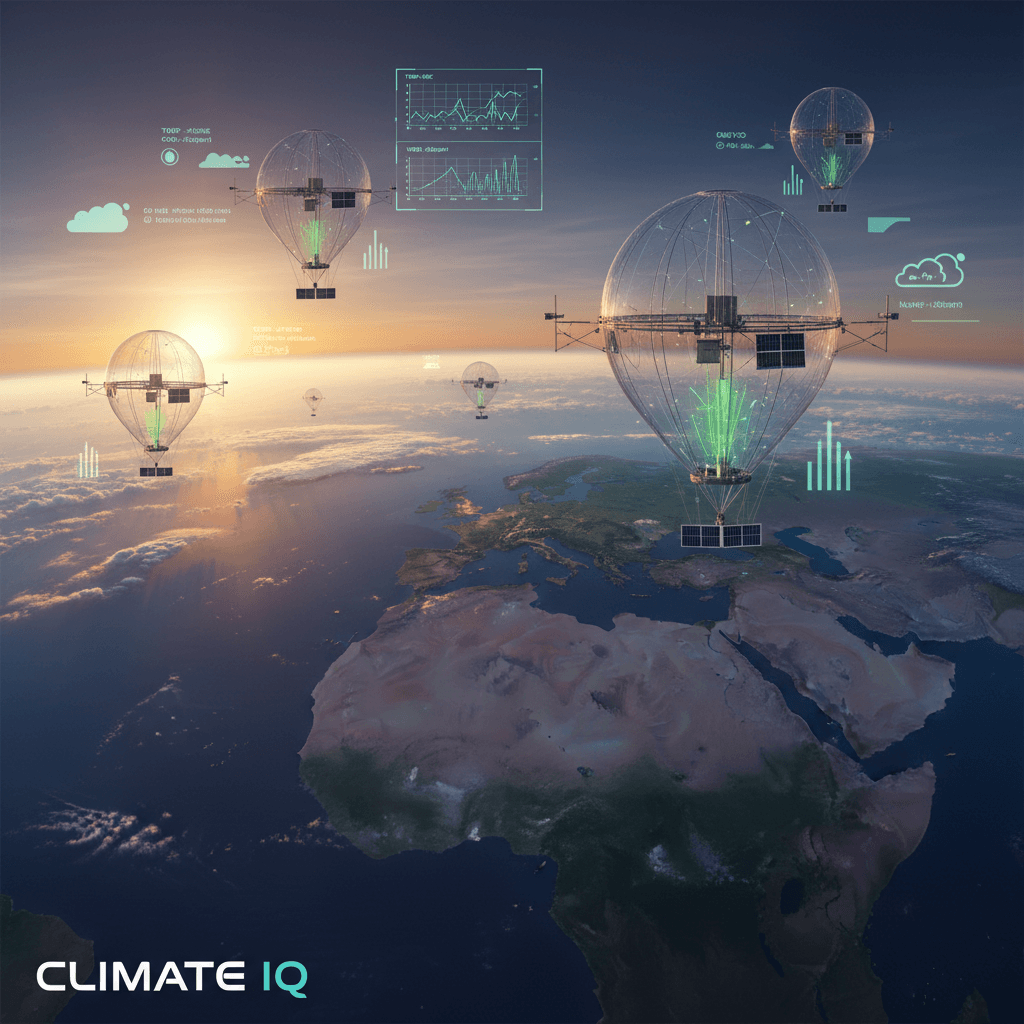
Most companies planning for climate risk still rely on weather data that misses 80–85% of the atmosphere. That blind spot isn’t just a technical detail; it’s the difference between a near miss and a $34 billion disaster like Hurricane Milton.
Hurricane Milton in October 2024 intensified so fast that forecasters were caught off guard. Communities in its path had less time to prepare, and the storm went on to kill 15 people and cause tens of billions in damage across Florida. The science didn’t fail. The data did.
This matters because accurate, timely forecasts are now a core part of green technology. If you’re running wind farms, solar portfolios, smart grids, or climate-resilient infrastructure, your returns live and die on how well you can see the weather coming.
In this post, I’ll walk through how WindBorne Systems built what’s arguably the most accurate AI weather-forecasting system in the world—and why it’s a big deal for clean energy, climate adaptation, and any business that wants to operate sustainably in a volatile climate.
From 2‑Hour Balloons to a “Planetary Nervous System”
The core idea is simple: better data in, better forecasts out. Traditional weather balloons rise, burst within a couple of hours, and fall back down. They give you a single vertical profile over land, mostly near cities and airports. That covers only about 15% of the globe.
WindBorne flipped that model.
They designed Global Sounding Balloons (GSBs) that:
- Stay aloft for 50+ days (and have reached 104 days)
- Navigate by “surfing” different wind layers
- Communicate via satellite
- Carry sensors for temperature, pressure, humidity, and wind
Instead of a quick up-and-down snapshot, you get weeks of continuous in situ data over oceans, deserts, polar regions—exactly where extreme weather often starts and where traditional observations are weakest.
John Dean, WindBorne’s CEO, describes the vision as a “planetary nervous system”: thousands of autonomous sensors feeding a central AI “brain” (their model, WeatherMesh) that constantly updates a live picture of Earth’s atmosphere.
For green technology, that’s not just poetic. It’s an operational advantage:
- Wind and solar portfolios get far more reliable production forecasts
- Grid operators can plan around heatwaves, storms, and low-wind events hours or days earlier
- Agriculture and water managers can anticipate droughts and heavy rainfall with better precision
The reality? Most sustainability strategies quietly assume that tomorrow’s weather will be “about right.” Systems like this start to remove that guesswork.
How AI Forecasting Beats Traditional Weather Models
Traditional global weather forecasts rely on physics-based numerical models. In the US, that’s the Global Forecast System (GFS); in Europe, ECMWF runs its own flagship model. They:
- Ingest data from satellites, ground stations, radar, and short-lived balloons
- Assimilate new observations into a giant 3D picture of the atmosphere
- Run complex fluid dynamics equations on supercomputers, four times a day
These models are still essential, but they’re constrained by two things:
- Sparse data in critical regions (oceans, polar regions, remote land)
- Massive compute cost, limiting how often and how finely they can update
Over the last few years, AI has changed the game. Models like Huawei’s Pangu-Weather and Google DeepMind’s GraphCast/GenCast showed that transformer-based neural networks can match or surpass physics-based models while running faster and cheaper.
WindBorne’s twist is that it marries dense, unique data with a lean, purpose-built AI model.
Inside WeatherMesh: A Transformer for the Planet
WeatherMesh uses the same architectural family as large language models—transformers—but tuned for fluid dynamics instead of text.
The pipeline looks like this:
- Encoder – Compresses raw weather data (temperature, pressure, wind, humidity) into a compact latent representation where patterns are easier to learn.
- Processor – Evolves that latent state forward in time, step by step. Run it once, you get a 10-minute forecast. Run it repeatedly, you get days ahead.
- Decoder – Expands the latent state back into physical variables: winds at different heights, surface temperature, precipitation, cloud cover, solar radiation, and more.
A few details stand out:
- It was trained on hundreds of terabytes of atmospheric data using a relatively modest cluster of RTX 4090 GPUs
- The hardware outlay was ~$100k, versus an estimated 4× that using cloud compute
- Training used ~1/10–1/15 of the compute that Big Tech models like GraphCast and Pangu required
Despite being smaller and cheaper to run, WeatherMesh has tested as more accurate than both physics-based models and other AI systems on standard benchmarks. That’s not a small incremental gain—it’s exactly the kind of efficiency edge green technology needs.
The Hurricane Milton Test: AI Meets Extreme Weather
The real proof came with Hurricane Milton.
As Milton exploded over the Atlantic in October 2024, WindBorne launched six GSBs from Mobile, Alabama, at a safe distance. Over the next 24 hours, the balloons navigated into the storm and did something no one had done before:
They released dropsondes from balloons instead of crewed aircraft.
Those dropsondes measured the vertical structure of the storm—temperature, wind speed, humidity, pressure—as they fell through the hurricane. This is exactly the data traditional forecasters get by flying “hurricane hunter” aircraft into the storm, at significant cost and risk.
Two big outcomes:
- The balloon-based dropsonde deployment proved you can sample extreme storms without putting pilots at risk
- When the new data was fed into WeatherMesh, the AI’s track forecasts for Milton were more accurate than the U.S. National Hurricane Center’s at the time
Because the mission was experimental, the results weren’t used operationally. But as a systems test, it was huge. It showed that:
- A distributed sensor network can adapt on the fly to extreme events
- AI can digest that data quickly enough to update forecasts in near real time
- There’s a path to safer, cheaper, and more precise storm forecasting
For climate adaptation, that matters. An extra 12–24 hours of accurate warning can be the difference between an orderly evacuation and chaos.
Why This Matters for Green Technology and Climate Strategy
If you work in green tech, you’re probably not planning balloon launches yourself. But you are relying on forecasts—directly or indirectly—for revenue, risk, and compliance.
Here’s where systems like WeatherMesh and the Atlas balloon constellation change the calculus.
1. Smarter Renewable Energy Operations
Wind and solar are weather businesses wearing energy clothes. Better forecasts mean:
- Wind farms can schedule maintenance during low-wind windows and bid more confidently into power markets
- Solar operators can anticipate cloud cover and irradiance swings to smooth output with storage
- Hybrid wind–solar–storage projects can use high-resolution (down to ~1 km) predictions to optimize dispatch
I’ve seen project finance models where a 2–3% improvement in forecast accuracy materially shifts the debt-service coverage ratio. That’s the difference between “nice project” and “bankable portfolio.”
2. Grid Stability in a Decarbonized System
As grids lean more on renewables, stability relies on knowing when and where generation and demand will spike.
High-frequency forecasts (WeatherMesh updates can be produced every 10 minutes) help transmission operators:
- Anticipate ramp events from storms, heatwaves, or calm conditions
- Manage congestion on key lines
- Plan demand response before a crisis erupts
Less emergency gas peaker usage, fewer forced outages—that’s decarbonization with fewer political headaches.
3. Climate-Resilient Infrastructure and Insurance
For infrastructure owners and insurers, climate risk is no longer theoretical. Better weather intelligence supports:
- Localized flood and storm surge risk modeling
- Dynamic pricing and underwriting for climate-exposed assets
- More targeted adaptation investments instead of blunt overbuilding
The more granular the forecast—say, down to 1 km instead of 25 km—the easier it is to justify very specific resilience upgrades. That’s both cheaper and greener than blanket hardening.
4. Agriculture and Water Management
Food systems are one of the largest levers in climate and biodiversity. High-quality forecasts help:
- Farmers time planting, irrigation, and harvesting around heat and rainfall windows
- Water authorities plan reservoir releases before extreme events
- Sustainable agriculture projects reduce waste and crop loss
If you care about emissions from food waste and inefficient irrigation, weather accuracy is a surprisingly practical tool.
Under the Hood: Why WindBorne’s Data Matters So Much
Everyone building AI weather models trains on similar historical datasets. ERA5, for example, is a widely used reanalysis product with decades of global weather records at about 25 km resolution.
WindBorne does use ERA5, but that’s not the differentiator. The edge comes from massive, continuous in situ data from their own balloon fleet.
A few specifics that matter:
- Each GSB collects 30–50× more data than a conventional single-use balloon
- Atlas, their constellation, often has hundreds of balloons in the sky simultaneously
- They already collect more in situ data per day than the U.S. National Weather Service balloon network
To handle the messy reality of live data, they built U-Net–based adapters that translate up-to-the-minute observations and analyses into the same internal format WeatherMesh was trained on. That’s how they avoid the common AI pitfall where models perform well on curated historical data but degrade badly on live feeds.
The result: a system that’s accurate on benchmarks and robust in production.
The Road to 10,000 Balloons and What Comes Next
WindBorne’s roadmap is aggressive: by around 2028, they aim for ~10,000 GSBs in the air at any time, launched from roughly 30 global sites, with 300 launches per day.
If they pull that off, you’re looking at something close to continuous global coverage—from the remote Pacific to polar ice caps—with:
- Frequent AI forecasts at global scale
- On-demand high-resolution forecasts around assets that matter (ports, wind farms, cities)
- A feedback loop where better data → better forecasts → better flight paths → even better data
Crucially, this doesn’t replace physics-based models; it complements them. AI can run faster and cheaper, while physics engines enforce sanity during rare or extreme events. The hybrid approach is where I think most serious operators will land.
For the broader green technology ecosystem, this is the pattern to watch:
Distributed, low-impact sensing + efficient AI models = smarter, more resilient, less carbon-intensive systems.
Whether you’re managing renewables, agriculture, logistics, or insurance portfolios, that’s the direction to align with.
What This Means for Your Climate and Sustainability Strategy
If you’re responsible for sustainability, risk, or operations, here are practical moves to consider as AI weather forecasting matures:
-
Audit where weather risk really hits your P&L.
- Energy yield
- Logistics delays
- Asset downtime
- Flood/fire/storm losses
-
Map which decisions depend on 6–72 hour forecasts. These are prime candidates to benefit from higher-accuracy, higher-frequency AI predictions.
-
Ask your vendors hard questions about weather data.
- What models do they use?
- How often are forecasts updated?
- Do they incorporate AI models and nontraditional data sources?
-
Pilot advanced forecast data for one high-impact use case. For example, wind curtailment reduction on a single site, or outage prediction for one region.
I’ve found that the fastest wins usually come from small, well-scoped pilots tied to a clear financial metric—lost production, overtime costs, reserve usage—rather than grand “AI strategy” programs.
As extreme weather tightens its grip, the organizations that treat weather intelligence as core infrastructure—not a commodity widget—will have a real edge in keeping both emissions and costs down.
Hurricane Milton exposed how fragile our current forecasting infrastructure still is. But it also showed what’s possible when you combine autonomous green technology in the sky with focused AI on the ground.
The direction of travel is clear: a planet blanketed by clean, low-footprint sensors feeding models that turn raw weather chaos into actionable signal. For anyone serious about renewable energy, resilient cities, or sustainable industry, AI-powered weather forecasting isn’t a curiosity anymore—it’s becoming a foundational tool.
The next question is simple: where in your operations would a 10–30% improvement in forecast accuracy change how you design, invest, or protect?