AI and green tech are racing ahead, but copper supply is a hard limit. See how AI-guided microbes are unlocking cleaner copper for data centers and grids.
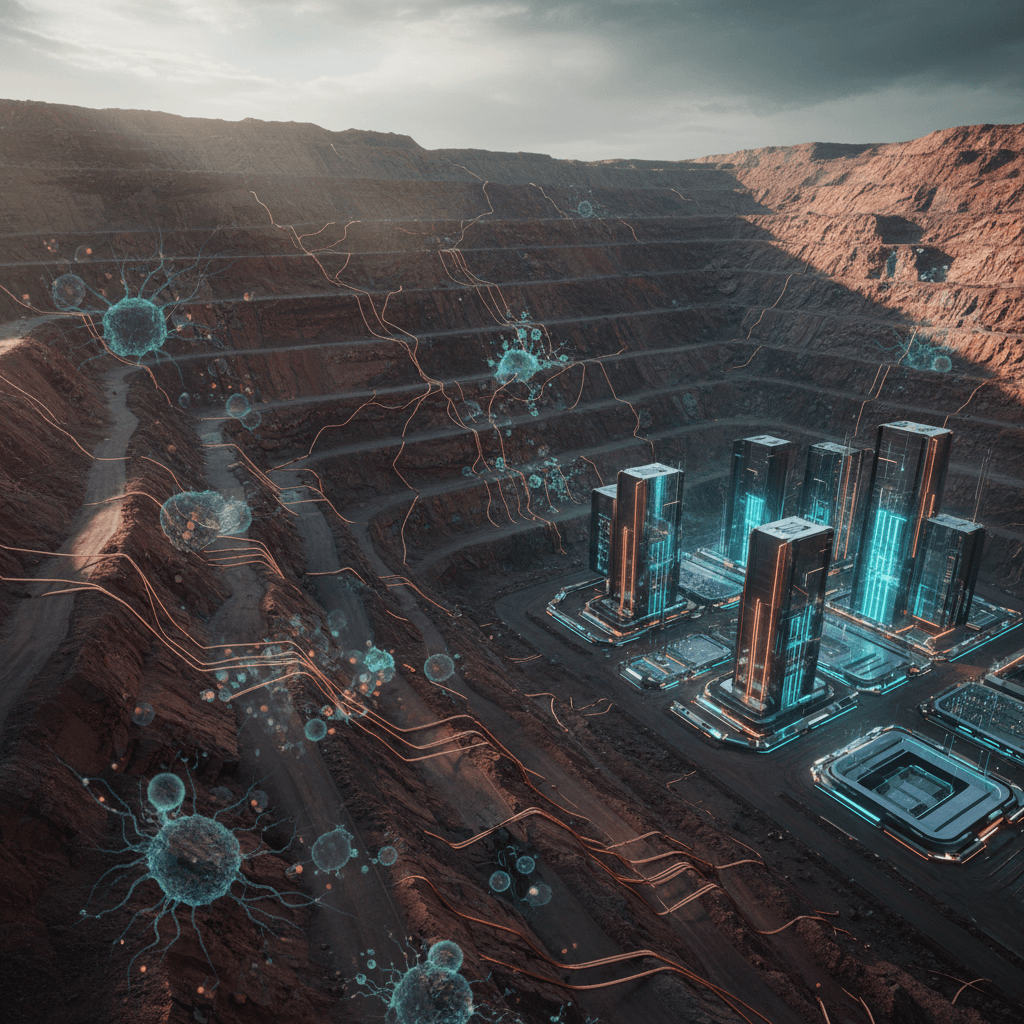
AI’s Copper Crisis: How Microbes Make Data Centers Greener
Most people tracking the AI boom are staring at GPU charts and power curves while ignoring the metal that quietly makes all of it possible: copper.
Here’s the uncomfortable fact: one large AI data center can require thousands of tonnes of copper, and global demand is racing toward ~37 million tonnes a year by 2031. At the same time, the easiest copper is already gone. What’s left is locked in low‑grade ores, complex minerals, and massive waste piles that conventional mining struggles to touch.
This matters for anyone betting on green technology, clean energy, or AI infrastructure. If copper supply stalls, everything from grid upgrades to renewable projects to GPU-packed data centers slows down. The good news is that a surprisingly elegant solution is emerging at the intersection of AI, microbes, and sustainable mining.
In this post, I’ll walk through why AI has a copper problem, how microbial mining (bioleaching) works, what companies like Endolith are actually doing in the field, and how this fits into a smarter, greener technology stack.
The Hidden Copper Cost of AI and Green Technology
AI infrastructure is copper-intensive because every part of the physical stack depends on it: power delivery, cooling systems, networking, transformers, and long-distance transmission.
A single hyperscale data center:
- Uses hundreds of kilometers of copper cabling
- Can consume thousands of tonnes of copper in wiring, transformers, and substations
- Demands new high-voltage lines and substations, which are themselves copper-heavy
Microsoft has reported data centers using ~27 tonnes of copper per megawatt. Multiply that by the global race to build AI capacity, and the scale becomes obvious.
Meanwhile, the green transition is pulling on the same copper thread:
- Wind turbines use 2–4 tonnes of copper per MW
- Solar farms require heavy copper for inverters and cabling
- EVs use 2–4x more copper than combustion cars
- Grid modernization for renewables and data centers is copper from end to end
So when utilities say they can’t deliver transformers for two or three years, or when transmission projects stall, that’s not just bureaucracy. Often, it’s a materials bottleneck, with copper sitting at the center.
The paradox: AI is helping drive the green technology transition, but both depend on a metal that’s getting harder and dirtier to produce.
Why Traditional Copper Mining Can’t Keep Up
Copper isn’t running out; easy copper is. The remaining resources are increasingly:
- Low-grade ores (less copper per tonne of rock)
- Complex minerals like chalcopyrite and enargite
- Massive waste piles and tailings from past mining operations
More than 70% of global copper reserves are trapped in ores that conventional methods don’t process efficiently.
How conventional copper mining works
Most mines follow a familiar pattern:
- Drill & blast: Break the rock and haul it out.
- Crush & grind: Turn ore into fine particles.
- Concentrate: Use flotation to separate copper minerals.
- Smelt & refine: Apply high temperatures, chemicals, or strong acids to extract pure copper.
The problems are clear:
- Energy-intensive: Crushing, grinding, and smelting are some of the most power-hungry steps in mining.
- High emissions: Smelters are major CO₂ and SO₂ sources.
- Water & chemical use: Large volumes of water and reagents are required.
- Waste: Tailings dams and waste piles store billions of tonnes of partially processed ore.
As ore quality declines, everything gets worse: more rock moved per tonne of copper, more energy burned, more emissions, more waste. That’s the opposite of what you want when you’re trying to build a greener, AI-powered energy system.
This is where microbes start to look very attractive.
Microbial Mining 101: How Bioleaching Pulls Copper from “Useless” Rock
Microbial mining, or bioleaching, uses naturally evolved microbes to accelerate the process of releasing metals from rock. Instead of brute force and extreme heat, you use biology and chemistry.
What the microbes actually do
Certain microbes:
- Attach to copper-bearing minerals such as chalcopyrite and enargite
- Oxidize iron and sulfur, which breaks down mineral structures
- Convert solid copper-bearing minerals into soluble copper ions that can be collected from solution
Endolith, founded by geoscientist Liz Dennett, focuses on precisely this: applying carefully chosen microbial communities to low-grade or complex ores and waste piles that traditional mining leaves behind.
Their microbes:
- Are field-deployable (they work in real leaching heaps, not just lab beakers)
- Thrive under harsh conditions in mine environments
- Recover more copper from challenging ores than traditional chemical-only leaching
Instead of harsh acids or only high-temperature smelting, these “microbial minions” accelerate a natural process that’s been happening in rocks for millions of years — but in a controlled, industrially useful way.
Why bioleaching is greener
Bioleaching has some clear advantages over conventional methods:
- Lower energy use: No massive smelters running at 1,200°C.
- Smaller environmental footprint: Fewer emissions and often less chemical intensity.
- Better resource utilization: Turns waste piles and low-grade deposits into productive resources.
- Scalability: Microbes reproduce; once you have the right communities, they can be grown on-site.
From a green technology perspective, this is a big deal. You’re not just mining more copper—you’re mining smarter copper, with lower embedded emissions per tonne.
Where AI Meets Microbes: Smarter Bioleaching at Scale
The clever twist here is that AI itself is being used to power this microbial approach, closing a loop between digital and physical infrastructure.
Endolith and similar players use machine learning to answer three hard questions:
- Which microbes will survive and thrive in a specific ore environment?
- How will they interact with each other and the rock chemistry over time?
- How should the microbial community be tuned or adjusted as conditions change?
Turning biology from trial-and-error into a system
Historically, bioleaching had a reputation problem, especially with tough ores like chalcopyrite:
- Processes were too slow.
- Recoveries were incomplete.
- Scaling from lab to heap leach pads was unreliable.
AI shifts this from guesswork to engineering:
- Genomic data from thousands of microbes is used to predict who can handle which rock chemistry.
- Metabolic models estimate how fast microbes will process specific mineral assemblages.
- Heap performance data trains models to improve strain selection and operating parameters.
In practice, that means:
- You can match the right microbe mix to the right ore, instead of hoping a generic cocktail works.
- You can design adaptive microbial communities that evolve with changing heap conditions.
- You get a feedback loop: ore data → AI model → microbial recipe → field performance → better model.
AI, in this case, isn’t just optimizing ad campaigns or routing trucks. It’s making biology a predictable, scalable tool for sustainable copper production—which then powers more AI.
Modular “biohatcheries” as infrastructure
Endolith’s approach includes modular biohatcheries: field units that grow and deliver tailored microbes to mine sites. These units:
- Deploy in days, not months or years
- Are tuned to local conditions (pH, temperature, mineralogy)
- Can be adjusted as data comes back from the heap
That modularity matters for operators who don’t want to rebuild entire process plants just to try a new technology. It makes microbial mining a bolt-on upgrade to existing copper operations instead of a risky moonshot.
Why This Matters for Data Center, Grid, and Sustainability Leaders
If you’re responsible for AI infrastructure, data centers, or grid planning, copper supply probably isn’t your favorite topic. But it should be on your risk register.
Here’s the thing about AI growth: it’s already hitting physical constraints.
- Data center projects delayed because transformers aren’t available.
- Utilities scrambling to add transmission capacity for new loads.
- Renewable projects competing with AI campuses for limited grid headroom.
All of these are, at least in part, copper problems in disguise.
What forward-looking organizations should do now
If you’re building or financing AI or green tech infrastructure, you don’t need to become a mining expert, but you should:
-
Stress test your plans against copper constraints
- Model project timelines assuming longer lead times for transformers and cables.
- Ask suppliers how they’re addressing raw material risks, not just manufacturing capacity.
-
Prioritize “low-embedded-carbon” copper where possible
- Encourage or require suppliers to disclose the carbon intensity of their copper sources.
- Treat lower-footprint copper as part of your sustainability strategy, not an afterthought.
-
Watch (and eventually partner with) new extraction players
- Companies working with bioleaching, tailings reprocessing, and circular copper recovery will shape next-decade availability.
- Early engagement can translate into more secure long-term sourcing.
-
Align internal narratives with physical reality
- When AI and sustainability roadmaps are presented, ask: What assumptions are we making about copper?
- Bring operations, sustainability, and infrastructure teams into the same conversation.
The organizations that do this well will avoid a lot of hidden delays and PR pain later. Those that ignore the materials side risk discovering that their “AI-first” or “green by 2030” goals are hostage to mines that take 10–15 years to permit and build.
Microbial Copper as Part of the Green Technology Stack
Within this Green Technology series, we’ve looked at AI for energy optimization, smart grids, and sustainable industry. Microbial copper recovery is another layer of the same story: aligning digital growth with physical sustainability.
Here’s why I think this approach deserves a seat at the table:
- It taps billions of tonnes of underused material in tailings and low-grade deposits.
- It reduces the carbon and pollution footprint per tonne of copper.
- It uses AI where it truly matters: tuning biological systems to match tough industrial conditions.
If the AI boom is going to stay credible as part of a climate solution, it can’t just optimize workloads and power usage effectiveness. It has to confront the embodied impacts of its own hardware — copper, steel, concrete, silicon. Microbial mining is one of the few tools that directly tackles that challenge for copper.
The reality? It’s simpler than it looks.
- No copper, no transformers.
- No transformers, no high-density data centers.
- No data centers, no large-scale AI.
So if we care about AI for clean energy, smart cities, and sustainable industry, we have to care about how we extract the metals that make that infrastructure possible.
Where This Goes Next
Over the next few years, expect three trends to converge:
- AI demand keeps climbing, pushing more grid and data center buildout.
- Copper grades keep falling, making traditional mining more expensive and carbon-heavy.
- Biology and AI keep improving, making targeted microbial approaches more competitive.
Companies that recognize this loop early will have a real advantage. They’ll design infrastructure plans that assume copper isn’t infinite, partner with cleaner extraction technologies, and treat materials strategy as part of their climate strategy—not separate from it.
If your organization is serious about AI and sustainability, now’s the moment to start asking harder questions about the metals beneath your roadmap. The next big leap in green technology might not come from a new chip or algorithm, but from tiny, ancient microbes quietly pulling copper out of rock.