Real-time audio deepfakes make voice phishing far more convincing. Learn practical controls to verify identity and protect payments, IT help desks, and ops.
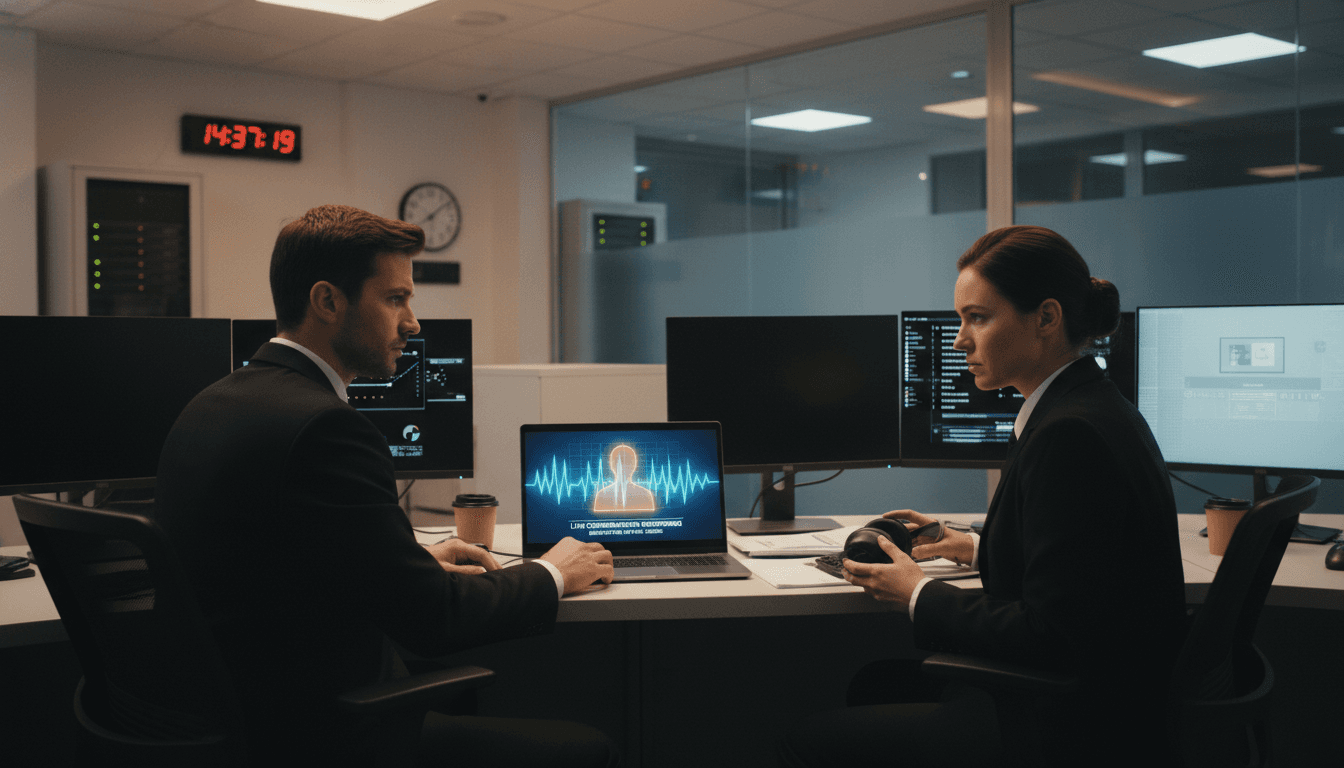
Real-Time Audio Deepfakes: How to Stay Ahead
A half-second delay used to be the “tell” that saved people. If the voice on the phone paused too long, sounded oddly stitched together, or repeated phrases like a chatbot, you had a chance to doubt what you were hearing.
That safety margin is shrinking fast. A September report from cybersecurity firm NCC Group showed a real-time audio deepfake setup that can imitate a target’s voice on live calls with no obvious latency—and it can run on affordable, readily available hardware. That’s not a lab curiosity. It’s a practical recipe for fraud.
This matters to anyone building or operating modern businesses—especially in industries being reshaped by AI and robotics. We’re automating customer support, onboarding, dispatch, clinical workflows, and remote operations. But the same automation that makes communication faster also creates new attack surfaces. If your security model assumes “a familiar voice equals trust,” it’s already outdated.
Real-time audio deepfakes are now an operational threat
Direct answer: Real-time audio deepfakes remove the biggest friction in voice scams—script constraints and generation delays—making voice phishing dramatically more convincing and scalable.
Older voice cloning attacks were usually asynchronous: a scammer generated clips in advance, then played them back. The problem was obvious once the conversation drifted off-script. The other option—generating audio “live”—often introduced delays long enough to raise suspicion.
NCC Group’s demonstration shows that hurdle is gone. Their consultant described a simple front end: click a start button and the voice changer runs. In tests (run with client consent), the firm combined voice cloning with familiar social engineering tactics such as caller ID spoofing, and the result was uncomfortable: targets believed the caller was who they claimed to be nearly every time.
Here’s the key shift: audio quality requirements are lower than people assume. The demonstration used poor input audio, yet the output still sounded believable. That means a scammer doesn’t need studio recordings; a few clips from meetings, webinars, podcasts, voice notes, or social media can be enough to train a model.
Why the “real-time” part changes everything
Direct answer: Real-time capability turns deepfake voice from “fake voicemail” into “interactive impersonation.”
Interactive voice impersonation enables:
- Dynamic responses when a victim asks unexpected questions
- Pressure tactics (“I’m in a meeting—do it now”) that rely on emotional timing
- Higher success rates because the attacker can steer the conversation like a real person
- Broader targeting beyond executives to anyone with payment, access, or authority
If you’ve invested in AI assistants, automated call routing, or robotics-enabled operations (think: field-service dispatch, warehouse coordination, telehealth devices), this is the security tax that comes with modern speed.
Why “trusting voice” is a bad security strategy
Direct answer: Voice is now an easily forged identifier, so workflows that treat voice as authentication will fail under realistic attacker conditions.
Most companies don’t explicitly say “we authenticate by voice,” but they do it in practice:
- A finance team hears the CEO’s voice and initiates a wire.
- A help desk hears a “known employee” and resets MFA.
- A clinic hears a “patient” and changes pharmacy or insurance details.
- A logistics coordinator hears a “dispatcher” and reroutes shipments.
The uncomfortable truth: humans are trained to trust familiar voices. We also over-weight urgency. Attackers know this. Real-time voice cloning weaponizes both.
Here’s a line I’ve found useful when talking to leadership teams: “If voice is enough to approve an action, then a recording is enough to steal it.”
The industries most exposed in 2026 planning cycles
Direct answer: Any sector with phone-based approvals, remote verification, or high-volume call centers should assume deepfake vishing will become routine.
High-risk areas include:
- Financial services: wire approvals, account recovery, brokerage transfers
- Healthcare: prescription changes, patient identity, benefits verification
- Retail and e-commerce: chargeback disputes, high-value shipment reroutes
- Manufacturing and logistics: vendor payments, dispatch instructions, access to OT support lines
- IT and cybersecurity operations: password resets, MFA enrollment changes, incident-response “requests”
As AI and robotics transform these industries, the operational default becomes “remote first.” Remote-first is efficient. It’s also impersonation-friendly.
How attackers combine deepfake voice with other tools
Direct answer: The most effective deepfake scams don’t rely on the voice alone—they combine it with caller ID spoofing, context harvesting, and process manipulation.
Real scams work because they feel plausible. Real-time audio deepfakes make plausibility cheap.
A typical attack chain looks like this:
- Recon: The attacker gathers voice samples and context (org charts, vendor names, travel schedules, recent projects).
- Pretext: They pick a scenario with a time constraint: payroll cutoff, end-of-quarter purchasing, holiday shipping, incident response.
- Channel control: Caller ID spoofing or compromised email threads make the call “fit” the narrative.
- Action request: The target is pushed toward a step that bypasses controls—manual override, MFA reset, urgent payment, changing bank details.
- Persistence: If stopped, the attacker iterates with another employee or a different department.
December is a particularly risky month for this. Teams are short-staffed, approvals get rushed, and year-end purchasing is common. The timing alone increases success rates.
One-liner to remember: Deepfake voice doesn’t create trust by itself—it borrows trust from your processes.
Real-time video deepfakes are close enough to matter
Direct answer: High-quality real-time video deepfakes aren’t fully mainstream yet, but video is already good enough to fool typical hiring and verification workflows.
Alongside audio, synthetic video has been surging on social platforms and in fraud cases. Recent model releases have made it easier to place a real person’s face into almost any environment. A consultant cited a case where a company was fooled during hiring and shipped a laptop to an address tied to the scam.
Video still has more “tells” than audio—mismatched facial emotion, odd eye movement, imperfect lip sync under stress. But that’s not reassuring.
Why? Because enterprise workflows often don’t require Hollywood realism. They require just enough believability to pass a recruiter screen, convince a help desk agent, or get through a vendor onboarding call.
If your organization treats a video call as definitive proof of identity, you’re setting yourself up for the next round of fraud.
What actually works: authentication that doesn’t depend on voice
Direct answer: The best defense against real-time audio deepfakes is to move from “recognition” to “verification,” using out-of-band and process-based controls.
You don’t need to panic-buy a “deepfake detection platform” tomorrow. Detection will help in some environments, but it’s an arms race.
The more reliable approach is boring, procedural, and effective: design workflows that remain safe even if the voice is fake.
1) Create “deepfake-safe” approval paths
Treat any voice call as untrusted input unless verified.
Practical controls:
- Out-of-band confirmation: Approve payments or sensitive changes only after confirmation in a second channel (secure app, ticketing system, or known corporate chat).
- Two-person integrity: Require two approvers for high-risk actions (wire, payroll changes, vendor bank updates).
- Hold periods for changes: Add a mandatory delay for first-time bank detail changes or new payee setup.
- Limit help desk power: Make MFA resets and password changes require additional proof (device-bound prompts, identity checks tied to HR systems).
2) Use shared secrets the right way (and rotate them)
A “baseball signal” sounds corny until it prevents a $250,000 wire.
What works better than a static secret is a rotating or contextual signal, such as:
- A one-time phrase stored in a password manager
- A challenge code generated inside a company portal
- A pre-agreed rule: “No financial actions triggered by phone—ever”
Static secrets get leaked. Rotating secrets reduce that risk.
3) Upgrade identity to device-bound verification
If you’re modernizing operations with AI systems, robotics platforms, or distributed teams, you’ll get more value from device-based identity than from voice biometrics.
Examples:
- FIDO2/security keys for admins and finance
- Device posture checks before sensitive approvals
- Number matching for MFA prompts (reduces “approve fatigue”)
4) Train teams on the new “tells” (without relying on them)
Training should focus on behaviors, not just audio artifacts.
Coaching points that stick:
- Urgency is a tactic. Treat urgency as a reason to slow down.
- Authority can be forged. Assume “CEO voice” is not proof.
- Process beats intuition. If the process says verify, verify—even if it feels awkward.
If you only train people to listen for robotic tone or glitches, you’ll lose. The audio will keep improving.
People also ask: what should we change first?
Direct answer: Start by protecting money movement and account recovery, then expand to operational controls.
If you’re prioritizing for Q1 2026 planning, here’s a sane sequence:
- Lock down vendor bank changes and wire workflows (two-person approval + out-of-band confirmation).
- Harden help desk identity verification (reduce phone-only resets).
- Create an “urgent request” policy (no exceptions for payments or access grants).
- Add tabletop exercises featuring real-time voice deepfake scenarios.
- Review executive and public-facing voice exposure (what’s posted publicly, recorded meetings, etc.).
This fits naturally into broader AI transformation programs: as you automate operations, also automate safeguards.
Where this fits in AI & robotics transformation
Direct answer: Real-time audio deepfakes are the shadow side of AI-enabled communication—proof that every automation layer needs an authentication layer.
In our “Artificial Intelligence & Robotics: Transforming Industries Worldwide” series, we often talk about speed: faster decisions, fewer manual steps, more autonomy. Real-time voice cloning shows the other side of that coin. When communication becomes software-driven, deception becomes software-driven too.
The organizations that handle this best won’t be the ones that ban AI. They’ll be the ones that redesign workflows so that AI-generated content—audio, video, text—can’t single-handedly trigger irreversible actions.
If you’re modernizing customer communications, rolling out AI agents, or integrating robotics into operations, take this as your prompt to run a simple audit: Where does a phone call still function as “proof”? Fix those points, and you’ll be ahead of the next wave of deepfake vishing.