People-centered AI robotics is about amplifying humans. Learn how MIT’s Daniela Rus applies physical intelligence across healthcare, logistics, and safety.
People-Centered AI Robots: Lessons From MIT’s Rus
A lot of robotics talk still frames automation as a replacement story: fewer people, more machines. Most companies get this wrong. The leaders who actually ship useful robots—especially in healthcare, logistics, and public safety—start with a different thesis: robots should expand what humans can do, not erase the human from the process.
That’s the through-line in the work of Daniela Rus, director of MIT’s Computer Science and Artificial Intelligence Laboratory (CSAIL) and a 2025 recipient of the IEEE Edison Medal for sustained leadership in modern robotics. Her phrase is blunt and memorable:
“I like to think of robotics as a way to give people superpowers.”
If you’re building (or buying) AI-powered robotics in 2026 planning cycles, this matters because the most expensive failures aren’t sensor problems or model problems. They’re product problems: robots designed without a realistic understanding of human workflows, safety, and trust.
This post is part of our “Artificial Intelligence & Robotics: Transforming Industries Worldwide” series, and it uses Rus’s “people-centered robots” approach as a practical lens. We’ll connect her research themes—soft robots, networked fleets, modular machines, and on-device AI—to real decisions businesses are making right now.
People-centered robotics is a design constraint, not a slogan
People-centered robotics means your robot is judged by the human capability it increases—measurably and safely. That sounds simple, but it forces hard tradeoffs.
Rus’s career story—moving from Communist Romania to the United States, then building labs at Dartmouth and MIT—underscores the point: constraints shape innovation. Early scarcity, limited fabrication resources, and real-world friction pushed her toward approaches that work outside ideal lab conditions, including early adoption of 3D printing for rapid robot prototyping.
What “superpowers” looks like in industry terms
When you translate “superpowers” into an operations dashboard, you’re usually aiming for one (or more) of these outcomes:
- Reach: access to places humans can’t safely go (collapsed buildings, inside the body, high heat)
- Precision: manipulation beyond typical human steadiness or endurance (micro-movements, consistent grasping)
- Scale: coordinated work across many tasks at once (warehouse fleets, inventory movement)
- Speed of decisions: perception + action loops that run continuously (collision avoidance, routing, detection)
The common thread is collaboration: a human sets goals, supervises, or performs judgment-heavy steps; the robot handles repeatable physical work or hazardous exposure.
The leadership angle companies miss
Rus often emphasizes mentoring and community (including IEEE). For a business audience, the analog is straightforward: robotics success depends on talent systems, not just tech. If you’re deploying AI robotics, you need operators, safety owners, maintenance techs, data/ML partners, and change management—all planned from day one.
Physical intelligence: why robotics isn’t “just AI with wheels”
Rus calls the convergence of AI and robotics physical intelligence—systems that understand dynamic environments, cope with unpredictability, and make decisions in real time.
Physical intelligence is AI that must live with physics. In a warehouse or a hospital corridor, the “edge cases” are the actual job: glare, clutter, uneven floors, fragile objects, humans doing unexpected things.
The real bottleneck: closed-loop reliability
If you’re evaluating AI-powered robotics vendors, ask how they manage the full loop:
- Perception (what’s happening?)
- Prediction (what happens next?)
- Planning (what should I do?)
- Control (do it safely, now)
- Recovery (what if it goes wrong?)
In practice, robots fail not because they can’t see, but because they can’t recover gracefully when the world surprises them. Rus’s focus on robots that can handle disturbances and adapt is exactly the business requirement: fewer stoppages, fewer escalations, fewer incidents.
Materials can replace computation
One of the most underrated ideas in Rus’s work is that the body of the robot can do part of the “thinking.” Soft robots can self-stabilize or conform to objects because their materials and geometry absorb complexity.
That reduces:
- Compute requirements (and sometimes cost)
- Tuning and calibration effort
- Risk of brittle behaviors in messy environments
If you’ve ever watched a rigid gripper fail on slightly irregular packaging, you’ve seen why this approach matters.
Healthcare robotics: soft machines that work inside the body
Healthcare is where “people-centered robots” stops being philosophical and becomes urgent. The stakes are safety, time, and outcomes.
A widely discussed prototype direction from Rus’s group involves ingestible, soft-bodied robots designed to retrieve foreign objects from the body—for example, button batteries swallowed by children, which can cause severe internal injury if not removed quickly.
Why ingestible robots are a big deal
The clever part isn’t just miniaturization. It’s system design:
- Origami-like folding so the device is swallowable
- Magnetic steering/control so clinicians can guide it
- Soft compliance so it interacts gently with tissue
- Biocompatible/digestible materials so it can be absorbed safely after completing its task
That combination points to a bigger healthcare trend: targeted, minimally invasive intervention supported by robotics and AI.
Business impact: where this goes beyond prototypes
Even if your organization isn’t building ingestible robots, the pattern is applicable:
- Design for constrained environments (inside the body = ultimate constraint)
- Put intelligence near the action (latency and safety matter)
- Engineer for retrieval and failure modes (what if it stalls, tears, or misses?)
For hospital innovation teams and medtech partners, a practical “next step” is to identify procedures where time-to-intervention is critical and manual approaches are highly variable. Those are prime candidates for robotics-assisted workflows.
Logistics and smart facilities: fleets that behave like one system
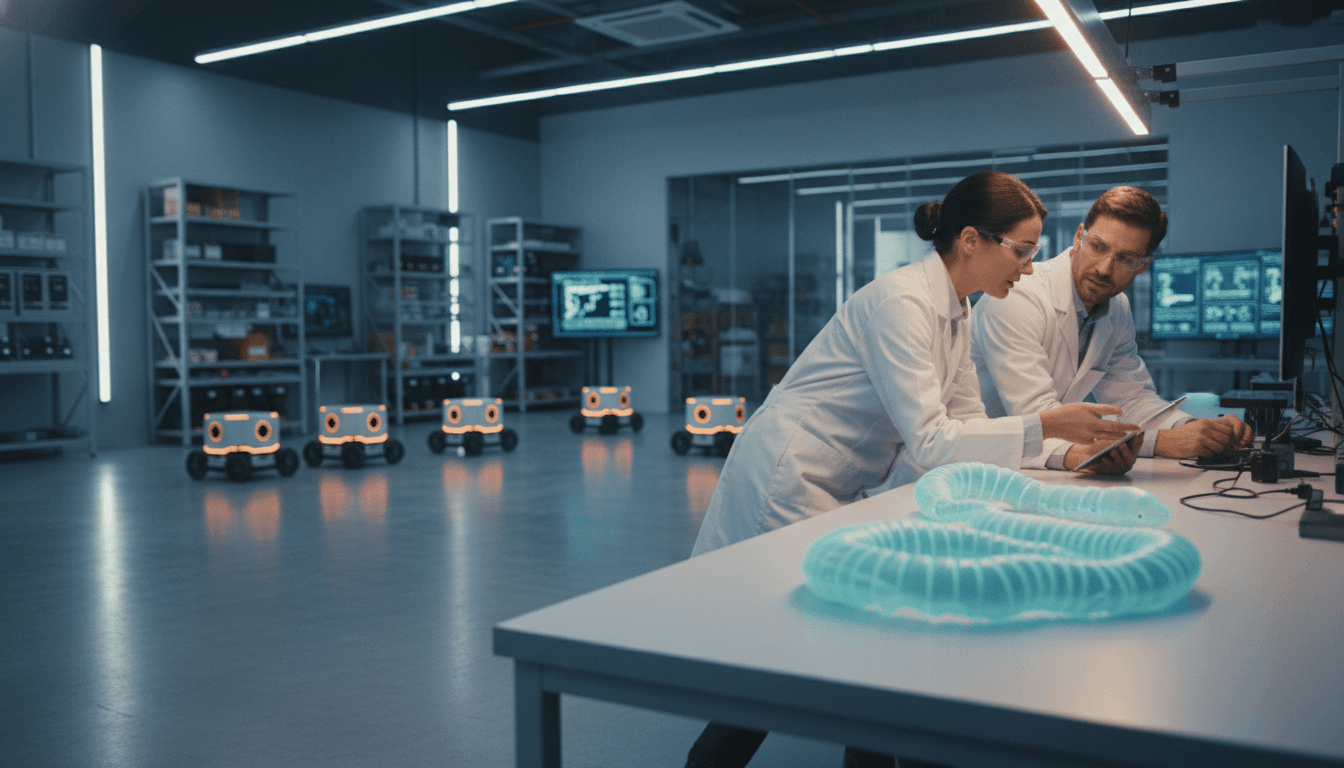
Rus’s distributed robotics work—teams of small robots cooperating—maps directly to the way modern fulfillment operates. With networked robots (think large fleets used in warehouse operations), value comes from coordination: task division, routing, collision avoidance, and throughput optimization.
The unit of value isn’t the robot—it’s the fleet. That’s the mental shift many buyers need.
What to measure in warehouse robotics (beyond “robots deployed”)
If you want a deployment that produces ROI, track metrics that reflect real operational health:
- Pick/pack cycle time and variability
- Human walk time reduced (minutes per shift is a real number)
- Exception rate (how often humans must intervene)
- Near-miss and safety incident rate
- Robot utilization vs. congestion (high utilization can be bad if it causes traffic jams)
And here’s the uncomfortable truth: the best robotics program often starts with process cleanup, not hardware. Standardize bin locations, label consistently, reduce SKU chaos, and make “robot-friendly” pathways. A robot can’t compensate for a facility that’s physically unpredictable by design.
Seasonal relevance: why Q1 is the right planning window
It’s late December, which means many teams are closing out peak season performance reviews. Q1 is where robotics decisions should get specific:
- Which workflows created the most overtime?
- Where did safety incidents cluster?
- Which exceptions were repeated and automatable?
People-centered robotics turns those answers into a roadmap: automate the dangerous and repetitive parts first, then expand.
Emergency response robotics: extending human reach when time matters
Rus points to applications like firefighting, mining rescue, and disaster response. These environments punish brittle automation. Smoke, heat, dust, collapsing structures, blocked GPS, and rapidly changing conditions are normal.
In public safety robotics, the job is situational awareness and risk reduction. The robot doesn’t need to replace responders; it needs to buy them time and information.
What “superpowers” mean for responders
In practical deployment terms, robots can provide:
- Remote inspection of unstable structures
- Search support in low-visibility areas
- Mapping for navigation and planning
- Identification of hazards (heat sources, gas presence, structural risks)
If you’re in an industrial setting (oil & gas, utilities, mining), the same capabilities apply to inspections and incident response. The ROI includes avoided shutdowns and fewer dangerous entries.
On-device AI and “liquid” models: why autonomy can’t live in the cloud
Rus helped found Liquid AI in 2023 to build liquid neural networks, inspired by simple biological nervous systems that adapt continuously. Whether or not you use that specific approach, the strategic direction is clear:
Robots need intelligence on-board to be safe, responsive, and dependable.
Why cloud-only robotics breaks in the real world
Cloud dependency creates predictable failure modes:
- Latency spikes → delayed control decisions
- Connectivity loss → degraded autonomy
- Bandwidth limits → reduced sensor streaming
- Data governance issues → restricted usage in regulated sites
On-device AI doesn’t eliminate the cloud; it re-balances the architecture. Use the cloud for fleet analytics, updates, and training. Keep safety-critical inference and control local.
A practical architecture checklist for buyers
When evaluating AI robotics platforms, I’ve found these questions cut through marketing quickly:
- What runs on-device vs. in the cloud, and why?
- What happens on network loss—full stop, limp mode, or safe autonomy?
- How are models updated, tested, and rolled back?
- How do you log incidents for safety review and compliance?
- What’s the human override path, and how fast is it?
If the vendor can’t answer crisply, you’re buying risk.
How to apply Rus’s approach: a playbook for people-centered AI robotics
The simplest way to adopt people-centered robotics is to treat the human workflow as the “primary system” and the robot as an amplifier. Here’s a pragmatic sequence that works across healthcare, logistics, and industrial environments.
Step 1: Pick a task where humans want help
Start with tasks that are physically taxing, hazardous, or monotonous—where adoption is naturally high. Examples:
- Repetitive internal transport (bins, totes, carts)
- Hazardous inspection routes
- High-precision handling steps with fatigue issues
Step 2: Define success in numbers before you pilot
Write down target thresholds for:
- Throughput (units/hour)
- Exception rate (human interventions/day)
- Safety outcomes (near misses, ergonomic strain reports)
- Time-to-recovery after failure
If you don’t define these up front, you’ll “feel” progress and still fail to scale.
Step 3: Build for trust: explainability, training, and feedback loops
People trust robots that behave predictably and admit failure early. Operationally, that means:
- Clear status signals (what it’s doing, what it needs)
- Short training for frontline staff
- Fast bug reporting and iteration cycles
- A visible safety owner with authority
Step 4: Scale only after you’ve mastered exceptions
The pilot isn’t real until you’ve handled:
- Messy inputs (mislabels, damaged items)
- Human unpredictability (crowding, shortcuts)
- Maintenance schedules and spare parts
- Software update governance
Scaling without exception discipline is how robotics programs become expensive demos.
Where people-centered robotics is headed next
The most valuable idea in Daniela Rus’s work isn’t any single robot. It’s the stance: build machines that make people more capable—at work, at home, and in medicine. That stance is also the safest way to pursue ROI, because it forces you to design for real environments and real users.
As AI-powered robotics spreads across industries worldwide, the winners won’t be the companies that automate the most. They’ll be the ones that automate with judgment: keeping autonomy close to the action, using materials and morphology to simplify control, coordinating fleets instead of hero robots, and treating humans as core components of the system.
If you’re planning your 2026 roadmap now, take one workflow you own—warehouse movement, clinical handling, inspection, or emergency readiness—and ask a tougher question than “Can a robot do this?”
Ask: “What would it look like if our people had superpowers here—and what’s the smallest robot deployment that gets us there?”