Musculoskeletal robot dogs pair compliant bodies with AI control for tougher real-world work. See where they fit in logistics, manufacturing, and utilities.
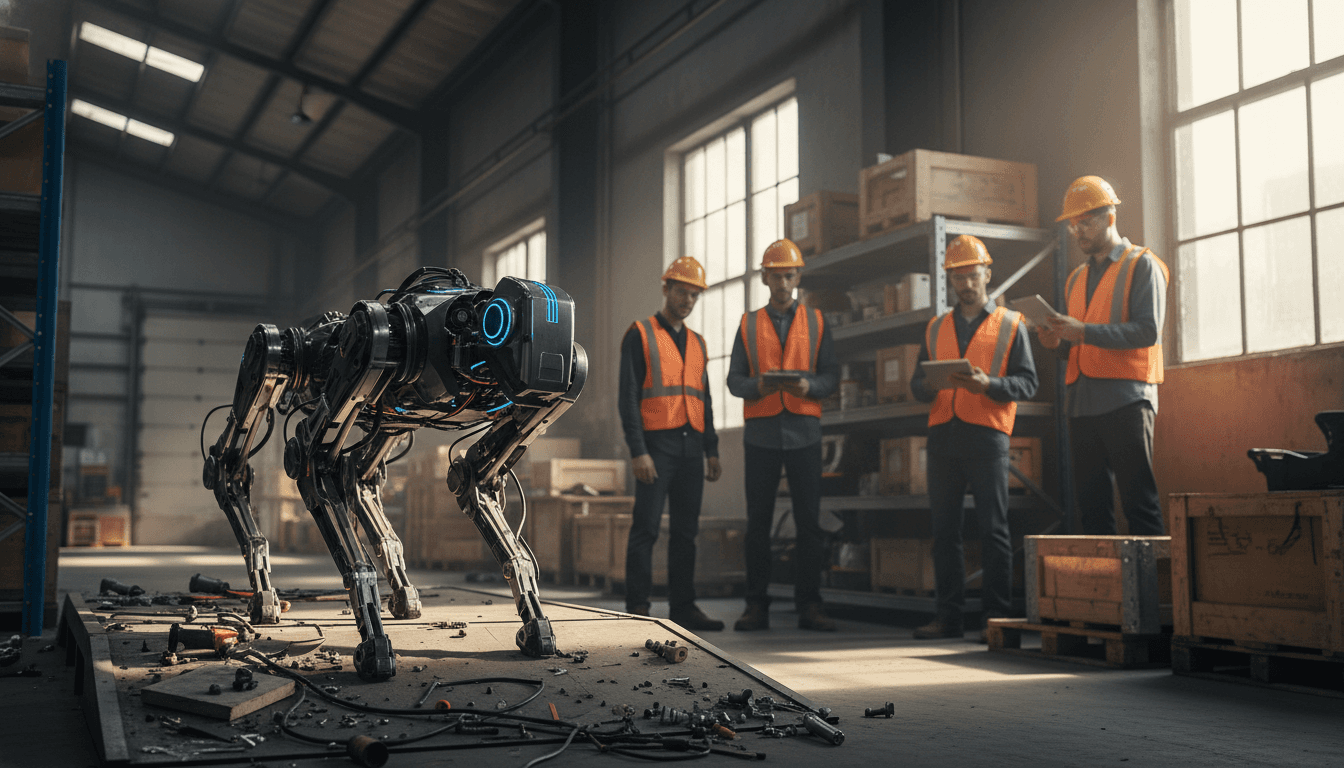
Musculoskeletal Robot Dogs: What Industry Learns
A rigid robot dog can look impressive on a demo floor. But it often fails in the places that actually matter—uneven steps, cluttered aisles, tight corners, unexpected bumps, and the slow wear-and-tear of daily operations.
That’s why the recent musculoskeletal quadruped from Suzumori Endo Lab (Science Tokyo), built with thin McKibben “muscles” and a dog-like shoulder structure, is more than a fun video moment. It’s a signal that robot mobility is shifting from “strong frames + precise motors” to “compliant bodies + smarter control.” And that shift is tightly tied to AI.
In this installment of our “Artificial Intelligence & Robotics: Transforming Industries Worldwide” series, I’ll explain what musculoskeletal robot dogs change, where they’ll matter first in industry, and what leaders should plan for in 2026 if they’re considering AI-powered robotics in operations.
Why musculoskeletal robot dogs matter (beyond cool demos)
Musculoskeletal design matters because compliance is a feature, not a flaw. Traditional quadrupeds are typically driven by electric motors and gearboxes that excel at repeatable motions. They’re great when the world is predictable.
The real world isn’t predictable.
A musculoskeletal robot—using artificial muscles, tendon-like routing, and biologically inspired joints—can absorb surprises in a way that reduces brittle failure modes. The “hammock-like” shoulder structure highlighted in the video isn’t cosmetic. It’s a different philosophy of locomotion: distribute loads, allow micro-adjustments, and avoid fighting physics.
Here’s the stance I’ll take: industrial robotics is overdue for bodies that behave more like products designed for the field, not the lab. Musculoskeletal quadrupeds push us in that direction.
The hardware shift: from torque control to body intelligence
McKibben muscles (pneumatic artificial muscles) contract when pressurized, producing motion that is naturally compliant. That compliance can:
- Reduce peak impact forces when stepping or slipping
- Protect payloads (sensors, compute modules, inspection tools)
- Improve traction on mixed surfaces
- Make interaction with people and infrastructure safer
But there’s a catch: compliance also creates complexity. If your actuators and joints behave like springs and dampers, control gets harder.
That’s where AI stops being a buzzword and becomes the practical glue.
The AI link: why “soft bodies” need smarter brains
AI matters more as robots become less mechanically deterministic. With a rigid drivetrain, you can often model motion precisely. With muscle-like actuation, you deal with hysteresis, pressure dynamics, temperature effects, and non-linear joint behavior.
So what does AI contribute in practice?
1) Learning control policies for locomotion
Legged locomotion is a high-frequency control problem. Musculoskeletal systems introduce more variables, and classical control alone tends to become a fragile stack of compensations.
Modern approaches (especially reinforcement learning and hybrid model-based + learning control) help robots:
- Learn stable gaits across surfaces
- Recover from slips or trips without falling
- Adapt to load changes (tools, packages, sensor booms)
- Improve efficiency by exploiting natural dynamics
The important business translation: AI increases robot uptime in messy environments, which is the number that actually drives ROI.
2) Perception that matches the body’s capability
Legs don’t help if the robot can’t see where to place them.
The RSS roundup also pointed to self-contained edge vision systems built for robotics (compute + sensing + 3D perception). That’s exactly the direction industry needs: low-latency perception at the edge, so foot placement and obstacle negotiation don’t depend on a flaky network connection.
For operations teams, this reduces the integration burden:
- fewer external compute boxes n- simpler mounting and power
- faster reaction times for navigation
3) Better human interfaces (yes, language matters)
One of the most practical trends in the roundup was the “speech to physical objects” concept: natural language driving generative design and robotic assembly.
For robot dogs in industry, the parallel is obvious: natural language is becoming a serious UI layer for field robots, especially for first-response, inspection, and maintenance workflows.
Voice and language won’t replace standard operating procedures. But they will reduce the “specialist bottleneck” when a technician needs the robot to do something slightly unusual.
Where robot dogs actually fit in 2026 operations
Robot dogs aren’t a universal automation solution. Wheels still win on smooth floors. Fixed automation still wins for high-throughput, repeatable tasks.
Quadrupeds win when three conditions are true:
- The environment changes often
- Human access is difficult or risky
- The task value is high enough to justify mobility
Here are the most realistic near-term use cases I’m seeing across industries.
Logistics and warehouses: exception handling, not conveyor replacement
In logistics, the high-value niche is exception handling:
- after-hours patrol of aisles and dock doors
- spotting leaks, spills, heat sources, or damaged goods
- checking inventory in hard-to-reach areas
- escorting staff in low-light or restricted zones
A musculoskeletal platform could matter here because warehouse environments are full of small “foot traps”: loose wrap, debris, uneven thresholds, temporary ramps.
A rigid quadruped can handle some of this—until it can’t. A more compliant body can increase tolerance.
Manufacturing plants: inspection routes across mixed infrastructure
Manufacturing sites have the awkward combination of:
- smooth floors inside production areas
- cable covers, grates, steps, and outdoor paths between buildings
- noise and low visibility in certain zones
Robot dogs are a strong fit for sensor-based inspection:
- thermal scans of panels and motors
- acoustic anomaly detection
- gas detection
- vibration sampling
The musculoskeletal approach adds value if it reduces maintenance events caused by repeated micro-impacts and awkward transitions.
Energy and utilities: the “last 50 meters” problem
Utilities and energy sites often have vehicles that can get close—but not all the way—to the asset. The last stretch might include stairs, gravel, snow, or narrow walkways.
Quadrupeds are built for that last segment.
A compliant robot body also helps where contact is unavoidable (tight enclosures, occasional bumping into pipes). Less impact means fewer broken sensors and fewer calls to send humans back out.
Disaster response and public safety: autonomy plus trust
The roundup referenced a student-built AI robotic dog designed for disaster zones using multimodal models, visual memory, and voice commands.
That combination—mobility + perception + task reasoning—is the right direction. The limiting factor isn’t imagination. It’s trust:
- Can it navigate without becoming a liability?
- Can it communicate what it sees clearly?
- Can it fail safely?
In disaster response, musculoskeletal compliance can help the robot “survive contact” with rubble and reduce the risk of getting high-centered or damaged.
What most organizations underestimate: deployment friction
Buying a robot dog is easy. Running one reliably is the hard part. If you’re evaluating AI-powered robotics for industrial transformation, plan for these operational realities.
Data and maps are operations assets
Perception models and navigation stacks need upkeep. Layout changes, seasonal lighting shifts, and reflective surfaces all create drift.
Treat robot navigation like you treat cybersecurity: continuous monitoring, patching, and clear ownership.
Maintenance is about connectors and contamination, not “AI”
In field robotics, boring failures dominate:
- connectors loosening
- dust and moisture ingress
- battery aging
- sensor windows getting dirty
- pneumatic leaks (especially relevant for artificial muscles)
Musculoskeletal systems can introduce new maintenance categories (air supply, pressure regulation, seals). The design wins are real, but so are the upkeep demands.
Safety needs layered controls
If a robot dog operates near humans, you need more than a checkbox compliance mindset.
Practical safety layers include:
- speed limits by zone
- geofencing and restricted routes
- emergency stop access and training
- behavior logging for incident review
- clear “what it will never do” rules
A compliant body can reduce impact forces, but it doesn’t replace safety engineering.
A practical evaluation checklist for AI robot dogs
If you’re considering quadruped robots for logistics, manufacturing, or utilities, evaluate the system like an operations product—because it is. Here’s a tight checklist I’ve found useful.
- Terrain tolerance: thresholds, slopes, grates, wet floors, loose debris
- Perception robustness: glare, darkness, fog/steam, reflective metal
- Edge autonomy: can it operate safely when connectivity drops?
- Intervention workflow: how quickly can a tech recover it if it gets stuck?
- Tooling and payload: sensor mounts, power budget, compute headroom
- Maintenance model: parts availability, service intervals, mean time to repair
- Integration: alerts into your existing CMMS/EAM, ticketing, and dashboards
If a vendor can’t answer these cleanly, the deployment will drag.
What to watch next: musculoskeletal design moving from labs to products
The musculoskeletal robot dog in the IEEE Spectrum video roundup is a research platform, but the direction is clear: robots are becoming biomechanical systems that rely on AI to stay stable, safe, and useful.
As 2026 budgets get finalized, the smart move is to stop viewing robot dogs as novelty assets and start viewing them as mobile automation nodes—a blend of locomotion, perception, and task intelligence that can extend your team’s reach.
If you’re building an industry roadmap for AI and robotics, musculoskeletal quadrupeds are a strong “watch closely” category—especially for mixed terrain inspection and exception handling in logistics.
The question that will separate leaders from dabblers is simple: when your facility changes next quarter, will your robots adapt in days—or will they sit idle until someone re-tunes everything?