AI-powered robots are getting better at transitions—between flying and driving, vision and touch, and solo work and team missions.
Robots That Drive, Fly, and Feel: What’s Next
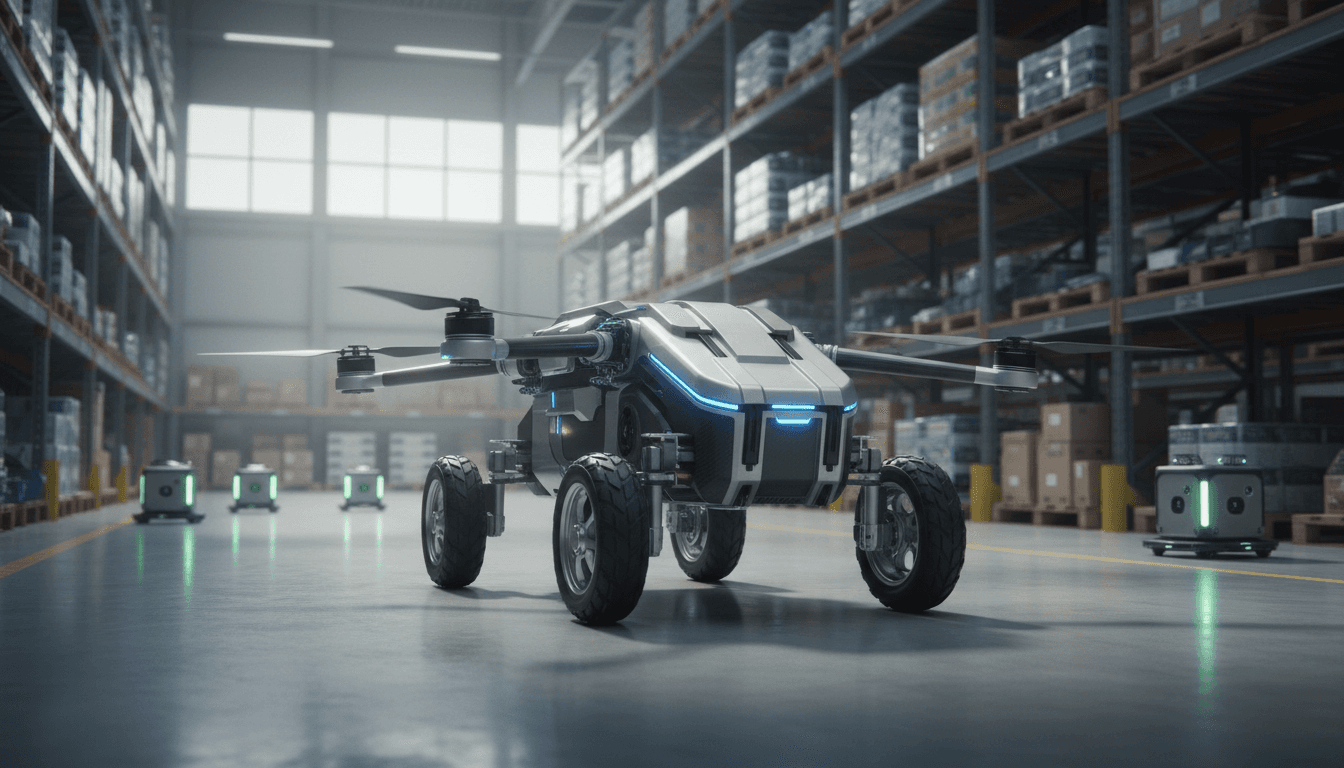
A delivery drone that lands, folds into “ground mode,” and drives through a warehouse aisle isn’t a sci‑fi flex—it’s a practical way to solve the least glamorous part of automation: the last 30 meters. Most robotics programs don’t fail because flight is hard or wheels are hard. They fail because transitions are hard: moving between environments, switching sensors when conditions change, and coordinating multiple machines when reality doesn’t match the plan.
This week’s robotics highlights (spanning hybrid drones, multimodal perception, LLM-grounded team coordination, and “generalist” humanoids) all point to the same industrial truth: the next wave of AI-powered robotics is about adaptability, not novelty. If you’re building for logistics, manufacturing, utilities, or smart cities, this is where the ROI will come from in 2026 and beyond.
Below is the throughline I see—and how to apply it if your goal is safer operations, faster throughput, and fewer “robot stuck again” escalations.
Hybrid drones that drive aren’t a gimmick—they fix the bottlenecks
Answer first: A drone that can both fly and drive reduces time, energy, and risk by using the right mode for the right segment of a route, especially indoors and in dense urban spaces.
The featured concept, a hybrid quadrotor design (Duawlfin), stands out for a very unsexy reason: it tries to avoid extra complexity. Many “fly + drive” robots pile on additional actuators or dedicated ground propulsion. That inflates weight, maintenance load, and failure points—exactly what fleet operators hate.
Duawlfin’s idea (as described) is to use the standard quadrotor motors and add a differential drivetrain with one-way bearings so it can drive without adding a whole new propulsion stack. The headline isn’t “cool transformation.” It’s this: a single propulsion system supporting multiple mobility modes is easier to scale.
Where hybrid mobility wins in real operations
If you run robotics in logistics or facilities, you already know the pattern: wide-open air is easy; tight spaces are brutal.
Hybrid aerial/ground mobility helps in scenarios like:
- Urban logistics: Fly over traffic, then drive the last stretch to a secure drop-off zone or parcel locker bay.
- Warehouses and micro-fulfillment: Fly between zones, then drive under shelving or through narrow aisles where downwash and safety constraints make flight annoying.
- Indoor navigation: Drive through corridors and doorways, then fly up stairwells, across atriums, or over temporary obstructions.
- Inspection workflows: Fly to a roofline, drive along flat surfaces for stable close-up sensing, then fly again.
The metric most teams miss: transition cost
Most companies get this wrong: they benchmark top speed or payload, then get blindsided by the cost of mode switching.
A hybrid robot only makes business sense when transitions are:
- Fast (seconds, not minutes)
- Reliable (no manual resets)
- Predictable (same behavior in varied lighting, dust, floor friction)
When you evaluate a “drive + fly” platform, ask for transition data the way you’d ask for battery life:
- Mean/median transition time
- Failure rate per 1,000 transitions
- Recovery behavior (what happens if a wheel slips or the robot bumps a curb)
That’s the difference between a demo and a deployable system.
Robots are learning when to use vision vs touch—and that matters for industry
Answer first: Multimodal AI in robotics is shifting from “fuse everything into one model” to “combine specialized experts,” which improves reliability when sensors are intermittent or sparse.
One of the most valuable ideas in the RSS summary is the simple backpack example: humans start with vision, then switch to touch when vision becomes useless. Robots struggle here—not because they lack sensors, but because they struggle with sensor handoffs.
The described approach trains separate expert policies (one for vision, one for tactile, etc.) and combines predictions at the policy level rather than forcing all sensor streams through a single monolithic network.
Why “expert policies” is a big deal in production robotics
In factories, warehouses, and field robotics, sensor data is often:
- partially blocked (occlusion)
- noisy (dust, glare, vibration)
- missing (tactile only happens at contact)
A single end-to-end model tends to learn brittle shortcuts. Expert policies can be more robust because:
- Each expert specializes in a domain it can “trust.”
- The system can weight experts differently at different moments.
- Sparse signals (like touch) can carry outsized importance without being drowned out.
Here’s my stance: the winners in industrial automation will treat perception like a portfolio, not a monolith. One model for everything is elegant on slides; in the wild, specialization often wins.
Practical use cases: picking, kitting, and “messy” manipulation
Multimodal policy blending is directly relevant to:
- Bin picking: Vision gets you close; touch confirms grasp and detects slip.
- Cable handling: Tactile feedback matters more than camera confidence once contact starts.
- Packaging: Vision aligns a label; touch ensures adhesion pressure and placement.
If you’re evaluating AI robotics vendors, ask a blunt question: What happens when the camera is wrong but touch is right? The answer will tell you whether they’ve designed for real environments.
LLMs coordinating robot teams is real—if grounded in capabilities
Answer first: LLM-based planning for robot fleets works when the system explicitly maps language plans to what each robot can physically do, then revises plans based on online feedback.
A framework like SPINE-HT (as summarized) is tackling the actual hard part of “LLMs for robots”: not chatting, but grounding. In heterogeneous teams (UGVs, quadrupeds, UAVs), the system has to:
- break a mission into subtasks,
- assign tasks to the right platform,
- adapt when the world surprises you.
The summary reports an 87% success rate in real-world experiments using a mixed team (Clearpath Jackal, Clearpath Husky, Boston Dynamics Spot, and a high-altitude UAV) on missions that require reasoning about capabilities and refinement from feedback.
What “grounding” means for operations teams
Grounding is the difference between:
- “Spot, go inspect the area,” and
- “Spot, navigate this slope, keep a standoff distance of 1.5 m from the edge, and stream thermal data while the UAV provides overhead localization.”
In practical deployments, you need:
- Capability models: payload limits, terrain limits, battery constraints, sensor payloads
- Verification loops: did the robot achieve the subtask, or did it just try?
- Fallback behaviors: if the UAV can’t fly due to wind, who takes over?
LLMs can help teams move faster from intent to plan, but only if you treat them as a planning interface—not a magic autonomy layer.
Where this shows up first: utilities, public safety, and large campuses
Heterogeneous robot teams make sense when the environment is too big or too dynamic for one robot type:
- Utilities: UAV reconnaissance + UGV close inspection
- Ports and rail yards: wide-area scanning + on-the-ground verification
- Smart city pilots: sidewalk robots + aerial monitoring for congestion or incidents
If you’re considering a pilot in 2026, prioritize vendors who can demonstrate capability-aware task allocation and online replanning, not just natural-language control.
Generalist humanoids are coming—but narrow usefulness is winning today
Answer first: “Generalist humanoid robots” are a promising direction, but near-term value comes from robots that do a small set of tasks safely and consistently.
The RSS roundup points at two ends of the market:
- Humanoid ambition: research talks and demos pushing toward generalist autonomy.
- Practical utility: non-humanoid systems that already do useful work and likely have a reasonable total cost of ownership.
I like the realism in that contrast. Companies don’t buy robots because they look like people. They buy them because:
- injuries go down,
- throughput goes up,
- downtime becomes predictable.
The data problem is still the constraint
Humanoid generalists need massive, diverse datasets spanning:
- manipulation,
- locomotion,
- human environments,
- long-horizon tasks.
Research groups are increasingly combining real-world, synthetic, and web data to train foundation models for robotics. That’s the right direction. But in production settings, the question remains: How quickly can the robot learn your exact workflows without months of babysitting?
For most buyers, the winning roadmap is:
- automate a narrow, high-frequency task,
- expand to adjacent tasks,
- only then consider full “generalist” behavior.
A note on design: softness vs durability
Soft, compliant humanoid hands look safer—and sometimes they are. But fragile-looking fingers raise a real procurement concern: replacement cycles, spare parts, and maintenance labor. In industrial automation, a hand that survives 10,000 cycles beats a hand that looks human.
The “weird” robots matter: pipe worms, jumping legs, and magnetic droplets
Answer first: Field robots and bio-inspired systems are pushing techniques (locomotion, control, miniaturized actuation) that later show up in mainstream industrial robotics.
Not every highlight is aimed at your warehouse. Still, these projects shape what’s deployable in 3–5 years:
- Pipe-crawling worm robots tested in real drainage systems: This is exactly the kind of inspection automation municipalities and agriculture operators need—dirty, constrained, and hard to staff.
- Jumping robot policies trained with curriculum reinforcement learning: Jumping with centimeter accuracy sounds like a stunt until you consider rubble, uneven terrain, and disaster response.
- Magnetically guided oil droplets for microrobotics: Today it’s cargo transport at tiny scales; tomorrow it’s targeted lab automation or micro-assembly.
The pattern: locomotion and control research migrates. What looks niche now becomes standard once costs drop and reliability rises.
What to do if you’re buying or deploying AI-powered robotics in 2026
Answer first: Focus on transition reliability, multimodal robustness, and capability-grounded autonomy—those three predict whether a pilot becomes a program.
Here are practical steps I’d use to de-risk a robotics initiative (especially for logistics automation, smart city robotics, or industrial robotics upgrades):
-
Write requirements around failure and recovery, not just performance.
- Ask for recovery behavior when sensors fail, wheels slip, or GPS is degraded.
-
Test multimodal perception in “annoying” conditions.
- Low light, reflective wrap, dust, glove contact, vibration.
-
Measure transitions as first-class KPIs.
- Mode switching (fly↔drive), sensor switching (vision↔touch), autonomy switching (auto↔teleop).
-
Demand capability-aware planning for fleets.
- If a vendor uses an LLM, require a clear capability model and online replanning story.
-
Plan for operations from day one.
- Spares, cleaning routines (yes, sand and dust matter), battery logistics, and technician training.
A useful rule: If the demo doesn’t include a failure, you haven’t seen the product.
Where this series is headed: adaptable robotics wins industries
The bigger theme in our Artificial Intelligence & Robotics: Transforming Industries Worldwide series is straightforward: AI is making robots more useful by making them more adaptable. Hybrid mobility tackles physical transitions. Multimodal learning tackles sensory transitions. LLM-grounded coordination tackles organizational transitions—turning human intent into multi-robot execution.
If you’re trying to generate leads for robotics modernization—whether in logistics, manufacturing, utilities, or smart cities—anchor the conversation on one question: Where do your operations break when the environment changes? That’s where adaptable robots pay back first.
Next step if you’re exploring a pilot: pick one workflow where mobility, perception, or multi-robot coordination is currently forcing humans into repetitive “exception handling.” Automate that exception path, not just the happy path.
What would happen to your throughput if your robots could switch modes—driving, flying, seeing, and feeling—without calling an operator every time the world gets slightly messy?