A $29.9K humanoid robot is a market signal. See what this means for AI-powered automation, VLA models, and real-world robotics ROI.
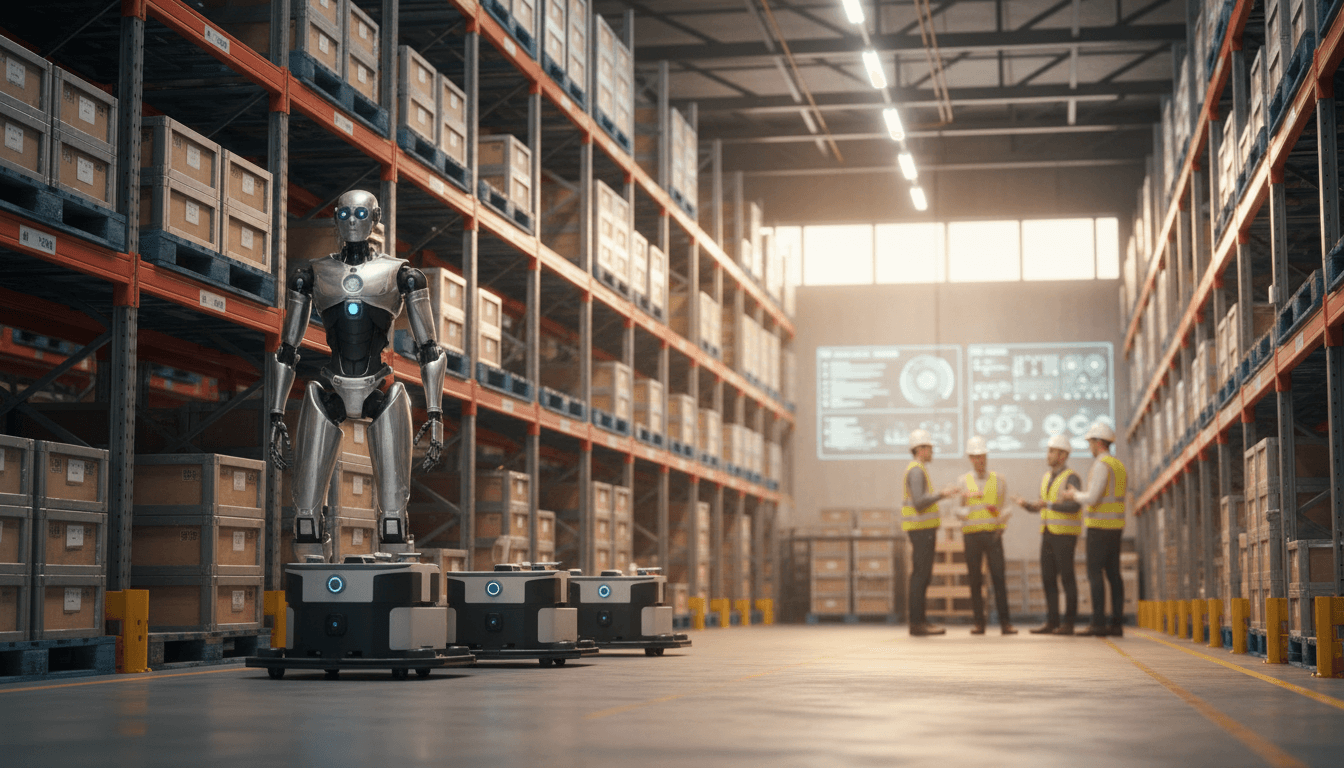
Humanoid Robots Hit $29.9K: What It Means for Business
A human-size humanoid robot advertised at US$29,900 is a signal, not a stunt. Prices like that push humanoids out of “research lab curiosity” territory and into the messy middle where businesses start asking practical questions: What can it do on day one? What breaks? Who supports it? And does it actually lower my operating costs?
That’s the backdrop for this week’s robotics roundup—highlighting Unitree’s H2 bionic humanoid (180 cm, 70 kg), a new class of lightweight robotic arms for small platforms, and a growing consensus across major conferences (IROS 2025, GRASP talks, industry chats) that generative AI and vision-language-action (VLA) models are becoming the “interface layer” that makes robots easier to deploy.
This post is part of our “Artificial Intelligence & Robotics: Transforming Industries Worldwide” series. The theme here is straightforward: robotics isn’t waiting for a perfect future. It’s already reshaping logistics, manufacturing, inspection, and service work—especially when paired with AI that makes robots more adaptable and easier to train.
Humanoid robots are getting affordable—deployment is the hard part
Humanoids are becoming commercially plausible because the price/performance curve is bending fast. A starting price of $29,900 for a human-size platform changes how teams think about pilots: it’s now closer to buying a vehicle or an industrial machine than funding a research project.
Unitree’s H2 positioning—“born to serve everyone safely and in a friendly way”—is classic consumer-friendly framing. For business buyers, the real question is simpler: can a humanoid do useful work in human-designed spaces without expensive facility changes? That’s the main promise of humanoids versus fixed automation.
Where a $30K humanoid can create value first
Most companies get this wrong: they start with “human replacement” fantasies instead of task selection. Early ROI comes from repetitive, low-judgment work that still benefits from human-like reach and mobility.
Here are realistic first deployments that don’t require sci-fi capabilities:
- Material handling in tight spaces: moving totes, bins, and light payloads where conveyors or AMRs struggle with handoffs.
- Simple machine tending: opening/closing doors, pushing buttons, loading/unloading lightweight parts—especially in brownfield facilities.
- Inspection rounds: using onboard cameras/thermal sensors to follow routes and capture structured checklists.
- Event and retail assistance (controlled environments): guiding, greeting, basic item retrieval—useful for brand experience and staffing relief.
The limiting factor usually isn’t whether the robot can walk—it’s whether you can integrate it into operations: authentication, safety rules, escalation paths, uptime monitoring, spare parts, and training.
The uncomfortable truth about humanoid ROI
A humanoid at $29.9K can still be a money pit if you treat it like a gadget. Total cost of ownership isn’t just purchase price.
Budget for:
- Operator training: who’s allowed to “drive” it, reset it, and supervise it.
- Maintenance and spares: batteries, joint components, grippers, covers.
- Safety validation: speed limits, force limits, geofencing, e-stops, audits.
- Workflow engineering: mapping tasks into steps the robot can repeat reliably.
If you’re doing a pilot in 2026, build your business case around hours of human time removed from the least-loved tasks, not around headcount reduction. Teams adopt robots faster when they feel relief, not threat.
The hidden breakthrough: lightweight arms change the “small robot” equation
Humanoids get the spotlight, but some of the most commercially meaningful progress is happening in components—especially manipulation.
A research team at Seoul National University tackled a longstanding constraint: small robots often couldn’t have capable arms because the motors needed for multiple joints made them too heavy. Their approach—using a single motor paired with miniature electrostatic clutches—enables a high-degree-of-freedom lightweight arm that can even hitch onto a drone.
Here’s why that matters for industry: manipulation is the bottleneck. Mobility (wheels, tracks, even walking) is increasingly solved. But picking, turning, fastening, and handling irregular objects is where automation projects go to die.
Why “one motor + clutches” is a business story, not just a lab demo
When an arm becomes lighter and simpler, three things improve immediately:
- Battery life and payload planning: lighter arms reduce energy draw and center-of-mass issues.
- Platform options: you can mount arms on smaller mobile robots, carts, or aerial systems.
- Cost and serviceability: fewer motors can mean fewer failure points and easier maintenance.
Practical use cases show up quickly:
- Warehouse exception handling: a small mobile base with a light arm can resolve mis-sorts, snagged labels, and fallen items.
- Remote inspection with intervention: drones that don’t just look—they interact (pulling a sample, pressing a test switch, placing a sensor tag).
- Maintenance in constrained areas: lightweight manipulators on compact robots for underfloor, ceiling voids, or narrow corridors.
Humanoids are one path to manipulation in human spaces. Smarter, lighter arms are another—and often the faster path to ROI.
Natural motion is becoming a product requirement, not a research flex
A quiet theme across the videos is whole-body coordination—robots transitioning from lying down to standing, handling balance, and producing motion that looks less “jerky.” LimX Dynamics’ Oli (165 cm, 31 degrees of freedom) demonstrates coordinated sequences that are closer to human movement patterns.
For operations leaders, “natural motion” sounds cosmetic. It isn’t. Smooth motion correlates with safer motion because it reduces surprise accelerations, minimizes tip risk, and makes it easier for humans to predict what the robot will do next.
What to ask vendors about stability and recovery
If you’re considering humanoids or legged platforms for facilities work, ask these questions early:
- Recovery behaviors: can it get up from a fall reliably, and how often does it need human help?
- Speed limits near humans: what’s the enforced cap and how is it validated?
- Footprint and turning radius: can it work in your actual aisles and doorways?
- Failure modes: what happens on sensor dropout, low battery, or network loss?
Robotics buyers should get comfortable demanding “boring” answers. Reliability beats flashy demos.
Generative AI is becoming the robot’s “operations layer”
Industry conversations are converging on a practical point: generative AI isn’t just for chat. It’s increasingly used to reduce the labor of programming and supervising robots.
A fireside chat featuring an Amazon Robotics leader discussed the trajectory of robotics and how generative AI contributes to innovation. The takeaway for business isn’t that robots will suddenly become autonomous everywhere. It’s that AI can lower the friction in three places:
- Task specification: turning human instructions into structured action plans.
- Exception handling: interpreting unusual scenes and suggesting safe recovery actions.
- Knowledge transfer: capturing “tribal knowledge” from technicians into reusable playbooks.
If you manage a fleet (AMRs, arms, or humanoids), the operational burden often sits with a few robotics specialists. Generative AI is pushing the system toward a broader user base—more supervisors, fewer bespoke scripts.
VLA models: the clearest route from “language” to “work”
A GRASP talk from Physical Intelligence focused on vision-language-action models, which aim to connect what a robot sees (vision), what it’s told (language), and what it does (actions) in closed-loop control.
Here’s the simplest way to think about VLA models:
A vision-language-action model is a robot control system that turns instructions and camera input into step-by-step physical behavior, then corrects itself as the world changes.
Why VLA matters to industries worldwide:
- Faster onboarding for new tasks: less hand-coded logic for every SKU, fixture, and layout.
- Better generalization: one model can handle variations—different boxes, lighting, or placements.
- More scalable data strategy: training improves with more examples, not just more engineering hours.
The catch: scaling robot learning is harder than scaling chatbots because physics is unforgiving. Data collection is expensive, safety constraints are real, and the robot must act reliably in real time.
Robustness is the real KPI (and conferences are finally treating it that way)
A workshop talk at IROS 2025 focused on surviving failures in robotics—exactly the topic that decides whether a pilot becomes a rollout.
Robots don’t fail like software. They fail like machines: wear, misalignment, calibration drift, dust, vibration, collisions, and human unpredictability.
A practical robustness checklist for AI-powered robotics
If you want AI-powered robotics to improve efficiency—not create a new support nightmare—evaluate these areas before you scale:
- Uptime targets: define required availability (for example, 95%+ during shift hours) and measure it from day one.
- Mean time to recovery: how quickly can a non-expert reset the system?
- Monitoring and logs: are there actionable fault codes, video replay, and sensor snapshots?
- Safety and compliance: documented risk assessments, emergency stop behavior, and restricted-speed modes.
- Change management: what happens when your facility layout changes, SKUs change, or lighting changes?
Robustness is where the “AI + robotics” story becomes credible to executives.
What this week’s robotics videos say about 2026 planning
This isn’t just entertainment content. It’s a market signal.
- Humanoids are becoming purchasable assets, not one-off prototypes.
- Manipulation improvements are trickling down into smaller platforms and new form factors (including drones with arms).
- Generative AI and VLA models are shifting the labor curve from custom programming to higher-level supervision.
- Global collaboration is accelerating through venues like IROS and ROSCon, shortening the distance from research to deployment.
If you’re building your 2026 automation roadmap, the right move is to treat humanoids and AI-enabled robotics as portfolio bets:
- Pilot one high-visibility humanoid use case in a controlled area.
- Deploy “boring” automation (AMRs/arms) where ROI is already proven.
- Invest in your data and operations layer (telemetry, labeling, procedures).
- Build a safety and governance framework that scales with the fleet.
The reality? The companies that win with robotics don’t start with a robot. They start with a workflow that’s worth automating and a plan to keep it running.
If a $29.9K humanoid can be ordered today, the better question for most leaders is: what would you automate first if deployment friction dropped by 50%—and what’s stopping you from running that pilot next quarter?