Humanoid Olympics-style tasks—doors, laundry, tools, and wet cleanup—show what useful robots still can’t do, and what to watch in 2026.
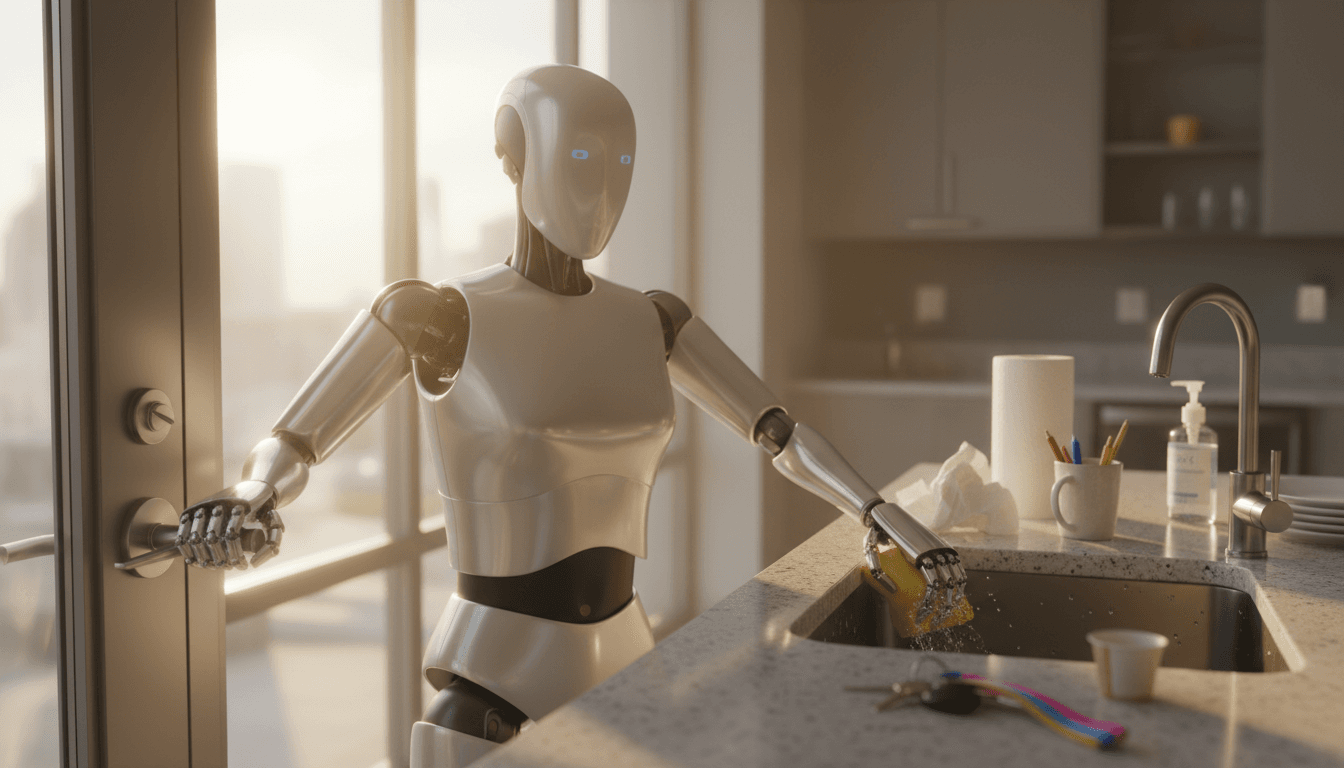
Humanoid Olympics: The Real Test for Useful Robots
Most humanoid robot “competitions” still optimize for the wrong thing: spectacle. Punching, flipping, even kickboxing looks impressive on video—but it doesn’t tell you whether a robot can meaningfully reduce labor in homes, hospitals, warehouses, or retail.
The better benchmark is boring on purpose: doors, laundry, tools, wet cleanup. Benjie Holson’s “Humanoid Olympics” challenge nails what the AI robotics industry actually needs next—general-purpose robotic manipulation that works outside curated demos. And the timing is perfect for late 2025: companies are shipping more capable humanoid platforms, but the dexterity gap (force control, fingertip precision, touch, reliability) is still the bottleneck keeping many deployments stuck in pilots.
This post unpacks the Humanoid Olympics events, explains why today’s robot learning approaches hit a ceiling, and translates the challenge into what business leaders should watch if they care about AI-powered robotics transforming industries worldwide.
Why “robot chores” are a better benchmark than robot sports
If a humanoid robot can reliably do chores, it can do a lot of paid work. That’s the point. The economic value isn’t in a robot landing a punch—it’s in a robot handling the messy, variable tasks that consume human time.
Here’s what chore-style benchmarks measure that sports don’t:
- Contact-rich manipulation: twisting, pulling, scraping, wiping—real environments fight back.
- Long-horizon autonomy: multi-step tasks that require retrying and adapting when something slips.
- Safety and robustness: operating around humans, fragile objects, and clutter.
- Generalization: doing the same task on slightly different doors, shirts, sinks, and tools.
A memorable line I’ve found to be true in robotics: “If it works only in your lab, it doesn’t work.” The Humanoid Olympics forces robots into the world we actually live in—where doors self-close, fabric bunches unpredictably, and soap makes everything slippery.
What’s working now—and why it stalls
The current state-of-the-art for many humanoid manipulation demos is learning from demonstration via teleoperation. A human “puppeteers” a robot (often via VR or a mirrored robot), records hundreds of short trajectories (10–30 seconds), and trains a neural policy to imitate them.
This approach has real wins. It handles tasks with:
- High state complexity (a towel can be crumpled in countless ways)
- Chaotic micro-interactions (tugging a corner until fabric lies flat)
But Holson’s critique is on target: imitation alone doesn’t magically become general-purpose manipulation. The limitations show up quickly:
The four bottlenecks that keep showing up
1) Weak wrist force feedback Teleoperators can’t “feel” what the robot feels with high resolution. That makes it hard to teach subtle torque/force strategies—especially for latches, knobs, and tool use.
2) Limited finger control Many hands still behave like “open/close plus a few poses.” Even hands with high degrees of freedom are hard to control and hard to train.
3) No real sense of touch Human hands are sensor-dense. Most robots still rely heavily on vision, which fails when the critical information is tactile: slip, micro-collisions, deformation.
4) Medium precision (often ~1–3 cm in practice) That’s enough for gross grasps. It’s not enough for keys, buttons, bag openings, or neat tool alignment.
The reality? We don’t have a single missing ingredient. We have a stack of missing ingredients—hardware sensing, compliant control, better data, better policies, better evaluation.
The Humanoid Olympics events—and what they really test
Holson’s events look playful, but they’re a serious roadmap. Each one isolates a capability that industry-grade robots must master.
Event 1: Doors (whole-body, asymmetric force, timing)
Doors are a manipulation stress test disguised as daily life. They require strong torque to actuate a handle, precise pulling/pushing along a constrained arc, and coordinated locomotion to pass through without losing control.
- Bronze: round-knob push door
- Silver: lever-handle self-closing push door
- Gold: lever-handle self-closing pull door
Why businesses should care: doors are everywhere—hospitals, hotels, office buildings, retail backrooms. A robot that can’t handle doors can’t move independently between work areas. And if it needs a human “door assistant,” the ROI collapses.
What it demands technically:
- Force-aware grasping without slipping
- Whole-body planning (arm + torso + base)
- Dynamic execution (sometimes you must move quickly)
Event 2: Laundry (deformables, in-hand repositioning, long-horizon)
Laundry is the poster child for why robotics is hard. Fabric is deformable, self-occluding, and highly variable—exactly the opposite of rigid industrial parts.
- Bronze: fold an inside-out T-shirt (starts as a wad)
- Silver: turn a sock inside-out
- Gold: hang a men’s dress shirt, fix a sleeve, button at least one button
Why this matters beyond the home: garment handling maps directly to e-commerce returns, retail back-of-house, hotel linen operations, hospital laundry, uniform services, and even some packaging tasks where soft goods deform.
My stance: shirts + buttons are a “truth serum” benchmark. If a humanoid can button reliably, it can likely manage many other high-precision contact tasks.
What it demands technically:
- Deformable object perception (occlusion is constant)
- Bimanual coordination with tension control
- Fine manipulation for sleeves, collars, and especially buttons
Event 3: Tools (strong grasps, re-grasping, torque transfer)
Tool use is where many robot hands look capable… until they need a “human-like” strong tool grasp. Humans don’t just hold tools; we continually adjust grip for stability and force.
- Bronze: spray window cleaner and wipe with paper towels
- Silver: make peanut butter sandwiches (including knife use and spreading)
- Gold: use a key from a keyring without setting it down
Why this matters for industry: tool competence is a gateway to facility maintenance, retail cleaning, light manufacturing, lab operations, and healthcare support tasks.
Key insight: Tool tasks aren’t “hand tasks.” They’re “force-transfer tasks.” The hand must transmit torque without wobble, compensate for slip, and maintain alignment.
What it demands technically:
- In-hand reorientation (especially for keys)
- High friction control and slip detection
- Stable force control at the end effector
Event 4: Fingertip manipulation (precision without fixtures)
Fingertip manipulation is the difference between a gripper and a hand. This is where robots need touch, micro-control, and geometry-aware strategies.
- Bronze: roll matched socks
- Silver: open and use a dog poop bag (separate the opening)
- Gold: peel an orange with no tools
Why this matters for real deployments: many tasks in pharmacies, grocery, lab sample handling, food prep, and packaging require delicate, high-precision fingertip moves. If your robot can’t “start” a bag or peel a label, it will stall constantly.
What it demands technically:
- Fingertip force modulation
- Slip-aware manipulation
- Better tactile sensing and tactile policy learning
Event 5: Wet manipulation (water, soap, grease, contamination)
Wet tasks are where “demo robots” go to die. Water changes friction, causes slip, damages unsealed hardware, and creates safety and reliability problems.
- Bronze: wipe a countertop with a damp sponge
- Silver: clean peanut butter off the manipulator
- Gold: wash a greasy pan in a sink with a sponge
Why this matters: cleaning isn’t glamorous, but it’s a massive labor category—commercial kitchens, hospitals, airports, stadiums, elder care facilities. If humanoids are going to matter economically, they need a path into these environments.
What it demands technically:
- Splash-resistant or washable end effectors
- Contamination-aware planning (don’t spread grease)
- Robust grip under variable friction
What business leaders should take from the “Olympics” format
The rules are as important as the tasks: real-time video, no cuts, autonomous operation, and a time limit (up to 10× human time). That combination targets the biggest failure mode in robotics marketing: cherry-picked success.
If you’re evaluating humanoid robots for your operation, borrow this mindset. Ask vendors to demonstrate:
- No-edit autonomy: show full runs including retries and recovery.
- Time-to-complete: slow success can be economic failure.
- Generalization: repeat on at least 3 variations (different doors, different shirts, different sinks).
- Failure handling: what happens when the grasp slips or the item drops?
- Maintenance reality: how often do hands need servicing, and what’s the replacement cost?
A practical rule: If a robot needs an expert on-site to “babysit” it, you’re buying a research project, not automation.
The roadmap: what needs to improve for general-purpose manipulation
Getting from impressive clips to dependable labor requires progress in four layers at once.
1) Better sensing (especially tactile)
Vision-only manipulation breaks down in occlusions (sleeves, bags, inside socks). Expect faster progress as tactile sensors become more durable and easier to integrate into fingers and palms.
2) Force control and compliance
Door handles, keys, and scrubbing require controlled force, not just position tracking. The winners here will treat manipulation as interaction control, not “arm moves through waypoints.”
3) Data efficiency and learning beyond imitation
Imitation learning is a start, not an end. The next step is combining demonstrations with:
- self-correction and trial-and-error in safe training setups
- simulation-to-real strategies for contact tasks
- policy architectures that can re-plan mid-task
4) Reliability engineering
Industry adoption will be decided by the unsexy parts:
- sealed joints
- easy-to-clean end effectors
- modular hands
- predictable failure modes
Where this fits in “AI & Robotics: Transforming Industries Worldwide”
The Humanoid Olympics is more than a fun challenge—it’s a useful lens for the global automation wave. Warehouses want robots that can handle exceptions, hospitals want robots that can move between rooms, retailers want robots that can restock and clean, and facilities teams want help with repetitive maintenance.
Humanoids won’t replace every job, and they won’t arrive everywhere at once. But the competition makes one thing clear: the next industrial leap comes from manipulation skills, not flashy locomotion. The first companies to crack doors, tools, and wet cleanup reliably won’t just win medals—they’ll win contracts.
If you’re building, buying, or piloting humanoid robots in 2026, take a hard look at these events and ask: which one maps to our real workflows? Then measure progress against it, relentlessly.
A practical benchmark for AI-powered robotics: “Can it do the annoying task, end-to-end, on video, without edits?”
The question I’m watching next: Which team will prove they can generalize these skills across environments—without collecting thousands of new demonstrations per site?