Heavy-lift drones and mass-produced humanoids signal a real shift in AI robotics for logistics. Learn what’s deployable in 2026 and how to choose use cases.
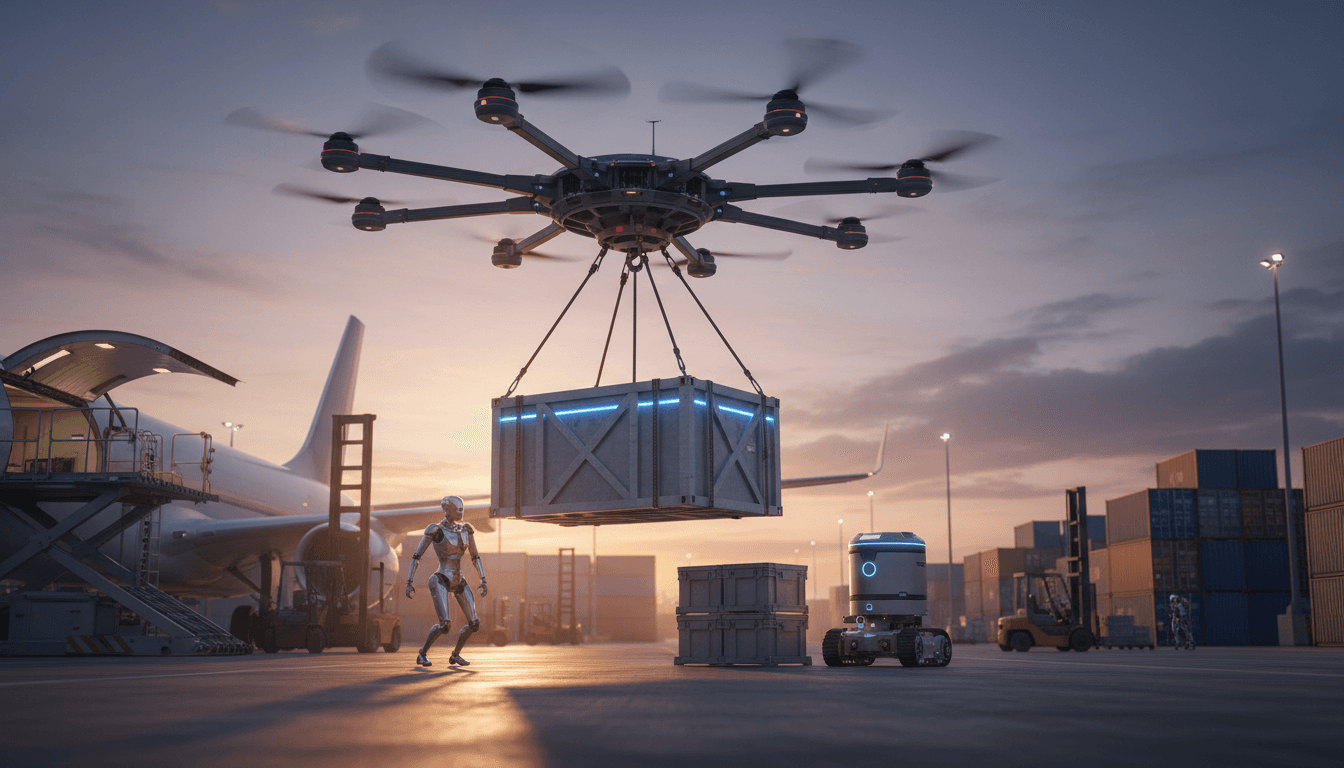
Heavy-Lift Drones and Humanoids Are Shipping Now
A payload-to-weight ratio of 1:1 is the quiet ceiling that’s kept most commercial multirotor drones in “light-duty” territory. Great for cameras, small parcels, and inspections—then the math stops working. DARPA’s Lift Challenge is explicitly trying to break that ceiling by pushing for drones that can carry 4x their own weight. If that number lands in the real world, it won’t just make drone operators happy—it changes how warehouses, disaster response teams, and field crews plan work.
At the same time, humanoids are shifting from lab demos to logistics realities. UBTECH’s headline-worthy milestone—hundreds of Walker S2 humanoid robots delivered—isn’t interesting because it’s flashy. It’s interesting because it signals a transition: robots are being built, shipped, and integrated as products, not prototypes.
This post sits in our “Artificial Intelligence & Robotics: Transforming Industries Worldwide” series, and it’s about one thing: capability is compounding. Heavy-lift aerial robotics, mass-produced humanoids, and flexible industrial mobile robots are converging into a new automation stack that’s practical, scalable, and increasingly AI-driven.
DARPA’s heavy-lift drone goal: break the payload bottleneck
The Lift Challenge matters because logistics is constrained by physics, not hype. Today’s multirotor drones are popular precisely because they’re simple: fewer moving parts than helicopters, easy control loops, and a mature component ecosystem. But the tradeoff is brutal: carrying more payload usually requires disproportionately more energy, and energy density in batteries isn’t improving fast enough to brute-force the problem.
DARPA’s target—payloads more than four times the drone’s weight—is a direct attack on the “payload bottleneck.” If a drone weighs 25 kg and can carry 100 kg, you can start to treat it like a flying forklift instead of a flying camera.
What changes when payload-to-weight jumps from 1:1 to 4:1
A higher payload fraction changes operations more than it changes engineering. Here’s what becomes feasible when the payload dominates the vehicle mass:
- Point-to-point industrial resupply: moving tools, parts, batteries, or medical kits across large sites without roads or human runners.
- Disaster response: lifting generators, water, comms gear, and rescue equipment to places trucks can’t reach.
- Construction and utilities: delivering heavy items to rooftops, towers, or remote lines where cranes and access roads are the bottleneck.
- Agriculture: not just spraying or mapping—think hauling supplies, swapping sensors, or moving harvested sample loads.
The result is a shift from “drones as sensors” to drones as material handling.
Why AI matters (even when the challenge is about lift)
Lift is hardware, but usable lift is software. Heavy payloads introduce control instability, safety risks, and operational complexity. That’s where AI-driven autonomy earns its keep:
- Adaptive control to handle shifting loads, wind, and changes in the center of mass.
- Perception and landing intelligence for safe placement near people, vehicles, and structures.
- Route optimization and fleet scheduling so heavy-lift drones behave like a coordinated logistics system, not one-off flights.
In practice, the winner won’t be “the drone that can lift the most once.” It’ll be the drone + autonomy stack that can lift reliably in messy environments.
Humanoid robots: the milestone isn’t the demo—it’s the delivery
The interesting part about UBTECH shipping hundreds of Walker S2 units is the supply chain signal. When you can deliver humanoids in volume, you’ve solved at least four unglamorous problems:
- Repeatable manufacturing (tolerances, quality control, parts availability)
- Serviceability (how you repair, swap modules, and support deployments)
- Deployment packaging and handling (yes, shipping matters)
- Software distribution (updates, configuration, fleet management)
This is the same inflection every industrial technology hits: once it ships repeatedly, buyers stop asking “is it real?” and start asking “what’s the ROI and the risk?”
Where humanoids actually fit in industry (and where they don’t)
Humanoids make sense where the environment is built for humans and the tasks change often. Warehouses, light manufacturing, retail backrooms, and some healthcare logistics are the obvious targets because they’re full of human-scale tools, shelves, carts, and doors.
But here’s my stance: humanoids shouldn’t be your first automation purchase unless variability is killing you.
- If your workflow is stable and repetitive, a fixed cell, conveyor, or specialized robot usually wins on cost and throughput.
- If your workflow changes weekly, you’re short-staffed, and your environment can’t be rebuilt, humanoids become compelling.
The winning deployments will look boring: tote handling, kitting assistance, simple pick-and-place, and transport tasks that are too variable for traditional automation.
Behavioral foundation models: the software trend that makes humanoids scalable
A major thread in the RSS roundup was the push toward Behavioral Foundation Models (BFMs) for humanoids, including research like BFM-Zero. The core idea is simple and powerful:
A behavioral foundation model aims to let one robot policy handle many tasks through prompting, rather than retraining a new controller every time.
Why that matters in 2026 deployments:
- Faster task onboarding: new behaviors can be configured with less bespoke programming.
- More reuse across sites: a “generalist” policy is easier to roll out fleet-wide.
- Better long-term economics: the cost shifts from per-task engineering to platform improvement.
This is exactly how AI and robotics are transforming industries worldwide: not by one perfect demo, but by reducing the cost of adaptation.
Industrial mobile robots are winning because they don’t demand a remodel
If you want near-term ROI from robotics, flexible material flow is the most reliable bet. The RSS item on Robust.ai’s Carter is a strong example: a “virtual conveyor” moving totes between lines and drop-off points without installing fixed conveyor infrastructure.
That framing—virtual conveyor—is worth stealing. It captures the value: you get many of the throughput benefits of conveyors without committing to a layout for the next decade.
What a “virtual conveyor” changes in fulfillment operations
In real operations, the killer isn’t picking speed. It’s transfer friction:
- work-in-process piling up between stations
- label and pack lines starving or flooding
- people walking goods across the building
A mobile robot that reliably runs totes between 20+ points can:
- increase station uptime (less waiting)
- reduce travel time (less walking)
- smooth peaks (robots can surge during rushes)
And crucially, it’s deployable in weeks—not the multi-quarter timeline typical of fixed automation.
The decision rule I use for clients
Start with flow before you start with dexterity. If your facility is chaotic, don’t buy the fanciest manipulator first. Improve movement of goods and work-in-process, then automate high-value touches.
A practical sequence:
- Map and measure internal moves (totes per hour, average travel distance, choke points)
- Deploy mobile transport to stabilize flow
- Add vision QA, labeling automation, or picking where errors and labor costs are highest
- Only then consider humanoids for variable, human-centric tasks
Multi-robot teaming: the “real work” version of autonomy
One of the most forward-looking items in the roundup was research on an aerial–ground robot team using a language–vision hierarchy and only 2D cameras for long-horizon navigation and manipulation (UAV + quadruped).
This is where autonomy becomes useful instead of impressive. A UAV can scout, localize targets, and provide overhead context; a ground robot can carry tools, manipulate objects, and do the physical work.
Why language + vision hierarchies matter for operations
Most industrial autonomy fails for a boring reason: tasks don’t stay neatly bounded. A “simple” mission turns into a chain:
- find the right location
- identify the right object
- handle exceptions (blocked path, missing item, changed layout)
- complete the manipulation
- confirm completion
A language–vision hierarchy is promising because it supports goal-driven behavior over longer time horizons. The robot isn’t just executing a pre-baked script; it’s managing a task sequence with perception feedback.
If you’re planning deployments in 2026, the question to ask vendors isn’t “does it have AI?” It’s:
- How does it recover when perception is wrong?
- How does it escalate to a human operator?
- How do I audit what it decided and why?
What to do with this in 2026: a practical robotics adoption checklist
Robotics projects succeed when you choose constraints you can actually control. Here’s a field-tested checklist you can use to evaluate heavy-lift drones, humanoids, and mobile robots without getting lost in demos.
Step 1: Quantify the job in numbers, not adjectives
Write down:
- payload weight and dimensions (min/avg/max)
- distance traveled per task
- tasks per shift and peak surges
- allowable failure rate and safety constraints
- time-to-train operators and time-to-recover from faults
Step 2: Separate “autonomy” from “operations”
Autonomy is only half the product. Ask about:
- fleet management and monitoring
- maintenance intervals and spare parts
- software update process and rollback
- incident reporting and audit logs
Step 3: Plan for the human-in-the-loop reality
Even strong AI-powered robotics needs humans:
- exception handling
- remote assist
- safety oversight
- continuous improvement
The best deployments treat humans as supervisors of a system, not as “robot babysitters.”
Step 4: Pick the right first use case
If you want leads and wins fast, target workflows with:
- high internal transport volume
- frequent changeovers
- measurable bottlenecks
- clear safety boundaries
That’s why “virtual conveyor” deployments often outperform ambitious multi-step manipulation projects early on.
Where this is headed: heavy lift + mass production + adaptable AI
Heavy-lift drones (DARPA’s focus), mass-produced humanoids (UBTECH’s milestone), and flexible industrial robots (like Carter) point to the same direction: automation that scales because it adapts.
In this series, we’ve tracked how AI and robotics are transforming industries worldwide—from factory floors to fulfillment centers to field operations. The pattern is getting clearer: the winners aren’t just building smarter robots. They’re building deployable systems with training, monitoring, maintenance, and business metrics baked in.
If you’re deciding what to pilot in 2026, pick one question and answer it honestly: Where is your operation still paying a “human tax” for moving things, not thinking? That’s where robotics pays back first. And if DARPA’s 4:1 lift target becomes real, you may soon have a new option for moving heavy stuff where roads, forklifts, and crews can’t go.
The next phase of robotics adoption won’t be driven by flashiest hardware. It’ll be driven by the teams that turn capability into a repeatable deployment playbook.