Robot Halloween videos reveal serious progress in AI-powered robotics—from warehouse testing to tactile dexterity and trust-building HRI. See what to watch next.
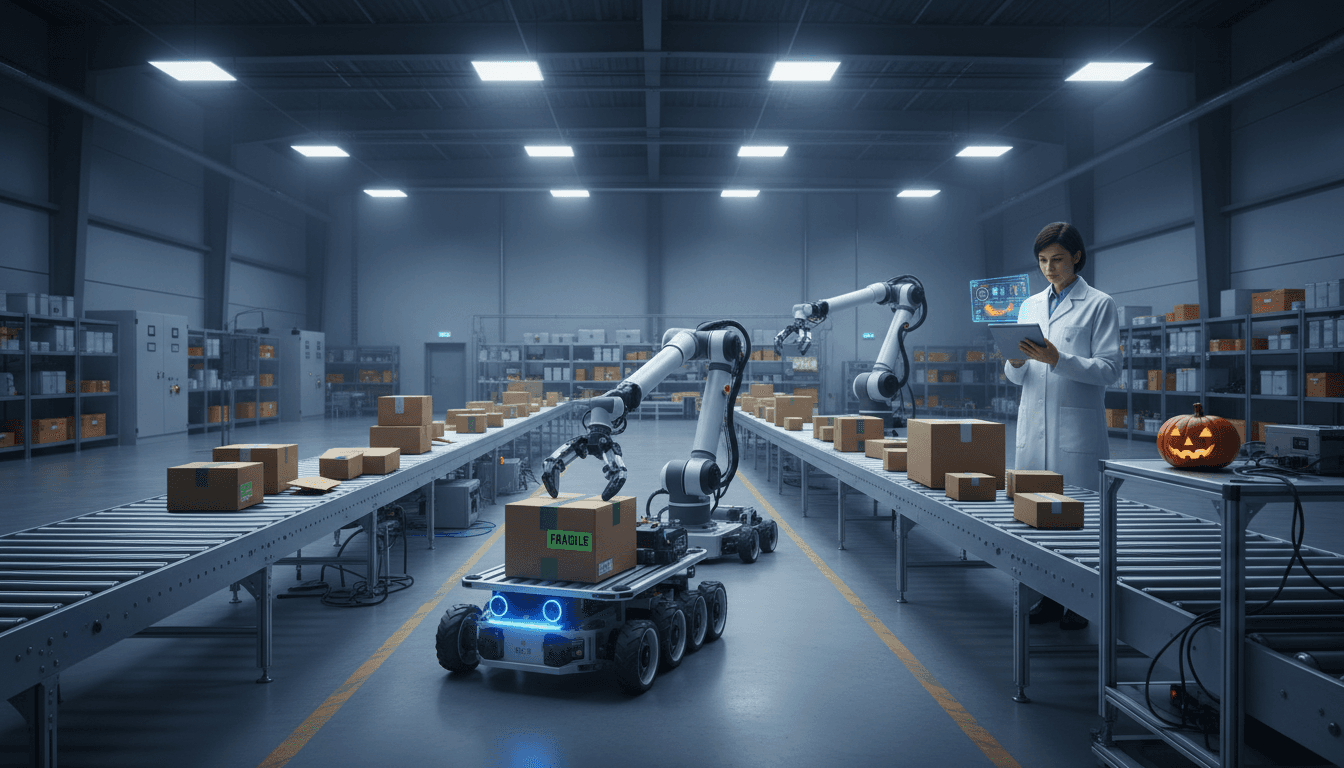
Robot Halloween, Real Business Impact: What’s Next
Robotics labs don’t usually coordinate their content calendars. So when multiple teams across universities and companies all post “Happy Robot Halloween” videos in the same week, I pay attention—not because it’s cute (it is), but because it’s a real-time snapshot of the innovation pipeline.
Behind the costumes and seasonal demos is a serious story: AI-powered robotics is shifting from “cool prototype” to “repeatable capability.” And that shift is what’s transforming industries worldwide—logistics, manufacturing, healthcare, retail, and even education.
This matters if you’re leading operations, product, or innovation. The labs posting playful clips are also publishing tactile sensors that detect contact onset in milliseconds, open-sourcing dexterous hands that can be assembled in a workday, and building warehouse robots that are tested like industrial equipment—not research projects.
The real signal in “Robot Halloween” demos
The fastest way to misread robotics progress is to treat viral lab videos as entertainment. The better way: see them as evidence that teams are converging on shared milestones—mobility that’s stable, manipulation that’s getting delicate, and AI that’s learning from more than just cameras.
Here’s the pattern I see across the week’s videos and talks:
- More labs are demonstrating “contact-rich” tasks (touching, gripping, adapting) instead of only free-space motion.
- More companies are showing test infrastructure, because reliability—not novelty—is what sells.
- More research is modularizing AI policies, because real deployments need models that can survive missing sensors, new tooling, and changing SKUs.
That blend—playful packaging, serious capability—is exactly how robotics has always moved into the mainstream.
A seasonal meme with a practical takeaway
Halloween content is a low-stakes way for labs to show what their robots can do without overselling. If a biped can handle a goofy “trick-or-treat” routine or a hand can manipulate a prop without dropping it, you’re seeing stability, perception, and control doing their jobs.
For businesses, the takeaway is simple:
If robots can repeat “silly” behaviors reliably, they’re getting closer to repeating “expensive” behaviors reliably.
That’s the bridge from lab to ROI.
Warehouse automation is maturing—because testing is getting ruthless
Warehouse robotics is no longer about whether automation is possible. The question is whether it’s robust under messy conditions: damaged cartons, variable lighting, mixed pallet heights, untrained staff interactions, and peak-season throughput.
One of the most telling highlights is the emphasis on warehouse-scale testing facilities—for example, recreating inbound operations (dock setups, conveyors, freight flow) to validate performance in the real world. That’s not marketing fluff. It’s a sign the industry is behaving more like automotive and aviation: test, break, fix, repeat.
Why this changes buying decisions
If you’re evaluating warehouse automation or robotics process automation for physical operations, you should care less about polished demos and more about:
- Mean time to recovery (MTTR): When the robot fails, how quickly can your team restore normal operations?
- Edge-case coverage: Does the vendor have a test regimen for the weird stuff (torn shrink wrap, crushed corners, glossy tape, odd barcodes)?
- Integration realism: Can it run with your WMS, your safety rules, your conveyor timing, and your staffing model?
The reality? A warehouse robot that’s 95% reliable can still be a headache if the 5% failure modes happen at the worst possible time—like late December peak. This is why serious test facilities are becoming a competitive advantage.
Practical next step: ask for “failure footage”
When vendors show only success clips, you’re learning nothing about operations. Ask for:
- Top 10 failure modes observed in customer-like tests
- The mitigation strategy for each failure mode
- What changed in hardware/software as a result
Good vendors will have that list ready. Great vendors will have measurements.
Touch is the missing sense in industrial robotic manipulation
Vision got robotics far. But in the real world—especially in manufacturing and fulfillment—touch is what prevents damage, enables gentle handling, and makes manipulation reliable when vision is occluded.
A standout theme in this week’s roundup is tactile sensing progress, including a multimodal tactile finger design that combines:
- Fast dynamic response (using PVDF film) to detect the onset and break of contact
- Static sensing (capacitive) to understand ongoing contact state
That combination matters because many industrial mistakes happen right at the moment of contact:
- A gripper closes a fraction too fast and crushes packaging
- A finger slips and “corrects” too late, dropping the item
- A robot bumps a fixture and keeps pushing, causing a jam
High-speed tactile feedback is how robots learn to stop being “strong” and start being “careful.”
Where tactile robotics pays off first
If you’re looking for near-term wins, tactile sensing shows up early in these use cases:
- E-commerce and grocery picking (soft items, deformable packaging)
- Electronics handling (fragile components, tight insertion)
- Healthcare automation (assistive devices, tool handoffs, patient-adjacent tasks)
- Automotive sub-assembly (cable routing, connector seating)
And yes—touch also reduces dependency on perfect vision setups, which lowers your total deployment friction.
AI policies are getting modular—because the real world is messy
A quiet but important research direction in the roundup: instead of concatenating all sensor features into one giant policy (where vision often dominates), some teams are factorizing policies into separate models per sensory representation (vision-only, touch-only, etc.), then using a router network to weight them.
This is more than a neat architecture trick. It solves three painful deployment problems:
- Dominant sensor bias: Vision can drown out sparse but critical touch signals.
- Incremental upgrades: You can add a new sensor later without retraining everything from scratch.
- Graceful degradation: If a modality fails (a camera gets occluded), the policy can still act.
If you’ve ever run an automation pilot that worked on Day 1 and became flaky by Day 30 due to sensor drift, lighting changes, or wear-and-tear, this is exactly the direction you want.
“Diffusion for control” is showing up in manipulation
Diffusion models aren’t just for generating images anymore. In robotics, diffusion-style policies can generate action sequences and handle uncertainty better than brittle, single-shot outputs.
For industry teams, you don’t need to implement diffusion models yourself to benefit. But you should watch for vendors and integrators who can explain:
- How their policies handle uncertainty and contact
- How they adapt to new SKUs or new fixtures
- What data they require to reach target performance
Which brings us to the uncomfortable part.
The home-data economy for humanoids is real—and ethically tricky
One of the most provocative developments mentioned: a model where people can be paid (e.g., $500/month) to allow a company’s robot to collect data inside their home.
I’m not going to pretend this is straightforward. It’s not.
From a robotics development standpoint, it makes sense: homes contain the long-tail variability that breaks robots—tight spaces, clutter, pets, reflective surfaces, and tasks humans do without thinking.
From a societal standpoint, it raises hard questions:
- Who truly controls the data?
- What gets captured incidentally (voices, faces, habits)?
- What counts as informed consent for everyone in the household?
Here’s my stance: consumer-sourced robotics data can accelerate capability, but only if privacy protections are designed like safety systems—default-on and independently audited. If your robotics roadmap involves real-world data collection, treat governance as a core product feature, not legal cleanup.
Dexterous hands are getting cheaper—and that changes everything
Dexterous manipulation has been “almost there” for a long time. What’s changing is the hardware accessibility.
An open-source anthropomorphic robotic hand design highlighted in the roundup claims:
- 17 degrees of freedom
- Tendon-driven architecture
- Integrated tactile sensors
- Assembly in under 8 hours
- Material cost below ~2,500 USD
Even if your final deployed hand costs more (it will, once you add production, QA, support, and safety), the direction is clear: hand hardware is becoming more standardizable, more reproducible, and easier to iterate.
Why dexterous robotics matters beyond humanoids
Humanoid robots get attention, but dexterity is valuable even on non-humanoid platforms:
- A stationary arm with a great hand can handle high-mix kitting.
- A mobile manipulator can restock shelves, pick returns, or service equipment.
- A collaborative robot with tactile feedback can do finishing tasks humans hate.
Dexterity is a capability multiplier. Once you can reliably grasp, reorient, and insert, whole categories of “manual-only” work become automatable.
Empathetic robots aren’t fluff—they’re a performance feature
Industrial robotics is about throughput. Human-facing robotics is about trust.
Research highlighted from the University of Chicago focuses on programming robots with empathetic responses and nonverbal social cues (like nodding) to improve human-robot teaming—for example, supporting children’s learning outcomes.
If you’re skeptical, you should be. Plenty of “social robot” demos have overpromised.
But dismissing rapport entirely is a mistake. In real deployments—schools, hospitals, hotels, retail—acceptance is part of system performance. A robot that people avoid, sabotage, or ignore is functionally broken.
A practical way to frame it:
In human environments, user experience is uptime.
Empathy doesn’t mean a robot has feelings. It means it has behaviors that reduce friction so the task gets done.
What to watch next: ICRA 2026 and the “capability stack”
The calendar note for ICRA 2026 (Vienna, June 1–5, 2026) is worth highlighting because conferences like ICRA are where you can see the capability stack come together:
- Hardware: hands, actuators, tactile skins
- Sensing: multimodal perception (vision + touch)
- Learning: modular policies, diffusion-based control
- Reliability: test infrastructure and operational metrics
- Interaction: trust cues, human-robot collaboration
If your company is building an AI and robotics strategy for 2026 budgets, this stack is the checklist. Not because you need everything at once, but because missing layers become hidden costs later.
People also ask (and the blunt answers help)
Is warehouse automation “solved”? No. But it’s mature enough that ROI is mostly an integration and reliability problem, not a feasibility problem.
Why is tactile sensing suddenly everywhere? Because manipulation without touch is like walking with noise-canceling headphones on. You can do it, but you’ll hit things.
Are humanoid robots the future of work? Some jobs, yes—especially where environments are built for humans. But dexterity, safety, and unit economics will decide timelines, not hype.
What this means for industry leaders right now
If you’re trying to turn AI-powered robotics into an operations advantage, focus on three moves that consistently work:
- Start with a task, not a robot. Define the workflow, constraints, safety rules, and variability.
- Demand reliability evidence. Ask for failure modes, recovery processes, and test results that resemble your environment.
- Plan for multimodality. Even if you start with vision, design the roadmap so touch (and other sensors) can be added without rebuilding everything.
This week’s “Robot Halloween” posts are a reminder that the robotics community is collaborative and surprisingly transparent. Labs share prototypes. Companies show testing. Researchers open-source hands and publish policy architectures. That’s good news if you’re buying, building, or partnering—because progress compounds across the ecosystem.
If you’re mapping where robotics can transform your industry in 2026, the question worth asking isn’t “Which robot should we buy?” It’s:
Which part of our work is ready for a robot that can see, feel, recover, and earn trust?