Chef+ is an AI meal-assembly robot built on 80M servings of production insight. Here’s what it changes on food lines—and how to evaluate ROI fast.
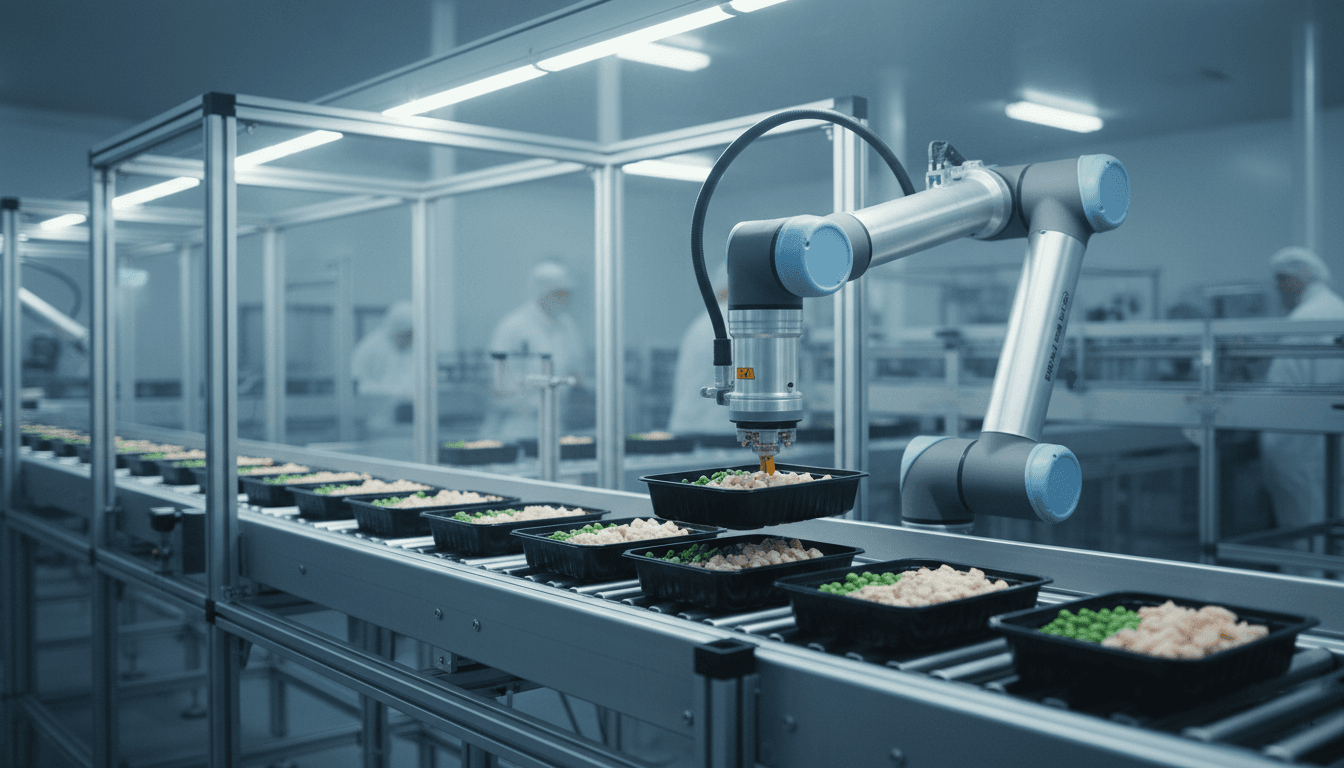
Chef+ Shows What AI Meal Assembly Looks Like in 2026
Eighty million servings is an unusually strong “lab.” It’s also the dataset Chef Robotics says sits behind Chef+, its newest AI-enabled meal-assembly robot for food manufacturing.
That number matters because most food automation fails for predictable reasons: ingredient variability, cold-room condensation, constant changeovers, and lines that never behave exactly the same way for long. Robots don’t struggle with the idea of repetition—they struggle with reality. Chef+ is interesting because it’s designed around the realities that make food production hard, not the brochure version of an assembly line.
This post is part of our “Artificial Intelligence & Robotics: Transforming Industries Worldwide” series, and Chef+ is a clean example of the theme: AI-powered robotics moving from pilot projects to daily production work where uptime, sanitation, and throughput decide whether the technology survives.
Why food manufacturing is a stress test for AI robotics
Food plants force robotics teams to earn their credibility. If you can assemble meals in a cold room with wet pneumatics, gloved operators, and ingredients that shift, clump, and tear, you can probably automate in a lot of other environments too.
Three constraints dominate most high-volume meal assembly operations:
- Floor space is capped. Adding a new machine often means removing something else—or reducing operator access, which creates new bottlenecks.
- Refills break throughput. Every time an ingredient pan empties, you either stop the line or create quality drift while someone rushes.
- Food safety is non-negotiable. Hygienic design isn’t a “nice to have.” If equipment is hard to clean, it becomes expensive quickly.
Chef Robotics is aiming Chef+ directly at these constraints. And that’s the right bet. In 2025, the winners in industrial AI aren’t the companies that promise fully autonomous factories. They’re the ones that remove the worst friction from real lines, week after week.
What Chef+ changes on the line (and why it’s not just “a faster robot”)
Chef+ isn’t positioned as a dramatic leap in robot arm capability. It’s positioned as a set of operational upgrades that compound: fewer refills, fewer failures, less cleaning pain, and more consistent placement.
Doubled ingredient capacity: throughput is a refill problem
Chef Robotics says Chef+ doubles ingredient capacity by using ingredient pans that are twice the volume of prior models. In practice, this targets an unglamorous metric that matters more than peak picks-per-minute: minutes between interruptions.
In many ready-meal plants, “refill runners” become an invisible bottleneck. When pans run dry—especially with low-density ingredients like leafy greens—the line rhythm degrades:
- More human touchpoints (and therefore more chances for contamination events)
- Micro-stoppages that accumulate into lost output
- Increased variability in portioning at the tail end of a pan
If you’re evaluating meal assembly robotics, ask a simple question: What percentage of your lost time is driven by refills versus mechanical faults? If refills are a top driver, capacity improvements can beat “speed improvements” on ROI.
Same footprint as a worker: robots need to fit the plant you already have
Chef Robotics says Chef+ maintains a footprint comparable to a worker while increasing capacity. That’s important because many facilities aren’t designed for modern automation lanes.
Space constraints drive decisions like:
- Whether you can run two lines back-to-back
- Whether operators can still access the conveyor for QA pulls
- Whether sanitation teams can clean around the equipment without disassembly
My take: footprint is one of the most underweighted requirements in automation RFPs. Plants rarely have “extra meters” sitting around, and facilities teams hate re-layout projects for good reason.
Reliability upgrades: cold rooms punish electronics
Chef Robotics is explicit about reliability engineering choices, including sealed wiring, IP cameras instead of USB-C cameras in cold environments, and a water separator to keep pneumatic air dry.
Those details aren’t marketing fluff—they’re survival tactics. Cold production environments create condensation cycles that quietly kill uptime:
- Moisture in pneumatics can cause sticking, inconsistent actuation, and maintenance churn.
- Consumer-style connectors (and even some industrial ones) can loosen or corrode in harsh washdown-adjacent realities.
- Connectivity drops become “robot problems” even when they’re infrastructure problems.
Chef+ also includes multiple dome antennas to improve Wi‑Fi connectivity. If you’ve ever watched an automation project get blamed for a flaky network, you know why that matters.
Food safety by design: easier cleaning is a performance feature
Chef Robotics says Chef+ replaces two front closed tubes with an open-angle iron frame, reducing crevices that trap residue.
That’s the right direction. Hygienic design directly affects:
- Sanitation cycle time (and therefore available production time)
- Risk of allergen cross-contact during changeovers
- Audit readiness and documentation burden
A practical buying tip: during demos, don’t just watch the robot run. Watch how it gets cleaned. Ask what tools are required, what parts are removed, and how long a full sanitation cycle takes.
Usability: gloves, changeovers, and operator patience
Chef+ includes features aimed at daily operator use: glove-friendly touchscreen tech, sliding pans with a locking mechanism, daisy-chain power options, self-leveling feet, and an integrated handle for moving it.
These choices matter because the real enemy of automation is not “technology risk.” It’s operator workarounds. If setup is annoying or changeovers are slow, the line will find a way to bypass the system.
When robotics feels like it’s built for the plant (not for an engineering lab), adoption happens faster and failure rates drop.
Performance: vision and compute where it counts
Chef Robotics says Chef+ offers higher CPU/GPU processing power and a three-camera vision system to track conveyor speed and trays for precise placement.
This is the core AI robotics promise in food manufacturing: not blind repetition, but real-time adaptation when trays drift, conveyors change speed, or lines pause.
Traditional automation often assumes:
- Fixed tray position
- Consistent speed
- Minimal variation
Food lines rarely behave that way. Vision-based perception and closed-loop adjustments are what make AI-powered robotics credible here.
The “pat-down” gripper: why end-of-arm tooling is where ROI often hides
Chef Robotics’ new pat-down capability automates a manual task: flattening ingredients to improve tray coverage and sealing. It uses vibration technology in the end effector and a flat, cross-slotted utensil.
That may sound niche. It isn’t.
Sealing problems create a chain reaction:
- Poor seals → leaks and spillage
- Spillage → sealing machine downtime and cleaning events
- Downtime → missed production targets
- Rejected trays → waste and rework
If a robot can reduce variability before sealing, it can prevent issues that are far more expensive downstream.
Why “flattening” is a robotics problem, not just a labor problem
Humans flatten food intuitively. They compensate for uneven distribution and ingredient clumps without thinking about it. Robots need explicit sensing and control.
Chef Robotics says its AI-powered computer vision detects and tracks trays in real time, handling variations in tray position, line stoppages, and speed changes—situations that older automation struggles with.
Here’s the stance I’ll take: the most valuable robots in food plants will be the ones that stabilize variability, not the ones that chase maximum speed.
Coordinated robots (R2R): the real path to throughput
For high-volume operations, Chef Robotics notes its robot-to-robot system can coordinate multiple robots by alternating trays. This is another important industry trend: moving from “one robot cell” to multi-robot orchestration.
In practice, orchestration helps when:
- One task (like deposition) is fast but another (like pat-down) needs more dwell time
- You want redundancy (one robot can keep partial throughput during maintenance)
- You’re scaling capacity without redesigning the whole line
It’s also a preview of where industrial AI is heading: not isolated smart machines, but networks of machines sharing context.
How to evaluate AI meal-assembly robots without getting fooled
If you’re considering AI-enabled robotics for food production, the goal isn’t to buy “the smartest robot.” The goal is to buy predictable output with manageable risk.
The due diligence checklist I’d use
- Uptime proof, not just demo videos
- Ask for run-time evidence in environments similar to yours (cold room, humidity, washdown proximity).
- Changeover time and sanitation time
- Get numbers: minutes for a typical recipe change, minutes for full clean.
- Refill model and labor impact
- Quantify refill frequency today vs. expected after deployment.
- Vision robustness
- Verify performance during conveyor speed changes, tray drift, and brief stoppages.
- Integration scope
- Clarify what’s required from your side: networking, power drops, compressed air quality, conveyor modifications.
- Commercial model fit
- Chef Robotics uses a robotics-as-a-service model for capabilities like pat-down. RaaS can speed adoption, but you should still model total cost over 24–60 months.
A practical ROI model (simple, but effective)
For ready meals, ROI typically comes from a mix of:
- Labor reallocation (not always headcount reduction)
- Higher throughput from fewer stops
- Less waste from better portion consistency and fewer seal rejects
- Reduced injuries by removing repetitive tasks
If you can’t quantify at least two of those with baseline data, you’re not ready to sign anything.
What Chef+ signals about AI and robotics in manufacturing for 2026
Chef+ is a reminder that industrial AI progress looks like engineering details: sealed wiring, better cameras, moisture control, glove-friendly UX, and tooling that solves one annoying, expensive task.
Zooming out to the theme of this series—Artificial Intelligence & Robotics: Transforming Industries Worldwide—this is exactly how transformation spreads. Not through flashy humanoids, but through specialized robots that show up to work every day and make factories measurably calmer.
If you’re leading operations or engineering in food manufacturing, now is a good time to audit your line constraints: where do stoppages start, where does waste get created, and which manual tasks exist purely because the environment is too variable for old automation? Those are the first places AI-powered robotics can pay for itself.
If you want help pressure-testing a meal-assembly automation plan—requirements, integration risk, and an ROI model you can defend—build a shortlist of your top three bottlenecks and map them to measurable metrics. The right robotics program starts there.
What’s the one task on your line that everyone accepts as “just the way it is,” even though it quietly drives downtime or waste?