TE’s 3D industrial application tool helps teams choose connectivity and sensor components in context—speeding robotics integration and smart manufacturing rollouts.
TE’s 3D Tool Makes Robotics Integration Less Painful
A lot of automation projects don’t fail because the robot can’t move. They fail because everything around the robot—connectors, sensors, cabling, enclosures, network paths, power distribution—was treated like a late-stage shopping list.
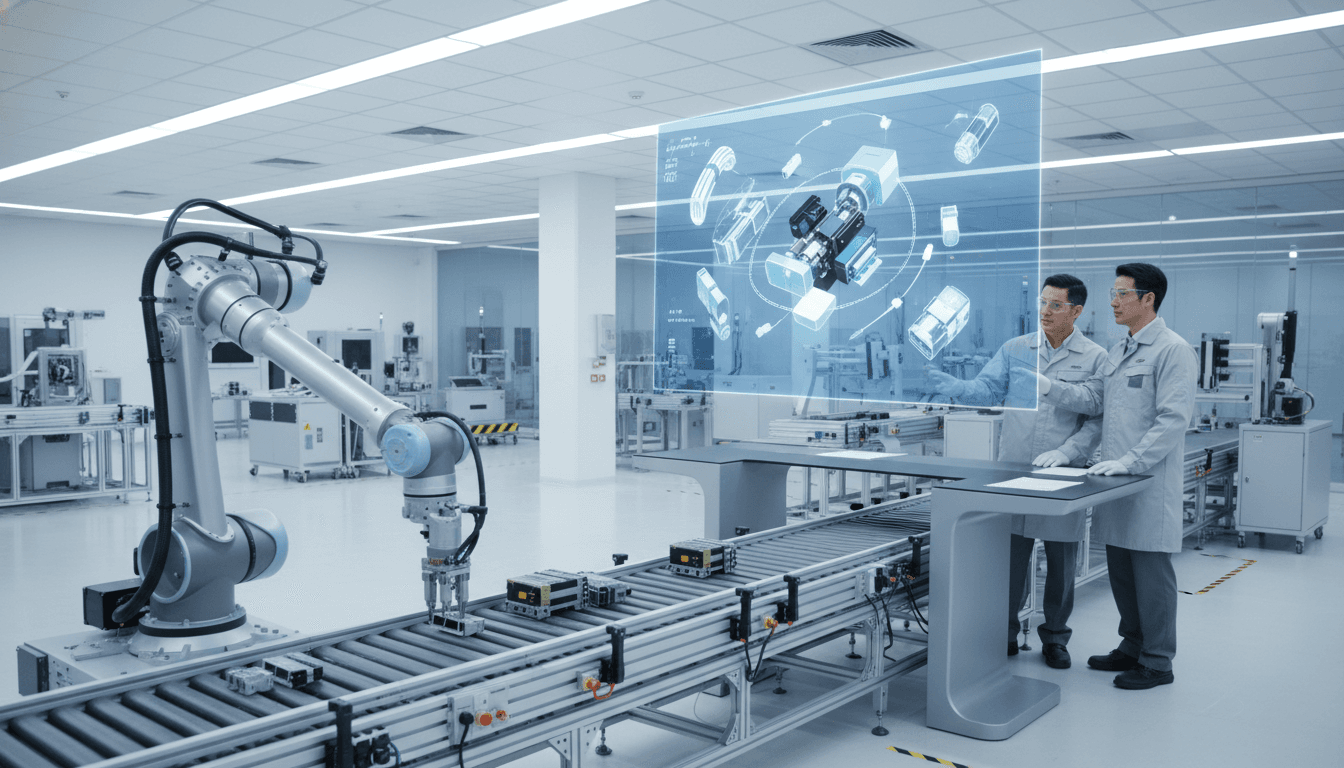
TE Connectivity’s new 3D Industrial Applications Tool is a direct response to that reality. Instead of forcing engineers and ops teams to piece together a solution from scattered datasheets and product pages, TE is putting its portfolio into realistic industrial scenes so you can see where parts live, how they’re used, and what’s typically paired together. For AI and robotics leaders trying to scale smart manufacturing, that’s not a “nice UI.” It’s an enablement layer.
This post is part of our “Artificial Intelligence & Robotics: Transforming Industries Worldwide” series, and I’ll take a stance: visual, application-first product discovery is becoming a prerequisite for scaling industrial automation. The stacks are too complex, and the cost of integration mistakes is too high.
Why a 3D industrial application tool matters for AI and robotics
A 3D industrial application tool reduces integration friction by turning component selection into a context-driven workflow. In robotics and AI-enabled factories, context is everything—temperature, vibration, ingress protection, EMI, washdown requirements, cable routing, maintenance access, and safety constraints.
TE’s tool is built to be an “intuitive journey” through industrial environments, letting users explore solutions using familiar application language. That matters because most robotics programs involve cross-functional decision-making:
- Controls engineers think in I/O, protocols, and cabinet layouts
- Manufacturing engineers think in uptime, takt time, and changeovers
- Maintenance thinks in access, replaceability, and standardization
- Procurement thinks in suppliers, lead times, and alternates
- IT/OT thinks in segmentation, reliability, and security
When each group evaluates components in isolation, you get the classic outcomes: mismatched connector families, field wiring that’s hard to service, sensors mounted in fragile locations, or networking gear that doesn’t match the environment.
TE says the tool includes 53 industrial applications and 120+ product cards, with access to 3D representations, images, videos, and links (we won’t include links here). The bigger story is what that structure enables: a shared visual reference for teams trying to standardize automation.
The hidden bottleneck: “last-meter” integration
AI gets the headlines, but the factory wins are often decided in the last meter—where the robot connects to the cell.
If you’re deploying robotics and warehouse automation at scale, you’re managing hundreds (sometimes thousands) of repeating integration decisions:
- How do we route power and data to moving axes?
- Which connector system survives coolant mist and daily washdowns?
- Where do we place sensors so they don’t get smashed during maintenance?
- How do we keep the network stable when the cell expands?
A well-designed 3D application navigator doesn’t answer every question. But it shortens the time from “we should automate this” to “here’s a buildable bill of materials that meets the environment.”
What TE’s nine focus areas signal about industrial automation in 2026
TE’s nine focus applications map cleanly to where AI-driven robotics is actually scaling. TE consolidated its platform around:
- Automation control
- Automation sensors
- Networking devices
- Motion and drives
- Robotics and warehouse automation
- Semiconductor manufacturing equipment
- Battery energy storage systems (BESS)
- Electric vehicle charging
- Climate solutions
This isn’t a random list. It’s a snapshot of the industrial investment priorities that are likely to dominate 2026 planning cycles.
Robotics and warehouse automation: the “repeatability” problem
In robotics and warehouse automation, leaders aren’t struggling to prove value anymore—they’re struggling to repeat deployments across sites.
Repeatability depends on standard cell architectures:
- consistent sensor/actuator wiring approaches
- consistent connector families and cable management
- consistent network topologies and ruggedization choices
A 3D application tool supports that by making standardization easier to communicate. If your team can point to a “known-good” pattern in a realistic scene, you spend less time debating basics and more time improving throughput.
BESS and EV charging: harsh environments plus high uptime
Battery energy storage systems and EV charging share two traits: high uptime expectations and environmental stress. That’s where connectivity and sensing choices get unforgiving.
If you’ve ever diagnosed intermittent faults caused by moisture ingress, vibration loosening, or thermal cycling, you know why “tested in harsh environments” is more than marketing language. The right selection early prevents a lot of ugly field failures.
Semiconductor manufacturing equipment: precision at scale
Semiconductor equipment pushes reliability, cleanliness, and precision. It also increasingly relies on dense instrumentation and data capture.
As AI expands in process control and predictive maintenance, the number of sensors and data paths grows. Tools that help engineers visualize where and how components fit into these systems save time—and reduce the chance of creating service nightmares.
How 3D modeling accelerates smart manufacturing decisions
3D modeling speeds up smart manufacturing by reducing back-and-forth during design, procurement, and commissioning. It also helps avoid expensive rework.
Here are three practical ways teams can use a 3D industrial application tool like TE’s.
1) Faster alignment between design and maintenance
A robotics cell that’s hard to service will punish you for years. Visualizing connector placement, routing, and access paths early can prevent:
- blocked access to quick-disconnects
- cables routed too close to pinch points
- sensor mounts that require disassembling half a guard to replace
I’ve found that maintenance teams give better feedback when they can react to a scene rather than a schematic. They’ll spot the “you can’t reach that” issues immediately.
2) Better component standardization across sites
If you’re scaling AI and robotics across plants, standardization is one of the highest ROI moves you can make. But standardization fails when it’s presented as a spreadsheet mandate.
A visual tool makes it easier to build an internal standard library:
- “This is our default approach for robotics end-of-arm wiring.”
- “This is our standard for warehouse conveyor zones.”
- “This is what we use for motion and drives in high-vibration areas.”
Once those patterns are established, procurement and spares strategies get simpler.
3) Smoother vendor and integrator communication
Most automation programs involve integrators, OEMs, and internal engineering. Miscommunication is common—especially when people use different terms for the same thing.
Application-based navigation helps teams communicate intent:
- “We’re building this kind of cell.”
- “The environment is like this.”
- “The connector needs to be serviceable from here.”
That reduces churn in the RFQ and commissioning phases.
What manufacturing leaders should look for in “AI-ready” connectivity
AI-ready robotics requires connectivity that’s robust, serviceable, and scalable—not just fast. Data speed matters, but factories lose money when systems are fragile.
Use this checklist when evaluating connectivity and sensing solutions for robotics integration and smart manufacturing.
The AI/robotics connectivity checklist
- Environmental fit: ingress protection, temperature range, vibration, chemical exposure, washdown.
- EMI resilience: shielding strategy and grounding paths that match your environment.
- Serviceability: tool-less access where possible, clear labeling conventions, accessible disconnect points.
- Modularity: ability to swap assemblies without redesigning the whole harness.
- Supply chain realism: alternates, lead times, approved vendor lists, and spares strategy.
- Mechanical protection: strain relief, bend radius management, protection near moving joints.
- Network architecture support: segmentation needs, rugged networking device compatibility, and expansion paths.
A 3D application tool doesn’t replace engineering validation, but it can improve the starting point so fewer projects begin with assumptions.
TE’s broader 2025 moves show what “infrastructure innovation” looks like
The 3D Industrial Applications Tool fits a pattern: TE is investing in the infrastructure that helps customers build faster. The original report highlights several 2025 developments, and they’re worth reading as a single narrative.
Rapid prototyping capacity (medical manufacturing)
TE expanded rapid prototyping capabilities in two U.S. facilities (Plymouth, Minnesota, and Wilsonville, Oregon), including quick prototypes, 3D printing, polymer extrusion, and material testing.
Why it matters for AI and robotics: prototyping speed is increasingly a competitive advantage in automation. Whether you’re iterating an end effector mount or validating a sensor housing, the ability to prototype quickly reduces the time from concept to stable production.
Data center and AI connectivity (PCIe Gen 7)
TE launched Ultra Low-Profile PCIe Gen 7 connectors and cable assemblies with an 8.7 mm mating height and 128 gigatransfers per second capability.
That’s not factory-floor hardware, but it’s part of the same story: AI workloads demand dense, reliable connectivity, and the companies that can deliver it tend to bring that discipline into industrial portfolios too.
Modular transceiver platforms (data-intensive environments)
TE also introduced the MULTIGIG Transceiver platform aimed at rugged, modular fiber optic transceiver placement for performance.
The smart manufacturing connection is direct: as factories become more data-intensive—vision systems, quality analytics, predictive maintenance—connectivity becomes a scaling constraint. Modular, rugged approaches are the difference between “pilot” and “rollout.”
How to use tools like this in your next robotics rollout
Treat 3D application tools as decision accelerators, not marketing demos. If you approach them with a structured workflow, you’ll get value quickly.
A practical 30-minute workflow
- Pick one target cell type (e.g., palletizing, machine tending, conveyor zone, AMR charging area).
- List your environmental constraints (washdown, coolant, vibration, temperature, dust).
- Map the critical interfaces: robot-to-cabinet, cabinet-to-network, sensor-to-PLC, end effector wiring, safety.
- Use the 3D environment to shortlist the families that match your constraint profile.
- Document a “standard pattern” (even a one-page internal note) and reuse it for the next cell.
When teams do this consistently, they reduce design variability—and variability is the enemy of uptime.
One-liner worth sharing: Robotics scale isn’t limited by robot count; it’s limited by integration repeatability.
Where this is heading in 2026
AI and robotics are transforming industries worldwide, but the winners won’t be the ones with the flashiest demos. They’ll be the ones who can deploy reliable systems repeatedly across real sites, under real constraints.
TE Connectivity’s 3D Industrial Applications Tool is a small sign of that shift: more vendors are building experiences that reduce ambiguity and help engineers make context-correct choices faster.
If you’re planning your 2026 automation roadmap, consider this question: Where are your teams still making “spreadsheet decisions” that would be better made with shared visual context—and how much rework is that causing you every quarter?