AI guest communication is becoming hotel infrastructure. See how unified messaging and review management improve response time, reputation, and direct bookings.
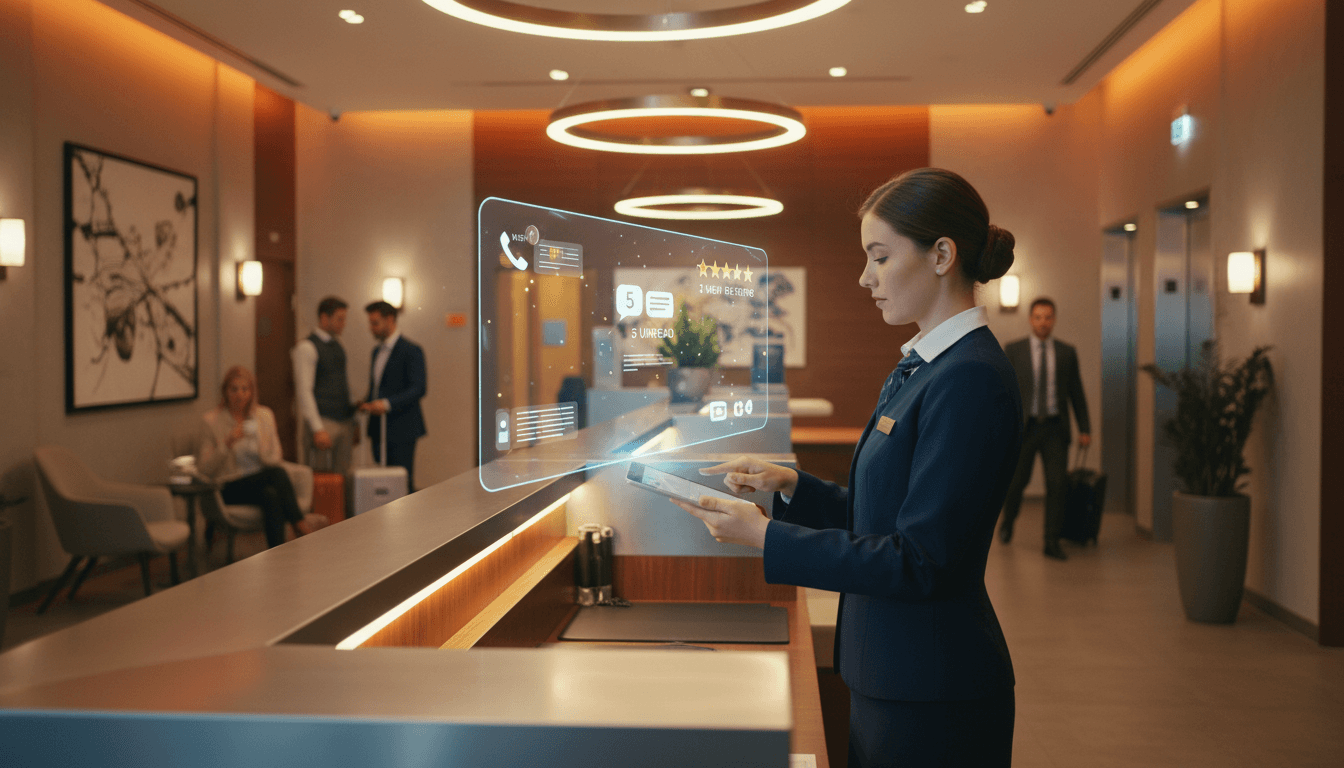
AI Guest Communication in Hotels: Faster Replies, Better Reviews, More Direct Bookings
A hotel’s guest experience is increasingly decided before the guest even arrives—inside an inbox, a WhatsApp thread, a web chat, or a phone call that hits your front desk at peak check-in.
That’s why the Cloudbeds–Traversing.ai partnership announced this week matters for anyone following our “पर्यटन और आतिथ्य उद्योग में AI” series. It’s not just another vendor integration. It’s a signal that AI customer experience in hospitality is becoming operational infrastructure: messaging, voice, booking, upsell, and review management living in one workflow instead of five disconnected tools.
The promise is straightforward: respond faster across channels, protect (and lift) your online reputation, and convert more demand into direct bookings. The hard part is execution—getting AI to help without making your service feel robotic. Let’s talk about what this partnership enables, what to measure, and how to roll it out in a way that actually improves guest satisfaction.
Why hotels are betting on AI guest communication in 2025
Answer first: Hotels are adopting AI guest communication because modern guests expect near-instant responses across voice and digital channels, and manual handling can’t scale without adding headcount.
Guests don’t think in “departments.” They don’t care whether a question belongs to reservations, front office, or housekeeping. They care that someone answers—quickly, accurately, and in the same channel they used.
Here’s the operational reality I see again and again:
- Response time slips during high-occupancy periods (hello, year-end holiday surge and winter travel peaks).
- Teams juggle too many channels—calls, email, OTA messages, web chat, social DMs.
- Important requests get stuck in the middle: late check-out approvals, airport pickup, baby cot, dietary notes.
When response time slows down, three things happen quickly:
- Conversion drops (especially for direct bookings)
- Review sentiment worsens (“no one replied”, “impossible to reach”)
- Staff burnout rises because the work becomes constant interruption
This is exactly where AI in tourism and hospitality earns its keep: not as a novelty, but as a load-balancer for guest communications.
What the Cloudbeds + Traversing.ai integration actually changes
Answer first: This integration brings AI-driven contact center, unified messaging, and review management inside the Cloudbeds ecosystem, aiming to reduce response times and improve booking conversion and reputation outcomes.
The announcement highlights three capabilities now available to Cloudbeds customers globally:
- AI Contact Center (voice + digital)
- Review Management Suite (centralized review workflows)
- Conversational Distribution Engine (chat-led booking and demand conversion)
Cloudbeds is already positioned as a unified operating platform for many hotels. Traversing.ai adds the layer most hotels struggle to staff consistently: always-on guest communication and reputation follow-through.
Unified messaging isn’t a “nice-to-have” anymore
Answer first: Unified messaging reduces operational friction by keeping guest context in one place, so staff don’t waste time hunting for history and can respond consistently.
When guests bounce between channels (they do), the worst experience is repeating themselves: “I already told you my flight lands at 2 AM.” AI-supported unified messaging is valuable when it:
- Preserves conversation history across channels
- Uses templates and tone guidelines aligned to your brand
- Routes edge cases to humans with the right context
If you’re running a property in a competitive destination, this matters because speed + consistency is now part of your product.
AI-generated upsell recommendations (with a real revenue claim)
Answer first: The big commercial opportunity is turning service conversations into revenue moments—without pushing guests.
The RSS announcement cites “up to a fourfold increase in direct bookings” and incremental upsell revenue from AI-generated recommendations. Don’t treat that as a guaranteed result, but do treat it as a directional truth: conversations are where revenue is won or lost.
A practical example:
- Guest asks: “Is your pool heated in December?”
- A human might answer yes/no.
- A smart AI-assisted flow answers, then offers:
- a room upgrade closer to the pool,
- a spa slot during cooler evenings,
- or an airport pickup for late-night arrivals.
This works only if the offer is relevant and polite. Guests can smell desperation. They reward usefulness.
Review management becomes a performance lever, not a chore
Answer first: Centralized review management helps hotels respond faster and more consistently, which strengthens trust and improves future conversion.
Reviews aren’t just reputation; they’re demand signals. The pattern of complaints tells you what to fix. The pattern of praise tells you what to double down on.
AI review workflows can help by:
- Consolidating reviews from major platforms into one dashboard
- Drafting response suggestions in your brand voice
- Flagging urgent negative reviews for immediate human handling
- Tracking response rate and response time as KPIs
The real win is cultural: you stop treating reviews like PR cleanup and start treating them like product feedback.
The guest-experience flywheel: how communication, reviews, and demand connect
Answer first: Faster, higher-quality communication improves satisfaction; better satisfaction improves reviews; stronger reviews increase conversion; higher conversion funds better service.
This is the bridge point that connects the integration back to our series theme: AI ग्राहक अनुभव, मांग पूर्वानुमान और सेवा निजीकरण को बेहतर बनाता है।
Think of it as a flywheel with three inputs:
- Guest communication speed (voice, chat, messaging)
- Service personalization (remembering preferences, intent-based suggestions)
- Online reputation management (review response and sentiment trends)
When these are disconnected, you get mismatched expectations:
- Marketing promises “instant support,” operations can’t keep up.
- Guests mention issues in reviews, but nobody closes the loop internally.
- Direct booking campaigns drive inquiries that staff can’t answer fast enough.
An integrated AI layer can close that loop by turning conversations into structured data:
- What questions are asked most?
- Which amenities drive booking decisions in December?
- Which room types trigger the most pre-arrival confusion?
- What complaints show up repeatedly in reviews?
That’s not just automation. That’s operational intelligence.
How to implement AI guest communication without sounding robotic
Answer first: The safest rollout is to automate the repetitive 60–70% and keep humans in control of exceptions, tone, and service recovery.
Most companies get this wrong by aiming for “full automation” on day one. Guests don’t want that. Teams don’t trust it. And one weird reply can become a screenshot that lives forever.
Here’s a rollout plan that works.
Step 1: Define what AI can answer (and what it must escalate)
Start with a simple policy matrix:
- AI can answer: check-in/out times, parking, pet policy, directions, Wi‑Fi basics, breakfast hours, room availability questions, invoice request routing.
- AI must escalate immediately: medical issues, safety/security, cancellations with penalties, overbooking conflicts, discrimination/harassment complaints, compensation requests.
Set escalation triggers based on keywords and sentiment.
Step 2: Train your brand voice (and stick to it)
If your hotel is premium, your tone should be calm and concise. If you’re a family resort, warmer is fine—but avoid forced cheer.
Create a “voice sheet” with:
- 5 example replies you love
- 5 phrases you never want used
- Rules for formality (Mr./Ms. vs first name)
- Rules for multilingual responses (especially for high inbound markets)
Step 3: Build service personalization from real signals
Personalization doesn’t mean guessing. It means using known context:
- Arrival time, length of stay, party type (solo/couple/family)
- Previous requests (quiet room, high floor)
- Current season patterns (December: heating, holiday dining, airport delays)
Good AI personalization feels like attentiveness, not surveillance.
Step 4: Put review response on a clock
Decide your standards and publish them internally:
- Respond to negative reviews within 24 hours
- Respond to positive reviews within 48–72 hours
- Escalate serious accusations immediately to management
AI can draft, but a human should approve anything sensitive.
Metrics that prove AI is helping (not just “doing stuff”)
Answer first: The best metrics tie AI activity to guest satisfaction, conversion, and labor efficiency.
If you’re implementing AI in hospitality operations, measure this weekly:
- Median first response time by channel (voice, chat, messaging)
- Resolution time (how long until the guest gets a real outcome)
- Direct booking conversion rate from chat/voice leads
- Upsell attach rate (spa, transfers, upgrades) from conversations
- Review response rate and review response time
- Sentiment trend (percentage of negative reviews mentioning “communication”)
- Staff workload indicators (messages per agent per hour, after-hours volume)
One stance I’ll defend: if you can’t connect AI to at least one revenue metric and one satisfaction metric, you’ll end up cutting it during budget season.
What this means for tourism and hospitality leaders planning 2026
Answer first: Partnerships like Cloudbeds + Traversing.ai show AI is moving from pilot projects to platform-level deployment across global hotel operations.
As we head into 2026 planning cycles, hotels that win won’t be the ones with the most tools. They’ll be the ones with fewer tools that share data and support consistent service.
This partnership also signals a shift in buying criteria:
- Hotels will prefer AI that lives inside core workflows (PMS/ops platform), not as a separate tab no one opens.
- Reputation management will be evaluated as part of revenue performance, not marketing hygiene.
- “Personalization” will be judged on whether it reduces friction and improves outcomes, not whether it sounds fancy.
If you’re leading operations or guest experience, the practical next step is simple: map your communication journey end-to-end, identify where response time collapses, and decide what you’re comfortable automating first.
You don’t need more AI. You need the right AI in the right moments—the moments guests remember.
If AI can help your team answer faster, recover service issues earlier, and turn genuine questions into direct bookings, what would you redeploy your staff time toward—more training, better upsell conversations, or deeper guest delight?