EU-funded 5G XR apprenticeships offer a clear model for AI-powered healthcare training—scalable, measurable skills practice across campuses and rural regions.
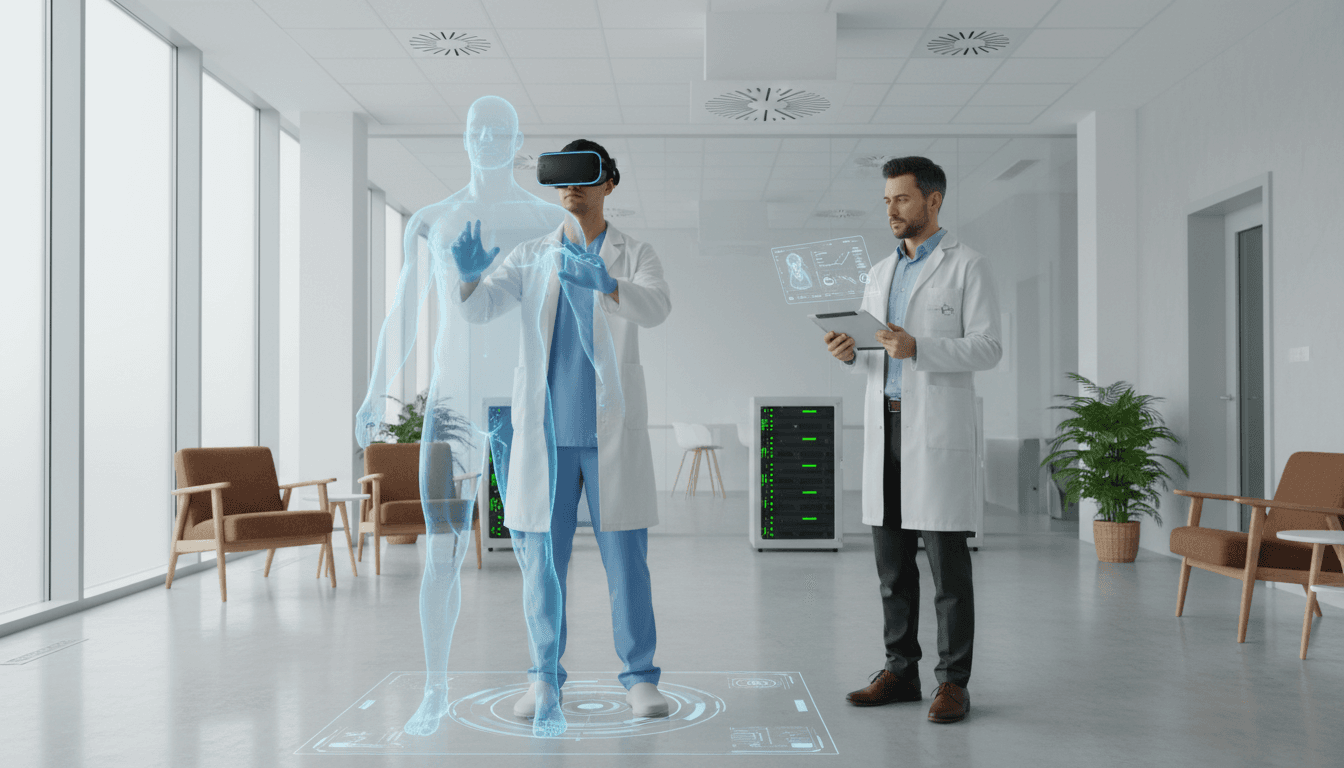
EU-Funded 5G XR Apprenticeships: A Playbook for AI
€6.25 million is a serious vote of confidence in one idea: skills training doesn’t have to be tied to a specific room, a specific timetable, or even a single campus. Atlantic Technological University (ATU) and Vodafone Ireland have secured €4.6 million from the EU’s Connecting Europe Facility (CEF) Digital Fund—then topped it up with their own investment—to build XR (extended reality) learning labs running on a private 5G standalone network with on-campus edge computing.
On the surface, this is about engineering and construction apprenticeships. The bigger story for our “AI in Technology and Software Development” series is how this model can translate almost directly into AI-enabled healthcare training—where the stakes are higher, the talent pipeline is tight, and hands-on practice is expensive.
I’m strongly in favour of this direction. Most “online training” still treats practical work like an afterthought. The reality? If we want more clinicians, technicians, and biomedical engineers—without lowering standards—we need better digital practice environments, not just better video calls.
What ATU and Vodafone are building (and why it matters)
ATU and Vodafone are building an apprenticeship platform where the network is part of the classroom. That sounds abstract until you picture what XR needs: high-resolution 3D environments, responsive interaction, multi-user sessions, and stable performance.
Here’s what’s in the plan, as described in the project announcement:
- XR labs that support virtual and augmented reality learning
- A private 5G standalone network (not “best-effort” public connectivity)
- Edge computing on campus to keep latency low and performance consistent
- Piloting at ATU Donegal, with collaboration across borders via the wider €12.3 million 5G-SHARE programme alongside universities in Romania and the Czech Republic
- Consortium support from FifthIngenium, focused on immersive educational applications
The training tools highlighted include:
- Virtual construction labs for practising builds using digital models
- Immersive platforms that simulate construction environments
- 3D video streaming for teaching technical skills through realistic simulations
Answer-first takeaway: This initiative matters because it treats connectivity + compute + content as one integrated system—exactly the foundation you need for serious AI-powered training in healthcare.
The hidden healthcare angle: XR labs are “clinical sim” infrastructure
Healthcare education has a bottleneck that’s hard to fix with traditional e-learning: you can’t scale clinical placement capacity as quickly as you can scale lecture capacity. Simulation helps, but physical simulation centres are costly and geographically limited.
An XR lab supported by private 5G and edge compute is basically a distributed simulation centre. Translate “virtual construction lab” into healthcare and you get:
- A virtual ward for patient deterioration scenarios
- A simulated operating theatre for OR safety checklists and teamwork
- An imaging suite for radiography positioning practice
- A pharmacy workflow simulator for dispensing and medication safety
Even more useful: XR creates a controlled environment where you can repeat scenarios until performance improves—without putting patients at risk.
My stance: If healthcare systems are serious about reducing adverse events and improving workforce readiness, they should treat immersive simulation as core infrastructure—on par with learning management systems.
Where AI fits naturally (and where it doesn’t)
AI doesn’t replace the lab. It makes the lab smarter.
In a 5G + edge + XR environment, AI can:
- Personalise learning paths based on a learner’s error patterns (not just quiz scores)
- Provide real-time coaching (for example, flagging a missed sterile field step)
- Enable automatic competency documentation through interaction logs
- Support scenario generation so instructors can create variations quickly
- Power speech-based assessment for communication and handover drills
Where AI doesn’t help much: pretending that watching a model answer is equivalent to doing the work. AI is strongest when it’s measuring, adapting, and coaching—not when it’s replacing practice.
Why private 5G and edge computing are the real enablers
A lot of organisations try to run immersive learning over consumer-grade networks and then blame the content when learners disengage.
Answer-first: Private 5G + edge computing matters because it delivers predictable performance, which is what practical training needs.
Here’s what those components do in plain terms:
Private 5G standalone network: controlled, not crowded
A private 5G SA network gives the provider control over:
- Quality of service (prioritising XR traffic)
- Security boundaries (important for real-world healthcare data later)
- Coverage design (campus labs, workshops, clinical skills rooms)
For healthcare training, this is the difference between “it worked yesterday” and “it works every session.”
Edge computing: reducing latency where it counts
XR training often fails when the system feels laggy. Latency doesn’t just annoy learners—it can cause motion discomfort and breaks “presence,” which is the whole point.
Edge compute keeps heavy processing closer to the user so that:
- Interaction feels immediate
- Multi-user sessions stay synchronised
- High-resolution 3D and 3D video streaming remain stable
From an AI perspective, edge computing also supports on-site inference for certain models (for example, motion analysis or speech recognition), which can reduce dependency on remote cloud calls.
A cross-sector partnership model healthcare should copy
The ATU–Vodafone consortium structure is a preview of how healthcare AI will scale: universities + network operators + specialist software builders + government support.
Healthcare often tries to procure “AI” as a product. That’s the wrong mental model. What you actually need is an ecosystem:
- Education providers define competencies and assessment standards
- Connectivity providers ensure performance and availability
- XR and simulation vendors build scenario content and tooling
- AI teams implement analytics, coaching, and adaptive pathways
- Regulators and funders align incentives and de-risk adoption
This is especially relevant in Ireland, where workforce shortages and regional access challenges make “train locally, consistently” more than a nice-to-have.
Snippet-worthy line: If you want scalable healthcare upskilling, build the networked training platform first—then add AI where it measurably improves competence.
What EU-style programmes teach us about AI governance
EU-backed programmes tend to force clarity on outcomes: what’s being built, who benefits, and how collaboration happens across borders.
For AI in healthcare education, that discipline is useful. It pushes teams to define:
- Which competencies are being measured
- How learner data is stored and used
- What fairness looks like across different learner groups
- How performance evidence is audited
Even if the ATU project isn’t “an AI project” on paper, it lays the groundwork for responsible AI-enabled training.
How to design an AI-powered apprenticeship platform for healthcare
If you’re a hospital group, medtech company, or training provider, here’s a practical blueprint you can steal.
1) Start with competency maps, not content libraries
Answer-first: The fastest way to waste money is building beautiful simulations that don’t map to assessed skills.
Define 15–30 competencies that matter for a specific role (for example, healthcare assistant, radiography trainee, theatre nurse). For each competency, define observable behaviours. Then decide which behaviours can be captured digitally.
2) Instrument the learning environment
AI needs signals. XR is great for this because it can log:
- Sequence of actions (did they sanitize first?)
- Timing (how long to complete a task)
- Error rates (wrong tool selection)
- Collaboration patterns (handover completeness)
These logs become the foundation for learning analytics, coaching, and evidence-based progression.
3) Put “edge-first” where real-time feedback is required
Not all AI needs to run at the edge. But anything that provides instant feedback benefits from low latency.
A sensible split:
- Edge: real-time prompts, motion tracking, speech-to-text for coaching
- Cloud: longer-term analytics, cohort benchmarking, content updates
4) Build for rural and working learners from day one
The ATU project explicitly targets flexibility for rural learners and those balancing work and study. That’s not a feature; it’s a design constraint.
For healthcare, that means:
- Short modules (15–30 minutes)
- Offline-safe workflows where possible
- Scheduled synchronous sessions for teamwork practice
- Remote assessment options with clear integrity controls
5) Measure outcomes that a CFO and a clinician both respect
Completion rates are not enough. Track:
- Time-to-competence (weeks to hit a defined standard)
- Assessment pass rates on first attempt
- Reduction in supervised practice hours needed
- Incident trends in early employment (where available)
If AI can’t improve at least one of those metrics, you don’t have an AI strategy—you have a demo.
People also ask: practical questions you’re probably thinking
Can XR really replace hands-on healthcare training?
No—and it shouldn’t try to. XR is strongest as a pre-clinical accelerator: it prepares learners so scarce in-person training time is used for refinement, not first exposure.
Is private 5G necessary, or can Wi‑Fi do it?
Wi‑Fi can work for lighter simulations, but private 5G becomes compelling when you need predictable performance at scale, device mobility, or stricter network control. If your training depends on stable multi-user XR, private 5G is a serious option.
Where does AI add the most value in training?
In my experience, AI pays off when it does three things well:
- Detect common errors early
- Adapt the next practice scenario based on performance
- Document competence evidence automatically
What this means for Ireland’s AI and health-tech pipeline
Ireland’s tech sector already uses AI for software automation, cloud optimisation, cybersecurity, and large-scale analytics. The missing link is turning that capability into a repeatable pattern for workforce development—especially in healthcare.
The ATU–Vodafone project shows a pattern worth copying:
- Treat connectivity as a learning dependency, not an IT detail
- Invest in platforms that support both on-campus and remote learners
- Build consortiums that combine education, infrastructure, and specialised software
If we apply that to healthcare, we can reduce the “either/or” thinking: either train more people or maintain standards. With the right digital infrastructure, you can do both.
If you’re planning AI in healthcare training—whether for apprenticeships, CPD, or onboarding—start by auditing your current learning stack. Ask one tough question: what percentage of practical competence can you verify digitally today? If the answer is close to zero, your next investment is obvious.
Where could an XR + AI training platform make the biggest difference in your organisation: clinical onboarding, patient safety, or specialist skills like imaging and theatre workflows?