Del Monte’s Chapter 11 highlights how legacy grocery brands fall behind on digital shelf, pricing, and demand sensing. AI helps fix the blind spots.
Del Monte’s Chapter 11: The AI Wake-Up Call for Grocery
Del Monte has been on U.S. shelves for 139 years. That kind of longevity usually signals a brand that knows how to survive wars, recessions, and changing diets. So when a legacy canned-food giant files for Chapter 11, it’s not just a company problem—it’s a grocery-aisle signal.
The short version is familiar: rising costs, shifting consumer preferences, and a category (canned foods) that’s been squeezed by fresh, frozen, and private label. The more useful version for retail and e-commerce leaders is this: many legacy brands are still trying to steer a modern omnichannel market using last decade’s instruments.
In our “AI in Retail and E-Commerce” series—often through the lens of how retailers in Ireland are adopting AI for customer behaviour analysis, personalised recommendations, pricing optimisation, and omnichannel experience—this story lands as a cautionary tale. Not because “AI would’ve saved them” (that’s lazy). But because AI is now table stakes for sensing demand shifts early, making margin decisions faster, and showing up consistently across digital and physical shelves.
What Del Monte’s filing really signals for grocery and CPG
Answer first: Del Monte’s bankruptcy filing reflects a broader reality: legacy grocery brands are getting hit from three sides at once—cost inflation, behaviour change, and digital shelf competition—while their decision-making cycles are still too slow.
Canned food used to be an easy default: shelf-stable, affordable, familiar. But consumer habits haven’t stood still. In many markets, shoppers increasingly trade toward:
- Fresh and “less processed” cues (even when budgets are tight)
- Frozen convenience (often perceived as fresher than canned)
- Private label (stronger value story, improving quality)
- Meal kits, ready meals, and quick-prep solutions
When that preference shift happens gradually, it’s tempting for big brands to treat it as a marketing problem—new packaging, a refreshed campaign, maybe a coupon push.
The reality? It’s also a data problem.
If you can’t see where demand is slipping (which retailers, which regions, which shopper segments, which search terms, which occasions), you respond with blunt tools. Blunt tools are expensive. And in a year where input costs and logistics costs have been painful across food supply chains, expensive mistakes pile up fast.
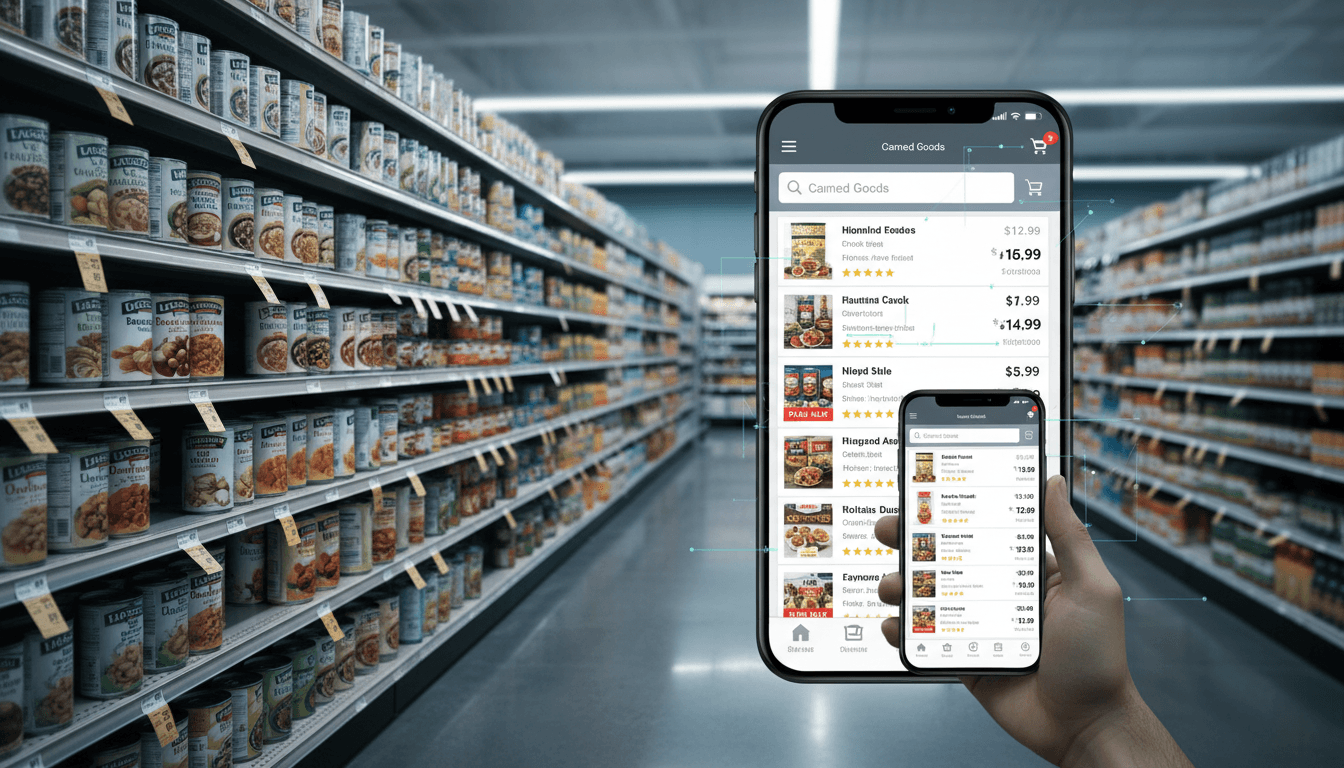
The grocery aisle changed. The “digital aisle” changed faster.
Answer first: Even if your product is bought in-store, the decision is increasingly shaped online—via retailer apps, search results, ratings, and personalised offers.
A lot of legacy CPG strategy still over-indexes on physical shelf dynamics: planograms, end caps, price promos. Those still matter. But the digital shelf has its own rules:
Search is the new shelf space
On a retailer site or app, placement often depends on:
- Relevance to the query (keywords, taxonomy)
- Availability (out-of-stocks get buried)
- Price competitiveness
- Promotion participation
- Conversion history
If your brand isn’t actively managing digital shelf content (titles, attributes, images, variants) and tuning to retailer-specific search behaviour, you’re invisible at the exact moment shoppers are deciding.
Private label learned the digital game
Private label used to win mostly on price and shelf positioning. Now, retailers can push their own brands through:
- Personalised recommendations
- Default sort order
- Substitution logic during out-of-stocks
- Basket-building prompts (“frequently bought together”)
That’s not a conspiracy. It’s a platform reality. If you’re a manufacturer, you either adapt to it—or watch your share get quietly redistributed.
Omnichannel inconsistency is a revenue leak
Many brands still have mismatches across channels: different pack sizes, different claims, unclear naming, or inconsistent pricing logic. Shoppers notice.
Omnichannel isn’t a buzzword. It’s the practical ability to be found, trusted, and purchased across store, app, delivery, and click-and-collect without friction.
Where AI actually helps (and where it doesn’t)
Answer first: AI helps most when it’s used for fast, specific decisions: predicting demand shifts, optimising pricing and promos, reducing waste and out-of-stocks, and personalising offers. It doesn’t help if it’s bolted on as a branding exercise.
Here’s the stance I take after watching too many “AI projects” stall: don’t start with a model—start with a margin problem.
1) AI-driven customer behaviour analysis: spot the shift early
Most legacy brands learn about consumer shifts late because they rely heavily on lagging signals:
- Quarterly sales reviews
- Post-campaign reporting
- Retailer scorecards that summarise what already happened
AI-enabled behaviour analysis can pull forward the signal by combining:
- Loyalty and basket data (where available)
- Retail search queries and browse paths
- Promo response by segment
- Social and review sentiment (not to chase hype, but to catch recurring objections)
What you want to know early:
- Are shoppers leaving the category or just trading down?
- Which occasions are shrinking (weekday lunches vs weekend cooking)?
- Which competitor SKUs are being substituted in?
Snippet-worthy truth: If you only look at sales, you’re reading the last page of the story. Behaviour data shows the plot while it’s still unfolding.
2) Pricing optimisation: protect margin without scaring shoppers
Food brands have been squeezed by packaging, freight, labour, and commodity volatility. The common response is blanket price increases or aggressive promotions. Both can backfire.
AI pricing optimisation focuses on elasticity at SKU and segment level:
- Which pack sizes are most price-sensitive?
- Which retailers can tolerate price moves because shoppers are less likely to switch?
- Which segments respond to value messaging vs premium claims?
This matters because price isn’t one decision. It’s a set of micro-decisions across regions, channels, and shopper types.
For Irish retailers and brands selling across both in-store and online, this is even sharper: the digital shelf makes price comparisons effortless, and shoppers can switch in seconds.
3) Promotion planning: fewer promos, better outcomes
Most companies get this wrong: they measure promotions by volume lift and ignore whether they trained shoppers to wait for discounts.
AI can improve promo planning by predicting:
- Incremental lift vs cannibalisation
- Post-promo dip magnitude
- Stock risk and fulfilment constraints
- Which segments should receive an offer (and which shouldn’t)
A practical rule: if a promo doesn’t increase profit, it’s not a promo—it’s a donation.
4) Demand forecasting + supply planning: stop paying for bad surprises
Canned goods are shelf-stable, but that doesn’t mean supply planning is easy. Wrong forecasts still create:
- Excess inventory and write-downs
- Out-of-stocks that kill ranking on retailer sites
- Expedited freight costs
Modern forecasting uses near-real-time signals like:
- Weather patterns (for certain categories)
- Local events and seasonal surges
- Retailer search trends
- Substitution patterns when items go unavailable
It’s not about predicting the future perfectly. It’s about being less wrong, earlier.
A practical “AI readiness” checklist for legacy brands
Answer first: If you want AI to improve performance, you need three basics: clean product data, shared performance metrics, and a way to deploy decisions into retail channels quickly.
Here’s what I’d check first if I walked into a legacy grocery brand trying to avoid becoming the next Chapter 11 headline.
Data foundation (weeks, not months)
- One consistent product catalogue: names, sizes, ingredients, attributes
- Digital shelf content standards per retailer
- A simple customer and channel taxonomy (who buys, where, and why)
Decision loops (the part most teams skip)
- Weekly demand sensing meeting using the same dashboard across sales, supply chain, and e-commerce
- Clear “if-then” rules for pricing and promos (what triggers action)
- Ownership: who can approve changes within 48 hours
Omnichannel execution (where value becomes revenue)
- Retail media and onsite search alignment with core SKUs
- Stock availability tied to digital merchandising (don’t advertise what you can’t fulfil)
- Consistent pricing logic across online and store where possible
If any of those are missing, AI becomes theatre: impressive demos, minimal impact.
“People also ask” questions brands are asking right now
Answer first: The fastest wins usually come from digital shelf visibility, forecasting, and promo optimisation—not from flashy generative AI pilots.
Can AI really prevent a legacy brand collapse?
AI won’t fix structural debt or years of declining category relevance on its own. What it can do is reduce the time between signal and action—and that speed is often the difference between a manageable correction and a compounding crisis.
What’s the first AI project a grocery brand should run?
Start with one of these, because they connect directly to revenue and margin:
- Digital shelf analytics (availability, ranking, content quality, conversion)
- Demand forecasting for top SKUs and key retail partners
- Promo effectiveness modelling to cut unprofitable discounting
How does this apply to retailers in Ireland?
Irish grocery is highly competitive, with strong private label and price-sensitive shoppers. That environment rewards:
- personalised recommendations that don’t feel spammy
- pricing optimisation that protects trust
- omnichannel experience consistency across store, app, and delivery
If you’re selling into that market, you need the same capabilities—because the retailer already has them.
What to do next if you’re a retailer or CPG leader
Del Monte’s Chapter 11 filing is a reminder that brand heritage doesn’t protect you from modern shopping behaviour. If anything, heritage can slow you down—because you’re used to winning the old way.
Here’s the better approach: treat AI as an operating system for retail decision-making. Start small, focus on margin impact, and build fast feedback loops across e-commerce and physical retail.
If you’re working on AI in retail and e-commerce—especially around AI-driven customer behaviour analysis, personalised recommendations, pricing optimisation, and omnichannel experience—ask yourself one forward-looking question: if your category demand shifts 5% in a quarter, would you see it in days… or in months?