AI shopping agents are coming in 2026. Learn what Irish retailers must fix—trust, data, and omnichannel handoffs—to win more e-commerce sales.
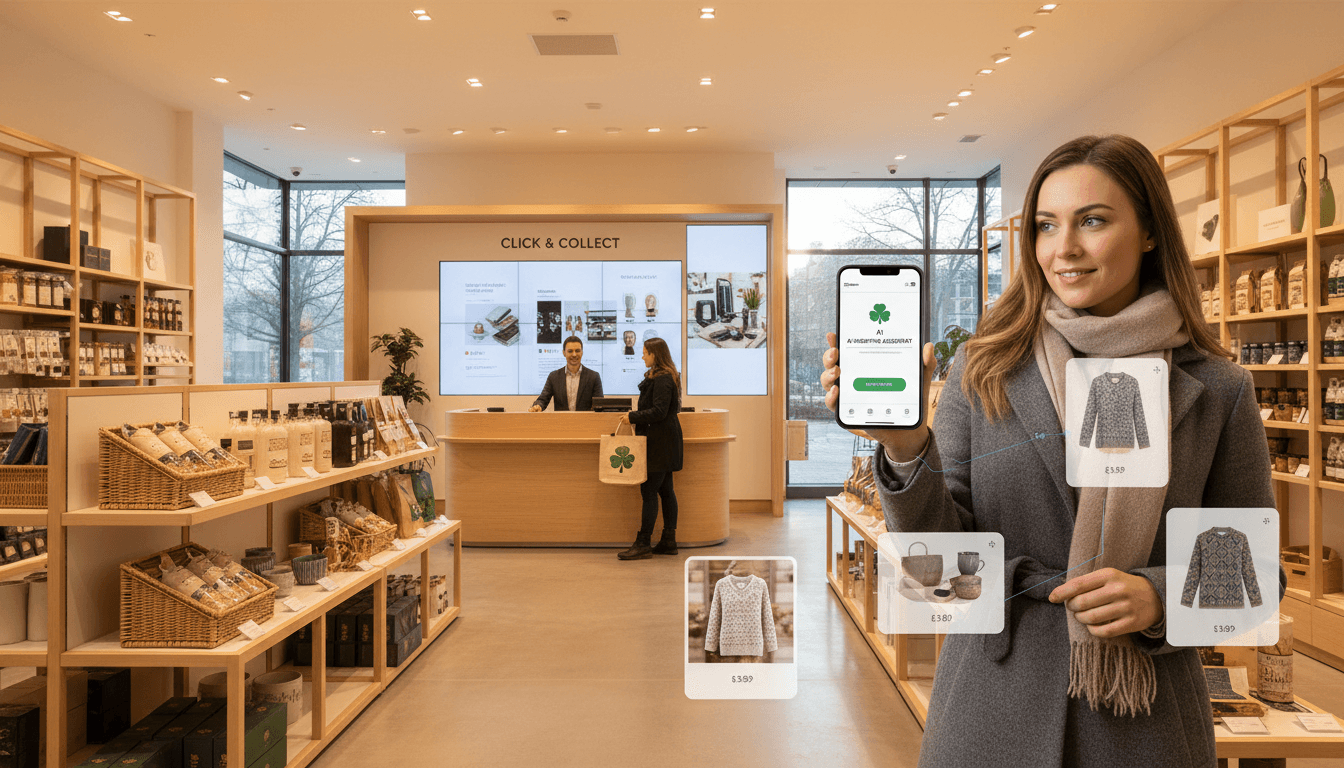
AI Shopping Agents in 2026: What Retailers Must Fix
Seventy percent of shoppers have already used AI features during a shopping journey. That’s not a forecast — it’s the baseline. The real shift for 2026 is where the decision-making happens: shoppers won’t just use AI to search and compare. They’ll start handing AI an objective (“get me a winter coat under €200, arrives this week, not polyester”) and expect it to plan, evaluate options, and complete the purchase.
Most retailers aren’t ready for that handoff. Not because they lack AI tools, but because they haven’t earned permission. Research behind recent 2026 predictions shows only 12% of shoppers currently trust AI to buy on their behalf, with privacy, scams, and loss of control topping the concern list.
This post is part of our AI in Retail and E-Commerce series, and I’m going to take a stance: agentic commerce will happen faster than your org chart can react. The winners in Ireland and globally won’t be the loudest “AI-first” brands. They’ll be the brands that make AI shopping safe, verifiable, and value-driven across stores and e-commerce.
2026 won’t be “more AI.” It’ll be AI that acts.
Answer first: 2026 is shaping up to be the year shoppers move from AI-assisted browsing to AI companions and intelligent agents that execute purchases.
Shoppers already use AI for discovery (searching, summarising reviews, finding deals). The 2026 step-change is delegation: the AI becomes a doer, not just an adviser. Think of it as the jump from “satnav tells you the route” to “the car drives.”
For retailers, that changes the funnel:
- Search visibility becomes less about ranking for a human and more about being machine-readable for an agent.
- Conversion optimisation becomes less about page persuasion and more about policy clarity, data quality, and low-friction approval steps.
- Customer experience becomes less about a single channel and more about handoffs (agent → app → store pickup → returns).
And yes, Gen Z will push it. They’re already comfortable with automation so long as it’s transparent and reversible.
What “agentic commerce” looks like in real life
Here’s a realistic 2026 scenario for an Irish retailer:
A customer says to an AI companion: “Restock the usual household bits for under €80, prefer Irish brands, deliver Saturday.” The agent:
- Checks purchase history and preferences.
- Compares prices across retailers.
- Filters by availability and delivery slots.
- Selects substitutions based on rules (“no scented detergent”).
- Requests approval only for exceptions (out-of-stock items, price spikes, new brands).
If your product data is messy, your returns policy is vague, or your delivery promise isn’t reliable, the agent will route around you.
Trust is the bottleneck — and retailers caused it
Answer first: Shoppers’ biggest barrier to AI-driven purchasing isn’t capability; it’s trust, and trust is built through controls, transparency, and consistent outcomes.
The 12% trust number tells you something uncomfortable: consumers believe AI can help them shop, but they don’t believe retailers (or platforms) will protect them when AI acts.
Shoppers’ common concerns are predictable:
- Privacy and data use: “What are you storing? Who gets it? For how long?”
- Unapproved purchases: “Will it buy something I didn’t authorise?”
- Fraud and scams: “Will it fall for fake sellers or spoofed products?”
- Lack of control: “Can I undo it easily?”
If you want more sales via AI shopping agents in 2026, you need to make these fears boring. Boring is good. Boring means predictable.
Practical trust features that actually move adoption
Retailers often over-invest in chat interfaces and under-invest in guardrails. The trust stack looks like this:
-
Explicit permissions
- Let customers set “buy rules” (max spend, allowed categories, approved brands).
- Default to “confirm before checkout,” then earn the right to offer “auto-buy.”
-
Receipts an agent can explain
- Provide a clean breakdown: price, delivery date, substitutions, promo logic.
- Make it exportable inside your app/account so it’s auditable.
-
Verified inventory + delivery promises
- Don’t show “available” if it’s a guess.
- Agents will penalise unreliable fulfilment because it ruins their perceived competence.
-
Fast reversibility
- One-tap cancel windows.
- “No-questions” returns where possible.
-
Fraud-resistant marketplaces (if relevant)
- Seller verification that’s visible.
- Strong product authenticity signals.
My view: retailers who treat trust as a product feature will outperform retailers who treat it as a legal checkbox.
Personalisation at scale will shift from “recommendations” to “relevance”
Answer first: AI in retail and e-commerce is moving from “people who bought X also bought Y” to context-aware relevance that respects budgets, health goals, and values.
The prediction set behind the RSS piece also calls out two themes that matter for personalisation:
- Health gets personal, functional, and transparent
- Consumers demand holistic value — from stores to dining
That’s not fluff. It’s a signal that shoppers want outcomes, not options. They want food that supports specific goals, skincare that’s traceable, and pricing that feels fair when budgets are tight.
Where Irish retailers can win quickly
Ireland has a mix of strong local brands, high-quality grocers, and fast-growing e-commerce. That’s an advantage: local preference can be encoded into personalisation.
Examples of AI-driven customer insights that convert into revenue (without being creepy):
- “Known-good” replenishment: predict reorder windows for household staples and offer a pre-approved basket.
- Dietary and allergen relevance: not just “gluten free,” but “gluten free and kid-friendly and under €4 per serving.”
- Functional health filters: “high protein breakfast options under 10 minutes.”
- Transparent product narratives: surface origin, certifications, and ingredient clarity in a consistent format.
A strong stance: personalisation that ignores price sensitivity in 2026 will backfire. The economy has trained shoppers to be value detectives. Your AI needs to speak fluent “total value,” not just “premium.”
Omnichannel in 2026: agents will punish broken handoffs
Answer first: AI shopping agents will expose weak omnichannel experiences because they optimise for completion, not brand preference.
An agent doesn’t care that your store team and e-commerce team have separate KPIs. It cares that the customer asked for pickup at Dundrum (or delivery to Galway) and your systems can’t agree on stock.
If you’re working on omnichannel experiences, prioritise the points where journeys break:
1) Stock accuracy across channels
Agents will choose the retailer with the least uncertainty. That often means:
- one inventory truth source
- frequent updates
- clear “available today” vs “ships in 3–5 days” logic
2) Click-and-collect that behaves like a promise
For agent-driven shopping, click-and-collect must have:
- guaranteed pickup windows
- substitution rules (customer-defined)
- immediate notifications when something changes
3) Returns that don’t feel like punishment
Agents will prefer retailers with predictable returns because it reduces downstream risk. If your returns policy is strict, at least make it clear, consistent, and easy to execute.
The retailer playbook for AI shopping agents (next 90 days)
Answer first: You don’t need a moonshot. You need clean data, clear policies, and controlled automation that earns trust.
If you’re a retail leader reading this in late December 2025, you’re probably balancing end-of-year performance reviews with 2026 planning. Here’s a practical sequence that fits real operating constraints.
Step 1: Make your catalogue “agent-readable”
Agents can’t reason over messy attributes.
- Standardise product titles, variants, sizes, and units
- Normalise key attributes (ingredients, materials, compatibility, dimensions)
- Clean promotional logic so discounts are interpretable
Snippet-worthy rule: If your product data can’t be understood by a machine, your customer won’t see it when machines do the shopping.
Step 2: Add permissions and approvals before adding autonomy
Start with “assist,” then graduate to “act.”
- Set customer spend caps
- Require approval for first-time brands/categories
- Provide an “exceptions list” the agent must ask about
Step 3: Build trust signals into every automated step
Trust isn’t a banner saying “we care about privacy.” It’s visible controls.
- Purchase previews with clear totals
- Delivery confidence indicators
- Transparent substitution and out-of-stock handling
Step 4: Use AI for pricing optimisation with guardrails
Pricing is where “holistic value” is won or lost.
- Optimise price based on elasticity and inventory, but avoid whiplash changes
- Create “price integrity” rules (max daily change, fairness checks)
- Explain discounts in plain language
Step 5: Measure what agents will optimise for
Agents will optimise toward retailers that minimise friction and risk. Track:
- order accuracy rate
- fulfilment promise accuracy (on-time, complete)
- return reasons and time-to-refund
- substitution acceptance rate
- customer control usage (caps, approvals, auto-buy opt-ins)
People also ask: what should retailers do about AI in 2026?
Will AI shopping agents replace brand loyalty?
They’ll reduce habit-based loyalty. But brands that deliver consistent value and predictable outcomes will become the agent’s default.
Do shoppers actually want AI to buy for them?
Yes — for repeat purchases and low-risk categories. The 12% trust figure is your clue: shoppers want the convenience, but only after you prove it’s safe and controllable.
What’s the first AI use case that pays off for mid-sized retailers?
Replenishment and customer service automation, tied to clean product data. They reduce costs and improve conversion without requiring full autonomous checkout.
The retailers who win in 2026 will treat trust as inventory
AI shopping agents in 2026 are going to be ruthless in a very specific way: they’ll pick the retailer that completes the job with the fewest surprises. That’s why trust, data quality, and omnichannel reliability are now commercial advantages — not “tech improvements.”
If you’re running retail or e-commerce in Ireland, this is the moment to get practical. Build agent-ready product data. Put permissions at the centre. Fix the handoffs between online and store. Then experiment with automation in ways customers can reverse.
Our AI in Retail and E-Commerce series is focused on exactly this: using AI for customer behavior analysis, personalised recommendations, pricing optimisation, and omnichannel experiences that hold up in the real world. If an AI agent tried to shop your brand tomorrow, would it feel confident enough to come back next week?