Mining protests can disrupt sales, deliveries, and safety. Learn how Ghana SMEs can use AI alerts and playbooks to monitor risk and respond fast.
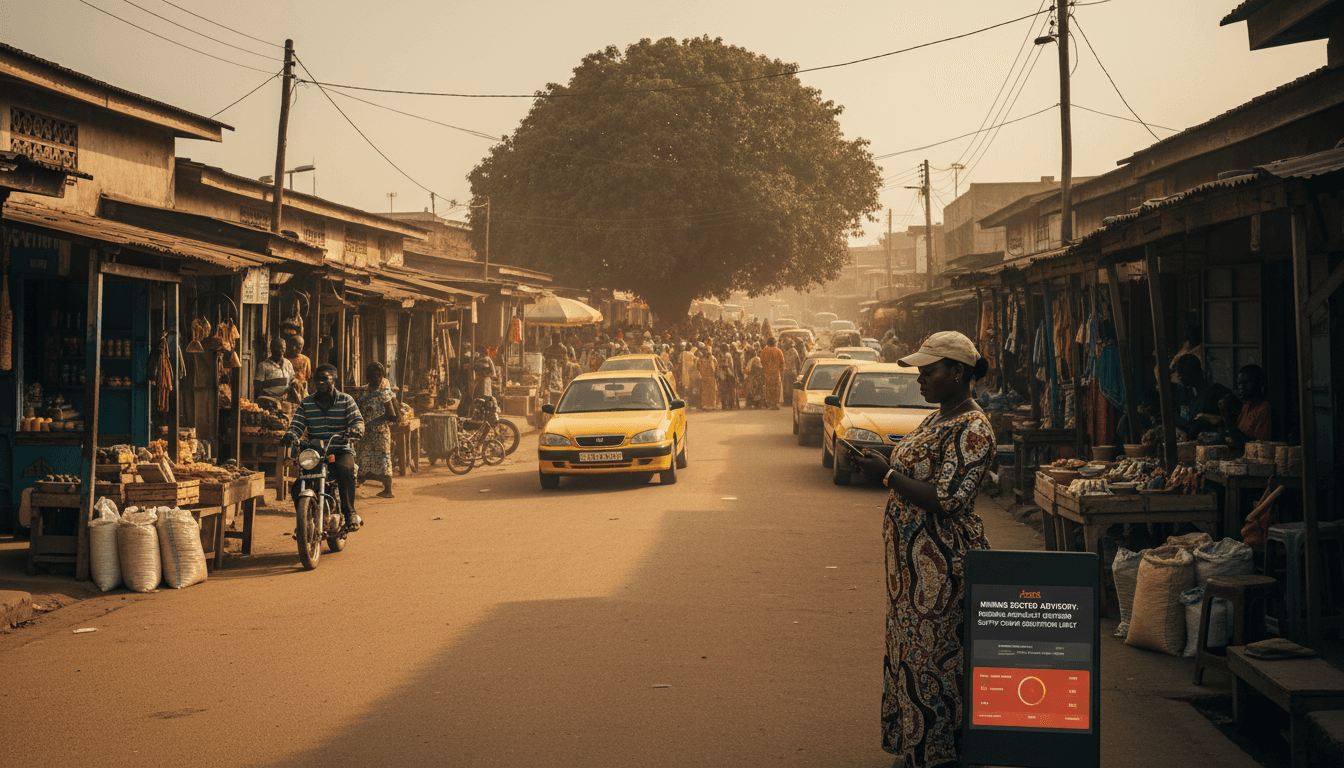
AI Risk Alerts for Ghana SMEs Amid Mining Protests
A community protest can change a local economy in a single morning.
That’s the uncomfortable lesson many businesses in Ghana’s mining towns have learned the hard way—and it’s why the planned #Y’abre mass protest in Bogoso-Prestea on Tuesday, January 6, 2026, matters far beyond the mining pits. The RSS report flags a tense situation: hundreds of ex-workers and community members in the historic Bogoso-Prestea mining hub are preparing to take to the streets over grievances tied to Heath GoldFields.
If you run an SME—retail shop, transport service, pharmacy, food business, microfinance, agro-dealer—social unrest isn’t “someone else’s problem.” It hits sales, deliveries, staff safety, cash flow, and reputation. And the most common failure I see? Businesses wait for the disruption to arrive before they react.
This post is part of the “Sɛnea AI Reboa Adwumakuo Ketewa (SMEs) Wɔ Ghana” series. The point here isn’t to debate the protest. It’s to show how Ghanaian SMEs can use practical AI tools to spot early warning signals, plan for disruption, and communicate responsibly—without needing a big team.
What the Bogoso-Prestea protest signals for local SMEs
Direct answer: A large community protest is a predictable operational risk: it can disrupt movement, reduce customer footfall, delay supplier routes, and trigger short-term cash squeezes.
Bogoso-Prestea is not just another town. It’s a mining economy—meaning household incomes, informal trade, and transport demand often correlate with mine activity and mine-related tensions. When ex-workers mobilize, the knock-on effects spread quickly:
- Transport and logistics: roadblocks, reroutes, fuel waste, delayed deliveries.
- Retail and markets: fewer shoppers on protest day; demand spikes the day before; shortages after.
- Services (salons, repairs, pharmacies): customers postpone non-urgent spending; urgent needs concentrate in “safe hours.”
- Hospitality: cancellations if visitors perceive the area as unstable.
The reality? Even if your shop is peaceful and your staff is neutral, you still operate inside a living community. If community trust breaks down—whether with a mining company or local authorities—SMEs absorb the shock.
The hidden cost: uncertainty, not just lost sales
Most owners calculate the obvious losses (a slow day). The bigger cost is uncertainty:
- Stock decisions become guesswork.
- Credit risk rises (customers delay payment).
- Staff attendance becomes inconsistent.
- Rumours spread faster than verified updates.
That uncertainty is exactly where AI for SMEs in Ghana can help—not by “predicting the future perfectly,” but by reducing blind spots.
Why SMEs should treat social unrest as a risk category (like forex)
Direct answer: Social and economic instability should sit on your risk register alongside price hikes and exchange rate swings, because it hits operations just as hard.
Ghanaian SMEs already track inflation, fuel prices, and cedi volatility because those show up on invoices. But community tension often gets ignored until it becomes unavoidable.
A practical way to think about it:
- Forex risk changes your costs.
- Supply risk changes your availability.
- Social risk changes your ability to operate at all.
And unlike forex, social risk has local patterns you can monitor—community meetings, union statements, radio discussions, WhatsApp chatter, and shifts in sentiment.
Corporate accountability and SMEs: you’re in the middle
When big institutions clash with communities, SMEs sit in the middle:
- Customers expect you to “know what’s happening.”
- Staff want clarity about safety.
- Suppliers want to know if they should dispatch.
You don’t need to pick sides. You do need a reliable information workflow. AI can support that workflow by helping you:
- Collect signals from multiple channels.
- Summarize what’s consistent vs what’s speculation.
- Trigger actions (route changes, stock changes, opening hours updates).
Practical AI tools SMEs can use to monitor disruptions
Direct answer: SMEs can set up low-cost AI monitoring using social listening, news summarization, and automated alerts—then connect those alerts to a simple action plan.
You don’t need a data science team. You need a system that answers three questions every day:
- What’s changing around my business environment?
- How likely is it to affect operations in the next 24–72 hours?
- What should we do now?
1) AI-assisted social listening (without spying on anyone)
Focus on public, ethically accessible information: public posts, public group announcements, local radio headlines reposted online, community pages.
Set up a routine where AI helps you:
- Track keywords: “Bogoso”, “Prestea”, “demonstration”, “protest”, “roadblock”, “strike”, “Y’abre”, “mine workers”.
- Classify posts into: traffic disruption, security concerns, service interruptions, verified updates.
- Flag spikes: “mentions increased sharply since yesterday.”
Operational output: a morning brief you can read in 2 minutes, not 2 hours.
2) News and memo summarization for decision-making
Even when you have only fragments (like an RSS snippet), AI is useful for:
- Summarizing what’s known vs unknown.
- Drafting internal memos: “What we’re hearing, what we’re doing, what staff should do.”
- Generating a list of clarifying questions to ask suppliers, community contacts, or local authorities.
Rule I use: If your team can’t explain the situation in 5 bullet points, you’re not ready to act.
3) Simple “risk scoring” you can run in a spreadsheet
You can implement a basic score from 1–5 for each factor:
- Likelihood (is it actually happening?)
- Impact (what does it break—sales, deliveries, safety?)
- Time window (today, next week, unknown)
- Confidence (do we have reliable confirmation?)
AI can help you fill this in consistently by turning messy inputs into structured notes. Over time, you’ll see patterns: which signals were “noise” and which were early warnings.
Snippet-worthy rule: “A risk you can’t score becomes a problem you can’t manage.”
A disruption playbook for SMEs around protest days
Direct answer: Prepare with a 72-hour plan: stock and cash adjustments, staff safety protocols, customer comms, and supplier coordination.
Here’s a straightforward playbook SMEs in mining communities can adapt—especially with a scheduled event like January 6.
72 hours before: tighten operations
- Inventory: stock fast-movers that don’t spoil quickly (basic groceries, OTC essentials, phone credit). Avoid over-stocking fragile items.
- Cash flow: reduce unnecessary credit sales; encourage partial payments; keep working cash accessible.
- Supplier calls: confirm delivery windows; ask about alternate drop-off points.
- Data backup: back up sales records and customer balances (cloud + offline export).
AI helps by generating reorder suggestions and highlighting what usually sells ahead of “no-movement” days.
24 hours before: communicate clearly
Your customers don’t need a speech. They need certainty.
- Post opening hours for the next two days.
- Share service limitations: “deliveries may delay,” “pickup only,” “cash preferred.”
- Give a single contact line for updates.
AI can draft two versions of your message:
- A neutral, safety-focused customer update.
- An internal staff message with protocols.
On the day: protect people first, then profits
- Staff safety: don’t pressure anyone to travel through hotspots.
- Short shifts: operate during safer windows if you must open.
- Delivery rules: no rider should “try their luck.” Use confirmed routes only.
- Incident log: write down what happened hourly (customer flow, closures nearby, delays).
That incident log becomes training data for your next plan—AI can summarize it and help you improve each time.
48 hours after: recover fast and learn
- Audit sales losses and stock spoilage.
- Follow up on delayed receivables.
- Restock based on what actually moved.
- Update your risk scoring: which signals were accurate?
The SMEs that win are the ones that treat disruption like a process, not a panic.
Using AI to strengthen community relations and accountability
Direct answer: SMEs can use AI to communicate responsibly, listen to community concerns, and avoid reputational mistakes during tense periods.
When emotions run high, a badly worded post can cost you customers for months. AI can help, but only if you set the right boundaries.
Do: use AI for clarity and neutrality
Ask AI to produce messages that are:
- Fact-based (no rumours)
- Safety-focused
- Respectful to all parties
- Specific about what your business is doing
Example stance that works:
- “We’re adjusting hours to keep staff and customers safe. We’ll share verified updates as we receive them.”
Don’t: use AI to manipulate sentiment
Avoid prompts that try to “spin” community pain into marketing. People notice. And in close-knit towns, reputational damage spreads offline, not only online.
If you serve mining communities, your long-term asset isn’t just inventory. It’s trust.
People also ask: “Can AI really help a small shop in Ghana?”
Direct answer: Yes—if you focus on narrow tasks (alerts, summaries, messaging, and simple forecasts) instead of big “AI transformation” projects.
Here are four high-return use cases I’ve seen work for SMEs:
- Daily environment brief: AI summary of local risk signals + what to watch.
- Customer communication drafts: consistent tone, faster updates.
- Demand forecasting: even basic forecasts reduce overstock and stockouts.
- Credit control support: AI-generated payment reminders and aging summaries.
None of these require custom software. They require discipline: a routine, clear inputs, and decisions tied to outputs.
What to do next if your SME operates near mining towns
The January 6 Bogoso-Prestea #Y’abre protest is a reminder that operational stability is not guaranteed, even when your own business is doing everything right.
If you’re following this series—Sɛnea AI Reboa Adwumakuo Ketewa (SMEs) Wɔ Ghana—this is exactly the point: AI isn’t only for accounting and marketing. It’s also for risk awareness, crisis readiness, and community-safe communication.
Start small this week:
- Write your top 10 local risk keywords.
- Create a one-page disruption plan (hours, staff rules, supplier steps).
- Use AI to produce a 2-minute daily brief template.
A final thought worth sitting with: If the streets shut down tomorrow, do you have a plan that fits on one page—and an alert system that buys you time?