Food companies are shifting from net-zero promises to climate resilience. Here’s how Ghanaian food SMEs can use AI to forecast, source smarter, and cut waste.
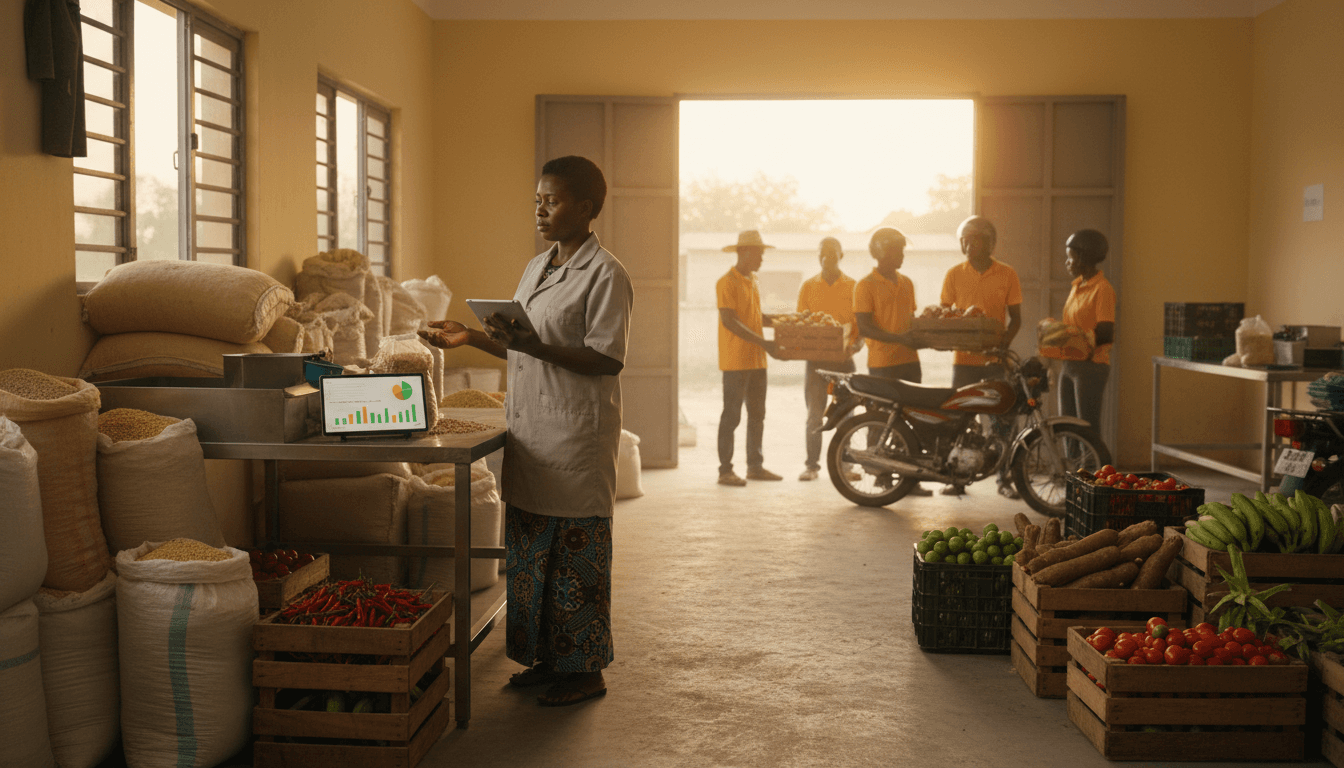
AI-Powered Resilience for Ghana Food SMEs in 2026
Food businesses didn’t stop caring about climate targets. They stopped pretending a 2050 net-zero pledge is enough when droughts, floods, price shocks, and supply disruptions are already hitting weekly procurement decisions.
That shift—away from glossy net-zero statements and toward resilience—is showing up across global food companies. And it matters a lot for Ghana, where many food and agribusiness SMEs live or die by the next harvest, the next delivery, or the next cedi swing.
This post sits in our series “Sɛnea AI Reboa Adwumakuo Ketewa (SMEs) Wɔ Ghana” and focuses on one practical idea: AI can help Ghanaian food SMEs build climate resilience without abandoning sustainability goals. Not by buying expensive “enterprise” systems, but by using simple AI workflows for forecasting, sourcing, inventory, and farmer support.
Why net-zero talk is turning into resilience work
Resilience is becoming the new language because it matches the problem businesses are actually facing: ingredient supply is less predictable every year. Many large food companies set ambitious net-zero timelines, then realized the hardest emissions live in Scope 3—the supply chain—where they have less direct control.
The corporate reset isn’t “climate is over.” It’s “climate risk is now an operations problem.” When olive harvests fail, when water becomes constrained, when disease risk rises, brands don’t lose points on a sustainability report—they lose stock availability, margins, and customer trust.
For Ghanaian SMEs, that’s not a new discovery. It’s daily reality.
What this means for Ghanaian food and agribusiness SMEs
A Ghanaian processor relying on maize, cassava, tomatoes, palm oil, or poultry feed doesn’t need a lecture about 2040 targets. They need answers to:
- Which suppliers are most likely to fail next season?
- How do we lock in stable quality and volumes without overpaying?
- If rains shift, what happens to our output and cashflow?
- How do we reduce waste when demand spikes during festive periods?
Resilience is simply staying in business while the climate (and market) keeps moving.
The real risk: supply chains that assume “normal seasons”
The uncomfortable truth is that many food supply chains—global and local—were built on an assumption of repeatable seasons and reliable regions. That assumption is weakening.
Large corporates are reacting by diversifying sourcing regions, signing longer contracts, shifting some production closer to home, and asking suppliers to improve practices around water and biodiversity. Those ideas are relevant for Ghana too, but SMEs need to apply them with smaller budgets and thinner teams.
Resilience is not just “more suppliers”
Many SMEs hear resilience and think: “Let’s add two more suppliers.” That helps, but it doesn’t solve the bigger issue: when climate stress hits multiple regions at once, backups disappear.
A better framing is:
- Supplier resilience: which farmers/aggregators consistently deliver under stress?
- Operational resilience: can you adjust recipes, packaging, or batch sizes quickly?
- Financial resilience: can you absorb price spikes without breaking cashflow?
AI is useful because it helps you see risk early, quantify it, and act while options still exist.
Where AI fits: practical resilience systems SMEs can actually run
AI in this context isn’t a robot on a farm. It’s a set of lightweight tools that turn your existing business data (sales, purchases, deliveries, yields) into early warnings and better decisions.
Here are four AI use-cases I’ve seen work well for SMEs—especially where teams are small and planning time is limited.
1) Demand forecasting that respects seasonality (and December spikes)
Answer first: AI forecasting reduces overproduction and stockouts by learning patterns your spreadsheet misses.
December in Ghana is not a “normal month.” Demand for many food products jumps around:
- salary timing
- holiday travel
- events and catering
- weather changes affecting fresh supply
An AI forecast can blend:
- last year’s weekly sales
- promotions and distributor orders
- price changes
- lead times and spoilage rates
So instead of “gut feel” production planning, you get a weekly plan with confidence ranges.
SME action steps (start small):
- Export 12–24 months of sales by product and week.
- Add a simple calendar column: holidays, school terms, major festivals.
- Use an AI tool (or analyst) to generate a forecast plus a “risk band.”
- Set reorder points based on worst-case lead time, not average lead time.
2) Supplier risk scoring (so procurement isn’t blind)
Answer first: Supplier risk scoring helps you rank which suppliers are likely to fail—and which deserve longer-term contracts.
Global companies are pushing for “resilient suppliers.” SMEs can do a simpler version using data they already have:
- on-time delivery rate
- defect/quality issues
- price volatility
- volume reliability
- region exposure (flood/drought-prone areas)
AI can cluster suppliers into groups like:
- Stable but expensive
- Cheap but unreliable
- Seasonally strong
- High risk under drought
Then procurement decisions become clearer: you don’t treat every supplier the same.
What to do next:
- Create a monthly supplier scorecard.
- Use AI to summarize patterns: “Supplier B fails when rains start late.”
- Move your best suppliers to longer-term purchase commitments with quality and delivery terms.
3) Recipe and product flexibility (resilience through formulation)
Answer first: Flexible formulations reduce your dependence on one volatile ingredient.
The RSS story highlights companies reducing animal protein where substitutes work. For Ghanaian SMEs, recipe flexibility can mean:
- partial substitutions (e.g., blending inputs where quality allows)
- adjusting pack sizes when raw material price jumps
- creating “seasonal variants” that use what’s abundant
AI helps by analyzing:
- margin by SKU
- ingredient sensitivity (how cost changes affect profit)
- customer repeat purchase when minor formulation changes occur
This isn’t about lowering quality. It’s about designing products that can survive shocks.
4) Post-harvest loss reduction with AI-assisted operations
Answer first: Waste is a climate and profit problem—AI cuts waste by improving timing and handling decisions.
For SMEs dealing in perishables (tomatoes, leafy greens, fish, meat), resilience is often a cold-chain and timing issue, not a marketing issue.
AI can support:
- routing plans (which customers get which batch first)
- shelf-life prediction (basic models using temperature/time logs)
- inventory alerts (“sell/discount/redirect this stock now”)
Even a simple WhatsApp-based workflow where staff log deliveries, temperatures, and spoilage incidents can feed a model that flags recurring root causes.
A simple AI resilience playbook for Ghana SMEs (90 days)
Big companies talk about transformation. SMEs need an achievable plan.
Phase 1 (Days 1–14): Build your “resilience dataset”
Answer first: You can’t manage resilience without consistent records.
Minimum dataset:
- weekly sales by product
- supplier deliveries (date, volume, price)
- quality notes (pass/fail, reason)
- lead time per supplier
- spoilage/waste estimates
Keep it simple. Consistency beats perfection.
Phase 2 (Days 15–45): Add two AI decisions to weekly routines
Answer first: Resilience improves when AI outputs are used in weekly meetings, not stored in emails.
Pick two:
- demand forecast and reorder recommendations
- supplier risk ranking
- margin sensitivity by ingredient
- waste hotspot report
Run them weekly. Adjust based on results.
Phase 3 (Days 46–90): Lock in resilience through contracts and SOPs
Answer first: AI insights only matter if you change agreements and processes.
Use what you learn to:
- negotiate longer contracts with top suppliers
- set delivery and quality standards with penalties/bonuses
- diversify strategically (not randomly)
- create SOPs for handling, storage, and dispatch
This is where resilience becomes real: less firefighting, more control.
“But we’re an SME—won’t AI be too expensive?”
It doesn’t have to be.
The cost driver isn’t the tool. It’s the chaos.
Most SMEs already pay for chaos through:
- emergency purchases at high prices
- wasted inventory
- lost customers due to stockouts
- inconsistent quality damaging the brand
A lightweight AI approach—plus better recordkeeping—often pays back quickly because it targets those leakages.
If you’re starting, focus on one value chain (one product line, one region, one supplier group). Prove ROI, then expand.
What resilience-focused sustainability looks like in 2026
Resilience and sustainability are not competing goals. In practice, they reinforce each other.
- Reducing waste cuts emissions and costs.
- Smarter logistics reduces fuel spend and delays.
- Stronger supplier relationships improve livelihoods and supply stability.
- Better water and soil practices protect yields over time.
A line I’ve found useful when talking to finance-minded teams is this:
If your supply isn’t resilient, your net-zero plan is just a promise with no product behind it.
For Ghanaian food SMEs, the smartest play is to treat AI as a resilience engine—one that helps you survive the next disruption while still moving in a climate-smart direction.
Next steps (and a practical question)
If you’re part of a Ghana food SME—processor, distributor, aggregator, or farm-linked brand—start with one decision you currently make “by feeling,” and build a small AI workflow around it. Demand forecasting and supplier scoring are usually the fastest wins.
If you want leads, partnerships, and growth in 2026, resilience is marketing too—but only when it’s operational.
Which part of your business breaks first when the season shifts: sourcing, production, distribution, or cashflow?