AI-enabled pheromone pest control can help Ghana fight Fall Armyworm with better timing, fewer sprays, and stronger yields. See how to pilot it.
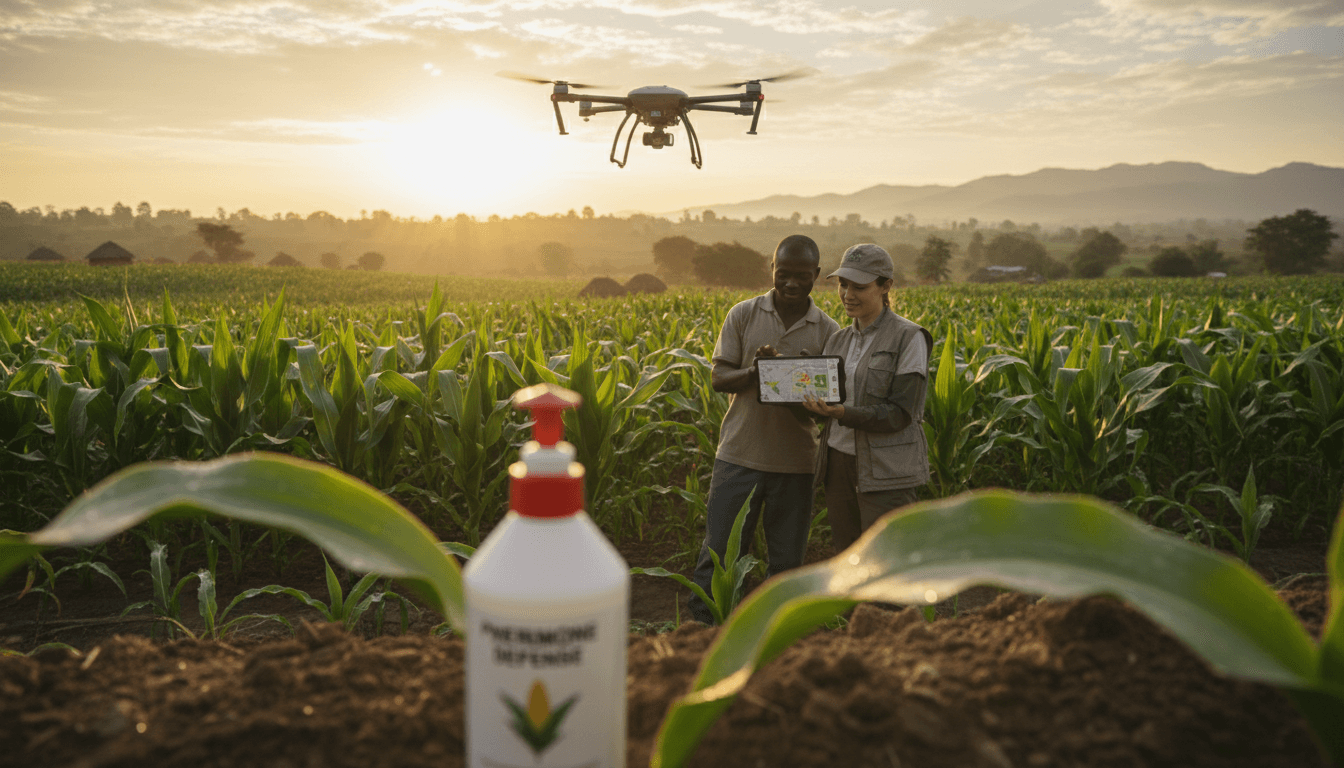
AI-Enabled Pheromone Pest Control for Ghana Farms
A multimillion-dollar pest problem pushed two giants—Provivi and Syngenta—into a major pheromone partnership in Brazil. That deal isn’t just “Brazil news.” It’s a loud signal that biological pest control is moving from niche trials into large-scale row-crop farming, even in markets where farmers are used to quick chemical knockdowns.
For Ghana, the lesson is practical: when pests develop resistance, farmers don’t need “more of the same.” They need better targeting and better timing. And that’s where this topic series—Sɛnea AI Reboa Aduadadie ne Akuafoɔ Wɔ Ghana—connects directly. Pheromones can reduce pest pressure by disrupting mating. AI can help decide when, where, and how to deploy them so they’re affordable and effective for Ghanaian production systems.
What Brazil’s Provivi–Syngenta deal really proves
Brazil’s deal proves one core point: pheromone-based pest control can be scaled beyond high-value crops when cost and distribution are solved. Provivi’s product targets Fall Armyworm using a sprayable pheromone blend that confuses mating behavior, reducing population growth and crop damage.
The second proof is even more important: distribution and farmer support matter as much as the science. Provivi didn’t just build a molecule; it partnered with a company that already has deep agronomy networks, field teams, and market trust. Syngenta will handle commercial distribution and technical support, while Provivi manufactures pheromone actives at industrial scale.
Third, the trials story matters. Provivi’s CEO reported yield increases “up to 5% on average across trials.” A 5% yield gain in a competitive commodity crop environment is serious money—especially when it comes with resistance-management benefits.
Why mating disruption fits resistance management
The hard truth in pest control is simple: if you spray the same modes of action repeatedly, you select for survivors. Over time, the survivors dominate.
Pheromones work differently. They don’t rely on killing pests by toxicity the way many insecticides do. They interfere with reproduction. That difference is exactly why agronomists want “alternative modes of action” in integrated pest management programs.
A useful rule for farmers and agribusinesses: if your control strategy is mostly one tool (one chemistry, one trait, one schedule), resistance is a calendar problem—you’re just waiting for it.
Ghana’s pest reality: the same pattern, smaller margins
Ghana’s farmers face many of the same pressures Brazil does—just with tighter cash flow, smaller average farm sizes, and less room for yield loss.
Fall Armyworm has been a major maize pest across Africa since it spread beyond the Americas. In Ghana, maize is both a food-security crop and an income crop, so FAW damage hits households twice.
Even when insecticides are available:
- Timing is often off (sprays happen after larvae are protected deep in whorls).
- Product choice can be inconsistent (counterfeits, mismatched actives, or incorrect rates).
- Resistance risk grows when the same products are used season after season.
So yes, pheromones sound promising—but Ghana doesn’t need a copy-paste of Brazil. Ghana needs systems that make biological tools workable under local constraints. That’s where AI earns its keep.
Where AI helps: making pheromone control practical, not theoretical
AI’s real value in agriculture isn’t fancy dashboards. It’s helping farmers make fewer wrong decisions—especially around timing. Pheromone tools are sensitive to when you apply them, where pest pressure is building, and how weather affects pest cycles.
Here are four places AI can directly strengthen pheromone-based pest control in Ghana.
1) AI forecasting: spray when it matters most
Answer first: AI models can predict pest pressure windows so farmers apply pheromones before populations explode.
In practice, a forecasting model blends inputs like:
- recent scouting counts (field data)
- planting dates by community
- temperature and rainfall patterns
- historical pest outbreaks by district
The output is not complicated: a risk level (low/medium/high) and a recommended action window.
If pheromones are applied too late, mating disruption won’t prevent the generation that’s already damaging the crop. AI reduces that “too late” problem.
2) AI-guided scouting: fewer field visits, better decisions
Answer first: AI can turn smartphone photos and simple field checks into consistent scouting data.
Many farmers already use WhatsApp for agronomy advice. The next step is structured capture:
- Take standardized photos (whorl damage, larvae, egg masses).
- Log location and crop stage.
- AI-assisted identification flags likely FAW severity.
- A human agronomist validates high-risk cases.
This hybrid approach works because it respects reality: AI speeds up triage; agronomists handle edge cases.
3) Micro-targeting: apply pheromones where they’ll pay back
Answer first: AI can recommend pheromone use on the right fields first, improving ROI.
Not every field needs the same intervention. Some communities have higher pest pressure due to planting patterns, nearby host plants, or continuous cropping.
A simple AI prioritization can rank farms by:
- expected yield value
- risk of FAW outbreak
- previous damage history
- proximity to “hotspot” fields
That means cooperatives and input suppliers can start with targeted deployment instead of wasting product everywhere.
4) Supply chain planning: avoid stockouts and panic buying
Answer first: AI demand forecasts help suppliers stock pheromones ahead of peak pest periods.
One reason farmers overuse insecticides is panic: they see damage, they rush to buy what’s available, and they spray immediately. If pheromones are to succeed, availability must be predictable.
AI can forecast seasonal demand by district, helping:
- distributors plan inventory
- agro-dealers time replenishment
- extension services schedule training
What Ghana can learn from Brazil’s partnership model
Brazil’s story isn’t only about a product. It’s about commercialization discipline.
Provivi has the tech. Syngenta has market reach and field support. The result is a multi-year partnership built on:
- regulatory pathway planning
- replicated trials (including trials run by the distributor)
- technical support that farmers can actually access
Ghana needs the same mindset—whether the partner is a multinational, a local input company, a farmer cooperative, or a public-private consortium.
A realistic Ghana playbook (that doesn’t depend on big budgets)
Here’s a practical approach I’d back for Ghana, especially for maize-growing belts where FAW hits hard:
- Pilot with clusters, not scattered farms: choose 3–5 communities per district so training and monitoring are efficient.
- Bundle pheromones with scouting support: product + decision support beats product alone.
- Run side-by-side plots: farmer practice vs integrated approach (pheromones + optimized timing + minimal targeted insecticide when necessary).
- Measure three numbers: yield, spray counts, and cost per acre.
- Scale through trusted channels: outgrower schemes, aggregators, and agro-dealer networks.
The goal isn’t to eliminate insecticides overnight. The goal is to reduce sprays, slow resistance, and protect yield.
People also ask: “Will pheromones work for smallholder farms?”
Yes—if the deployment is designed for smallholders, not imported as-is. The main barriers aren’t scientific; they’re operational:
- Training: farmers must understand timing and expectations.
- Product format: sprayable, easy-to-measure doses matter.
- Coordination: neighboring fields influence pest pressure.
This is where AI-enabled coordination helps. If a cooperative can coordinate action windows across many small plots, pheromone control becomes more consistent and more effective.
People also ask: “Are pheromones ‘organic’ and totally safe?”
Pheromones are generally viewed as low-toxicity and highly targeted because they mimic insect communication signals, rather than poisoning broad categories of organisms.
But “safe” doesn’t mean “careless.” Farmers still need:
- correct application timing
- proper handling and storage
- guidance on integration with other practices
A good integrated pest management plan treats pheromones as one pillar, alongside crop hygiene, resistant varieties where available, and targeted chemical use only when thresholds are exceeded.
A clear next step for Ghana: build an AI + biological IPM package
The Brazil partnership points to a direction Ghana shouldn’t ignore: biologicals scale when they’re paired with strong field support and data-driven decision-making. That’s exactly the intersection of sustainable agriculture and AI-enhanced farming.
If you’re a cooperative leader, agribusiness, NGO program manager, or extension team, here’s the move for 2026 planning: design a pilot where AI improves scouting and timing, and pheromones reduce pest reproduction pressure. Track yield and spray reduction with discipline.
This series—Sɛnea AI Reboa Aduadadie ne Akuafoɔ Wɔ Ghana—is about practical adoption, not hype. The big question isn’t whether Ghana can access biological pest control. The real question is: who will build the decision-support and distribution system that makes it work at farmer level?