AI autonomy kits show how farmers can upgrade existing machines. Here’s how Ghana can adapt AI and precision agriculture for more reliable fieldwork.
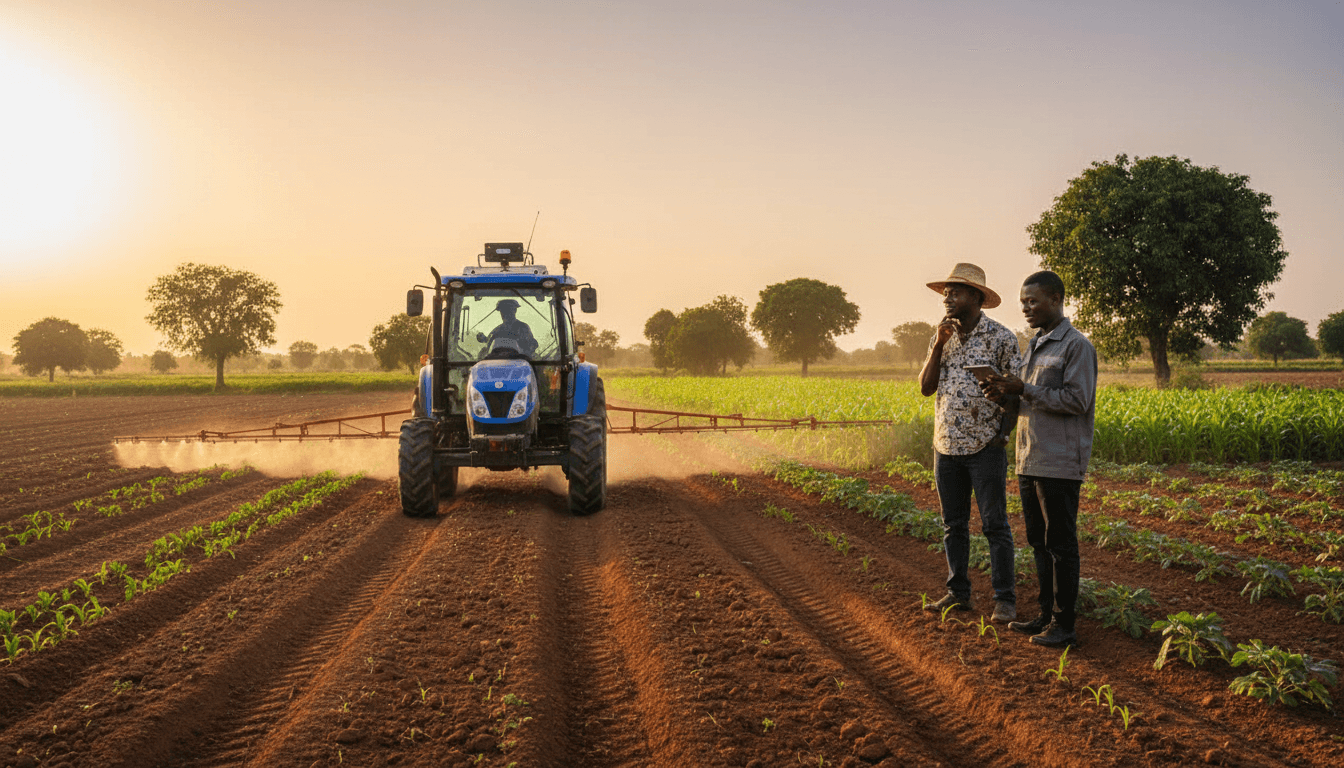
Most people assume autonomous farming starts with buying brand-new, expensive tractors. The reality? The fastest path is usually a retrofit—adding intelligence to machines farmers already own.
That’s why a recent move in Europe caught my attention. A French agtech company, Agreenculture, raised about $7 million to scale “ready-to-use autonomy kits” that farmers can install on existing tractors, sprayers, and off-road vehicles. Their pitch is simple: make farm autonomy practical, faster to deploy, and easier to maintain.
For this series—“Sɛnea AI Reboa Aduadadie ne Akuafoɔ Wɔ Ghana”—the bigger point isn’t France. It’s what the story reveals about where agriculture is heading: AI-powered autonomy is becoming a product farmers can adopt step-by-step, not an all-or-nothing leap. Ghana can benefit from that same mindset, especially as labor gets scarcer and input costs keep rising.
What Agreenculture’s raise signals about farm AI
Autonomy is moving from demos into day-to-day operations because the economics are starting to work.
Agreenculture’s funding is aimed at expanding production and commercial availability of its automation kits. Investors are betting that farmers don’t want “robot tractors” as a novelty—they want predictable work completed on time, with fewer labor headaches.
Europe’s situation makes the case clear: farm labor has been declining by about 2.6% per year on average, and only 11% of EU farms are run by people under 40. When fewer people are available to do repetitive fieldwork, farmers either reduce acreage, delay tasks, or pay more for labor. Autonomy becomes less of a luxury and more of a way to keep operations stable.
Ghana’s context differs, but the pressure is familiar:
- Peak-season labor can be expensive or simply unavailable.
- Youth interest in farming is uneven unless the business side looks attractive.
- Timing-sensitive work (planting windows, spraying, weeding) still determines yield.
A useful one-liner here: When farm labor becomes uncertain, automation becomes risk management.
Why autonomy kits (retrofits) matter more than new machines
Retrofits are often the adoption sweet spot because they fit how farmers actually buy equipment.
Agreenculture’s approach is not “replace your tractor.” It’s “add a kit.” Their system combines hardware and software that can automate tasks like weeding, spraying, and harrowing. They also highlight “fast install” and easier maintenance compared to many fully integrated autonomous solutions.
The practical advantage: faster upgrades
If a farmer buys a tractor, that machine might stay in service for 10–20 years. Software and sensors improve every year. A retrofit model means:
- You can update autonomy features without replacing the whole vehicle.
- Repairs are modular—swap a component instead of sending the whole machine away.
- Adoption can be phased: start with guidance/monitoring, then move to higher autonomy.
For Ghana, this matters because many farmers and agribusinesses:
- Keep machinery longer to protect capital
- Prefer upgrades that don’t disrupt operations
- Need technology that can be serviced locally
The trust advantage: safety and boundaries
Agreenculture’s kit is certified in the EU for use without local supervision, using “safe geofencing” to keep machines within a defined area.
Ghana may not mirror EU certification processes, but the principle is essential: autonomy must have clear limits. Farmers trust systems that behave predictably—especially around people, animals, field edges, and roads.
How AI autonomy actually helps farmers (not theory—field realities)
Autonomy succeeds when it targets tasks that are repetitive, timing-sensitive, and easy to measure.
From what’s described, Agreenculture is focusing on exactly that: field operations where consistency beats improvisation.
1) Spraying and spot spraying
Spraying is a classic place for AI and precision agriculture:
- The farm needs correct timing (too early/late reduces effectiveness).
- Over-application wastes money and increases residue risk.
- Under-application reduces control and yield.
A Ghana-ready lesson: Even before full autonomy, AI-assisted spraying decisions can reduce chemical spend by guiding where and when to spray. Pair this with scouting, simple maps, or drone imagery when available.
2) Mechanical weeding and inter-row work
Weeding is labor-heavy and expensive. Autonomy can:
- Keep a steady speed and consistent spacing
- Reduce missed strips and rework
- Allow longer operation hours during peak periods
For smallholders, this might show up first as service providers (tractor operators) adopting autonomy tools, not individual farmers buying them.
3) Harrowing and field preparation
These tasks look “simple,” but they’re time sinks. Autonomy:
- Frees skilled operators for higher-value work
- Improves scheduling across multiple fields
- Makes output more predictable for agribusiness planning
Here’s my stance: The best first automation targets are the jobs good operators don’t want to spend their whole day doing.
What Ghana can copy immediately (even without EU-level robotics)
Ghana doesn’t need to wait for perfect robot tractors. The near-term play is AI-enabled operations that improve decisions and make machine work more consistent.
Start with an “autonomy ladder”
Think of autonomy in levels. Ghana’s farming sector can adopt in a sequence that matches budgets and skills:
- Decision AI (now): yield forecasting, input planning, pest/disease alerts, basic advisory in local languages
- Precision support (next): GPS guidance, digital farm maps, recordkeeping, variable-rate recommendations
- Supervised autonomy (growing): operator in the loop; machine assists steering/speed or repeats routes
- Geofenced autonomy (later): machine operates in bounded areas with strong safety controls
This approach reduces fear because each step pays for the next.
Build around service models, not only ownership
In Ghana, machinery often spreads through:
- Tractor hiring centers
- Mechanization service providers
- Outgrower schemes and nucleus farms
That’s perfect for AI tools. A single autonomy or precision upgrade can serve hundreds of farmers through a service provider.
A practical example:
- A sprayer operator uses AI-based scheduling + geofenced route planning to cover more farms per week.
- Farmers get faster response times during outbreaks.
- The operator earns more through reliability, not just low pricing.
Focus on uptime and local maintenance
Agreenculture stresses maintainability. Ghana should too.
If you’re evaluating AI farming technology—autonomy kits, sensors, precision tools—ask these questions:
- Can a technician in Kumasi, Tamale, or Ho service it within 48 hours?
- Are spare parts standardized or proprietary?
- Does it work offline or with weak connectivity?
- What happens when a sensor fails—does the whole system stop?
Farm tech that can’t be maintained locally isn’t “advanced.” It’s fragile.
The policy and business pieces Ghana can’t ignore
Technology works when the ecosystem supports it. Autonomy in Ghana will move faster with three supports.
1) Clear safety rules for semi-autonomous field machines
Autonomy needs boundaries: geofencing, emergency stops, and basic operating standards.
The goal isn’t to copy Europe’s full certification model immediately. The goal is to define minimum safety expectations so insurers, operators, and farmers know what “safe enough” means.
2) Data discipline: the hidden input
AI in agriculture runs on field records: planting dates, input rates, pest pressure, yields.
If you want AI to help Ghana’s food systems, treat data like fertilizer—apply it consistently. Even simple recordkeeping (paper to digital) can unlock:
- better credit scoring
- input planning
- traceability for higher-value markets
3) Financing that matches the cashflow of farming
Autonomy kits and precision agriculture tools work best when financing matches seasonal revenue.
Options that fit Ghana well:
- pay-per-acre service fees
- lease-to-own models for service providers
- bundled finance via off-takers or aggregators
If the only option is upfront purchase, adoption will stay narrow.
People also ask: “Will AI autonomy replace farm jobs in Ghana?”
It will change jobs, but the bigger risk is actually the opposite: not having enough reliable labor during peak periods.
Autonomy mainly targets repetitive machine work—driving straight lines, repeating routes, consistent spraying. That shift usually creates demand for:
- technicians
- supervisors
- agronomy scouts
- data recorders and field managers
The strongest outcome is when automation frees people to do higher-value work: quality control, market timing, crop strategy, and post-harvest handling.
What to do next (if you want AI to boost productivity in 2026)
If you’re a farmer, cooperative leader, agribusiness manager, or mechanization operator, take these steps over the next 30 days:
- Pick one operation to improve: spraying, weeding, or field prep. Don’t start broad.
- Track three numbers weekly: cost per acre, time per acre, and rework incidents (missed rows, repeat spraying, breakdown delays).
- Test an AI-supported workflow: advisory + scheduling + simple mapping. Prove the savings before buying hardware.
- Talk to service providers about shared upgrades. In Ghana, shared adoption scales faster than individual purchases.
This series—Sɛnea AI Reboa Aduadadie ne Akuafoɔ Wɔ Ghana—keeps coming back to one point: AI isn’t “future farming.” It’s a practical tool for better timing, better decisions, and more reliable fieldwork.
Europe’s autonomy-kit approach is a strong hint of where the market is going: modular, serviceable, and upgradeable. Ghana should copy the logic, adapt the tooling, and build the local support that makes it dependable.
What would happen if your farm (or your mechanization business) could guarantee one thing next season—every critical field task happens on time?