Tanzania’s cassava strategy offers Ghana a clear template. See how AI can strengthen seed systems, digital extension, disease control, and cassava markets.
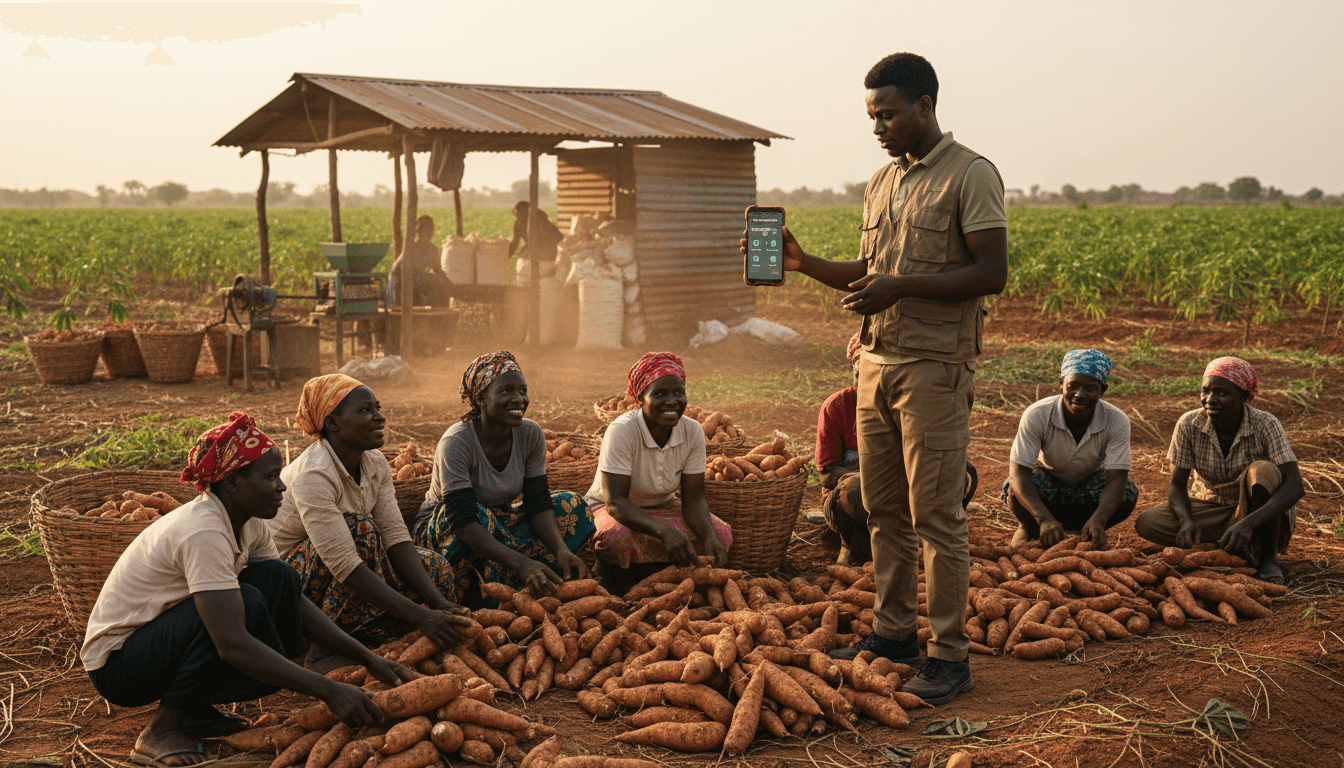
AI Lessons from Tanzania to Grow Ghana’s Cassava
Cassava is already a “quiet hero” crop across West Africa—reliable in tough seasons, central to food security, and packed with value for processing. Yet most cassava value chains still run on guesswork: farmers plant what they can find, diseases spread before anyone sees them clearly, and processors can’t get steady volumes of quality roots.
Tanzania took a different route. In 2021, it launched a National Cassava Development Strategy with strong coordination from research and value-chain partners. The detail that should catch Ghana’s attention isn’t the ceremony; it’s the operational focus: improved varieties, disease research, stronger seed systems, and digital extension tools.
This post is part of the “Sɛnea AI Reboa Aduadadie ne Akuafoɔ Wɔ Ghana” series, and I’ll be direct: AI in agriculture in Ghana will only matter if it solves these everyday cassava bottlenecks—seed quality, disease control, agronomy decisions, and market coordination. Tanzania’s approach gives Ghana a practical playbook, and AI can make it faster, cheaper, and more farmer-friendly.
What Tanzania got right: strategy first, then tools
A national strategy works when it answers one question clearly: Who does what, and how does it scale? Tanzania’s cassava strategy brought government, research institutions, seed certification bodies, and market actors into the same room to align on commercialization and industrialization.
The priority areas highlighted were the right ones:
- Disease research and surveillance (because cassava diseases can erase gains fast)
- Good agronomic practices (spacing, soil fertility, timely weeding, harvesting windows)
- Improved varieties (higher yield, disease tolerance, processing suitability)
- Seed systems and rapid multiplication to make clean planting material easy to access
- Extension services with advanced technologies, including digital tools
Here’s the takeaway for Ghana: a strategy isn’t a document—it's a coordination machine. When everyone agrees on the “rules of scaling,” technologies like AI stop being pilot projects and start becoming infrastructure.
Ghana’s parallel problem: good cassava, inconsistent systems
Ghana has strong cassava demand (gari, agbelima, industrial starch potential), and farmers know cassava well. The weak link is consistency:
- Clean planting material isn’t reliably available where farmers are
- Disease outbreaks are often identified late
- Advisory services don’t reach enough farmers at the right time
- Aggregation and processing suffer from uneven root quality and supply
AI won’t fix these alone. But AI can connect the parts—especially when paired with seed systems, extension networks, and buyer agreements.
AI-powered digital extension: the fastest win for smallholders
Digital extension was explicitly recognized in Tanzania’s discussions. That’s where Ghana can move quickly because the problem is mostly logistics and timing, not scientific discovery.
Answer first: AI makes extension more effective by delivering the right advice to the right farmer at the right time—using simple inputs like location, crop stage, and a phone photo.
What AI-enabled extension can do for cassava farmers
-
Field diagnosis from images (low-bandwidth friendly)
Farmers or extension officers capture photos of leaves and stems; AI flags likely issues (e.g., mosaic-like symptoms, nutrient stress patterns) and recommends next steps. Even when the diagnosis isn’t perfect, it’s better than silence. -
Localized agronomy nudges
A farmer in Bono East and a farmer in Volta shouldn’t get the same planting-date advice. AI can tailor messages using rainfall patterns, soil type proxies, and local calendars. -
Voice and local language delivery
Adoption improves when advice arrives in clear voice prompts (Twi, Ewe, Dagbani, etc.) with short, actionable instructions—“Do X this week” rather than long guides. -
Two-way feedback loops
Extension often fails because it’s one-directional. AI tools can collect quick farmer responses (“Did you weed?” “What variety did you plant?”), generating community-level insight that extension managers can actually use.
A practical model Ghana can run in 90 days
If you’re running a district program or an agribusiness outgrower scheme, don’t start with “big AI.” Start with one cassava pain point.
- Pick one district + one processor or aggregator
- Register 500–2,000 farmers (basic profile: location, acreage, variety, planting month)
- Push weekly, seasonal messages (planting material, spacing, weed timing, harvest maturity)
- Add photo-based issue reporting through extension officers (not necessarily every farmer)
- Track outcomes: stand count, root size uniformity, rejection rates, volume delivered
That’s AI in agriculture in Ghana that produces results people can see.
AI for disease and variety research: make science usable at scale
Tanzania’s Minister emphasized disease research and improved varieties, and I agree with the logic: cassava productivity rises when farmers can access varieties that match their context and markets.
Answer first: AI speeds up cassava R&D by improving how we detect disease spread, select varieties, and target trials—so farmers get better planting material sooner.
Where AI supports cassava disease management
- Early warning from field reports: clustering symptom reports by location can show hot spots early.
- Remote sensing + ground truth: satellite or drone signals can suggest stress zones; extension teams verify and respond.
- Decision support for control measures: not every field needs the same action; AI helps prioritize limited resources.
Where AI supports improved variety adoption
Improved varieties don’t spread because they exist; they spread because farmers trust them and can access them. AI can help by:
- Matching varieties to intended use (gari, fufu, starch) and agro-ecology
- Predicting likely adoption barriers (e.g., distance to seed source)
- Recommending trial “starter packs” for communities (small bundles with training)
If Ghana wants faster diffusion, the question shouldn’t be “Which variety is best?” It should be: “Which variety is best for this community, this buyer, and this planting window?” AI is built for that kind of matching.
Seed systems and rapid multiplication: AI’s hidden superpower is coordination
One of the most concrete elements from Tanzania’s initiative was the push for better seed systems, including rapid multiplication technologies. Clean planting material is the foundation; without it, extension advice is like building a house on sand.
Answer first: AI strengthens cassava seed systems by tracking quality, forecasting demand, and reducing the time it takes farmers to access certified planting material.
What “AI for seed systems” looks like in the real world
- Demand forecasting: estimate how many bundles of stems each district will need next season based on acreage trends.
- Distribution optimization: route planning for last-mile delivery to reduce delays and spoilage.
- Traceability and quality records: simple digital logs for multipliers—source, date, batch, field location.
- Fraud reduction: when farmers can verify a batch via a code and extension confirmation, fake “improved stems” become harder to sell.
Why this matters for Ghana’s cassava value chain
Processors need predictable supply. Farmers need predictable planting material. Seed multipliers need predictable buyers. AI connects these incentives by turning scattered data into scheduling, allocation, and accountability.
If Ghana is serious about cassava commercialization, seed systems deserve the same attention as fertilizers and mechanization.
Commercialization and industrialization: AI keeps markets honest
Tanzania’s strategy leaned hard into commercialization and industrialization—partly driven by export demand and the need to strengthen domestic markets. Ghana’s opportunity is similar: build a cassava economy where smallholders earn more because quality and volumes are reliable.
Answer first: AI improves cassava commercialization by reducing uncertainty—on price signals, harvest timing, quality grading, and delivery planning.
Three ways AI can reduce losses and boost income
-
Harvest timing recommendations
Cassava quality and dry matter vary by maturity. AI can suggest harvest windows by variety and planting date, which helps processors plan. -
Quality grading support
A simple phone-based checklist (plus images) can standardize what “acceptable roots” mean across buying points. Less argument. Faster payment. -
Aggregation planning
When an aggregator knows which communities will harvest in which weeks, trucks move efficiently, and farmers don’t wait days for pickup.
If you want a one-liner that’s true: markets grow when logistics stop being a gamble.
People also ask: practical questions Ghanaian teams raise
“Will AI replace extension officers?”
No. AI makes extension officers more productive. One officer can support more farmers when routine advice and triage tools are automated.
“What if farmers don’t have smartphones?”
Design for basic phones first: voice prompts, SMS, and community-based reporting through lead farmers or extension staff.
“Is data privacy a big issue?”
Yes, and it should be handled early. Keep data collection minimal, get clear consent, and avoid collecting sensitive personal data unless it’s necessary.
“What’s the first dataset we need?”
Start with a simple registry: farmer location, acreage, planting month, variety (if known), and buyer/processor linkage. That alone can improve planning.
What Ghana should do next (and who should lead)
Ghana doesn’t need to copy Tanzania line-for-line. But the sequencing works: policy alignment → seed systems → extension → markets. AI strengthens every step, but only if someone owns implementation.
Here’s what I’d push for in 2026 planning cycles:
- A cassava “digital extension minimum package” adopted by MoFA programs and outgrower schemes (voice + SMS + photo triage)
- A seed system dashboard that tracks stem multiplication, demand forecasts, and distribution performance
- A processor-led supply planning pilot in at least two cassava-processing corridors, using simple AI forecasting
- A national disease reporting workflow that turns field observations into response actions
This is exactly the spirit of the “Sɛnea AI Reboa Aduadadie ne Akuafoɔ Wɔ Ghana” series: practical AI that helps farmers earn more, helps extension teams respond faster, and helps agribusinesses plan with fewer surprises.
A cassava strategy succeeds when farmers can get clean stems, clear advice, and a buyer who shows up on time. AI is the glue that makes those three things consistent.
Ghana’s next step is to stop treating AI as a tech project and start treating it as a delivery system for better seed, better decisions, and better markets. If Tanzania’s strategy shows anything, it’s that coordination beats noise.
What would happen to Ghana’s cassava industry if every major cassava district could predict seed demand, spot disease hot spots early, and schedule harvests to match processor capacity—season after season?