AI agtech funding trends show what’s working globally. Learn how Ghana can apply AI for pest control, food innovation, and smarter farm planning in 2026.
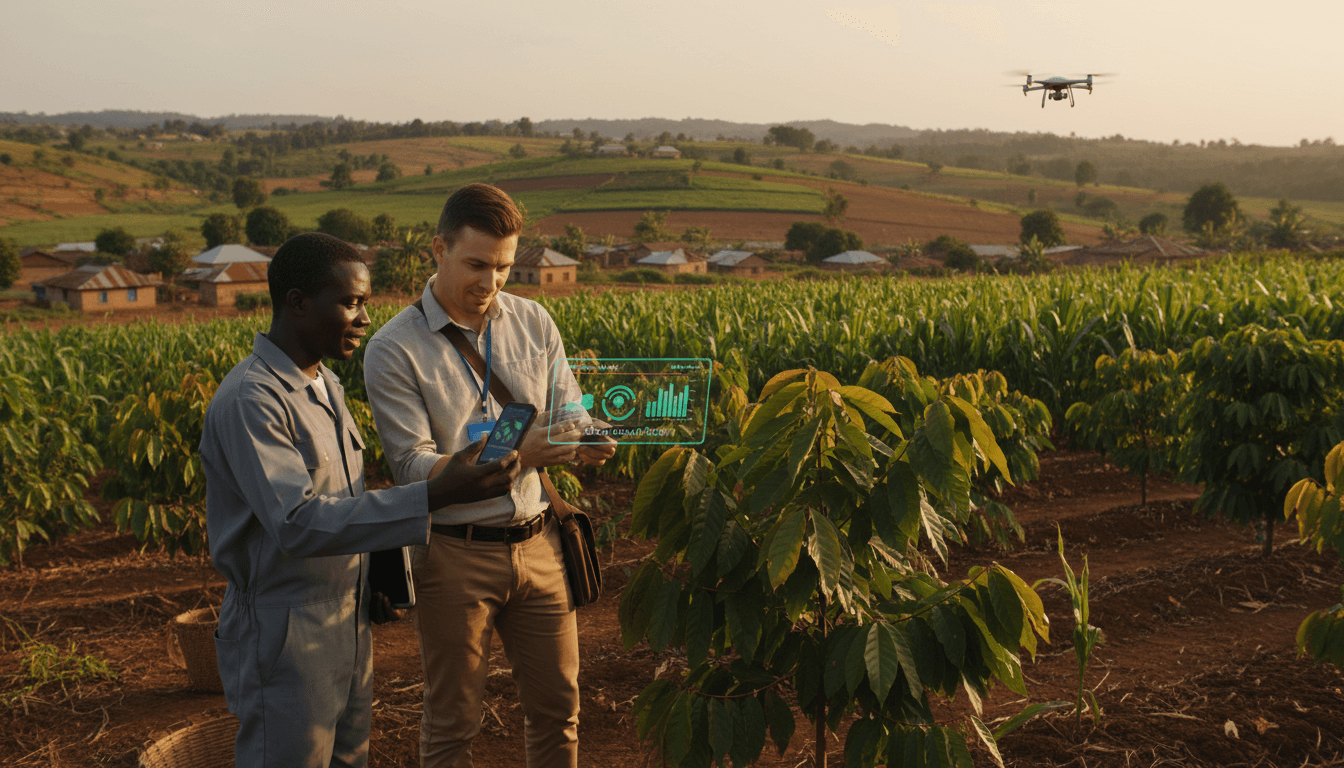
AI Agtech Trends Ghana Farmers Can Use in 2026
$19 million went into genetic insect control in one startup round recently. That’s not “Silicon Valley gossip.” It’s a signal: investors are paying for practical tools that reduce farm losses, stabilize food supply, and make agriculture more predictable.
For Ghana, that matters right now. Harmattan dryness, volatile input prices, and pest pressure don’t wait for perfect policies. Farmers and agribusinesses need solutions that work in the real world—on maize fields in Bono, tomato farms around the Volta basin, cocoa landscapes in the Western North, and poultry supply chains serving Accra.
This post sits inside our “Sɛnea AI Reboa Aduadadie ne Akuafoɔ Wɔ Ghana” series for a reason: global agtech funding and partnerships are basically a preview of what will become affordable, local, and mainstream next. If we read the signals well, we can make better decisions—what to pilot, what to ignore, and what to build locally.
The big signal: investors are funding problem-solving AI
The clearest takeaway from the latest agri-food funding news is simple: money is moving toward tools that directly reduce cost and risk—pest control, supply chain coordination, food formulation, and measurement of soil outcomes.
Several deals highlighted in the roundup point to where agriculture is heading:
- Genetic insect control (Biocentis raised $19m) aims to reduce damage from specific pests without blanket spraying.
- Rural vehicle marketplaces + fintech (Tractor Junction raised $22.6m) show that distribution and financing are becoming just as valuable as the machines.
- Secure AI for food innovation (AKA Foods raised $17.2m) suggests the next advantage will be faster product development—without leaking IP.
- AI in food R&D partnerships (Barry Callebaut working with NotCo’s AI) confirms large manufacturers now treat AI as a core tool, not an experiment.
Here’s the stance I’ll take: Ghana shouldn’t copy every shiny tool—but we should copy the pattern. Fund what reduces losses, improves planning, and strengthens market access.
What this means for Ghana’s agribusiness leaders
If you’re running a farm, a cooperative, a processor, or an input business, global funding news is basically a checklist of “where efficiency is being bought.” The opportunity is to:
- Pilot smaller, cheaper versions locally (phone-based scouting, SMS forecasting, simple farm ERPs).
- Partner with universities and startups to adapt models to Ghana’s crops and languages.
- Set up data pipelines (even basic ones) so AI tools have something to learn from.
AI pest and insect control: the direction is precision, not more chemicals
The most valuable pest-control trend is targeted action—detect early, treat precisely, document outcomes. Biocentis’ genetic insect control funding is one example of the broader movement: stop losing yield to insects by being smarter than the pest lifecycle.
Ghana’s pest reality is unforgiving. Fall armyworm in maize, mirids and black pod pressures in cocoa ecosystems, and storage pests in grains all add up to losses that are hard to measure—but easy to feel.
Practical AI pest control Ghana can deploy now
You don’t need genetic insect control to get benefits today. The near-term wins come from AI-assisted decision-making:
- Phone-based pest identification: farmers snap photos of leaf damage; models classify likely pests and suggest response options.
- Spray timing recommendations: combine local weather patterns with scouting reports to reduce “routine spraying.”
- Hotspot mapping for cooperatives: simple dashboards showing where outbreaks are rising, so extension officers prioritize visits.
A strong rule: AI doesn’t replace agronomy; it upgrades consistency. The agronomist’s advice becomes scalable when it’s turned into checklists, alerts, and decision trees.
Don’t ignore trust and safety
Genetic insect control is powerful, but it’s also sensitive. For Ghana, the first conversation should be about governance and community acceptance:
- What’s the regulatory pathway?
- How do we monitor ecological side effects?
- Who owns the data and the outcomes?
If those questions aren’t answered early, adoption will stall—even if the science is solid.
AI in food innovation: why NotCo-style partnerships matter to Ghana
The fastest way food companies are using AI is to reformulate products under pressure—cost, nutrition, supply volatility, and consumer taste. The partnership between a major chocolate manufacturer and NotCo’s AI is a loud message: AI is now part of mainstream food R&D.
Ghana sits in a unique position here. Cocoa is central, but cocoa markets are also volatile. Even when prices rise, value capture doesn’t automatically flow to farmers. Meanwhile, urban consumers are buying more packaged foods and expecting consistent quality.
How Ghanaian processors can use AI (even without a big lab)
AI food innovation doesn’t have to mean futuristic ingredients. It can mean:
- Smarter formulation: substitute inputs when prices spike (within taste and shelf-life limits).
- Quality prediction: relate moisture, temperature, and storage duration to spoilage risk.
- Demand forecasting: reduce overproduction during slow seasons and avoid stockouts during holidays.
And yes—December is a perfect example. Festive demand patterns for beverages, baked goods, and confectionery create predictable spikes. AI demand forecasting is basically profit protection during peak season.
Cocoa: the hard truth and the opportunity
The hard truth: cocoa supply volatility is pushing global companies to explore alternatives and hybrids.
The opportunity: Ghana can push value addition harder—not only exporting beans, but developing local processing lines that use AI for:
- Consistent roasting profiles
- Batch-level traceability
- Defect detection (mould, fermentation issues)
When traceability becomes a selling point, AI becomes part of market access.
Machinery and automation: Monarch Tractor’s trouble is a lesson
A headline about an autonomous tractor company preparing layoffs is not “bad news only.” It’s a reminder that hardware is brutally difficult—capital intensive, slow to service, and sensitive to financing conditions.
For Ghanaian farmers considering mechanization, the real lesson is:
Buy into systems you can maintain locally, and demand a service network before you scale.
What to copy in Ghana: the marketplace + financing model
The Tractor Junction funding story (vehicle marketplace + fintech) points to a model that fits Ghana well:
- Farmers don’t only need tractors.
- They need trustworthy listings, verified equipment condition, spare parts, and financing.
If you’re building or investing in agtech in Ghana, I’d bet on:
- Mechanization booking platforms (pay-per-acre services)
- Asset financing tied to usage data (if a tractor works, repayment is easier)
- Maintenance-first networks (mobile mechanics, parts inventory forecasting)
AI’s role here is quiet but crucial: predicting breakdowns, optimizing routes, and reducing downtime.
Soil data, carbon programs, and measurement: “prove it” is the new standard
Global partnerships around soil measurement and carbon-related outcomes are increasing because buyers and regulators are demanding proof.
For Ghana, especially cocoa and emerging regenerative projects, measurement, reporting, and verification (MRV) is becoming non-negotiable. If you can’t measure it, you can’t sell it—whether it’s a sustainability premium, a procurement contract, or carbon-linked finance.
What MRV looks like in practical Ghana terms
MRV doesn’t have to start with expensive sensors everywhere. A workable ladder looks like:
- Farm boundary mapping (GPS via phone)
- Practice tracking (mulching, pruning, shade management, fertilizer timing)
- Periodic soil sampling (targeted, not random)
- Remote sensing checks (vegetation indices and land cover consistency)
AI helps by flagging anomalies, estimating missing data, and prioritizing where to measure next.
A Ghana-ready action plan: 30 days, 90 days, 12 months
If you want AI to help farmers and food businesses in Ghana, start with a narrow problem and measurable outcomes. Here’s what works in practice.
Next 30 days: pick one pain point and instrument it
Choose one:
- Pest outbreaks
- Post-harvest losses
- Input fraud / wrong chemicals
- Demand volatility
Then define 3 numbers you’ll track (example: % damaged cobs, litres sprayed per acre, storage loss per bag). If you can’t measure before and after, AI becomes a “nice story” instead of a tool.
Next 90 days: run a pilot that farmers actually finish
A pilot should have:
- A clear workflow (who does what, when)
- A low-tech fallback (SMS/USSD options)
- A champion (lead farmer or aggregator)
- A feedback loop (weekly check-in)
I’ve found pilots fail most often because nobody owns the routine. AI doesn’t fix poor operations.
Next 12 months: build partnerships and local capability
By 12 months, aim for:
- A local dataset (images, yields, pest observations)
- A simple decision-support tool (not a giant platform)
- Training for extension agents and cooperative leaders
If Ghana wants durable AI in agriculture, we need local models trained on local conditions—our soils, our pests, our languages, our farming calendars.
Common questions farmers and agribusinesses ask about AI in agriculture
Will AI replace extension officers?
No. AI scales extension by standardizing advice and helping officers prioritize. Human trust still matters.
Is AI only for big commercial farms?
Not if it’s delivered through cooperatives, aggregators, and input dealers. Group-based tools (shared scouting, shared dashboards) fit smallholders well.
What’s the quickest ROI use case in Ghana?
In many value chains: reducing post-harvest loss and improving spray decisions. They’re measurable and tied directly to cash.
Where this leaves Ghana in 2026
The global signals are clear: AI is being funded where it reduces uncertainty—pests, formulation, supply chain coordination, and proof of outcomes. Ghana’s move isn’t to chase every trend. It’s to pick the few that match our biggest leaks: preventable losses, inconsistent quality, and weak market coordination.
This post is part of “Sɛnea AI Reboa Aduadadie ne Akuafoɔ Wɔ Ghana” because the mission is practical: AI that makes farming and food businesses steadier, not more complicated. If you’re building, buying, or piloting agtech in Ghana, focus on tools that farmers can use weekly—not once at a workshop.
So here’s the forward-looking question: If a cooperative in Ghana could only adopt one AI tool in 2026—pest scouting, demand forecasting, or traceability—which one would create the fastest income lift, and why?