Agrifoodtech 2025 punished hype and rewarded practical value. Here’s how Ghana can apply AI in agriculture to boost yields, cut losses, and build farmer trust.
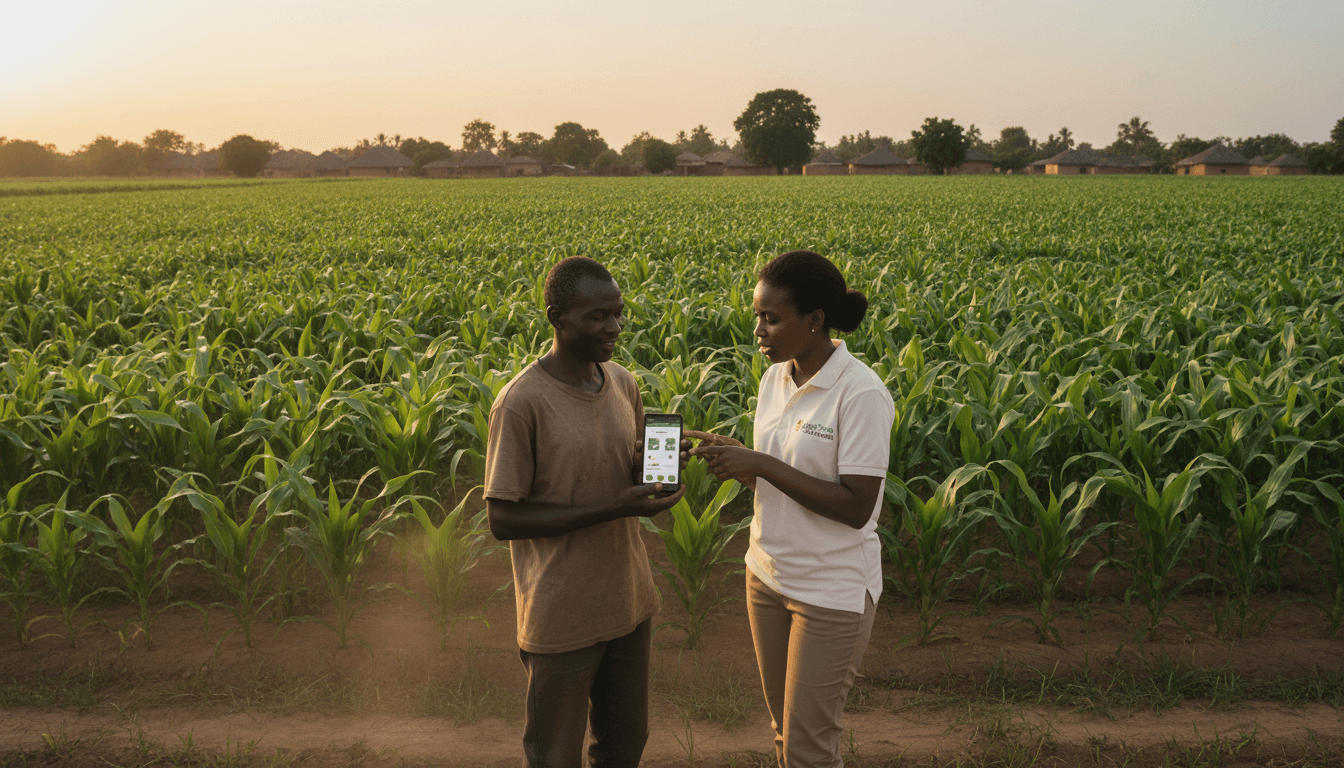
AI for Ghanaian Farmers: Lessons from Agrifoodtech 2025
2025 didn’t reward big promises in agrifoodtech. It rewarded cash flow, proof, and the kind of boring reliability farmers actually need. Funding dropped again, famous startups collapsed, and a lot of “future food” narratives ran into the same question every Ghanaian farmer asks naturally: Who will pay for this—and when will it work?
That’s why the most useful part of the global agrifoodtech story for Ghana isn’t the drama around alt-protein or vertical farms. It’s the shift toward practical AI in agriculture: tools that reduce losses, improve decisions, and make farming more predictable. In the Sɛnea AI Reboa Aduadadie ne Akuafoɔ Wɔ Ghana series, this is exactly the point—AI should serve real farms, real markets, and real budgets.
Here’s what broke globally in 2025, what bent but didn’t snap, and what Ghana can copy—without importing the hype.
1) 2025’s loud lesson: “No green premium” means AI must pay for itself
Core point: Sustainability messaging doesn’t sell on its own, and it won’t fund your product. Unit economics will.
A major theme in 2025 was the quiet admission that many consumers won’t pay extra just because something is “green.” In food, the “sustainability story” is rarely enough. The same applies in farming: if a tool doesn’t raise yield, cut costs, reduce losses, or improve prices, adoption stalls.
For Ghana, this is good news. It pushes everyone toward a cleaner standard:
- AI must produce measurable farmer value (more bags per acre, fewer pests, less wasted fertilizer, higher farmgate price).
- Climate benefits can be a bonus, not the only pitch.
A simple rule I’ve found useful: if your AI can’t show payback within one season for a smallholder, it’s a research project—not a product.
What “no green premium” means for Ghana’s AI products
If you’re building AI for agriculture in Ghana, your marketing shouldn’t lead with carbon. Lead with outcomes:
- “Reduce post-harvest losses in maize by improving drying decisions.”
- “Cut wrong pesticide use by diagnosing fall armyworm vs. leaf blight.”
- “Predict tomato price swings in Accra markets and recommend selling windows.”
Those are sustainability wins too—because efficiency reduces waste—but they’re framed in farmer language.
2) Where agrifoodtech broke: hype-heavy categories (and why Ghana should be cautious)
Core point: Some sectors didn’t fail because the science is impossible—they failed because the timelines and costs don’t match venture expectations.
Globally, 2025 exposed how fragile hype can be in:
- Alternative proteins (plant-based and cultivated meat)
- Vertical farming at scale
The pattern is familiar: big capital, big facilities, big consumer assumptions. Then the market refuses to pay a premium.
Ghana takeaway: don’t copy “capital-first” models
Ghana has innovators exploring controlled-environment agriculture, feed innovation, and new proteins. That’s healthy. But the global lesson is to avoid building a model that requires:
- Massive upfront capex
- A premium price
- Many years before profitability
Instead, Ghana’s strongest play is software-first and service-first innovation:
- AI advisory for cocoa, maize, rice, vegetables
- Forecasting tools for aggregators and traders
- Quality grading support for warehouses and processors
- Field monitoring via low-cost phones and (where viable) drones
In other words: start with decisions, not buildings.
3) What bent but still works: regenerative agriculture needs financing—and AI can target the money
Core point: Regenerative agriculture is a long game, but the biggest blocker is still capital. AI can reduce the risk that scares lenders.
The global discussion around regenerative agriculture in 2025 wasn’t “should we do it?” It was “who pays?” Transitioning to practices like cover cropping, reduced tillage, and improved grazing systems often brings short-term costs before benefits show up.
Ghana has its own versions of this challenge:
- Paying for improved seedlings and shade management in cocoa
- Financing irrigation for dry-season vegetables
- Funding better storage, drying, and aggregation to reduce losses
Practical Ghana model: AI + financing + verification
AI becomes powerful when it helps finance move with confidence.
Here are three high-impact combinations:
-
AI credit scoring for agriculture
- Use farm history, satellite signals (where available), and repayment behavior to price loans fairly.
- Result: more farmers qualify, and defaults reduce.
-
AI-driven field monitoring for input suppliers and aggregators
- Confirm planting dates, detect stress early, and trigger advisory.
- Result: fewer failed seasons, stronger supply reliability.
-
Verification for premiums that actually exist
- If a buyer truly pays more for quality or compliance, AI can help verify practices and reduce disputes.
This is where Sɛnea AI thinking fits: AI as a trust layer between farmers, buyers, and finance.
4) Biologicals, glyphosate debates, and Ghana’s “do we trust this input?” problem
Core point: Input decisions are becoming more political and more confusing globally. Farmers need evidence—not noise.
2025 brought renewed controversy around chemical crop protection (including glyphosate). At the same time, agricultural biologicals (biostimulants, biofertilizers, biopesticides) kept growing—especially in regions with friendlier regulation.
Ghanaian farmers already face a similar situation in practice:
- counterfeit or diluted inputs
- unclear labels
- conflicting advice from different sellers
- limited extension coverage
How AI can help farmers choose inputs safely
AI in agriculture isn’t only about “smart farming.” It can be basic protection:
- Input authentication using QR verification plus anomaly reporting
- Decision support that recommends action only when pest/disease thresholds are met
- Localized recommendations tied to district conditions (rainfall timing, crop stage, variety)
If we want to reduce chemical misuse and improve yields, the fastest win isn’t arguing online. It’s building systems that help farmers make fewer expensive mistakes.
5) The 2026 opportunity Ghana can seize: AI that speeds discovery and improves day-to-day decisions
Core point: The next wave isn’t flashy consumer tech. It’s AI for R&D, advisory, grading, and automation.
Globally, 2026 is expected to bring more practical AI deployments across agrifood:
- faster discovery of biologicals and formulations
- real-time quality grading (meat, grains, produce)
- better forecasting and supply planning
- robotics and automation where labor is tight
Ghana doesn’t need to copy everything. But Ghana can adopt the pattern: AI that reduces trial-and-error.
Three “Ghana-first” AI use cases that pay back fast
These are realistic, high-demand, and buildable without billion-dollar labs.
1) AI agronomy assistant on WhatsApp + voice
Most farmers don’t need an app store. They need answers that work on low data, in local languages.
What it should do:
- diagnose common crop issues from photos
- ask follow-up questions (crop stage, rainfall, symptoms)
- give safe, specific recommendations
- escalate complex cases to human extension agents
2) AI price and demand forecasting for traders and farmer groups
Farm income is often destroyed after harvest, not on the farm.
What it should do:
- predict near-term price movement by market
- recommend selling windows
- suggest storage vs. immediate sale
- flag abnormal drops that may signal supply gluts
3) AI quality grading for cocoa, maize, rice, and horticulture
Quality disputes cost everyone.
What it should do:
- grade beans/grains using phone cameras plus simple test inputs
- standardize acceptance rules for aggregators
- generate transparent buyer reports
People also ask: “Will AI replace extension officers?”
No—and it shouldn’t. AI should multiply extension capacity, not remove it. The best model in Ghana is a hybrid:
- AI handles the repeatable 80% (basic diagnosis, reminders, quick checks)
- human experts handle the nuanced 20% (complex outbreaks, new diseases, community training)
What Sɛnea AI is betting on (and what we think Ghana should bet on)
Agrifoodtech’s 2025 recalibration points to a clear stance: build for durability, not headlines.
That means:
- Start with the farmer’s cash cycle (weekly/seasonal), not a 10-year vision deck.
- Measure outcomes in the field (yield, loss reduction, margin).
- Design for Ghana’s constraints (low connectivity, language diversity, mixed literacy, small plots).
- Work through networks farmers already trust (FBOs, aggregators, input dealers, processors).
If your AI in agriculture needs perfect data, constant internet, and a premium-paying consumer, it will struggle. If it works offline, speaks the farmer’s language, and saves money, it won’t need hype.
Next steps: how to move from “AI ideas” to farmer adoption in 90 days
If you’re a cooperative leader, agribusiness, NGO, or district extension team, the fastest route is a small pilot with strict measurement.
Here’s a simple 90-day plan:
- Pick one crop and one district (example: maize in Bono East, rice in Northern Region, vegetables around Akuse).
- Choose one measurable target (example: reduce pest loss by 15%, reduce post-harvest moisture issues by 20%).
- Recruit 50–200 farmers through an existing group.
- Run a baseline for two weeks (current practices and outcomes).
- Deploy the AI advisory + human support loop.
- Report results publicly to build trust.
The agrifoodtech world learned the hard way in 2025: capital follows evidence. Ghana can learn it the easy way.
If AI is going to strengthen Ghana’s food system, it will happen farm by farm—through tools that farmers keep using after the pilot ends. What’s the one decision on your farm (or in your supply chain) that, if improved by AI, would pay for itself within a single season?