Bayer’s AI success comes from 12 years of data culture. Here’s how Ghana can apply the same approach to farming, workplaces, and aduadadie.
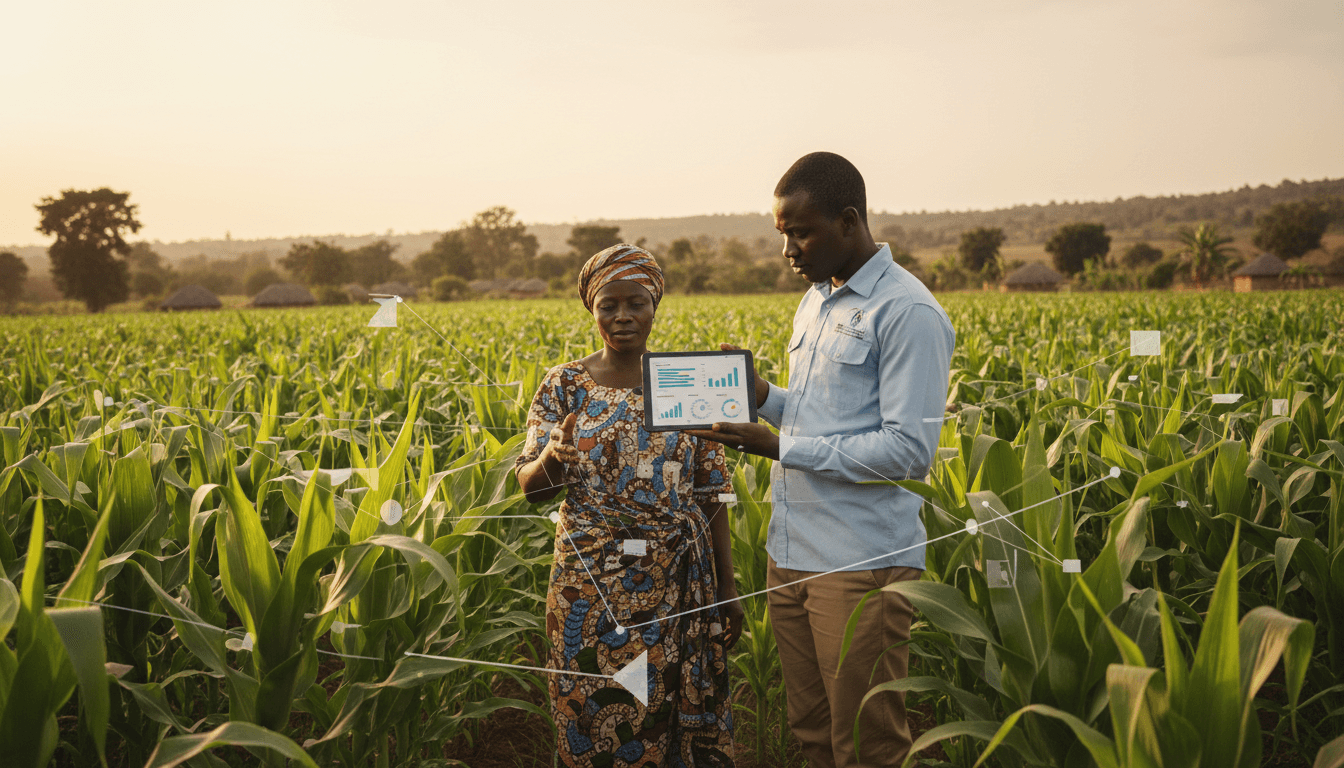
Bayer’s AI Lesson for Ghana: Data Culture Wins
Most organizations don’t fail at AI because they “don’t have the right tool.” They fail because they don’t have reliable data, shared workflows, and the patience to build a data culture.
Bayer Crop Science is a clean example of the opposite. They’re sitting on 117 billion data points on seed performance and have spent more than a decade building the habits, infrastructure, and talent that make AI actually useful. The result isn’t a flashy demo—it’s operational impact: Bayer’s GenAI tool E.L.Y. reportedly delivers about 60% productivity improvement, saving frontline agronomists roughly four hours a week.
For Ghana, this matters for two reasons. First, agriculture still employs a large part of the workforce, so improvements in decision-making and productivity spread fast. Second, our campaign theme—“Sɛnea AI Reboa Aduadadie ne Akuafoɔ Wɔ Ghana”—is really about one idea: use AI to support real people doing real work, whether that work is on the farm, in the office, or inside traditional systems where knowledge is passed down orally and informally. This post sits inside the “AI ne Adwumafie ne Nwomasua Wɔ Ghana” series because the core lesson is the same: AI works when it’s built into day-to-day work and learning—not bolted on.
Why Bayer is winning at AI (and why many others aren’t)
Bayer’s advantage isn’t “GenAI.” The advantage is 12 years of disciplined investment in data and digital product thinking.
A lot of big companies are still stuck in the pattern an operations leader once summarized well: the internet hype says everything has changed, but inside the business, nothing fundamental shifts. That gap happens when AI pilots stay trapped in innovation teams, while frontline staff keep using the same processes, the same spreadsheets, and the same informal knowledge systems.
Bayer did something different: they built a data culture long before GenAI became popular.
The real head start: building data like a product
Bayer’s foundation goes back to the 2013 acquisition of a precision agriculture company and the growth of platforms like FieldView. What matters isn’t the corporate history—it’s the discipline it created:
- Treating data as an asset that must be captured consistently
- Investing in data infrastructure (warehouses, semantics, discoverability)
- Hiring and retaining technical talent that can ship digital products
- Learning the difference between launching a physical product and a digital one
That’s a blueprint Ghana can use. Not by copying Bayer’s scale, but by copying their sequence: collect well → organize well → use well → improve continuously.
117 billion data points: what a “data moat” really means
A “data moat” isn’t about having a huge database for bragging rights. It means your organization has enough high-quality, well-labeled, context-rich data that competitors can’t easily replicate what you can build.
Bayer’s moat is specific: 117 billion seed-performance data points, including outcomes from products that succeeded and products that failed, plus genetic information and environmental context. That combination is what allows more confident predictions.
Here’s the stance I’ll take: Ghana doesn’t need a billion data points to benefit from AI. Ghana needs the right 10,000 data points captured consistently.
What “the right data” looks like for Ghanaian farming
If you’re supporting farmers in Ghana (or building services around them), the most valuable datasets are often boring:
- Planting dates, variety/hybrid used, seed source
- Fertilizer type, dosage, and timing
- Pest/disease incidents and the response taken
- Rainfall patterns (even simple local records help)
- Yields at harvest and storage losses
- Basic soil indicators (pH, texture category)
This kind of data supports practical AI: yield estimation, input optimization, pest risk alerts, and extension advice that matches local conditions.
What “the right data” looks like for aduadadie (traditional practices)
Aduadadie is knowledge-rich but often data-poor in the digital sense. AI can support it if communities choose to document it responsibly. Examples of valuable “traditional sector” datasets (with consent and governance):
- Event calendars and decision rules (who does what, when, and why)
- Local language terminology and variations across regions
- Case records of dispute resolution patterns (anonymized)
- Approved protocols for rites and ceremonies
AI shouldn’t replace authority in traditional systems. But it can become a knowledge assistant: helping people find the right guidance faster, preserving language nuance, and reducing confusion—similar to how E.L.Y. helps agronomists find product guidance quickly.
E.L.Y. proves a simple point: start with one painful workflow
Bayer’s E.L.Y. works because it targets a daily pain point: field agronomists losing time searching for scattered information.
The pattern is “Answer First” AI:
- Aggregate trusted knowledge (product sheets, agronomy guidance)
- Make it searchable in natural language
- Put it in the hands of frontline staff
- Measure time saved and behavior changes
Bayer tested with 1,500 agronomists for about a year—not because they love long pilots, but because credibility matters. If the tool gives wrong or inconsistent advice, users abandon it.
A Ghana-ready version of the E.L.Y. idea
If you’re a Ghanaian agribusiness, NGO, cooperative, or district office, a “Ghana E.L.Y.” doesn’t need to be fancy. It needs to be trusted.
Practical internal assistants that fit Ghana’s reality:
-
Extension Officer Assistant
- Answers: recommended spacing, disease identification steps, safe pesticide handling, local language explanations.
-
Input Shop Assistant
- Helps staff recommend appropriate products based on crop, location, and season, with clear cautions and dosage.
-
Cooperative Knowledge Desk
- Standardizes membership rules, pricing policies, aggregation schedules, and grievance steps.
-
Aduadadie Protocol Assistant (community-owned)
- Helps younger members learn approved processes and meanings without guessing or misquoting elders.
The goal is the same as Bayer’s: save hours, reduce mistakes, and free people to spend more time with farmers and communities.
Digital twins and “testing beyond the weather”: what Ghana can copy
Bayer describes building a digital twin of field testing networks—essentially simulating performance across millions of potential acres. The big idea is simple:
If you can’t test every condition in real life, simulate intelligently and learn faster.
For Ghana, the realistic version is smaller and still powerful:
Micro “digital twins” for districts and value chains
You can model a district or value chain with a limited set of variables:
- Typical planting windows
- Common varieties grown
- Expected rainfall ranges (historical + near-term forecasts)
- Likely pest pressure periods
- Input availability and price volatility
With that, you can run “what-if” scenarios:
- What happens if planting shifts two weeks later?
- Which crops become riskier if rainfall is delayed?
- What input substitutions keep yields stable when prices spike?
December is a good time to plan this because many organizations are budgeting and setting targets for the next season. A modest data-and-simulation project can be a practical 2026 initiative.
The real deployment challenge: people, process, and governance
Bayer’s CIO makes an uncomfortable point: once AI agents can do tasks people used to do, the organization must rethink the process, not just automate the old steps.
That’s where most Ghanaian AI projects will also struggle. Not because we lack talent, but because change management is hard.
Three non-negotiables for AI in Ghanaian workplaces and schools
If you’re building AI for agriculture, adwumafie (workplaces), or nwomasua (education), these are the three pillars I’d insist on:
-
One owner, one workflow, one metric
- Pick a single pain point and define success (e.g., “reduce extension response time from 48 hours to 12 hours”).
-
Data hygiene before model hype
- If your records are inconsistent, your AI will confidently produce nonsense. Fix naming, formats, and missing fields first.
-
Governance that respects community and culture
- For aduadadie-related knowledge, build consent and control into the system: who can upload, who can edit, what must stay private, and how sensitive cases are handled.
A practical 90-day plan (small, serious, measurable)
If you want leads and real adoption, offer a pilot that looks like this:
-
Weeks 1–2: Workflow selection
- Choose one high-volume workflow (extension Q&A, input recommendations, cooperative support, or training content).
-
Weeks 3–6: Knowledge capture + cleanup
- Collect documents, voice notes, and existing guides.
- Standardize terms in English + local language variants.
-
Weeks 7–10: Build and test with 20–50 users
- Measure: time saved per task, accuracy rating, repeat usage.
-
Weeks 11–12: Deploy + training + feedback loop
- Train users, publish usage rules, and schedule monthly improvements.
Bayer’s story says it clearly: iteration wins, but only when you’re measuring something real.
People also ask: “Do we need massive budgets to do this?”
No. You need clarity and consistency.
- A small organization can start with curated knowledge and structured spreadsheets.
- A district-level program can standardize forms and build a searchable knowledge base.
- A national platform can come later, once local systems produce reliable data.
The trap is skipping the basics and buying “AI” as if it’s a boxed product.
Where this leaves Ghana: build the culture, then scale the AI
Bayer’s biggest lesson for Ghanaian organizations isn’t the 117 billion number. It’s the patience and discipline behind it.
If we want AI that genuinely helps Akuafoɔ and strengthens aduadadie without distorting it, we need to treat AI as part of everyday work: documenting decisions, capturing outcomes, learning from errors, and improving processes.
If you’re leading a cooperative, agribusiness, school, or traditional council, the next step is straightforward: pick one workflow where people lose time or make repeated mistakes, and build a trusted assistant around your own knowledge. The question to sit with going into 2026 is simple: what would Ghana look like if every district had a reliable “knowledge engine” for farming decisions and community protocols—owned by the people who use it?