AI-driven digitization of government services is working where it standardizes decisions: healthcare scoring, emergency visibility, and elder care support.
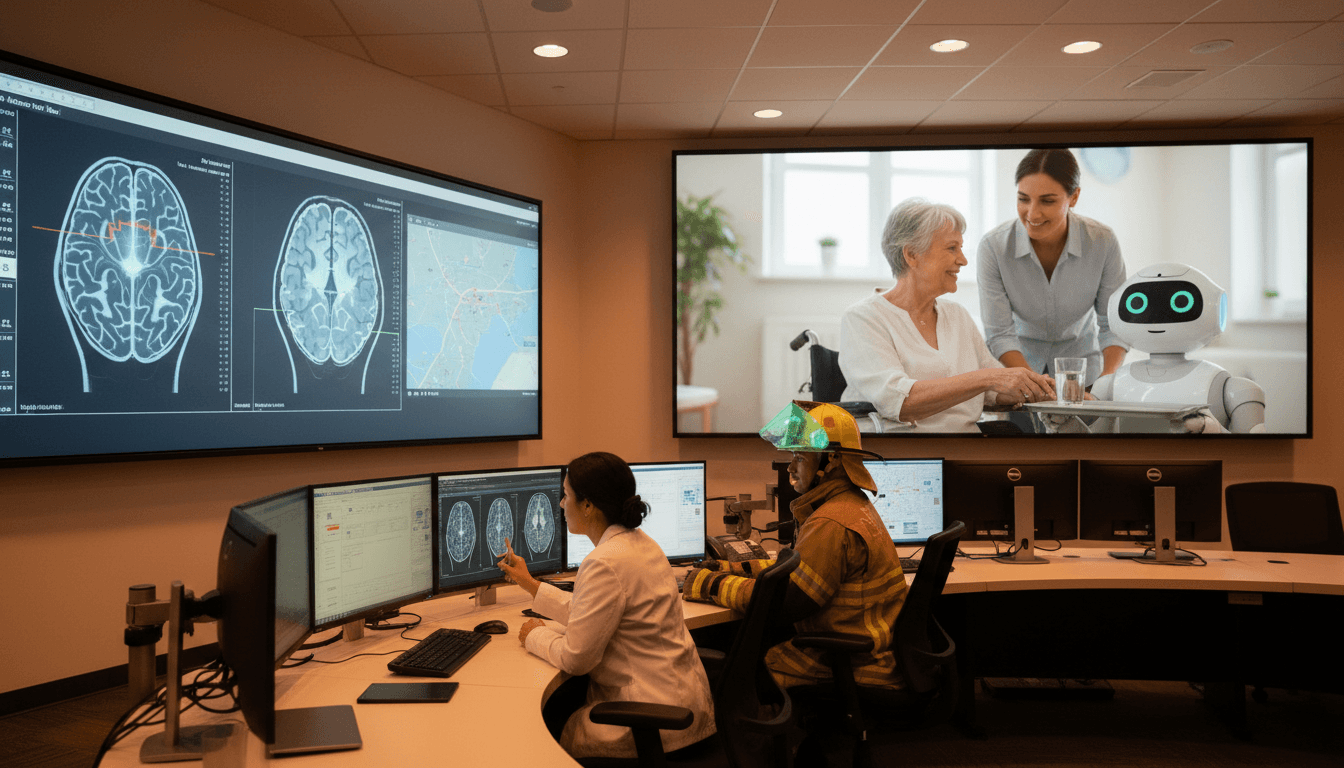
AI for Government Services: Health, Safety, Care
A simple pattern keeps showing up in December 2025’s most practical AI news: the winners aren’t “AI apps,” they’re AI workflows. When an AI tool fits cleanly into how institutions already make decisions—review, audit, approve, act—it stops being a demo and starts being public infrastructure.
That’s exactly what matters in our series on አርቲፊሻል ኢንተሊጀንስ በመንግስታዊ አገልግሎቶች ዲጂታላይዜሽን: using AI to reduce bureaucracy, speed up service delivery, and produce citizen outcomes you can actually measure. This week’s headlines—AI scoring liver biopsies for regulators, thermal vision helping firefighters see through smoke, and robotic caregivers supporting older adults—aren’t random. They’re a preview of what “AI-enabled public service” looks like when it’s built responsibly.
Here’s the stance I’ll take: Governments should prioritize AI that tightens feedback loops in critical services (public health, emergency response, and welfare). Not because it’s trendy, but because it’s where minutes, errors, and staffing gaps have real human costs.
The real shift: from digital forms to digital decisions
AI-driven digitization of government services works when it improves decisions, not just paperwork. Many public-sector “digital transformation” projects stop at portals, e-forms, and ticketing systems. Useful, yes—but they don’t change the underlying bottlenecks: reviews, handoffs, and inconsistent judgments.
What these December stories show is a stronger model: standardize the input, automate the first pass, keep humans in control, and produce outputs that can be audited. That formula is how you modernize without breaking trust.
If you’re planning an AI program inside a ministry, municipality, hospital network, or emergency management agency, this is the litmus test:
- Does the AI output map to an official decision step (approve/deny/triage/dispatch)?
- Can the result be reviewed and overridden by a qualified human?
- Can you audit performance over time across regions, languages, and demographics?
- Can you explain, at least at a practical level, why the system recommended what it did?
When the answer is “yes,” AI stops being a side project and becomes part of the service pipeline.
Public health: AI that regulators can actually use
The biggest bottleneck in public health isn’t data collection—it’s consistent evaluation. That’s why the FDA’s qualification of an AI tool to score liver biopsy images in drug trials matters beyond the U.S. context. The key idea is straightforward: the AI generates standardized scores for fat buildup, inflammation, and scarring, and physicians review those results.
Why this maps directly to government health systems
Health ministries and public hospitals face similar friction points every day:
- Radiology and pathology backlogs
- Variation between reviewers and facilities
- Slow reporting cycles that delay treatment decisions
In practice, an AI “first reader” can shorten turnaround time and reduce variability—if it’s implemented as a workflow, not a replacement. The FDA example is important because it models a governance-friendly approach: AI produces a structured assessment; clinicians remain accountable.
A concrete government use-case: faster triage and referrals
Here’s what works in the public sector: pick a high-volume condition where delays are common, then build an AI-assisted pipeline that outputs a standard score and a recommended pathway.
For example:
- Patient comes in → imaging/lab results digitized
- AI produces a severity score + flags uncertainties
- Clinician validates and signs off
- System triggers referral, follow-up, or additional tests
This is AI in public service optimization: not “AI diagnosis,” but “AI-enabled triage with accountability.”
Snippet-worthy principle: If an AI output can’t be reviewed, signed, and audited, it doesn’t belong in a government clinical workflow.
What to demand before deploying health AI
If you’re responsible for procurement or policy, insist on these minimums:
- Local validation using your patient population and your equipment
- Drift monitoring (performance can degrade when protocols or demographics shift)
- Clear escalation rules for ambiguous results
- Structured outputs (scores, categories, and confidence bands—no free-text mystery)
That’s how you move from pilot to national scale without inviting backlash.
Emergency response: visibility is a service, not a feature
In emergencies, the fastest improvement is often “better perception.” A helmet-mounted thermal vision system that overlays thermal infrared signals onto a firefighter’s view—and streams video to command centers—sounds like a hardware story. It’s actually a public service story.
The public doesn’t care whether the technology is “thermal infrared.” They care that responders can enter faster, coordinate better, and come home safely.
What changes when command centers get live visual data
Most emergency response failures come from three gaps:
- Responders don’t know what’s behind smoke/darkness
- Command doesn’t have real-time ground truth
- Teams lose coordination during rapid changes
A system that gives hands-free visibility and real-time streaming tightens the loop between field teams and incident command. That’s digitization done right: data flows where decisions are made.
How to integrate this into government emergency operations
To make this more than a gadget, agencies should treat it as part of the incident management stack:
- SOP updates: define when thermal overlays are required (industrial fires, airport incidents, night rescues)
- Training: run drills where commanders practice decision-making using live streams
- Evidence management: define retention policies (what’s stored, who can access it, how long)
- Interoperability: ensure feeds can be shared across police, ambulance, and fire when appropriate
I’m opinionated here: if you deploy sensor tech without updating SOPs and training, you’ll get disappointing results and skeptical crews.
Privacy and trust: solve it before the first incident
Streaming video from a public emergency can capture civilians in vulnerable situations. Governments should pre-commit to rules that protect dignity:
- Restrict access to authorized roles
- Mask or redact faces for non-investigative use
- Keep retention short unless legally required
That’s not bureaucracy; it’s what keeps adoption from collapsing under public criticism.
Public welfare and elder care: robots aren’t the point—capacity is
Robotic caregivers are a response to a staffing crisis, not a science project. Research teams developing humanoid robots that help with dressing, laundry, simple meals, and repositioning patients are targeting a blunt reality: aging populations are growing faster than caregiving capacity.
Governments already feel this in:
- long-term care facilities
- community health programs
- disability support services
- hospital wards where nurses are overextended
The most realistic role for “robotic caregivers” in government
The first public-sector win won’t be a robot doing everything. It’ll be robots doing the tasks that cause the most injury and burnout:
- patient repositioning to prevent bedsores
- safe transfers (bed to chair)
- repetitive logistics inside facilities
That reduces worker injury risk and frees human staff for the parts machines can’t do well: rapport, judgment, and emotional support.
Pair robotics with digital case management
Robotics becomes far more valuable when connected to the broader digitization agenda:
- If a robot-assisted repositioning schedule is logged automatically, supervisors can spot understaffing patterns.
- If tasks are timestamped, you can measure service levels objectively.
- If alerts are generated (missed turns, abnormal movement), you can intervene early.
This is where AI in government services becomes measurable. Not “we bought robots,” but “pressure ulcers decreased” or “staff injury leave dropped.”
Snippet-worthy principle: In public welfare, the KPI isn’t automation—it’s safer care with less burnout.
The supporting cast: what these other AI stories teach governments
Not every item in the news list is “government-first,” but several contain lessons that transfer cleanly into public service digitization.
Digital production platforms: the Navy’s Ship OS lesson
A digital shipbuilding platform reduced planning work from days to minutes in pilots by connecting schedules, supply data, and factory-floor info. Translate that to government services: stop running ministries on disconnected spreadsheets.
When permitting offices, procurement teams, and field operations share a unified operational view, you can identify delays early and fix root causes.
AI assistants and wearables: capture work where it happens
Hands-free AI assistants that listen, identify important information, and generate reminders point to a practical direction for field workers:
- community health workers documenting visits
- inspectors recording observations without paper
- social workers capturing follow-up actions
The constraint is governance: consent, secure storage, and role-based access. But the opportunity is big: less time writing notes, more time serving people.
Immersive tech for dementia: social connection is an outcome
VR projects that support older adults with dementia by enabling shared experiences with family highlight an often-missed point: public services aren’t only transactional. Sometimes the outcome is reduced isolation.
If a government runs elder programs, “digital services” can include guided social experiences, caregiver training modules, and remote check-ins—especially relevant during holiday seasons when loneliness spikes.
A practical roadmap for AI digitization in government (that won’t backfire)
The fastest way to lose trust is deploying AI without clear accountability. The fastest way to gain trust is delivering one or two services that become obviously better.
Step 1: Choose one high-impact workflow per sector
Pick workflows with clear metrics:
- Health: lab/imaging turnaround time, triage accuracy, referral delays
- Emergency: time-to-locate victim, responder safety incidents, command coordination errors
- Welfare: staff injury rates, missed care tasks, response times
Step 2: Design “human-in-the-loop” as a policy, not a slogan
Write it into SOPs:
- Who reviews AI outputs?
- What’s the override process?
- When must the system escalate to a senior reviewer?
Step 3: Build auditability from day one
Auditability means:
- immutable logs (who changed what, when)
- model performance dashboards by region/facility
- periodic re-validation
Step 4: Procure outcomes, not tools
Instead of buying “an AI system,” buy:
- reduced backlogs
- improved response time
- higher consistency across facilities
Vendors can argue about tech; they can’t argue with outcome metrics.
What to do next (if you want leads that turn into real projects)
If you’re working on የመንግስት አገልግሎቶች ዲጂታላይዜሽን and you want AI to produce results in 2026, start with three questions:
- Where does variability hurt citizens most? (inconsistent assessments, uneven service quality)
- Where does time loss hurt outcomes most? (triage delays, slow dispatch, backlog queues)
- Where are staff physically or cognitively overloaded? (care tasks, documentation, repetitive planning)
These December examples point to a clear direction: AI that standardizes assessments, improves visibility, and supports care capacity is the safest bet for government adoption.
The forward-looking question worth sitting with: when citizens look back at public services in five years, will they remember “we launched an AI initiative,” or will they remember that services got faster, fairer, and easier to access?