AI precision farming helps growers use less water and inputs while protecting yield. See where to start in 2026 with practical, measurable steps.
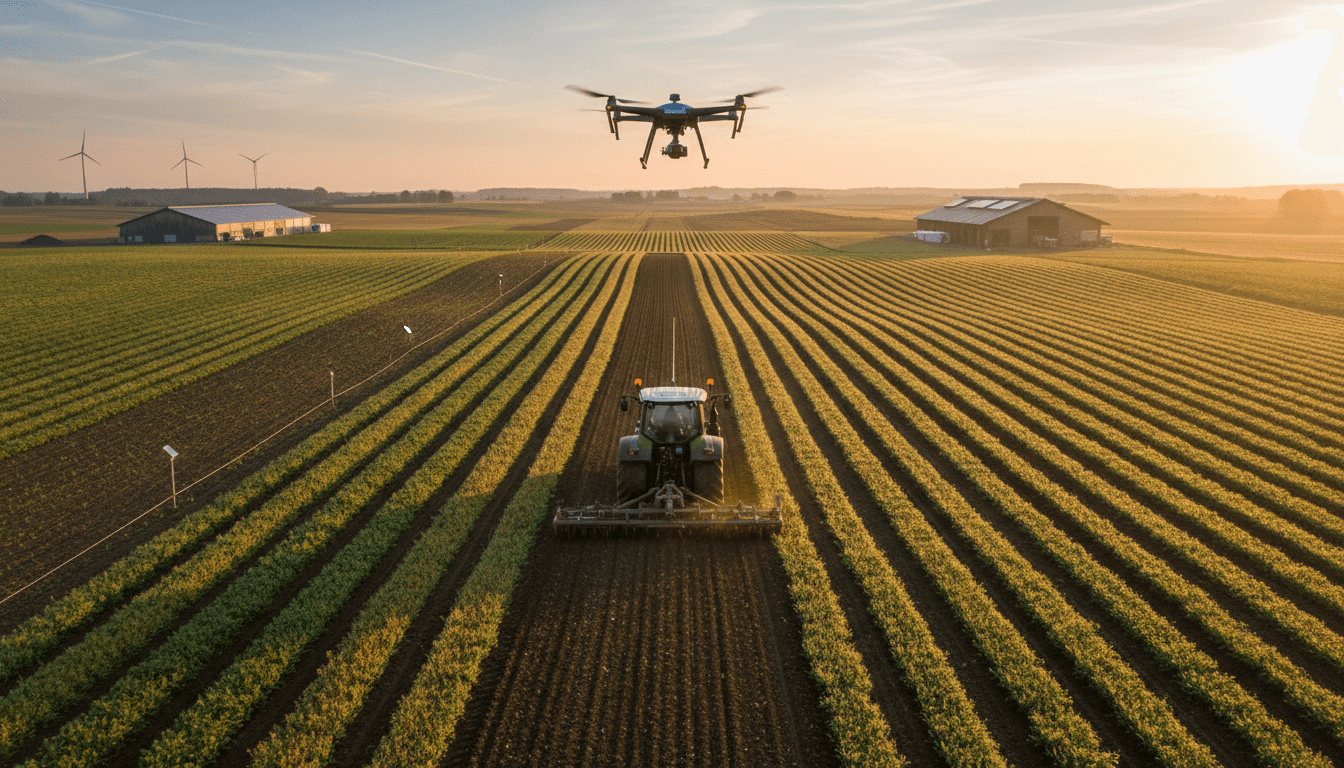
AI Precision Farming: Grow More Using Less in 2026
The precision farming market is projected to grow from USD 11.38 billion in 2025 to USD 21.45 billion by 2032—a 9.5% CAGR. That number matters less as “market news” and more as a signal: farms everywhere are being pushed toward a new baseline where data-driven decisions aren’t optional.
This post is part of our series “አርቲፊሻል ኢንተሊጀንስ በእርሻና ግብርና ዘርፍ ውስጥ ያለው ሚና”—and the timing is right. Late December is when many growers, agribusiness teams, and cooperatives plan budgets, input purchases, and trial plots for the next season. If you’re making 2026 plans, AI in precision agriculture isn’t something to “watch.” It’s something to choose intentionally, because the farms that treat AI as an operating system (not a gadget) tend to waste less and predict more.
Here’s the stance I’ll take: precision farming isn’t about more sensors. It’s about fewer wrong decisions. AI is the piece that turns farm data into actions you can trust—especially when climate volatility and input costs punish guesswork.
Why precision farming demand is rising (and why AI is the driver)
Precision farming demand is accelerating because agriculture is being squeezed from both sides: higher food demand and tighter limits on water, fertilizer, chemicals, and labor. The practical outcome is simple—every hectare must produce more value with fewer resources.
AI matters here because farms don’t have a data shortage anymore; they have an interpretation and timing problem. Soil sensors, satellite imagery, machine telemetry, scouting notes, and weather feeds can easily overwhelm a team. AI systems (especially machine learning models) can combine these streams to answer operational questions like:
- Where should we irrigate today to avoid yield loss next month?
- Which field block is trending toward nitrogen deficiency—before it becomes visible?
- When should we spray to avoid wash-off risk, resistance pressure, and wasted chemical?
A helpful way to frame it for this series: AI in agriculture works like business intelligence for the farm. It’s the same story as factories or logistics—collect signals, detect patterns, predict outcomes, and optimize decisions. The difference is the farm’s “factory floor” is exposed to biology and weather.
Snippet-worthy truth: Precision agriculture without AI is measurement. Precision agriculture with AI is management.
The AI stack behind precision agriculture (what’s actually doing the work)
Most teams talk about “AI precision farming” as if it’s one product. In reality, it’s a stack. Getting value requires knowing what each layer does and where you’re weak.
IoT + machines: the raw signals
Sensors and connected equipment create the inputs AI needs:
- Soil moisture and salinity sensors
- Weather stations (on-farm, hyperlocal)
- Tractor/implement guidance and telemetry
- Yield monitors on harvesters
- Livestock wearables and barn sensors
These tools are why automation and control system hardware has been taking a big share of the market: GPS receivers, guidance tools, variable rate controllers, and field sensors are the physical backbone.
AI analytics: the “so what” layer
AI earns its keep by doing three jobs:
- Prediction: yield forecasting, pest/disease risk scoring, irrigation timing
- Optimization: variable rate prescriptions for fertilizer, seed, water
- Automation: routing drones/robots, triggering alerts, generating work orders
If you’ve found that dashboards look impressive but don’t change field actions, that’s usually an AI workflow problem: the model isn’t tied to decisions like “apply,” “wait,” “scout,” or “shift inputs to zone B.”
Trust + traceability: why blockchain gets mentioned
You’ll often see blockchain in the same sentence as AI and IoT. The practical angle isn’t hype—it’s auditability. When supply chains demand proof (inputs used, spray records, harvest lots), a tamper-resistant record helps. AI can then use consistent records to learn and improve recommendations over seasons.
The use cases that pay off fastest: variable rate, yield, livestock
Precision farming can mean many things, but three applications tend to generate ROI quickly because they hit the biggest cost centers.
Variable Rate Application (VRA): spend inputs where they matter
Answer first: VRA reduces waste by matching input rates to within-field variability.
AI makes VRA smarter by learning from multi-year patterns rather than a single soil map. For example:
- Use yield history + satellite biomass + soil texture to identify stable low-yield zones
- Recommend reduced seeding or targeted fertility in zones that consistently underperform
- Increase inputs only where the probability of response is high
This is sustainability you can measure. Less nitrogen lost to runoff. Less over-application “just in case.” More margin retained.
Yield monitoring + analytics: turn a harvest map into next season’s plan
Answer first: Yield monitoring becomes valuable when it changes next season’s decisions.
A yield map alone is a report card. AI turns it into a coaching plan:
- Detect zones where yield loss correlates with moisture stress vs. nutrient deficiency
- Separate “weather year” impacts from management impacts
- Recommend hybrid/variety placement based on micro-zones
If you’re running multiple farms or contract growers, AI also helps standardize learning: it can highlight which practices consistently drive results across locations.
Livestock tracking: prevent losses before they show up
Answer first: AI-based livestock monitoring reduces avoidable loss by flagging early behavior changes.
Wearables and barn sensors can detect:
- Drops in activity or rumination (often earlier than visible illness)
- Heat detection for breeding timing
- Environmental stress (temperature/humidity) linked to feed intake changes
The sustainability link is real: healthier animals mean better feed conversion and lower emissions intensity per unit of output.
Weather forecasting is becoming the highest-growth AI application
The fastest-growing precision farming application highlighted in industry forecasts is weather tracking and forecasting—and it makes sense. Climate volatility punishes “average year” planning.
Answer first: Hyperlocal AI weather forecasting improves timing decisions that directly control cost and yield.
What changes when your forecasts get more local and more operational?
- Spray windows: Reduce drift and wash-off risk by timing applications to stable wind and rainfall probability
- Irrigation scheduling: Avoid stress during heat spikes while preventing overwatering ahead of rain
- Harvest planning: Reduce losses by aligning harvest with moisture, storm risk, and logistics
I’m opinionated here: many farms buy expensive hardware first and treat weather as an app. That’s backwards. Weather is the master variable for most cropping systems. If you improve decision timing by even a day or two during critical windows, the payoff can beat a new sensor array.
“People also ask”: Do I need my own weather station?
If you’re making spray and irrigation decisions, an on-farm station is often worth it—but only if your data is maintained and actually used. A poorly placed or uncalibrated station is worse than none because it trains your team to trust bad signals.
Adoption reality: infrastructure gaps are the real bottleneck
Developed regions adopt faster because they have better connectivity, dealer networks, and service capacity. Rural and remote regions face the classic blockers:
- Connectivity gaps
- Higher upfront costs
- Limited local technical support
- Tools designed for large farms, not smallholders
The good news is the gap is narrowing as mobile coverage and smartphones spread, and as governments and cooperatives invest in digital agriculture initiatives.
Answer first: For most farms, the adoption path that works is “start with decisions,” not “start with devices.”
A pragmatic sequence I recommend:
- Pick one decision to improve (irrigation timing, nitrogen top-dress, spray timing)
- Instrument only what you need (a few sensors + imagery + weather)
- Automate the workflow (alerts → tasks → validation)
- Measure outcomes (input cost per hectare, yield stability, quality grades)
This approach fits both large operations and smallholders. It also matches the broader theme of this series: AI should support the farmer with usable digital information, not bury them in dashboards.
What’s next: AI automation, drones, and smallholder-friendly tools
The next growth phase is already visible in three areas:
AI-powered automation becomes normal
Guidance, auto-steer, section control, and variable rate controllers are stepping stones toward automation where the machine executes decisions with minimal human friction. Labor shortages and rising wage costs make this a straightforward economic move.
Drone-based monitoring shifts from “cool” to “routine”
Drones can collect high-resolution imagery on demand—especially useful when cloud cover limits satellites. AI then classifies stress patterns and prioritizes scouting routes. The win isn’t pretty maps; it’s faster intervention.
Smallholder-oriented AI will define who benefits
If precision farming stays optimized only for large-scale farms, adoption will be lopsided. The best direction is tools that:
- Work offline or with low bandwidth
- Use mobile-first interfaces
- Provide recommendations in simple operational language
- Support cooperative models (shared drone service, shared agronomist, shared platform)
Another quotable line: The future of sustainable agriculture isn’t more data. It’s better decisions at the field edge.
Practical checklist: how to start AI precision farming in 30 days
You don’t need to transform the whole farm at once. You need one proof that changes behavior.
- Choose a high-cost input to optimize (water, nitrogen, chemicals, feed)
- Pick 1–2 fields or barns for a pilot (where outcomes are measurable)
- Define a single KPI (e.g., kg of N per ton produced, water per kg output, spray cost per hectare)
- Set a data routine (weekly imagery + weather alerts + scouting notes)
- Create an action rule (e.g., “If stress index rises above X, scout within 24 hours”)
- Run a post-season review and turn learnings into next season prescriptions
If you’re leading an agribusiness team, add one more step: make sure your system produces audit-ready records. Sustainability claims are increasingly verified through documentation, not marketing.
Where this fits in the series—and what you should do next
This article’s market signal is clear: precision agriculture is expanding quickly, and AI is the engine turning sensing and automation into sustainable outcomes. Within our series “አርቲፊሻል ኢንተሊጀንስ በእርሻና ግብርና ዘርፍ ውስጥ ያለው ሚና”, this is the chapter where AI shifts from “helpful” to “necessary”—because sustainability targets, climate pressure, and cost volatility don’t wait.
If you’re planning for 2026, commit to one AI-supported workflow you can measure. One. When it pays off, expand. If it doesn’t, you’ll learn exactly which data or process step was missing.
What’s the next decision on your farm that you’d most like to make with fewer assumptions—and more proof?