AI-powered hydroponics turns sensor data into stable yields, lower energy use, and less waste. Learn practical AI use cases and a phased roadmap.
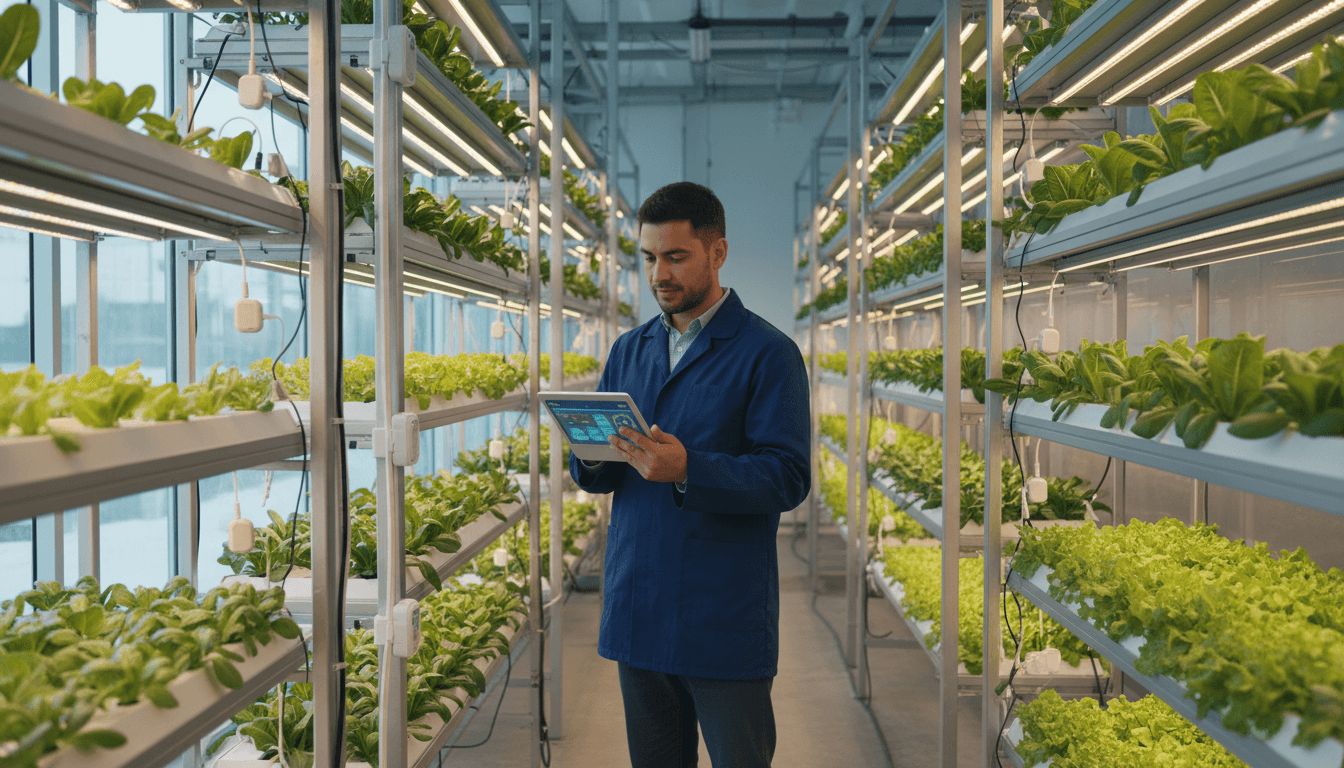
AI-Powered Hydroponics: Smarter Yields, Less Waste
The hydroponics technologies market isn’t “having a moment”—it’s compounding fast. One widely cited industry forecast puts the market at USD 20.47 billion in 2024, growing to USD 62.88 billion by 2035 at a 10.74% CAGR. Those numbers matter, but the more practical story is simpler: hydroponics is becoming a mainstream production model, and AI is quickly becoming the operating system behind it.
In our series “አርቲፊሻል ኢንተሊጀንስ በእርሻና ግብርና ዘርፍ ውስጥ ያለው ሚና”, we keep coming back to the same theme: the farms that win aren’t the ones with the most gadgets—they’re the ones that turn daily farm signals into decisions. Hydroponics is signal-rich (pH, EC, dissolved oxygen, temperature, humidity, VPD, CO₂, light intensity, flow rates). AI is what turns that flood into consistent yield, predictable quality, and lower cost per kilogram.
Hydroponics is growing because it fixes three hard problems
Answer first: Hydroponics scales because it addresses water constraints, land constraints, and supply-chain constraints—and those are getting tighter, not easier.
Hydroponics uses dramatically less water than field agriculture because most systems recirculate nutrient solution rather than losing it to soil evaporation and deep percolation. In water-stressed regions, that’s not a “nice-to-have,” it’s a license to operate.
Land constraints are just as real. Urbanization continues to concentrate consumers in cities, while arable land doesn’t expand. Controlled environment agriculture (CEA)—including hydroponics and vertical farming—brings production closer to demand, reducing spoilage, transport risk, and the cost of moving fragile leafy greens.
And there’s the holiday-season reality (it’s late December): demand spikes, logistics get messy, and weather disruptions can break delivery windows. Year-round hydroponic production with predictable harvest schedules is a direct answer to those volatility patterns.
Where AI actually fits in a hydroponic farm (and where it doesn’t)
Answer first: AI is most valuable when it’s tied to specific control points—nutrient dosing, climate setpoints, irrigation timing, lighting schedules, and pest risk—rather than “general analytics.”
Hydroponic farms already rely on sensors and automation. The difference AI makes is turning “monitoring” into closed-loop optimization. Here’s a clean way to think about it:
AI’s job: convert sensor data into decisions
In a hydroponic system, small drifts add up. A slightly off pH can lock out nutrients. A few hours of poor VPD can reduce transpiration and slow growth. An inconsistent DLI (daily light integral) can stretch crop cycles.
A practical AI model doesn’t need to be fancy. It needs to be useful:
- Prediction: “If we keep these setpoints, harvest will slip by 2 days.”
- Diagnosis: “Yield drop is linked to root-zone temperature swings after 2pm.”
- Recommendation: “Adjust nutrient A by +3% and increase aeration during peak heat.”
- Automation: “Make the adjustment automatically, then verify by sensor feedback.”
Where AI doesn’t help much (yet)
I’m skeptical when vendors promise AI will “fix” a poorly designed grow room. If airflow is broken, light distribution is uneven, or the plumbing design creates dead zones, AI becomes an expensive bandage.
The best results come when fundamentals are strong—good hygiene, good environmental control, repeatable SOPs—then AI improves consistency and reduces the labor needed to maintain that consistency.
The highest-ROI AI use cases in hydroponics
Answer first: The quickest payback tends to come from resource optimization (energy, water, nutrients) and labor reduction, not from exotic new crop recipes.
Below are the use cases that typically move financial metrics (cost per kg, yield per m², crop cycle length, downgrade rate) in a measurable way.
1) Nutrient and pH control that behaves like a “pilot,” not an alarm
Most growers start with threshold alerts: pH too high, EC too low, tank temperature out of range. That’s fine, but it’s reactive.
AI-assisted dosing uses historical response curves to anticipate drift. For example:
- Forecast pH drift based on water source variability and plant uptake patterns
- Detect sensor anomalies (bad probes cause expensive mistakes)
- Recommend dosing “little and often” to avoid oscillation
Snippet-worthy line: In hydroponics, stable chemistry beats perfect chemistry.
2) Climate optimization using VPD targets (and fewer arguments)
CEA teams often debate setpoints: humidity vs disease risk, temperature vs speed, CO₂ vs energy. AI helps by learning what setpoints produce the best outcomes for your facility, not a generic chart.
A strong approach:
- Set a baseline climate recipe (temperature, RH, CO₂)
- Track outcomes (growth rate, tip burn, disease pressure, shelf life)
- Use models to find which variables drive downgrades
- Adjust setpoints with guardrails (don’t chase noise)
3) Lighting schedules that minimize kWh per kilogram
Energy is the biggest pain point for many indoor farms. AI can coordinate lighting with:
- Utility time-of-use rates
- Desired DLI per crop stage
- Heat load constraints (lights are also heaters)
Even without complex optimization, a data-driven lighting schedule can reduce waste and smooth production. Pair this with modern LED control systems and you get more predictable morphology and timing.
4) Early pest and disease risk detection (before it becomes a shutdown)
Hydroponics reduces some soil-borne issues, but CEA still faces pests (aphids, thrips) and pathogens (powdery mildew, botrytis, pythium).
AI adds value when it combines:
- Vision systems (camera-based scouting)
- Environmental risk scoring (e.g., humidity patterns that favor mildew)
- Action playbooks (what to do in the next 24 hours)
The win isn’t “perfect detection.” The win is shortening the time between first signal and first action.
A practical “AI + hydroponics” stack you can build in phases
Answer first: Start with the minimum instrumentation and data hygiene, then layer automation, then optimization. Skipping steps usually costs more.
Here’s a phased plan that works for commercial sites and ambitious mid-size farms.
Phase 1: Reliable data (2–6 weeks)
You need consistent inputs before you can trust outputs:
- Calibrated sensors for pH, EC, water temperature, and (ideally) dissolved oxygen
- Climate sensors for temperature, RH, and CO₂
- Logging that stores data at a usable frequency (not once per day)
- A simple “crop diary” (transplant dates, harvest weights, issues)
If your pH probe lies, your AI will confidently tell you the wrong thing.
Phase 2: Rule-based automation (1–2 months)
Before machine learning, build predictable control:
- Dosing pumps with safety limits
- Irrigation scheduling by crop stage
- Alerts that notify the right person, not everyone
Phase 3: AI recommendations (2–4 months)
Now add models that deliver decisions:
- Yield and harvest-date forecasting
- Setpoint recommendations by cultivar and growth stage
- Anomaly detection (sensor failure, pump performance drift)
Phase 4: Closed-loop optimization (ongoing)
This is where strong operators separate from hobby systems:
- Automated setpoint tuning within approved ranges
- Continuous learning by batch (every crop cycle improves the next)
- Economic optimization (maximize margin, not just grams)
What the market growth tells us: the winners will be operators, not just builders
Answer first: As the hydroponics market grows, differentiation shifts from “who can build a farm” to “who can run it profitably every week.” AI is part of that operating discipline.
The RSS story highlights familiar growth drivers—sustainability, urban farming, and tech innovation like automation and IoT. I agree with the direction, but I’ll take a stronger stance: hydroponics doesn’t scale on inspiration; it scales on standardization.
That’s why we’re seeing more attention on:
- Repeatable crop recipes and cultivar selection
- Farm management software integrated with sensors
- Predictive maintenance (pumps, filters, HVAC)
- Quality consistency and shelf-life outcomes
AI supports each of these by turning experience into a system: what a senior grower “just knows” becomes measurable, trainable, and repeatable.
FAQ-style questions growers ask (and straight answers)
Does AI mean fewer farm jobs?
AI usually shifts jobs rather than eliminating them. You’ll need fewer hours of manual checking and more time on crop strategy, sanitation discipline, and exception handling. Farms still need people—just not people doing the same checks 12 times a day.
Is AI only for big commercial hydroponics operations?
No. Smaller farms can start with simpler wins: reliable sensor logging, alerting, and basic forecasting. The key is not size—it’s whether you can collect clean data and act on it.
What should I measure first?
Start with the variables that directly drive crop outcomes:
- pH and EC stability
- Root-zone temperature
- VPD (not just RH)
- DLI (light delivered per day)
- Harvest weight and downgrade reasons
If you can’t explain why product was downgraded, you can’t train any system—human or AI—to prevent it.
Next steps: turning AI into a real hydroponics advantage
Hydroponics is expanding because it answers real constraints, and the market forecasts reflect that momentum. But growth also brings competition, and competition squeezes margins. AI in hydroponic farming is how you protect margins: less waste, fewer surprises, tighter cycles, and more consistent quality.
If you’re following this series on አርቲፊሻል ኢንተሊጀንስ በእርሻና ግብርና ዘርፍ ውስጥ ያለው ሚና, this is a perfect “next chapter” topic: the moment AI stops being a buzzword and becomes a daily farm habit.
Pick one zone (one crop, one room, one system). Instrument it well. Track outcomes for 2–3 crop cycles. Then decide: are you ready to let the data run the routine, so your team can focus on the hard decisions?