AI harvest automation works best when loss targets match real field results. See how SmartPan measurement strengthens combine automation and profit.
AI-Driven Harvest Automation That Cuts Grain Loss
A combine can do a thousand things right and still leave money behind—quietly—through grain loss that no one measures in a way they trust. That’s why I pay attention any time “automation” gets paired with “ground-truth measurement.” Automation without verification is just confidence on a screen.
This month’s partnership between Bushel Plus SmartPan™ and John Deere Harvest Settings Automation is a good example of what practical AI in agriculture looks like: sensors and algorithms making fast decisions, plus a simple field method that checks whether those decisions are actually working. In our series “አርቲፊሻል ኢንተሊጀንስ በእርሻና ግብርና ዘርፍ ውስጥ ያለው ሚና”, this is exactly the kind of story that matters—because it connects AI to profit, not hype.
Below is what the partnership changes, why “measured loss” is the missing link in many harvest operations, and how to use AI-assisted harvesting workflows in a way that holds up in real fields.
The real problem: harvest loss is easy to underestimate
Harvest loss is expensive because it’s invisible by default. Operators see a clean sample and a strong yield monitor number, then assume the machine is “dialed in.” But a small loss rate spread across hundreds or thousands of acres becomes a real line item.
Here’s the operational truth: combine settings are a moving target. Crop moisture shifts during the day. Field variability changes feed rate. Lodging, weeds, and residue alter separation dynamics. Even a sharp operator can’t continuously re-tune rotor speed, fan speed, concave clearance, and sieve/chaffer settings with perfect timing.
That’s where AI-enabled automation earns its place. But it only works well when the machine is being trained against reality.
Why farmers don’t always trust “loss numbers” on a display
Displays estimate loss using onboard sensors and models. That’s useful, but it can also create a false sense of precision if calibration is off.
A simple rule that holds up across industries: when a metric is used to make decisions, people immediately ask, “Is it real?” In agriculture, the quickest way to answer that is to physically measure what’s on the ground.
What John Deere Harvest Settings Automation actually does (and why it matters)
John Deere Harvest Settings Automation adjusts the combine in real time to stay within operator-defined limits. Instead of a static “set it and hope” approach, the system automatically tunes key parameters—such as rotor speed, fan speed, concave clearance, and sieve and chaffer settings—to hit targets like:
- Grain loss limits
- Broken grain thresholds
- Foreign material limits
That matters because it turns the combine into a controlled process rather than a manual guessing game. In AI terms, this is continuous optimization: observe conditions, adjust settings, check results, repeat.
But there’s a catch.
Automation is only as good as the target it’s chasing
If your loss target is mis-calibrated, the combine can optimize toward the wrong goal. You may end up protecting grain quality while sacrificing yield, or pushing throughput while quietly leaking bushels behind the machine.
This is where most “AI in farming” conversations get too abstract. The winning approach is simple: pair machine intelligence with a measurement method you trust.
SmartPan as “ground truth”: the missing layer in AI-assisted harvesting
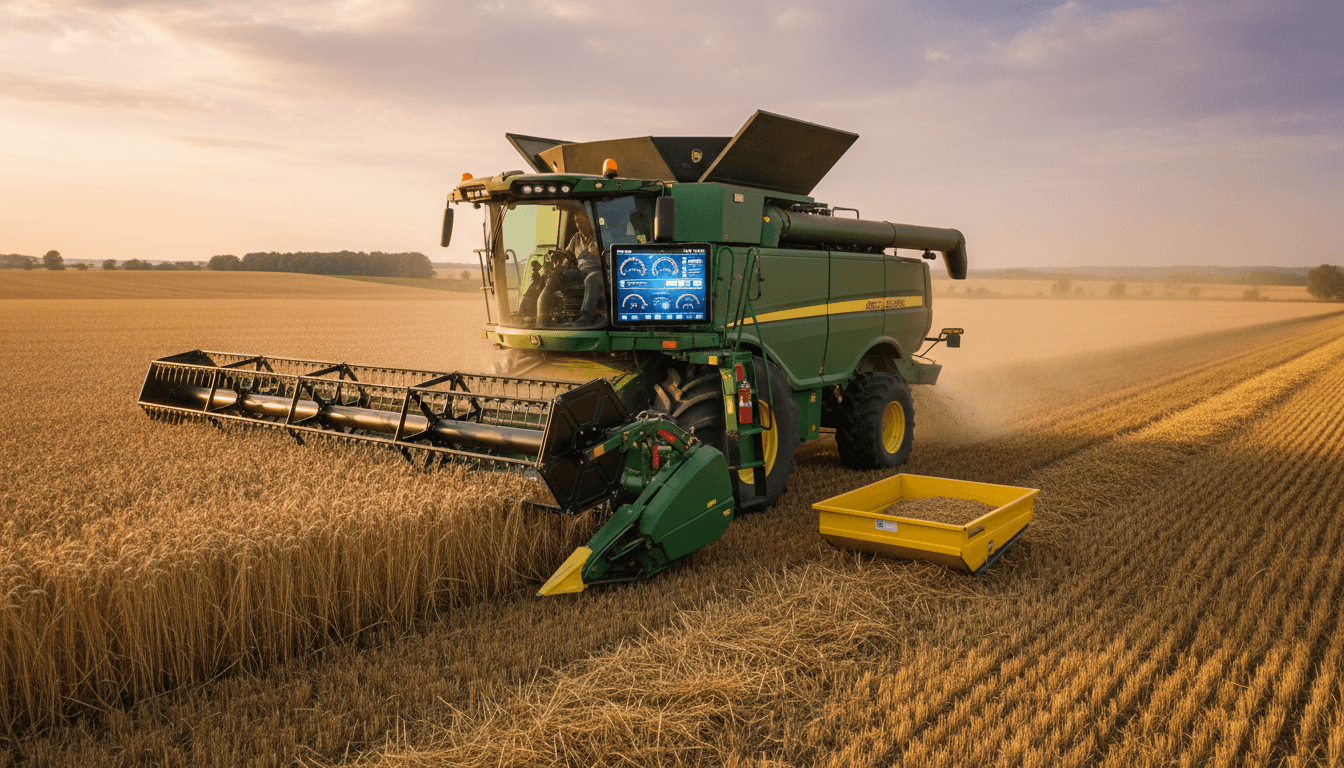
Bushel Plus SmartPan™ provides physical, field-verified loss measurement—true bushels-per-acre loss—right where it counts: behind the combine. Think of it as the audit trail for your automation.
John Deere’s automation needs a reliable baseline to calibrate its loss targets. SmartPan provides that baseline by letting the operator:
- Drop the pan during harvest
- Collect what’s actually being lost
- Compare the result to what the in-cab display is indicating
- Adjust calibration/targets so automation is steering based on reality
Snippet-worthy takeaway: AI makes faster decisions; SmartPan makes sure they’re the right decisions.
Why this combination is stronger than either tool alone
- Automation alone: fast adjustments, but can drift if the model/sensors don’t match real-world loss.
- Manual drop-pan alone: accurate, but too slow to manage changing conditions minute-to-minute.
- Automation + SmartPan: accurate calibration and continuous optimization.
This is the same pattern you see in modern business operations: AI can optimize a process, but you still need a trusted “source of truth” dataset to validate performance. In farming, SmartPan plays that role.
Practical workflow: how to run an AI + measurement harvest routine
The goal isn’t to measure once; it’s to create a feedback loop. If you’re running AI-driven harvest automation, this is a field-ready routine that works.
Step-by-step: a simple calibration cadence
-
Start the day with a baseline SmartPan check
- Do it early when conditions are stable.
- Set your initial loss limit and quality thresholds.
-
Re-check when conditions change
- Moisture swings, tougher residue, weeds, lodging, or switching fields.
- If you’re seeing the automation “hunt” (frequent adjustments), that’s a good time to verify.
-
Use SmartPan results to tune targets (not just settings)
- Operators often adjust rotor/fan/sieves manually.
- With automation, the higher-leverage move is adjusting the loss target calibration so the machine’s decisions are anchored.
-
Document what worked
- Write down crop, moisture, field condition, header width, and your best-performing target settings.
- Next season, you’re not starting from zero.
A quick “people also ask” section (because you will)
Does this reduce grain loss automatically? It reduces grain loss when you use measurement to calibrate the automation targets. The system can’t protect what it can’t accurately detect.
Will it slow down harvest? The pan drop takes time, but the point is fewer “bad hours” of harvesting where loss is high. One good measurement can prevent an afternoon of quietly leaking yield.
Is this only for corn? No. SmartPan supports multiple crops including corn, soybeans, wheat, canola, barley, rice, and milo, and comes in multiple pan sizes to suit different combines and headers.
Why this partnership matters beyond harvesting: AI adoption that scales
Distribution and training determine whether farm AI succeeds. A lot of ag technology fails not because it’s useless, but because it’s hard to buy, hard to support, and confusing to integrate.
This partnership makes SmartPan available through John Deere’s North American dealer network, with planned joint training sessions and in-field demos in 2026. That’s not a minor detail—it’s often the difference between “cool tech” and “used every day.”
The cross-industry lesson: AI works when it’s built into the workflow
In other industries, AI improves results when it’s embedded where decisions happen:
- In customer service: AI supports agents inside the ticketing system, not in a separate tool.
- In logistics: AI runs inside dispatch and routing, not as a standalone dashboard.
- In farming: AI has to sit inside the combine workflow and be validated by real measurement.
The partnership is really about operational design. Deere brings in-cab automation and a familiar interface; Bushel Plus brings verification that farmers trust.
What to watch in 2026: where AI harvesting goes next
AI in agriculture is moving from “more data” to “better decisions.” Harvest is a perfect example because the feedback loop is immediate: you can measure loss, adjust, and see results in the same field.
Here are three trends I’d expect to accelerate as partnerships like this mature:
1) Standardized calibration habits
Dealers teaching a repeatable measurement-and-calibration routine will create more consistent results across operators and regions. Consistency is underrated—especially when seasonal labor changes year to year.
2) Better benchmarking across farms and conditions
Once enough operators use measurement-based calibration, you get practical benchmarks:
- Typical loss ranges by crop and moisture band
- Throughput vs loss trade-offs by machine class
- Setup patterns that hold up across geographies
That’s how AI systems become more trustworthy: not by promising perfection, but by proving performance across many real cases.
3) Stronger “seed-to-harvest precision” alignment
When harvest loss becomes measured and managed, it changes upstream decisions too:
- Variety selection (standability, threshability)
- Fertility and lodging risk management
- Timing decisions (harvest order, drying strategy)
Harvest isn’t the last step. It’s the moment your agronomy either pays off—or gets left on the ground.
What to do next if you’re considering AI harvest automation
If you’re serious about AI in agriculture, start with the part of the operation where feedback is fastest and value is easiest to prove. Harvest is that place.
- If you already run automation: add a measurement routine so your loss targets are calibrated to reality.
- If you don’t: start by learning what your current loss actually is. Measurement creates the business case.
- If you manage multiple operators: standardize a simple checklist (when to check, how to record, how to adjust targets).
This post fits squarely into our theme—አርቲፊሻል ኢንተሊጀንስ በእርሻና ግብርና ዘርፍ ውስጥ ያለው ሚና—because it shows the most useful version of AI: the kind that helps people make better decisions under pressure.
What’s one harvest decision you still make “by feel” that you’d rather make with measured data next season?