AI-powered electric weeding helps farms cut herbicide dependence, control resistant weeds, and protect yields with precise, data-driven field operations.
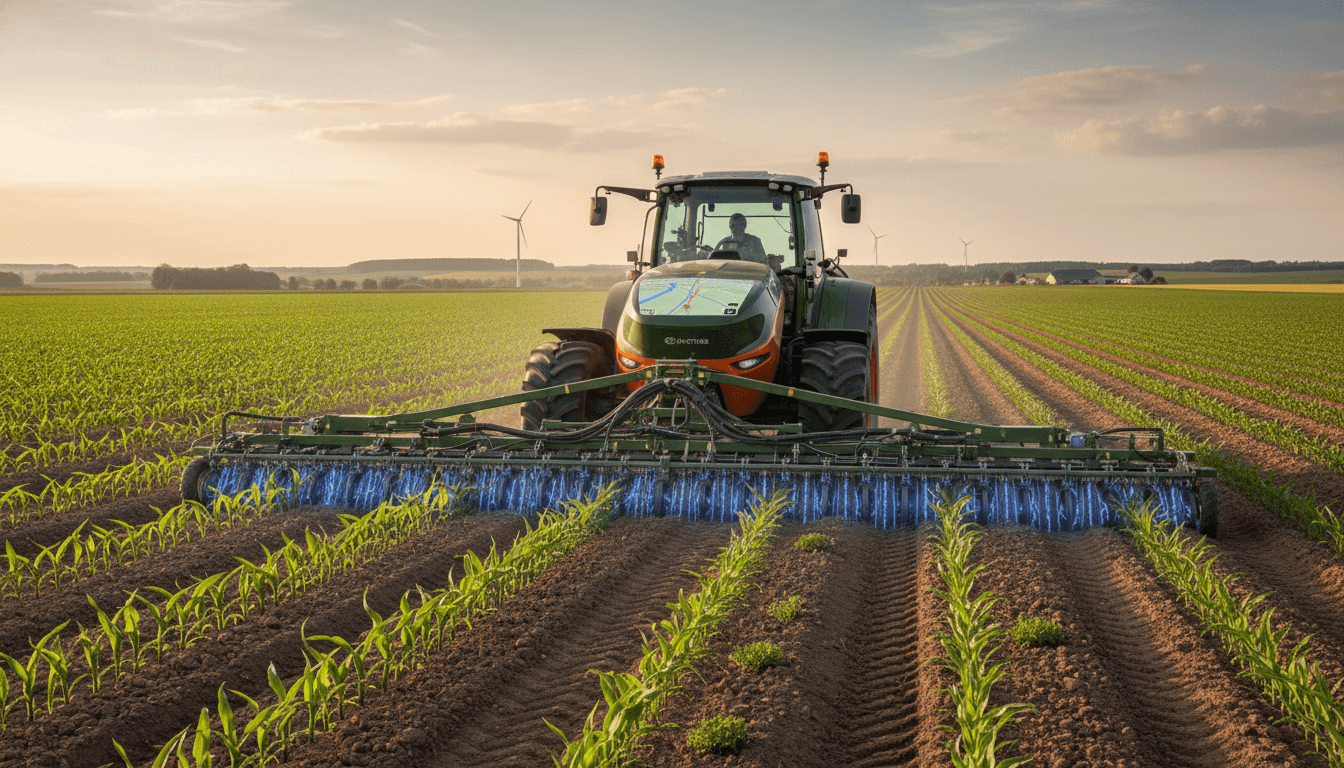
AI-Powered Electric Weeding: Cut Costs, Beat Resistance
Food prices have stayed stubbornly high, and farm input costs haven’t exactly cooled off going into the 2026 planning season. One place where those costs can spiral fast is weed control—especially when herbicide-resistant weeds force extra passes, tank mixes, and late-season “clean-up” decisions that never feel clean.
That’s why tools like LASCO’s Lightning Weeder™, showcased at the Nebraska Ag Expo, are getting attention. It’s not just because it’s chemical-free electric weeding. It’s because it signals a bigger shift we keep coming back to in our series “አርቲፊሻል ኢንተሊጀንስ በእርሻና ግብርና ዘርፍ ውስጥ ያለው ሚና”: modern weed control is becoming a data-and-decision problem, not only a chemistry problem.
Here’s the stance I’ll take: the farms that win the next decade won’t be the ones that spray more—they’ll be the ones that measure better and act precisely. Electric weeding paired with AI-style sensing and operational data is one of the most practical ways to get there.
Herbicide resistance isn’t a weed problem—it’s a systems problem
Resistant weeds spread because the system around them makes it easy: repeated modes of action, narrow rotation, tight labor windows, and weather that compresses operations into a few make-or-break days.
When resistance shows up, the real cost isn’t only the higher chemical bill. It’s the knock-on effects:
- More passes (fuel, labor, equipment wear)
- More complex programs (mixing risk, drift risk, crop response risk)
- Late-season escapes that drop seed and raise next year’s pressure
- Decision fatigue—the hidden cost when every field requires a custom playbook
Electric weed control shows up here as a systems stabilizer. Instead of adding another chemical decision, it adds another non-chemical intervention you can schedule and repeat.
Why late-season weed escapes are the expensive ones
Late-season weeds are brutal because they’re often beyond your “normal program” window. Many farms are already past the final planned application, or the crop stage and pre-harvest intervals limit options.
The RSS story highlights a consistent field reality: when weeds appear after the final spray, an electric weeder can stop them from taking over. That matters because late escapes are the weeds most likely to:
- produce seed
- complicate harvest
- become next year’s resistant population
A tool that targets those escapes is doing more than “killing weeds.” It’s reducing next year’s workload.
What the Lightning Weeder™ is doing (and what it isn’t)
The Lightning Weeder uses LASCO’s Electric Discharge System (EDS) to deliver electrical pulses to weeds, aiming to disable them from root to shoot while leaving the surrounding soil and crop untouched.
Let’s be clear about what this kind of tool is not:
- It’s not a magic replacement for all herbicides.
- It’s not an excuse to ignore crop rotation or cover crops.
- It’s not “set-and-forget.” You still need timing, scouting, and operator discipline.
What it is, when implemented well, is a repeatable, non-chemical control method you can integrate into an integrated weed management program.
A practical definition you can use with your team: Electric weeding is mechanical precision without soil disturbance—control that behaves like an application pass, but without chemistry.
Soil biology and chemical load: the quieter benefit
One claim in the source article is that EDS can preserve “living biology” in the soil by avoiding chemical exposure. While every farm’s soil response is different, the operational logic is straightforward: fewer chemical inputs can reduce selection pressure and can simplify compliance conversations with buyers and regulators.
For farms selling into programs with tighter residue expectations, or for operators trying to reduce worker exposure, non-chemical passes can be valuable even when the “spray vs. electric” cost comparison looks close.
Where AI fits: electric weeding becomes powerful when it’s guided by intelligence
The campaign focus here is AI in agriculture, so let’s connect the dots honestly.
The Lightning Weeder itself is fundamentally an electrical control platform. The AI value appears when you wrap it in the same decision stack farms are already building for precision ag:
- scouting data (human + machine)
- weed pressure maps
- pass timing models
- machine telemetry and performance logs
In other words: AI doesn’t have to mean a humanoid robot in a field. On many farms, “AI” shows up as computer vision, prescriptions, automation rules, and analytics that improve repeatability.
AI-driven weeding: three layers that matter on real farms
1) Detection (What’s in the field?)
Computer vision on sprayers, tractors, or scouting platforms can identify green-on-brown or distinguish crop vs. weed in-row. Even when classification isn’t perfect, it’s often good enough to flag “hot zones.”
2) Decision (What should we do and where?)
This is where digital agronomy earns its keep. A basic model can prioritize:
- fields with highest risk of seed set
- patches likely to be resistant based on history
- areas where a late chemical pass is constrained
3) Execution (Can we act precisely, every time?)
Electric weeders fit here because they’re designed to deliver a consistent physical effect. If you can maintain stable speed, height, and contact parameters, you can get predictable results—exactly what analytics needs.
Here’s the simple takeaway: AI makes weeding smarter; electric discharge makes it doable at field scale without extra chemistry.
What farms should measure before buying (the checklist most people skip)
Most equipment ROI mistakes come from fuzzy baselines. If you don’t know your current weed-control cost structure, any new tool can look “worth it” in a brochure.
Here’s what I recommend measuring for at least one season (or pulling from your last two seasons) before you commit.
Baseline metrics to capture
- Herbicide spend per acre by crop and by field
- Number of passes (spray, cultivation, hand labor) and total machine hours
- Late-season escape rate (even a simple 0–3 rating per field)
- Yield loss risk tied to weed pressure (field notes + yield maps)
- Resistance history (which fields are “always trouble”)
Operational fit questions (the “will we actually use it?” test)
- When do you realistically have labor and machine time for a non-chemical pass?
- Do you need row-crop precision, broad-acre coverage, or both?
- What’s your tolerance for adding another implement to the seasonal workflow?
- Who will own calibration, safety checks, and performance logging?
Electric weed control has high upside, but it’s still an implement. If it sits in the shed because nobody’s assigned to run it, the ROI is zero.
A practical integrated program: where electric weeding slots in
Electric weed control works best as part of a layered plan. Here’s a straightforward template many operations can adapt.
Pre-season: plan for resistance, not hope for it
- Rotate modes of action in your chemical plan where possible
- Target clean starts with cover crops or burndown strategies
- Mark historically problematic zones (yield maps + scouting notes)
In-season: use electric weeding as the “escape hatch” pass
This is the role the RSS piece emphasizes: when weeds show up after the final spray, electric weeding can keep fields from sliding into seed production.
The highest-value use cases tend to be:
- late flushes after rain events
- patch management in known resistant zones
- field edges and problem areas where weeds colonize first
Post-season: turn operations data into next year’s decisions
If you want the AI part to compound, you need records that can be compared year-over-year:
- where electric passes happened
- observed efficacy (simple ratings are fine)
- timing relative to crop stage
- weed species notes
The farms that treat this as an iterative system—measure, adjust, repeat—are the ones that get ahead.
What to ask vendors and dealers before a demo
Demos are useful, but the questions matter more than the show.
Ask for specifics on:
- Throughput: acres per hour under typical field conditions
- Efficacy expectations: which weed sizes/stages it performs best on
- Crop safety: how it avoids crop contact damage in your row spacing
- Energy and maintenance: what routine service looks like mid-season
- Integration: whether it supports data logging or can fit your farm’s digital recordkeeping
And ask something people avoid: “What are the failure modes?” If the answer is vague, push. Every tool has limits; you want to know them before they show up in July.
Why this matters for the AI-in-ag series
This series is about how artificial intelligence supports farmers with digital information, improves productivity, and makes decisions more precise. Electric weeding may look like a hardware story, but the trend line is bigger:
- Weed control is shifting from “blanket treatments” to field-specific interventions.
- The winning strategy is integrated: chemistry, physics, biology, and data working together.
- AI turns weeding from a reactive scramble into a plan that can be optimized.
If you’re building a modern farm system, think of tools like the Lightning Weeder as part of your “precision toolbox”—the same way variable-rate fertilizer and yield mapping became normal once the data proved their value.
The next step is practical: pick one or two fields where late-season weeds consistently cost you money, define the baseline, and test a non-chemical intervention you can repeat. If you can’t measure it, you can’t improve it.
Where do you see the biggest weed-control pain on your farm right now—early season competition, mid-season labor bottlenecks, or late-season escapes that drop seed for next year?