AI-powered digital twins help universities cut energy waste, predict maintenance, and optimize space with real-time modeling. Start with one question and scale.
AI Digital Twins for Smarter Campus Facilities
December is when campuses reveal their operational “truth.” Buildings run at odd hours for exams, libraries stay packed, residence halls shift into break mode, and maintenance teams try to squeeze in work orders before the next term. If you’ve ever worked with facilities in higher education, you know the pattern: a lot of decisions are still made with spreadsheets, walk-throughs, and phone calls.
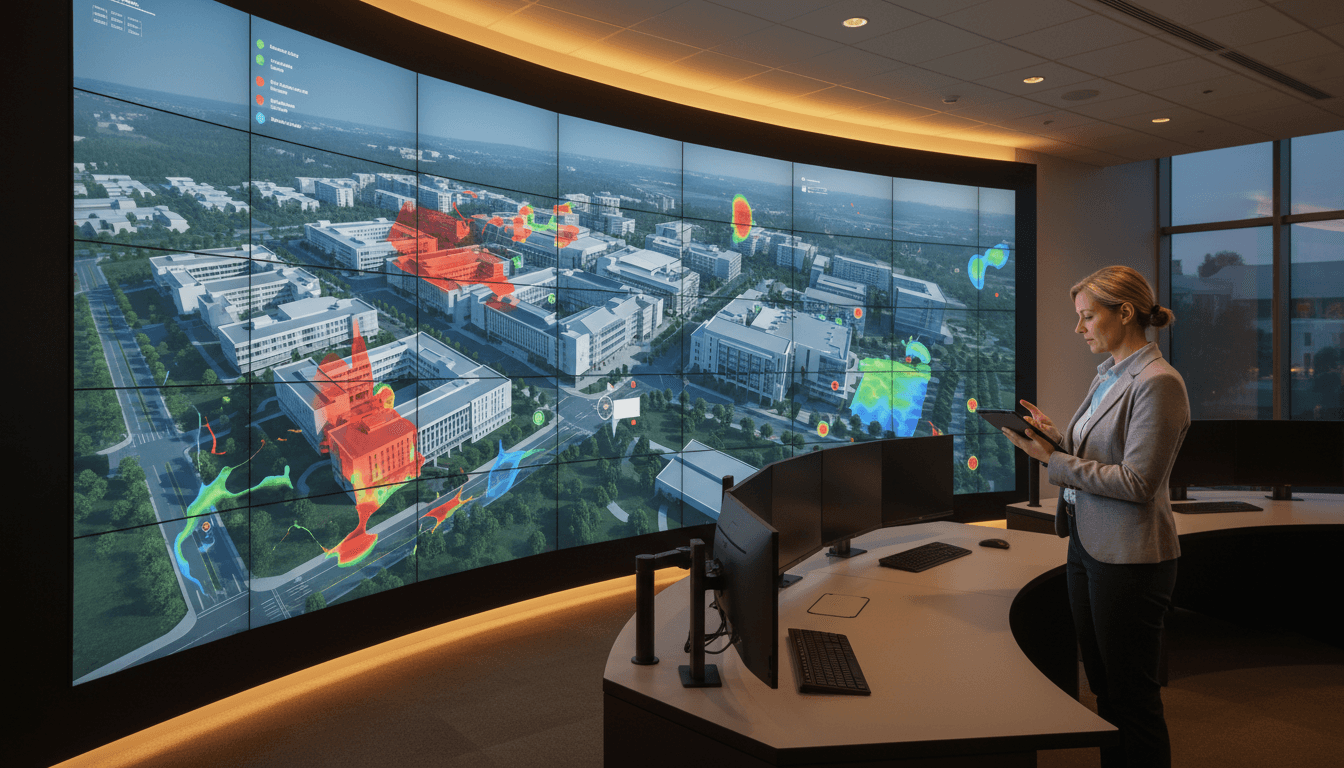
AI-powered digital twins change that. Not by replacing facilities teams, but by giving them a living, data-backed model of buildings and campus systems—one place where energy, space usage, assets, and even emergency response can be tested before actions happen in the real world.
This post reframes digital twins through the lens of our series on “አርቲፊሻል ኢንተሊጀንስ በእርሻና ግብርና ዘርፍ ውስጥ ያለው ሚና”. The connection is stronger than it looks: a campus is a complex “production system,” just like a farm. Both have inputs (energy, water, labor), assets (buildings or machinery), and outcomes (learning, research, yields). In both, AI works best when it turns messy reality into decisions you can trust.
Digital twins work when you start with one question
A digital twin is only valuable if it’s built to answer a specific operational question. That’s the core mistake most institutions make: they try to build a perfect virtual campus first, then figure out how to use it.
A better approach is what practitioners keep repeating: define the priority problem, build the smallest useful twin for that, then expand. Digital twins are not one single model that solves everything; they’re a stack—geometry, systems, sensors, historical data, simulation, and AI—assembled based on what you need.
Here are examples of “one-question” starting points that work well in higher ed:
- Which buildings are wasting the most energy after hours?
- Which HVAC units are likely to fail in the next 30–60 days?
- Where is space underutilized during peak times (midday, midweek)?
- What’s the fastest evacuation route if a stairwell is blocked?
This matters because digital twins are expensive in the wrong way: not always in software cost, but in integration time, data cleaning, and ongoing maintenance. If you can’t tie the work to a measurable outcome, the project turns into a pretty 3D model nobody uses.
AI + IoT is what makes a digital twin “alive”
A static building model is useful, but it isn’t a digital twin in the modern sense. The “twin” becomes powerful when it’s fed by IoT monitoring and improved by machine learning.
Here’s the practical breakdown:
The minimum components of an AI-enabled digital twin
- Built environment model: Floorplans, rooms, zones, capacity assumptions, building systems.
- Live data feeds (IoT/BMS): Temperature, humidity, CO₂, occupancy signals, equipment runtime, energy meters.
- Historical data: At least one academic cycle is ideal if you want seasonality (semester shifts, weather variation, break periods).
- Simulation layer: For higher education, agent-based models are often used to simulate student movement and occupancy patterns.
- AI models: Forecasting and anomaly detection (what “normal” looks like, and what’s drifting).
The key is that AI doesn’t just report what happened. It predicts what’s about to happen and recommends actions that reduce manual oversight.
If you’ve followed our agriculture-focused series, you’ve seen the same pattern in precision farming:
“A sensor isn’t the solution; the decision loop is.”
On farms, the loop is soil/moisture → model → irrigation decision. On campuses, it’s occupancy/energy → model → HVAC scheduling, maintenance, and space allocation.
Where digital twins deliver real savings in higher ed
Digital twins earn their keep when they reduce repeat work: fewer truck rolls, fewer emergency breakdowns, fewer “conditioning” mistakes where empty rooms get heated/cooled.
Predictive maintenance: stop reacting to failures
The clearest operational win is predictive maintenance. When equipment data (runtime, vibration, temperature, pressure) is captured over time, ML models can flag early signals of failure.
What changes in day-to-day operations:
- Maintenance teams shift from “fix what broke” to “service what’s drifting”.
- Parts and labor planning improves because you’re not ordering after failure.
- Downtime drops because maintenance is scheduled around academic priorities.
A strong starting use case is a small set of high-impact assets:
- Chillers and boilers
- Air handling units
- Critical electrical infrastructure
- Lab ventilation systems
Smart energy optimization: comfort with less waste
Energy is where the budget pressure shows up fast, especially during winter months. A digital twin can optimize HVAC setpoints based on:
- Room size and thermal characteristics
- Sunlight exposure by time of day
- Real occupancy vs. scheduled occupancy
- Outdoor temperature and humidity
- Calendar patterns (exam week vs. break)
The point isn’t to “turn down the heat.” The point is precision comfort: conditioning where it’s needed, when it’s needed.
This is the same logic as variable-rate application in agriculture—treat each “zone” based on its actual condition, not a campus-wide average.
Space utilization: treat space as a scarce resource
Most universities have a space paradox: some rooms are always booked, others sit empty, and decisions get stuck in politics.
Digital twins help by making space decisions evidence-based:
- Simulate student movement and congestion (agent-based modeling)
- Compare scheduled use vs. actual use
- Identify “dead hours” and seasonal patterns
A practical outcome is better allocation:
- Convert underused areas into study zones during peak weeks
- Adjust class scheduling to reduce congestion and improve student experience
- Plan renovations based on measured utilization, not complaints
Emergency response and physical security: practice with reality
Security and emergency planning improves when you can test scenarios in a model:
- Evacuation routes with blocked exits
- Crowd flow in event venues
- Response time modeling for security and medical teams
This isn’t about surveillance-first thinking. It’s about preparedness. When something goes wrong, minutes matter.
The hard parts: cost, data quality, and privacy
Digital twins are getting more accessible, but the barriers are real—and ignoring them is how projects fail.
Cost and build strategy: in-house vs. partner
You have two viable paths:
- Build in-house: More control, potentially lower long-term vendor dependency, but you need strong data engineering and facilities systems expertise.
- Outsource to a specialist: Faster time to value, but you must negotiate data ownership, integration responsibilities, and ongoing costs.
My bias: if your institution doesn’t already have a reliable building systems data pipeline, start with a partner for the first use case, then build internal capability while you operate.
Data requirements: “garbage in, garbage out” is ruthless here
Digital twins amplify data problems.
Common failure points include:
- Sensor gaps (no occupancy signals, inconsistent metering)
- Misconfigured building management system points
- Different naming conventions across buildings (no shared taxonomy)
- Missing historical data (no baseline for seasonality)
A simple rule that saves months: standardize your asset and sensor naming before modeling. If the data dictionary is messy, the twin becomes an expensive guessing machine.
Student data privacy: don’t treat it as an afterthought
Some digital twin scenarios can drift into personal data territory—like tracking attendance patterns or health-related trends. Even if your goal is operational (HVAC + space planning), it’s easy to over-collect.
Good governance is non-negotiable:
- Prefer aggregated occupancy over identity-based tracking
- Define retention periods (don’t store forever “just in case”)
- Limit access by role (facilities needs different access than security)
- Document “why” for every dataset connected to the twin
If you want trust on campus, build privacy into the architecture, not into the PR statement.
A practical 90-day roadmap for a “first digital twin”
Digital twin programs don’t need a five-year master plan to start producing results. A disciplined pilot can show value in one term.
Days 1–15: pick the problem and the building
Choose a use case with measurable outcomes and a manageable scope.
Good pilot criteria:
- One building (or one system across a few buildings)
- Existing sensors/BMS data availability
- A stakeholder who owns the outcome (facilities director, energy manager)
- Clear success metrics
Define success metrics like:
- Reduce after-hours HVAC runtime by 10–15% in the pilot building
- Cut reactive maintenance tickets for targeted equipment by 20%
- Improve room comfort complaints resolution time by 30%
Days 16–45: build the data foundation
This phase is mostly unglamorous, and it decides everything.
- Inventory sensors and BMS points
- Clean and align time-series data
- Create a shared naming taxonomy for rooms, zones, and assets
- Set up dashboards for baseline measurement
Days 46–75: model + simulate + validate
- Build the minimal building/zone model
- Connect live data feeds
- Validate against reality (walk-throughs, spot checks)
- Add ML anomaly detection to flag drift
Days 76–90: operationalize
- Define alerts and workflows (who gets notified, what actions follow)
- Train the team on how to use outputs in daily routines
- Publish results internally and decide whether to scale
That last step matters. A digital twin that doesn’t change workflows is just an expensive visualization tool.
Why this belongs in an AI-in-agriculture series
The fastest way to understand digital twins is to compare them to what’s already working in smart agriculture.
- Farms use sensors + AI to model fields and livestock systems.
- Campuses use sensors + AI to model buildings and human movement.
Both succeed when the organization treats data as a core asset, not an IT side project.
If your institution is exploring AI in education and training, digital twins are a practical entry point because they create visible, measurable benefits—lower operating costs, better comfort, more resilient facilities. And those savings can be redirected into what campuses care about: learning, research, and student support.
The next step is simple: choose one operational question you’re tired of answering manually, and build the smallest digital twin that can answer it daily. Which question would you pick first on your campus?