AI-powered crop nutrition improves predictable yields while reducing harmful fertiliser use. Learn how systems like Arginex pair with precision farming AI.
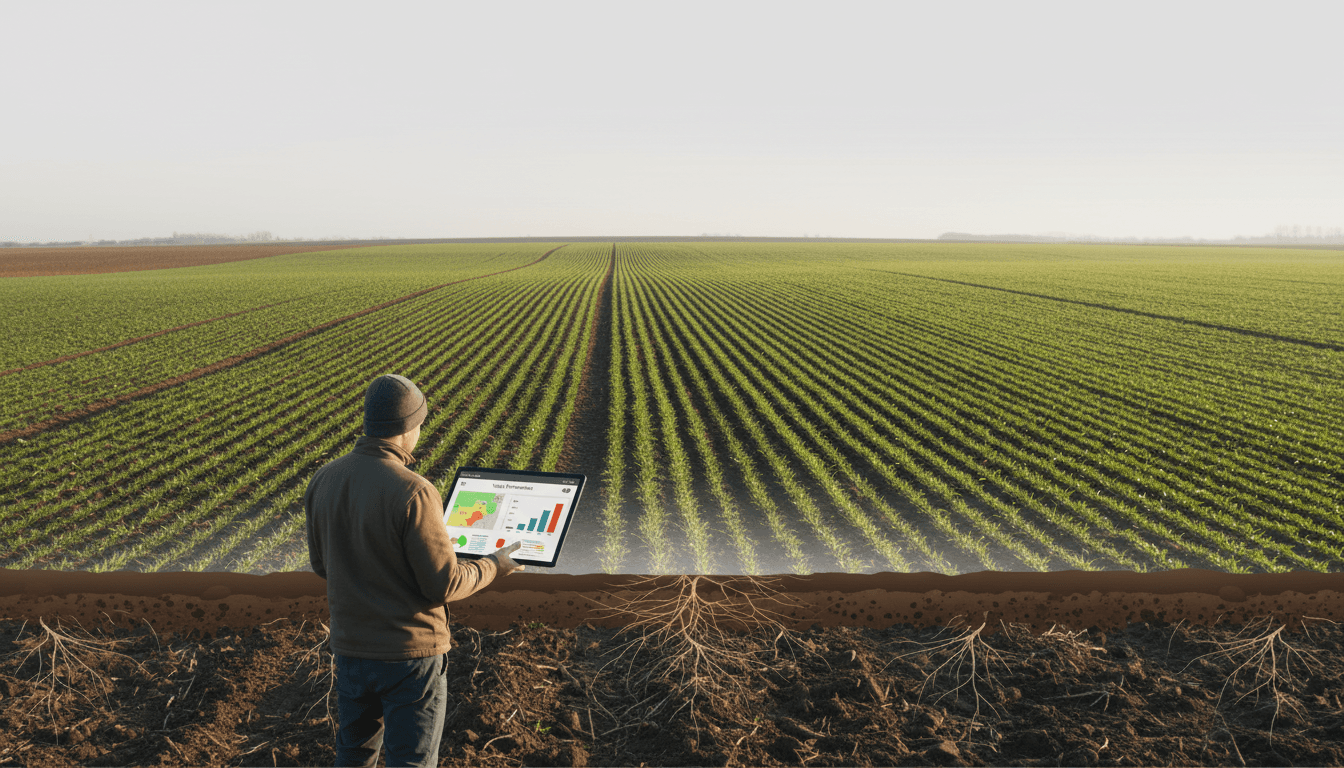
AI-Powered Crop Nutrition for Predictable Yields
A hard number should change how we think about inputs: 60–70% of EU soil is degraded, and the FAO reports at least a 10% productivity drop in areas with significant human-induced land degradation. That’s not a “future risk.” It’s a present constraint—showing up as uneven emergence, stressed root systems, lower nutrient efficiency, and yields that swing wildly from field to field.
At the same time, growers are being asked to do two things that often feel contradictory: reduce harmful fertiliser dependency and keep yields consistent. Most farms can’t afford experiments anymore. They need predictable outcomes, especially going into a new season when budgets are already tight.
This is why the recent launch of Arevo’s crop nutrition system, Arginex (an arginine + phosphate single-compound formula designed to resist leaching and feed roots steadily), is worth paying attention to. And because this post is part of our series “አርቲፊሻል ኢንተሊጀንስ በእርሻና ግብርና ዘርፍ ውስጥ ያለው ሚና”, we’ll go one step further: systems like Arginex get even more valuable when you pair them with AI-driven precision agriculture.
Why “less fertiliser” fails without predictability
Reducing synthetic fertiliser only works if the crop’s nutrient supply becomes more controlled, not less. That’s the trap many farmers fall into: they cut rates, hope soil biology fills the gap, then lose yield because the nutrient release didn’t match crop demand.
The source article highlights a painful reality: around 50% of synthetic fertiliser can be lost to the environment through leaching. Practically, that means you’re paying for nitrogen that never becomes grain, tuber, or pod. It also means increased runoff risk, water pollution, and pressure from regulators and buyers.
Predictability is the missing piece. If a nutrition strategy can’t consistently deliver nitrogen and phosphorus in the root zone when the plant needs it, you’ll see:
- uneven canopy development (harder to manage with one-size irrigation)
- increased pest/disease susceptibility (stressed plants are easy targets)
- bigger yield variability within the same field
My stance: sustainability messaging doesn’t move farmers. Predictability does. When yield consistency improves, sustainability becomes a byproduct.
What Arevo’s Arginex changes at the root level
Arginex is designed to keep nutrients where plants can use them: the root zone. Arevo’s approach combines arginine (a nitrogen-rich amino acid) with phosphate to form a stable, molecularly defined compound that resists leaching and feeds over time.
The “single-compound” idea is practical, not academic
One reason biological inputs sometimes disappoint is batch variability (especially with microbial products). Arevo’s CEO emphasizes Arginex is non-microbial (non-living) and consistent from batch to batch.
That matters operationally. On real farms, “it worked once” isn’t a product claim—it’s a warning.
The five mechanisms that matter in the field
The article lists five key benefits. Here’s the field translation:
- Direct feeding at the root: Arginine can be absorbed intact via root transporters. That can improve nutrient uptake efficiency, especially when soil conditions limit mineral nitrogen availability.
- Root biology activation: Better microbial partnerships often show up as improved water and nutrient scavenging—especially during dry spells or compaction stress.
- Reduced leaching/runoff: Positive charge binding to soil means nitrogen is less likely to disappear after a rain event.
- Predictable release curve: Slow, steady delivery reduces the “feast then famine” pattern that weakens plants.
- Flexible application: Seed, soil, or foliar programs become possible depending on crop, equipment, and risk level.
A useful one-liner to remember:
The goal isn’t “more nitrogen.” It’s “more crop per unit of nitrogen.”
Evidence: yield gains with reduced fertiliser inputs
Arginex claims measurable yield and efficiency gains across staple crops, including trials showing:
- Corn: +4.3% grain yield with 20% less fertiliser vs farmer standard
- Potato: +6.4% yield vs untreated control
- Soy: +4.5% to +6.0% yield vs untreated control
Even without turning this into a product review, the pattern is important for decision-makers: the gains aren’t framed as “max yield at any cost,” but “maintain or increase yield while lowering nitrogen input.”
That’s exactly where AI-based agronomy can amplify results—because AI thrives when there’s a controllable system to optimize.
Where AI fits: making crop nutrition systems smarter, not noisier
AI in agriculture is most valuable when it reduces uncertainty. For crop nutrition systems like Arginex, AI can do three high-impact things: optimize timing, customize rates by zone, and forecast outcomes.
1) AI helps you apply nutrition when plants can actually use it
Plants don’t absorb nutrients “because you applied them.” They absorb nutrients when root activity, moisture, temperature, and growth stage align.
AI models can combine:
- soil moisture and temperature sensors
- weather forecasts (rain probability, heat stress)
- crop growth stage data
- historical yield maps
…and recommend a more precise application window. This reduces the classic losses:
- applying before heavy rain (leaching risk)
- applying too late (yield potential already reduced)
Answer-first: If you want predictable yields, timing beats total volume more often than people admit.
2) AI turns “one field” into management zones (without overcomplicating it)
Most fields aren’t uniform. They’re mosaics—topography, texture, organic matter, compaction, salinity patches.
A practical AI workflow is:
- Build zones using yield maps + satellite imagery + soil EC (if available)
- Validate with 8–15 targeted soil/plant tissue samples (not random sampling)
- Generate a variable-rate plan (or a simple 2–3 rate plan if equipment is limited)
This is where a stable, low-leaching compound can shine: you’re not just varying nitrogen—you're matching a more predictable nutrition supply to the zones that respond.
3) AI improves yield predictability (the thing farmers actually buy)
When input costs rise (the article notes fertiliser up nearly 11%, and other farm costs rising too), the question becomes: What’s my risk-adjusted return?
AI-based yield forecasting can support decisions like:
- whether to reduce N rates without jeopardizing contract commitments
- whether to invest in an additional application pass
- how to prioritize fields under limited irrigation water
Predictable yield is a financial product, not just an agronomy goal. It determines storage, sales timing, and contract confidence.
Climate stress is the new baseline—roots are the insurance
A recent estimate referenced in the article puts agricultural losses from climate change at more than $28 billion per year due to adverse weather, including droughts. You don’t need a global number to feel this locally—most growers can name the week the season “turned.”
Stronger root architecture is the simplest insurance policy a crop can have. Deeper, denser roots mean:
- better water uptake during dry spells
- improved nutrient scavenging
- steadier canopy under heat stress
The article argues arginine-based nutrition improves seedling resilience through better root development and avoids nutrient shock by providing stable nitrogen supply.
Now add AI:
- AI can identify drought-prone zones early (topography + soil moisture + historic stress patterns)
- AI can recommend targeted interventions (rate adjustments, timing shifts, irrigation prioritization)
The best part? This isn’t futuristic. Many farms already have the raw data (yield maps, basic weather, some imagery). What they lack is a decision system that turns data into actions.
Practical playbook: adopting AI + sustainable crop nutrition in one season
You don’t need to overhaul everything at once. Here’s a realistic, season-ready approach I’ve seen work in precision agriculture projects.
Step 1: Start with one crop, one region, one objective
Pick a scenario where predictability matters:
- corn fields supplying a contract
- potatoes where size distribution affects price
- soy fields in variable rainfall zones
Define a single metric:
- “Maintain yield with 10–20% less N”
- “Reduce in-field variability (lower yield CV)”
- “Improve nitrogen use efficiency”
Step 2: Run a simple on-farm strip trial that AI can learn from
Design strips that compare:
- current program (farmer standard)
- Arginex-supported program (reduced N or shifted timing)
Collect:
- as-applied maps
- mid-season imagery (2–3 dates)
- harvest yield map
Even basic datasets can train a farm-specific model for next year.
Step 3: Use AI for decisions you’ll actually follow
Avoid dashboards that no one opens. Set up 3 decisions where AI outputs are actionable:
- application timing alerts (rain + growth stage)
- zone-level rate suggestions
- yield forecast updates before key spend points
If you can’t act on it within 48 hours, it’s usually noise.
Step 4: Make “reduced fertiliser” a measured outcome, not a slogan
Track:
- total N applied (kg/ha)
- yield (t/ha)
- nitrogen use efficiency proxy (yield per unit N)
- variability (difference between top and bottom zones)
Farmers don’t need perfect science. They need repeatable results.
The bigger picture for our AI-in-agriculture series
Our series focus—አርቲፊሻል ኢንተሊጀንስ በእርሻና ግብርና ዘርፍ ውስጥ ያለው ሚና—isn’t about replacing agronomists or turning farms into tech companies. It’s about giving growers a better way to make decisions under pressure: degraded soils, volatile costs, and more frequent weather extremes.
Arevo’s Arginex points toward a clear direction: inputs that behave more predictably in the soil. AI then adds the second half of the equation: decisions that behave more predictably on the farm. When you combine both, “reduce harmful fertilisers” stops being a risk and starts becoming a strategy.
If you’re evaluating crop nutrition programs for 2026 planning, a useful next step is simple: choose one field and test a sustainable nutrition approach alongside an AI-driven monitoring plan. Compare yield, variability, and nitrogen efficiency—not just the average yield.
What would change on your farm if you could predict yield swings earlier—and adjust nutrition decisions before the crop pays the price?