Learn how AI-driven cost-out farming turns fewer passes and smarter inputs into profit—using a real 2025 soybean plot result as the blueprint.
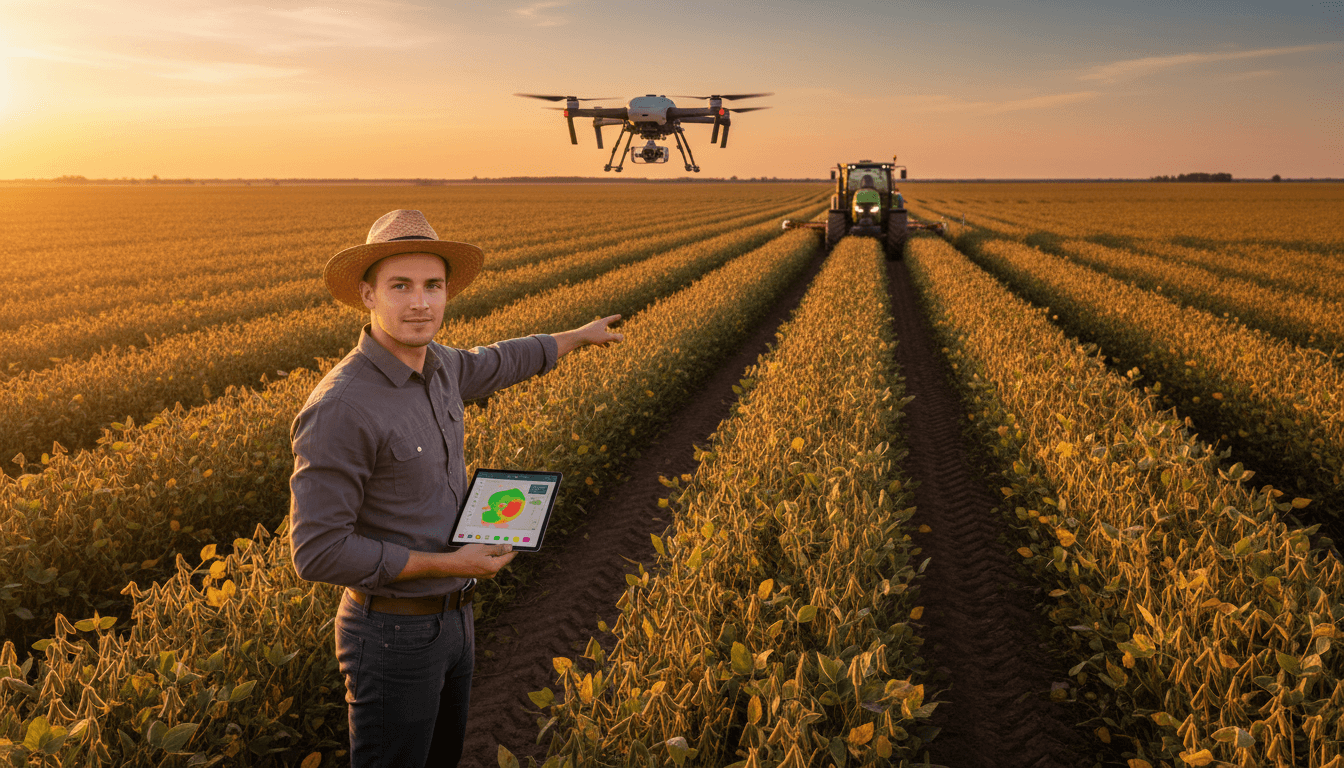
AI-Driven Cost-Out Farming: Lessons from Meristem
A single on-farm comparison in Indiana reported a ~$175 per acre advantage on one side of a soybean plot—driven by an 11-bushel yield bump, about $68 less phosphorus cost, and at least one fewer field pass. That’s not a “nice to have” improvement. That’s the kind of margin swing that can decide whether a season ends with confidence or stress.
What caught my attention isn’t only the products used. It’s the operating mindset: take cost out while protecting yield, and do it with tighter timing, fewer wasted inputs, and faster feedback from the field. That’s exactly where Artificial Intelligence in agriculture (AI በእርሻና ግብርና ዘርፍ) is heading—turning every decision (rate, timing, placement, passes) into a measurable, optimizable system.
This post is part of our series “አርቲፊሻል ኢንተሊጀንስ በእርሻና ግብርና ዘርፍ ውስጥ ያለው ሚና”. We’ll use the Meristem “take cost out” plot as a real-world anchor and then widen the lens: how AI-supported agronomy and precision farming reduce cost per bushel, what to measure, and how to implement a practical cost-out program on your own farm.
What the Meristem plot proves: profitability is a systems problem
The clearest lesson is simple: profitability is rarely won by one input; it’s won by a better system. In the reported 2025 side-by-side soybean plots (two 40-acre blocks), the Meristem program removed several “standard” costs on one side—while still delivering higher yield.
Here’s what changed in that system, based on the plot description:
- Inputs removed or reduced: standard seed treatment, 250 lb potash, and a tillage pass were taken out on the Meristem side.
- Nutrient economics: the farmer reported cutting ~$68 in phosphorus.
- Yield result: ~11 bushels higher on the Meristem side.
- Operational efficiency: faster canopy closure reduced weed escapes, which meant a saved spray pass later in the season.
“With the cost savings and increased yield, we were around $175 per acre ahead…”
If you’re thinking, “That sounds like what good analytics would do in any business,” you’re right. And that’s the bridge to AI.
The hidden insight: fewer passes is a profit multiplier
Most farms track input spend (seed, fertilizer, chemicals). Fewer farms quantify the total cost of a pass with enough discipline: fuel, labor, depreciation, compaction risk, and timing delays when weather windows are tight.
In practice, one less pass isn’t just cost reduction—it’s risk reduction. It also increases your flexibility: if you’re not busy redoing escapes, you can hit the next operation on time.
AI fits here because it’s great at predicting and prioritizing: which fields need attention first, when canopy is likely to close, and where risk of weeds or nutrient limitation is actually rising.
Where AI fits: cost-out decisions need better timing, placement, and proof
AI in agriculture isn’t magic. It’s a set of tools that make one thing easier: making consistent decisions with messy, incomplete field data. That matters because “cost-out” strategies fail when they become guesswork.
Here are the three AI roles that map directly onto what this plot tried to achieve.
1) AI for decision timing: act earlier, not louder
The plot narrative highlights faster canopy closure and fewer weed problems later. AI-enabled monitoring (satellite imagery, drone scouting, in-season crop models) helps you see trajectory rather than reacting to symptoms.
- If canopy is closing slower than expected, the system flags risk of late-season weed pressure.
- If residue breakdown or nutrient release is lagging, you adjust timing rather than simply increasing rates.
This is how AI supports the farmer’s real goal: avoid the “extra pass tax.”
2) AI for placement and rate: reduce waste, not performance
A lot of input waste is simply “wrong place, wrong time.” Tools like variable-rate application and zone management become far more effective when AI helps interpret layers:
- soil tests (including historical trends)
- yield maps
- topography and water holding capacity
- weather forecasts and season patterns
The operational objective is straightforward: spend where the crop can actually convert dollars into bushels.
3) AI for proof: run your own experiments faster
The Meristem plot is essentially a structured on-farm trial. AI strengthens this approach by improving the measurement side:
- auto-cleaning yield data
- creating consistent management zones
- comparing “like with like” (reducing noise)
- surfacing the drivers behind results (not just the final yield)
If your farm runs even a few well-designed strips each year, AI-supported analytics can turn that into a long-term advantage.
Building your own “take cost out” program (without gambling yield)
A cost-out program works when it’s disciplined. The rule I use is: remove costs only when you can replace them with information, timing, or biology that’s measured.
Step 1: Start with cost per bushel, not cost per acre
Cost per acre is easy to track and easy to misread. Cost per bushel forces the right conversation.
Set a baseline for each field:
- last 3-year average yield
- total variable input cost
- number of passes (and true pass cost)
Then define the target: for example, “Reduce cost per bushel by 5–10% while holding yield steady.”
Step 2: Identify the “quiet” costs to remove first
The easiest costs to remove are the ones that don’t immediately threaten yield.
Examples:
- a redundant field pass driven by habit
- blanket re-sprays after a rain
- over-application in low-response zones
The Meristem plot’s results point to the same idea: cost out + management in = margin up.
Step 3: Use AI-supported scouting to stop paying for surprises
A practical stack (you don’t need everything):
- satellite or drone imagery every 7–14 days
- a simple model/dashboard that flags anomalies (NDVI dips, uneven emergence, moisture stress)
- a workflow to turn flags into actions (walk it, sample it, treat it—or ignore it intentionally)
What changes is not only what you see. It’s how quickly you act and how confidently you skip unnecessary work.
Step 4: Run side-by-side strips like a business A/B test
On-farm trials don’t need to be complicated. They need to be fair.
A clean approach:
- Pick one practice to change (rate, product, pass, timing)
- Keep everything else constant
- Replicate it across at least 3 strips/areas
- Record operations and weather notes
- Compare yield and pass count and total input spend
If you can measure outcomes, you can remove costs without guessing.
Practical AI use-cases that match what happened in the plot
The plot included residue management, planter box treatment, drone applications, and operational savings. Here’s how AI commonly plugs into those exact touchpoints.
AI + residue and nutrient release: predict availability windows
When residue breakdown is part of the plan, the question becomes: Will nutrients be available when the crop needs them?
AI models can combine:
- temperature and moisture
- residue levels
- soil organic matter
- historical response patterns
That gives you a probability-based timing plan, which is far better than “we always apply on X date.”
AI + emergence and canopy closure: reduce weed control cost
The farmer noted a key operational win: the traditional side needed a later weed-escape spray after rain; the Meristem side didn’t.
AI-driven canopy and weed-risk prediction can:
- flag fields where canopy closure is behind schedule
- identify zones likely to suffer escapes
- recommend targeted spot treatments rather than whole-field passes
This is one of the cleanest examples of AI in precision agriculture paying for itself: spray less by being more specific.
AI + drone workflows: better applications, better records
Drones are often discussed like a novelty. I disagree. They’re a logistics tool.
AI scheduling and routing improves:
- which fields to fly first (based on risk)
- what rate to apply in which zone
- documenting what was applied, where, and when (critical for learning and compliance)
Even when the product choice differs by region, the workflow advantage stays the same.
What to watch out for: cost-out can backfire if you skip the basics
Cost reduction gets dangerous when it’s driven by frustration instead of data. These are the most common failure modes I see:
- Removing fertility without zone context: If you cut across the board, you’ll punish high-response areas.
- Overtrusting a single season: One year can lie (weather, pest pressure, late rains). Track trends.
- Ignoring operational constraints: A plan that requires “perfect timing” but lacks equipment/labor capacity will fail.
- Not measuring passes: If you don’t count passes, you won’t notice how much margin is hiding in logistics.
AI helps, but it won’t rescue a plan that isn’t measurable.
The bigger story for this AI-in-agriculture series
The Meristem plot is one example of a wider shift: farming is becoming an optimization problem, not a pure input problem. That’s the heart of ዲጂታል ግብርና and why AI በእርሻ ሂደቶች matters.
If you take one idea from this post, make it this:
“Cost-out isn’t about spending less. It’s about spending only where the crop responds.”
The next step is practical. Pick one field for 2026 planning, choose one cost-out hypothesis (one pass removed, one variable-rate change, one timing shift), and set up strips so you can learn fast. If you want to go further, build a simple AI-supported loop: observe → decide → act → measure → repeat.
What would change on your farm if every major input decision came with a confidence score—and every extra pass had to justify itself in bushels?