AI-powered autonomous farm equipment is set to reach USD 144.7B by 2035. Learn what’s driving adoption and how farms can plan practical next steps.
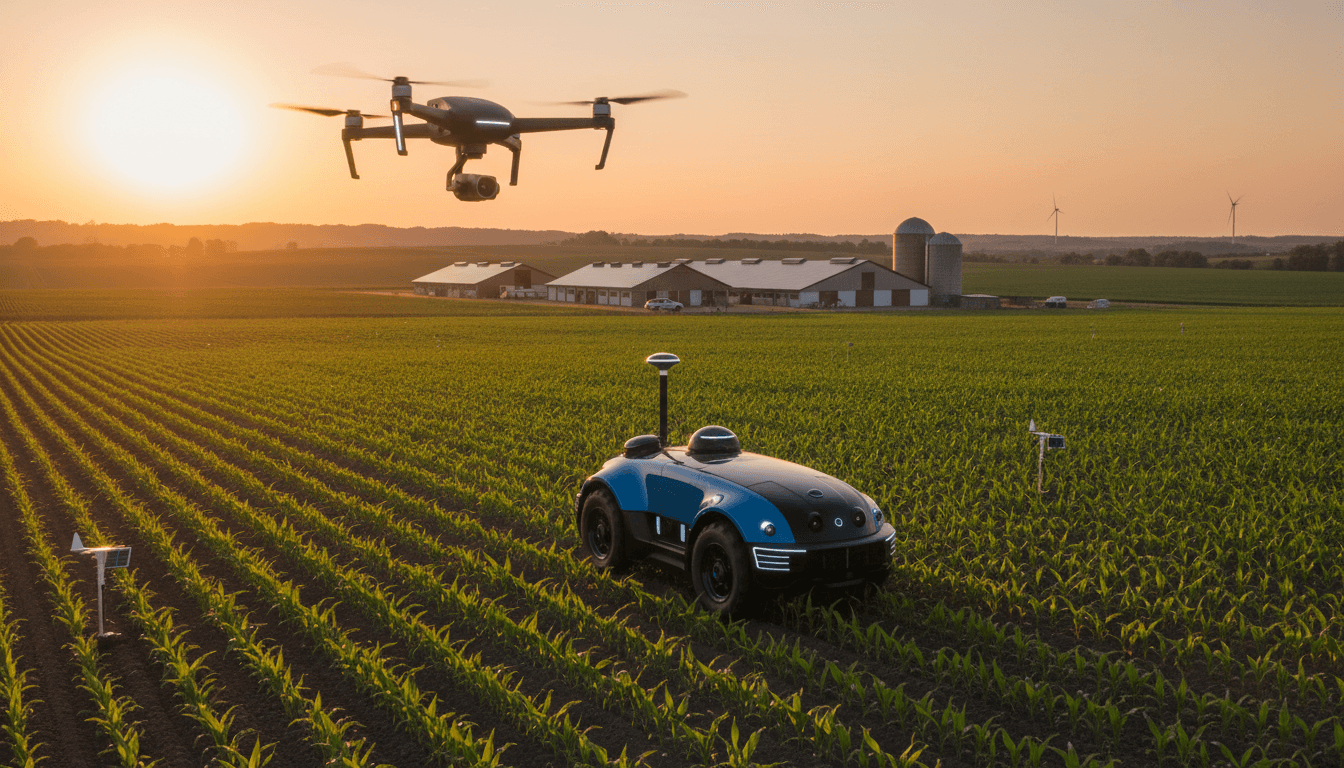
AI-Driven Autonomous Farm Equipment: What’s Next?
USD 70.9 billion in 2025, and projected to hit USD 144.7 billion by 2035. That’s not hype—it’s a clear signal that autonomous farm equipment is turning into a mainstream business category, not a niche experiment.
What’s pushing that growth isn’t “robots for robots’ sake.” It’s a practical mix of AI for decision-making, automation for execution, and precision agriculture for measurable ROI. If you’re following our series “አርቲፊሻል ኢንተሊጀንስ በእርሻና ግብርና ዘርፍ ውስጥ ያለው ሚና”, this is one of the most visible places where AI stops being an abstract idea and starts showing up as a machine that plants, sprays, or harvests.
This post breaks down what the market numbers actually mean, which autonomous machines are winning first (and why), and how to evaluate adoption without getting trapped in expensive pilots that never scale.
Why the autonomous farm equipment market is growing fast
The simplest explanation: farms are under pressure to produce more with fewer people and tighter input costs, and AI-enabled equipment directly targets those constraints.
According to the market outlook referenced in the source, the autonomous farm equipment market is valued at USD 70.9B in 2025, expected to reach USD 75.1B in 2026, and grow to USD 144.7B by 2035, at a 7.6% CAGR. Growth at that pace for a “heavy machinery” category only happens when the economics are real.
Three drivers keep showing up across regions:
1) Labor is the bottleneck (and automation is the release valve)
Peak seasons don’t wait. When labor is scarce—or expensive—equipment that can operate longer hours with fewer operators becomes a direct advantage. Autonomous tractors and sprayers aren’t about replacing every worker. They’re about ensuring that the farm can still execute on time when hiring is difficult.
A useful way to think about it: autonomy is often a scheduling technology as much as it is a robotics technology. If you can run longer shifts safely and consistently, you change the math on acreage per operator.
2) Input costs reward precision, not habit
Fertilizer, fuel, water, and crop protection products punish “average-rate everywhere” farming. Autonomy pairs naturally with variable-rate application, because an autonomous machine isn’t guessing—it’s following a prescription map, sensor feedback, and AI-driven recommendations.
When precision agriculture tools are adopted properly, you don’t just save inputs—you reduce waste and avoid yield loss from under/over-application.
3) AI and IoT are making machines more trustworthy
Early autonomy struggled when conditions weren’t perfect: dust, uneven terrain, unpredictable obstacles, and GPS drift. Now, sensor fusion (GPS + cameras + LiDAR/radar + IMU), improved edge compute, and better models have made autonomy more reliable.
Here’s the key point: trust grows when failures become predictable and recoverable. Farms don’t need perfection; they need a system that handles common failure modes safely and keeps work moving.
What “AI-powered autonomy” really means on a farm
Autonomous equipment isn’t one feature. It’s a stack. And the AI part often matters most in the messy middle—where reality doesn’t match the plan.
The autonomy stack (what’s inside the machine)
Most autonomous farm equipment combines:
- Perception: cameras and sensors detect rows, crops, obstacles, people, animals, and equipment
- Localization: GPS/RTK positioning plus onboard sensor fusion for accuracy
- Planning: path planning, headland turns, coverage planning, collision avoidance
- Control: steering, throttle, implement control, variable-rate actuation
- Monitoring: IoT telemetry, diagnostics, geofencing, remote alerts
When people say “AI tractor,” they often mean the perception + planning layer—where machine learning helps the system interpret what it’s seeing and decide what to do next.
Snippet-worthy take: Autonomous farming succeeds when AI reduces uncertainty—because uncertainty is what creates downtime.
Semi-autonomous vs fully autonomous: the practical difference
Many farms get value faster from semi-autonomous systems because they fit current workflows:
- Operator still supervises, but the machine handles repetitive steering/coverage tasks
- Fewer safety and compliance hurdles than fully autonomous operation
- Easier training and faster acceptance by crews
Fully autonomous setups shine when a farm can redesign operations around them—especially for large, uniform fields where the autonomy conditions are stable.
Which machines are winning first (and why tractors lead)
The source data points to a clear product leader: tractors.
- Tractor segment revenue in 2025: ~USD 35.2B
- Expected tractor growth (2026–2035): 7.4% CAGR
That dominance makes sense. Tractors are the most versatile platform on most farms—plowing, seeding, hauling, tillage, and more. If you can automate the base vehicle and attach different implements, you spread the autonomy investment across multiple jobs.
Where UAVs and sprayers fit
UAVs (drones) and autonomous sprayers are often the “fast ROI” entry points because they combine:
- Lower capital cost (relative to tractors/harvesters)
- Quick wins (scouting, targeted spraying)
- Strong data value (imagery and field variability insights)
For many operations, drones become the bridge between AI-driven monitoring and AI-driven action: detect the issue, then treat it precisely.
Harvesters are harder—but high impact
Harvesting is where autonomy gets complicated: crop variability, machine load changes, tighter tolerance for errors, and safety concerns. But it’s also where labor intensity and time pressure are extreme. As autonomy improves, harvest automation will likely become one of the strongest competitive differentiators for large operations.
Where adoption is happening fastest—and what it signals
The source highlights North America as the leading region, with the U.S. market at USD 18.5B in 2025 and projected 8.5% CAGR from 2026–2035.
That isn’t just because of tech enthusiasm. It’s structural:
- Larger average farm sizes (easier scaling of autonomy)
- Strong equipment financing ecosystems
- Mature precision agriculture adoption (data foundations already exist)
- Manufacturer and startup density (faster iteration and support)
Signal to watch: regions with improving connectivity, digitized farm records, and equipment service networks tend to adopt autonomy faster—because autonomy needs uptime support. The machine is only “autonomous” if it can be maintained, updated, and repaired quickly.
How to evaluate autonomous farm equipment without wasting money
Buying autonomous equipment based on demos is how budgets get burned. The better approach is to treat autonomy as an operational system with measurable outcomes.
Define the job first (not the machine)
Start with one repeatable workflow:
- spraying a defined acreage
- planting a single crop type
- tillage passes in consistent fields
- scouting + spot treatment
Then set 3–5 KPIs that matter for your business:
- cost per hectare/acre for the task
- input use per hectare/acre (seed, fertilizer, chemicals)
- time-to-complete (including setup and downtime)
- rework rate (missed strips, overlaps)
- safety incidents / near-misses
If you can’t measure it, you can’t manage it—and you definitely can’t justify scaling it.
Ask the vendor questions that reveal real readiness
Here are the questions I’ve found separate “good marketing” from “field-ready”:
- What happens when sensors get blocked by dust/mud? What’s the fallback mode?
- How do updates work during busy season? Can you defer them safely?
- What’s the support SLA and parts availability? Downtime kills ROI.
- Does it integrate with my farm management system? Data silos are expensive.
- What’s the operator training time to competence? Not “attendance,” competence.
Plan for data, because autonomy runs on it
Autonomy isn’t only hardware. It depends on:
- field boundaries that are correct
- obstacle maps and geofences
- consistent naming of fields/blocks
- telemetry and maintenance logs
If your farm’s data is messy, autonomy will feel unreliable even when the machine is technically capable.
Snippet-worthy take: Clean field data is the quiet prerequisite for AI in agriculture.
Business opportunities: who benefits beyond the farm owner?
A USD 144.7B market forecast doesn’t only mean more machines sold. It also signals growth for the ecosystem around them.
Dealers and service providers
Autonomous equipment increases demand for:
- calibration and seasonal readiness services
- sensor cleaning/maintenance routines
- remote diagnostics support
- operator training programs
The best service businesses will look more like “fleet support” than traditional mechanics-only shops.
Agri-tech startups and software teams
If you build software, the opportunity is in the workflow layer:
- AI-based prescription generation (spraying/fertilizing)
- predictive maintenance models
- cross-brand equipment data harmonization
- compliance reporting and traceability automation
Cooperatives and shared ownership models
Not every farm can justify ownership. As autonomy grows, equipment-as-a-service and rental models become more attractive—especially for high-cost machines like autonomous tractors and harvesters.
Practical next steps for farms starting in 2026
If you’re planning your next season right now, focus on a phased adoption path:
- Digitize the basics: accurate boundaries, field histories, and operator logs
- Start with monitoring: UAV scouting or sensor-based field monitoring
- Add controlled autonomy: auto-steer + variable-rate on one high-value task
- Scale by replication: same workflow across more fields, not more experiments
- Only then go fully autonomous: when the farm can support uptime and data ops
This is exactly how AI becomes useful in agriculture: one workflow, one KPI set, one operational improvement at a time.
What the USD 144.7B forecast should tell you
The market projection to USD 144.7B by 2035 is a reminder that autonomous farming is becoming part of the standard operating model for competitive agriculture. The winners won’t be the farms with the most gadgets—they’ll be the ones that treat AI-enabled automation as a system tied to cost, timing, safety, and yield.
Our broader theme in “አርቲፊሻል ኢንተሊጀንስ በእርሻና ግብርና ዘርፍ ውስጥ ያለው ሚና” is simple: AI supports better decisions and better execution. Autonomous equipment is where those two finally meet in the field.
If you’re considering autonomous farm equipment for the next 12–18 months, start small but design for scaling. Which single operation on your farm—spraying, planting, scouting, hauling—would produce the clearest ROI if AI and autonomy removed the bottleneck?