GROWMARK’s new biologicals plant signals a shift to scalable, data-driven ag inputs. See where AI improves production, QA, supply chains, and on-farm use.
AI-Driven Ag Biologicals: What GROWMARK Signals
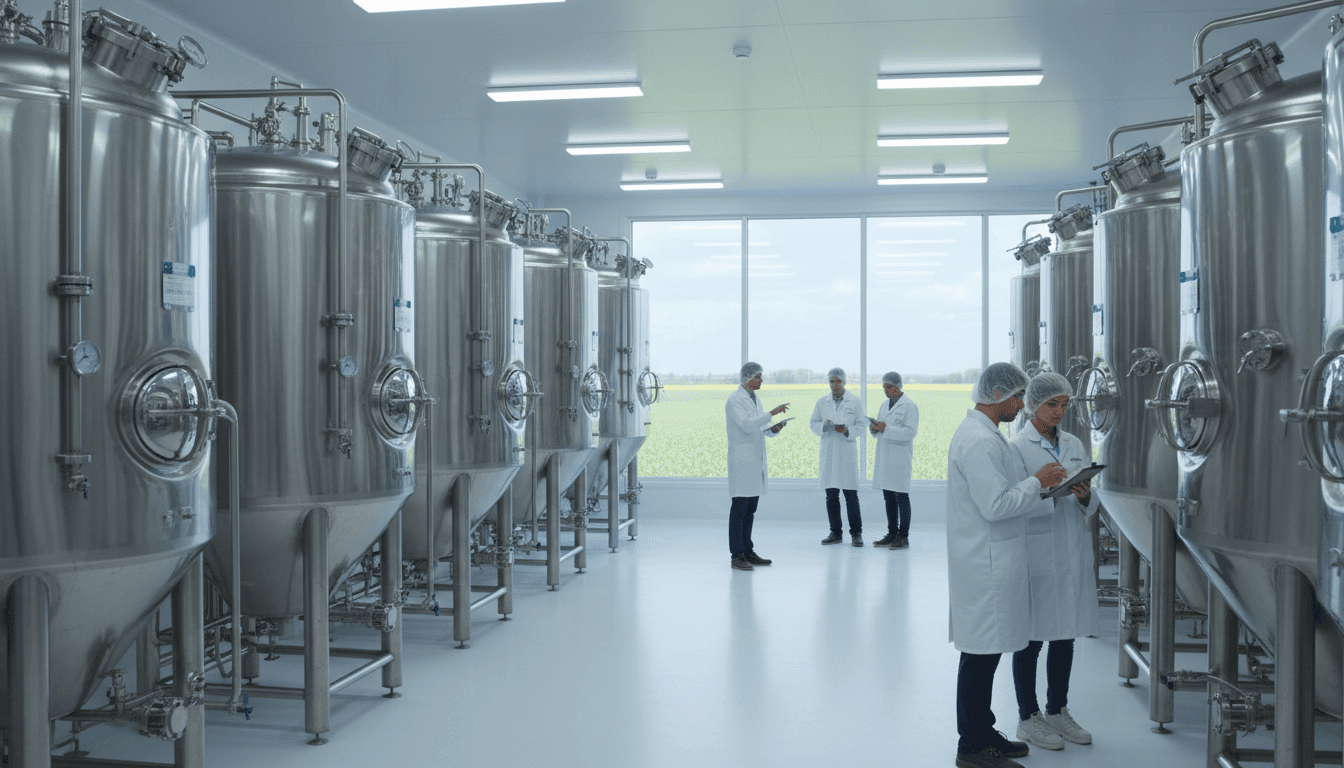
A new manufacturing plant doesn’t sound like a big AI story—until you look closely at what’s being built and why. GROWMARK’s decision to construct a new agricultural biologicals manufacturing facility at its St. Louis AgraForm site (expected to be operational in early 2027) is really a signal about where modern agriculture is heading: inputs are getting more biological, supply chains are getting tighter, and data-driven decision-making is becoming the difference between scaling and stalling.
This post is part of our series “አርቲፊሻል ኢንተሊጀንስ በእርሻና ግብርና ዘርፍ ውስጥ ያለው ሚና”—how AI improves farm processes, increases productivity, and supports growers with digital insight. The angle here is practical: if biological products are the new growth engine, AI is the operating system that helps them scale reliably—from fermentation tanks and quality control to demand forecasting and precision application on farms.
Why this St. Louis biologicals plant matters (beyond one company)
The key point: biological inputs are outgrowing today’s manufacturing capacity, and that capacity gap is now a strategic bottleneck. GROWMARK is building the plant to manufacture biological crop inputs for ag companies that don’t have their own facilities—or that need additional production access. The facility will also be capable of producing animal biological and waste treatment products, not just crop inputs.
This isn’t just incremental expansion. It’s an acknowledgement that the biologicals market is moving from “interesting products” to “industrial-scale supply.” In the original announcement, GROWMARK highlights that global demand is rising faster than supply, and that many companies have products but not enough manufacturing capacity to meet demand.
Here’s the chain reaction I expect we’ll see over the next 18–24 months:
- More biological product launches (biostimulants, biopesticides, biofertilizers)
- More toll manufacturing / contract production to avoid building plants from scratch
- More scrutiny on consistency (biological performance varies if production drifts)
- More pressure on logistics (lead times, storage, shelf stability, regulatory documentation)
All of that is where AI fits naturally—not as hype, but as a way to run complex biological production at scale.
Agricultural biologicals: why scale is hard
The simple answer: biologicals are living or naturally derived systems, and living systems are sensitive. The article describes biologicals as crop inputs derived from living organisms or natural substances used to protect plants, enhance growth, and improve soil health. They can be used alongside or instead of synthetic inputs.
What manufacturers wrestle with
Scaling biologicals is tougher than scaling many synthetic chemistries because variability sneaks in everywhere:
- Feedstock variability: raw materials can change based on season, supplier, storage conditions
- Fermentation/process drift: small shifts in temperature, pH, dissolved oxygen, mixing speed, or contamination can change yield and product composition
- Formulation stability: getting a microbe or extract to stay stable through packaging, transport, and storage is a real engineering problem
- Quality testing complexity: potency and viability aren’t always as straightforward as a single chemical concentration
A sentence I come back to: “If you can’t produce it consistently, you can’t recommend it confidently.” Farmers don’t have time to gamble on inputs.
Where AI actually helps in biologicals production
The key point: AI is most valuable where humans can’t reliably see patterns fast enough—process signals, lab results, supply variability, and demand swings. A modern biologicals plant generates a lot of data: sensor readings, batch records, microbial counts, lab assays, maintenance logs, and more. AI turns that into operational control.
1) AI for process control and yield stability
Biological production often depends on maintaining narrow “goldilocks” zones. AI models (especially time-series forecasting and anomaly detection) can:
- Predict when a batch is drifting before it fails
- Recommend adjustments (e.g., aeration, temperature ramps, nutrient feeds)
- Reduce batch-to-batch variability by learning from historical outcomes
This matters because variability is expensive. A single failed batch can wipe out weeks of margin and delay deliveries.
2) AI for quality assurance (QA) and faster release
Quality release is often a bottleneck. AI can speed and strengthen QA by:
- Detecting outliers across lab results (trend-based alerts, not just threshold checks)
- Correlating process conditions with potency/viability outcomes
- Prioritizing which samples deserve deeper testing
A practical approach I’ve found works: treat QA like a risk-scoring problem. Batches that “look normal” get standard release; batches with unusual signatures get extra testing—before they reach customers.
3) AI for predictive maintenance in bioprocess equipment
Downtime hits biologicals plants hard because batches are time-dependent. Predictive maintenance models can use vibration, temperature, motor current, and valve-cycle data to:
- Forecast failures in pumps, agitators, heat exchangers
- Reduce unplanned shutdowns
- Schedule maintenance around batch timing
The payoff isn’t just fewer breakdowns. It’s more reliable production scheduling, which protects the downstream supply chain.
4) AI for formulation and shelf-life learning
For many biological products, performance depends on formulation science—carriers, protectants, packaging, and storage conditions. AI can support R&D and formulation teams by:
- Modeling relationships between formulation components and stability outcomes
- Flagging combinations likely to degrade under heat or long storage
- Suggesting faster iteration paths (what to test next)
No magic. Just faster learning loops.
AI meets the farm: precision application of biologicals
The core idea: biologicals perform best when application timing and conditions are right, and AI improves that decision. Precision agriculture already uses imagery, weather, and soil data. Biologicals add a layer: biological efficacy can depend on humidity, temperature windows, leaf wetness, soil microbial activity, and crop stage.
What “AI-supported biologicals” looks like in practice
A farmer or agronomy advisor can use AI-driven decision tools to:
- Recommend when to apply a biostimulant (e.g., pre-stress, early vegetative growth)
- Adjust rates by zone using yield maps and soil variability
- Predict disease pressure and choose biological + synthetic rotation strategies
- Reduce unnecessary applications when weather conditions suggest low efficacy
A good rule of thumb: biologicals reward discipline. AI helps teams apply that discipline consistently across hundreds or thousands of hectares.
Supply chain reality: manufacturing capacity is now a competitive edge
The key point: having a product is different from being able to supply it—on time, at quality, at scale. GROWMARK’s message is blunt: demand is outpacing manufacturing capacity, and this plant lets them influence a critical point in the value chain.
From an AI lens, supply chain analytics is where many agribusinesses see quick wins:
What AI can do for biologicals supply chains
- Demand forecasting by region, crop mix, and seasonality (especially important heading into spring planning cycles)
- Inventory optimization (avoid stockouts while limiting product aging)
- Production planning that matches batch sizes and lead times to real demand
- Logistics routing and delivery scheduling to hit narrow application windows
This matters even more in late December. Many growers and cooperatives are finalizing input programs, and manufacturers are making production commitments for the 2026 season. Better forecasting now reduces panic later.
A practical playbook: how agribusiness teams can start using AI now
The key point: you don’t need a futuristic factory to benefit from AI—you need clean data, a clear use case, and ownership. If you’re a cooperative, manufacturer, distributor, or large farm operation, here’s a realistic starting plan.
Step 1: Pick one high-cost problem
Choose a pain point with a measurable cost:
- Batch failures
- QA release delays
- Stockouts during peak season
- Over-application / mis-timed application in the field
Step 2: Connect the minimum data needed
Don’t boil the ocean. Start with what you already have:
- Production: sensor histories, batch records, lab results
- Farm: weather, soil tests, scouting notes, yield maps
- Supply chain: orders, shipments, lead times
Step 3: Build simple models before complex ones
A lot of value comes from “unsexy” models:
- Anomaly detection for early warnings
- Forecasting for demand and inventory
- Classification for QA risk scoring
Step 4: Put results into workflows people actually use
If recommendations live in a dashboard nobody opens, you’ll get zero ROI. Push insights into:
- QA checklists
- Production shift handoffs
- Agronomy recommendations
- Order planning meetings
Step 5: Measure impact in numbers that matter
Track outcomes that leadership understands:
- Scrap rate reduction
- On-time-in-full delivery improvement
- Fewer emergency shipments
- Yield uplift in trial zones
- Reduced chemical use without yield loss (where applicable)
What to watch between now and early 2027
The key point: the winners will combine biological innovation with operational excellence—and AI is the shortest path to operational excellence. As GROWMARK’s St. Louis facility moves toward an early 2027 operational target, the industry signals to watch are:
- Faster expansion of contract biological manufacturing
- More standardization in biological QA and batch traceability
- Increased pairing of biologicals with precision agriculture programs
- Stronger data sharing across manufacturers, cooperatives, and farms
The broader theme of this series—አርቲፊሻል ኢንተሊጀንስ በእርሻና ግብርና ዘርፍ ውስጥ ያለው ሚና—shows up clearly here: AI doesn’t replace agronomy or biology. It makes them operational at scale.
If you’re building or buying biological products, the question to sit with is straightforward: Are you investing only in the input—or also in the intelligence needed to produce, move, and apply it reliably?