AI-driven HyFlex cost optimization lowers support load, improves room usage, and standardizes teaching. Practical steps to cut HyFlex costs without quality loss.
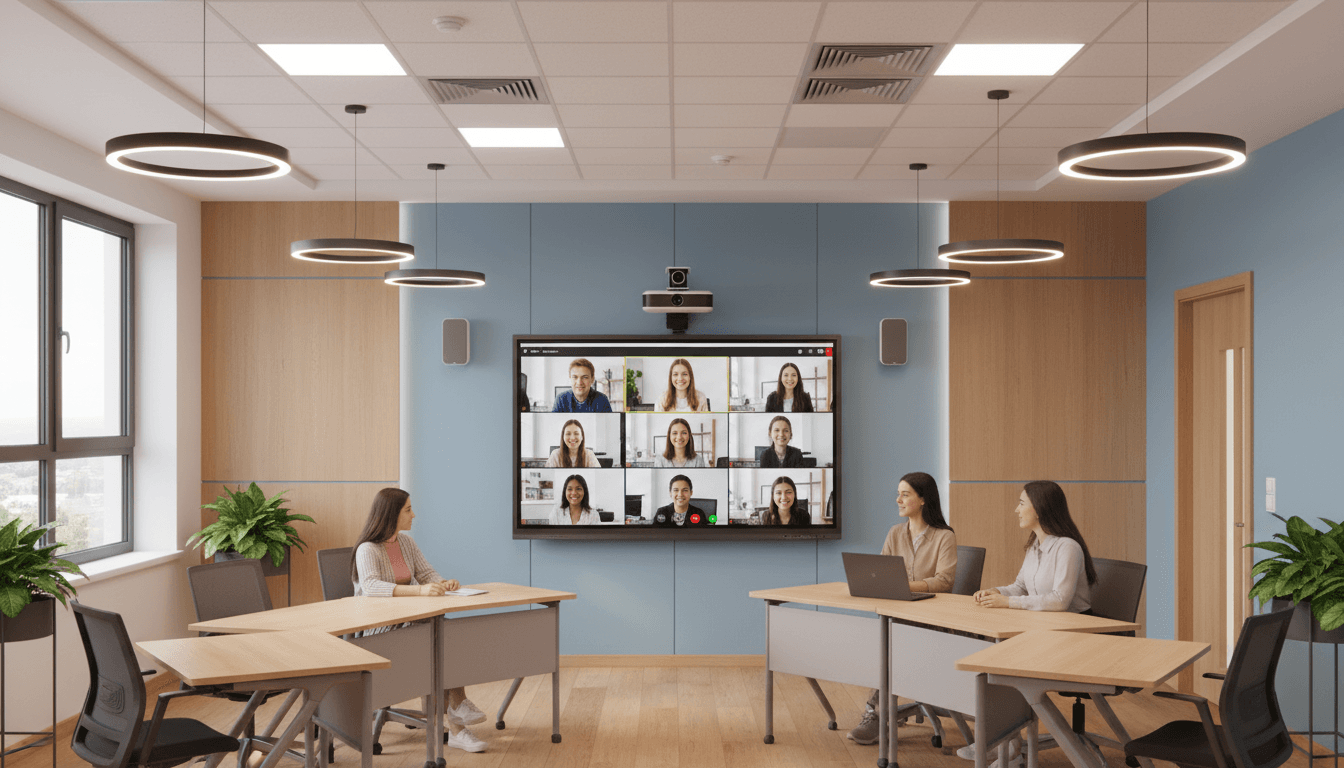
AI-Driven HyFlex Cost Optimization That Actually Works
Finals week tells the truth.
Half the class is sick, two students are traveling, one is working extra shifts for holiday money, and faculty are trying to keep everyone on pace without turning the course into a chaotic patchwork of recordings, links, and exceptions. HyFlex learning (students attending either in-person or remotely) is no longer a “nice-to-have.” It’s how you keep enrollment, retention, and learner satisfaction from slipping when real life happens.
Most institutions (and many training providers) still treat HyFlex as a hardware shopping list: camera, mic, display, maybe a room controller if the budget survives procurement. That’s how costs creep. The smarter approach is to treat HyFlex as a cost-optimization system: simplify the room, standardize the experience, and use AI in education to reduce operational drag—support tickets, repeated trainings, wasted space, and underused equipment.
This post builds on recent guidance about modern HyFlex classrooms—especially the move from projectors to interactive flat panels and the push to reduce complexity—and reframes it for a practical goal: cutting HyFlex learning costs without degrading the student experience. And because this is part of our “AI በትንሽና መካከለኛ ንግዶች (SMEs) ውስጥ” series, I’ll also translate the same playbook for SME training rooms and small learning providers.
HyFlex costs aren’t mainly hardware— they’re operations
The fastest way to optimize costs in HyFlex learning environments is to stop obsessing over purchase price and start measuring total cost of ownership (TCO).
A “cheap” setup becomes expensive when it creates friction:
- Faculty need repeated training because each room works differently
- Support teams spend time troubleshooting room controllers and integrations
- Remote students can’t see content clearly, so instructors reteach or re-record
- Rooms sit idle because scheduling doesn’t match real demand
Here’s a blunt metric I’ve found useful: the cost of HyFlex is the cost of exceptions. Every time a room requires special steps, special adapters, special workflows, or special people, you pay for it—either in IT labor or in teaching quality.
What AI changes in the cost equation
AI doesn’t magically make cameras cheaper. It makes the system cheaper to run.
In a HyFlex context, AI supports cost optimization by improving efficiency and resource allocation:
- Predictive scheduling and room utilization (fewer underused HyFlex rooms)
- Automated support and self-healing workflows (fewer tickets)
- Consistency and assistive teaching workflows (less rework for faculty)
If you’re an SME running internal training, AI helps you get enterprise-grade consistency without hiring an enterprise-size team.
Replace projectors with interactive panels—then standardize hard
A projector-based room is designed for people sitting in the room. HyFlex is designed for two audiences at once. That’s why “webcam pointed at the screen” consistently fails.
The most cost-effective baseline upgrade is moving from projectors to interactive flat panels (or large format displays designed for collaboration). The cost win isn’t just the device; it’s the reduction in integration complexity.
Why interactive panels reduce HyFlex costs
Answer first: interactive panels reduce HyFlex costs because they simplify the signal chain, reduce setup time, and make content readable for remote students without extra tooling.
In practice:
- Panels are often closer to plug-and-play than projector/controller stacks
- Remote participants can see shared content clearly (especially when the panel joins the meeting as a participant)
- Faculty spend less time “fighting the room,” and IT spends less time “fixing the room”
Projector environments typically drag in:
- Room programming
- Controller maintenance
- Lamp replacements and calibration
- Multiple failure points (source switching, scaling, audio routing)
Panels aren’t maintenance-free, but they’re usually simpler. And simplicity is a financial strategy.
Standardization is where the real savings hide
Once you choose a room pattern, standardize it aggressively.
- Same display class across room tiers
- Same camera/microphone families
- Same meeting platform workflow
- Same cable layout and labeling
- Same “start class” button sequence
Standardization means:
- Faculty can walk into any room and teach immediately
- Support can troubleshoot quickly n- You can buy spares and swap devices faster
Snippet-worthy rule: If every classroom is “custom,” your HyFlex budget will never stabilize.
Reduce complexity on purpose (and use AI to keep quality high)
The most complex HyFlex rooms often look impressive during a demo and miserable during week 7.
Answer first: cost optimization in HyFlex works when you design for the average day, not the perfect day.
A reliable, repeatable setup beats a fragile “premium” one—especially across dozens of rooms.
The right baseline HyFlex kit (for most rooms)
A sensible baseline that scales:
- 1 large interactive panel or display
- 1 quality camera with auto-framing
- 1 ceiling or table microphone (depending on room size)
- 1 small-form PC or dedicated room appliance
- Remote management + monitoring
The key is remote manageability. If your team has to physically visit rooms for common issues, you’re paying a recurring tax.
Where AI helps without adding fragility
AI features worth paying for in HyFlex rooms are the ones that reduce human time:
- Auto-framing / speaker tracking: fewer “camera operator” moments
- Noise suppression and echo cancellation: fewer audio-related failures
- Auto-leveling and voice enhancement: more consistent remote experience
- Meeting summaries and action items for recorded sessions (especially in training)
For SMEs doing training: AI-generated summaries reduce repeat sessions because learners can catch up faster. That’s cost optimization through reduced instructor hours.
AI-powered resource allocation: the overlooked HyFlex savings
Buying the right equipment is step one. Step two is making sure it’s used wisely.
Answer first: AI reduces HyFlex costs by matching demand (class modality and attendance patterns) to supply (rooms, time slots, and support coverage).
1) Use AI to predict which sections need HyFlex “priority rooms”
Not every class needs the same HyFlex fidelity.
AI models (even simple ones) can forecast which course sections are likely to have:
- higher remote attendance
- more working students
- more commuter variability
- higher accommodation needs
Then you allocate the best rooms to the sections that benefit most—rather than treating every room as a top-tier studio.
2) Use utilization analytics to reduce wasted upgrades
A common mistake: upgrading rooms based on politics or tradition (“this building is important”).
Better: upgrade based on utilization and impact:
- daily room occupancy
- course types (lecture vs discussion vs lab)
- support incident rates
- remote participation frequency
AI can cluster rooms into “high pain/high impact” vs “low pain/low impact,” so you modernize where ROI is real.
3) Automate support triage (and stop drowning the help desk)
HyFlex support issues are repetitive:
- “No audio for remote students”
- “Camera not detected”
- “Screen sharing is blurry”
- “Wrong input selected”
An AI help assistant trained on your internal knowledge base can:
- guide faculty through the fastest fix
- collect device logs before escalation
- route tickets to the right queue
That’s not flashy AI. It’s operational sanity.
A practical cost-optimization roadmap (for universities and SMEs)
Answer first: the fastest path to HyFlex cost optimization is a phased approach—pilot, standardize, instrument, then scale.
Here’s a roadmap you can execute in 60–120 days.
Phase 1 (Weeks 1–4): Define room tiers and a minimum standard
Decide what “good HyFlex” means for your organization.
- Tier 1: high-impact flagship rooms
- Tier 2: standard HyFlex rooms (most rooms)
- Tier 3: display-only + portable kit (overflow)
Write a one-page standard for each tier. Keep it strict.
Phase 2 (Weeks 3–8): Replace the highest-friction technology first
Start with rooms where projectors + controllers cause repeat issues.
Target fixes that cut recurring costs:
- projector-to-panel conversions
- simplified audio chains
- consistent camera placement
Phase 3 (Weeks 6–12): Add monitoring + AI-driven insights
Instrumentation is where you start saving month after month:
- remote management for panels/room PCs
- device health monitoring
- utilization analytics
- AI ticket triage
If you can’t measure uptime, you can’t reduce downtime.
Phase 4 (Ongoing): Train for behavior, not just buttons
Faculty training fails when it’s “feature training.”
Train for outcomes:
- “How to make remote students feel included in 2 minutes”
- “How to share content so it’s readable on a laptop”
- “What to do in the first 30 seconds if audio fails”
For SMEs: the same applies to trainers and team leads—keep it scenario-based.
People also ask: the questions that decide your HyFlex budget
Is HyFlex more expensive than traditional classrooms?
Upfront, it can be. Over time, well-designed HyFlex is often cheaper because it reduces rework (make-up sessions, re-recordings) and improves room flexibility. Poorly designed HyFlex is always more expensive because it generates constant exceptions.
Where should we spend to get the best ROI?
Spend on standardization, audio clarity, and remote manageability first. Fancy integrations come later—if ever.
Can SMEs use the same model for training rooms?
Yes. SMEs usually win faster because they have fewer rooms and can standardize quickly. A single “HyFlex-ready” training room plus a portable kit can cover most needs.
The stance: HyFlex should feel boring (because boring scales)
Cost optimization for HyFlex learning environments comes down to one decision: do you want a demo room or a dependable system?
A dependable system is consistent, easy to operate, and measurable. That’s where AI helps most—by improving efficiency and resource allocation rather than adding more complexity.
If you’re following our AI በትንሽና መካከለኛ ንግዶች (SMEs) ውስጥ series, this should feel familiar: SMEs don’t win by buying the most features. They win by choosing the smallest set of tools that removes the most friction—and then automating what they can.
Next step: list your top 10 HyFlex rooms, pull the last semester’s support tickets, and identify the two patterns causing most failures. If you fix those with a standardized room kit and AI-assisted support workflows, your HyFlex costs start dropping within the same term.
What would your campus—or your company training program—look like if HyFlex reliability became the default instead of the exception?